
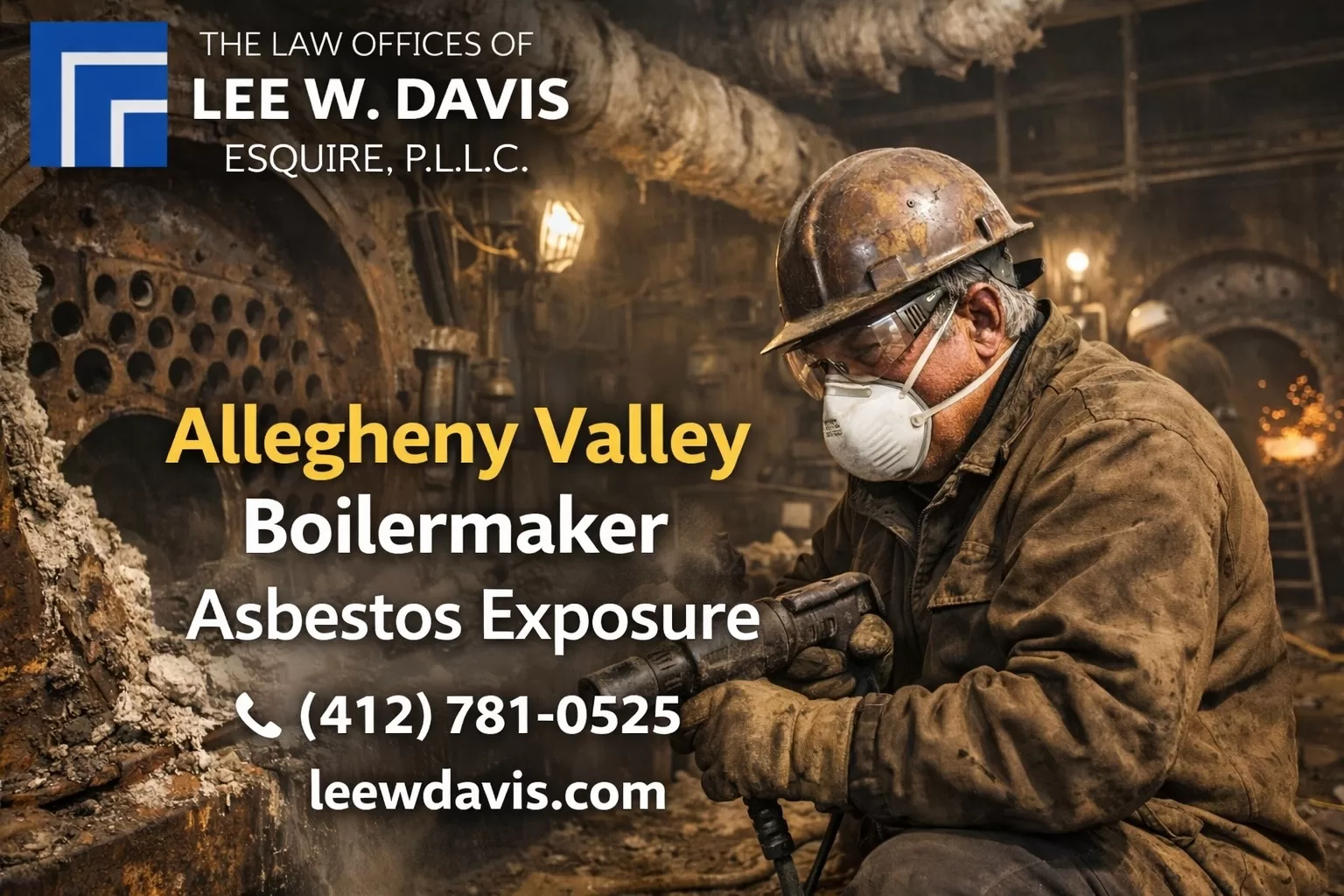
If you worked as a boilermaker in the Allegheny Valley and you’ve been diagnosed with mesothelioma or lung cancer, Allegheny Valley boilermaker asbestos exposure is one of the most severe occupational exposure histories in western Pennsylvania. Boilermakers at the region’s steel facilities, chemical plants, and power generating stations worked in direct and sustained contact with the asbestos-containing refractory, insulation, and gasket materials that lined the furnaces, boilers, and heat exchangers they maintained and rebuilt throughout their careers.
Why Allegheny Valley Boilermakers Faced the Heaviest Asbestos Exposure
Boilermakers occupied a unique and particularly hazardous position in the asbestos exposure hierarchy at Allegheny Valley industrial facilities. Where pipefitters encountered asbestos primarily through pipe insulation and gaskets, and electricians through panel components and bystander exposure, boilermakers worked directly on the furnaces, boilers, and pressure vessels themselves — the equipment most thoroughly constructed from and maintained with asbestos-containing materials.
The work that defined the boilermaker trade at Allegheny Valley facilities — tearing out old refractory, replacing furnace linings, rebuilding boiler systems, servicing heat exchangers and pressure vessels — involved direct physical contact with asbestos-containing materials in their most fiber-releasing state. Old refractory being broken out, old boiler insulation being stripped, old gaskets being scraped from flange faces — each of those tasks released asbestos fibers in high concentrations directly into the breathing zone of the boilermaker doing the work.
And boilermakers frequently performed this work in confined spaces — inside furnace shells, inside boiler drums, inside heat exchanger vessels — where the released fibers had nowhere to go and the worker’s fiber exposure was most intense.
The Specific Tasks That Created Boilermaker Asbestos Exposure in the Allegheny Valley
Furnace refractory tear-out and rebuild — Furnace linings at Allegheny Valley steel facilities and chemical plants required periodic demolition and replacement. The refractory materials being broken out — blocks, boards, and the hardened remains of ramming and repair materials used in previous maintenance cycles — contained asbestos that had been baked into the material over years of high-temperature operation. Boilermakers performing that tear-out work generated concentrated asbestos dust in enclosed furnace environments.
Boiler insulation removal and replacement — Boiler systems throughout Allegheny Valley industrial facilities were wrapped in asbestos-containing insulation for thermal efficiency. When boilers required inspection, repair, or replacement, boilermakers stripped that insulation — releasing fibers in the quantities associated with direct insulation handling rather than mere proximity.
Gasket and packing work on pressure vessels — The flanged connections, manholes, and access points on boilers and pressure vessels used asbestos-containing gaskets and packing materials. Boilermakers removing and replacing those components during inspection and maintenance cycles performed the same high-exposure gasket scraping work that pipefitters performed on pipe flanges — repeatedly, over careers spanning decades.
Heat exchanger service and rebuild — Heat exchangers throughout Allegheny Valley facilities used asbestos-containing materials in their construction and maintenance. Boilermakers who serviced and rebuilt heat exchangers worked with those materials directly in the concentrated exposure environment of the equipment itself.
Outage and shutdown work — Major maintenance outages at Allegheny Valley facilities concentrated boilermaker work — and boilermaker asbestos exposure — into intensive periods when multiple furnaces, boilers, and pressure vessels were being worked simultaneously. Boilermakers working major outages at facilities like Allegheny Ludlum or Cheswick Power Station were exposed to asbestos from their own work and from the simultaneous work of surrounding trades throughout the shutdown period.
Allegheny Valley Facilities Where Boilermakers Were Most Heavily Exposed
Allegheny Ludlum Brackenridge — The specialty steel facility at Brackenridge operated electric arc furnaces, annealing furnaces, and extensive steam systems requiring regular boilermaker maintenance and rebuild work throughout its operational life. Boilermakers at Brackenridge worked the furnace refractory, the boiler systems, and the heat exchangers supporting the specialty steel production process — all environments with significant asbestos-containing materials throughout.
Tarentum PPG Chemical Plant — Chemical plant boilermaker work at PPG Tarentum involved maintaining the reactors, heat exchangers, and steam systems supporting the chemical manufacturing process. The insulated and refractory-lined equipment throughout the Tarentum facility required regular boilermaker attention, and that work involved direct contact with asbestos-containing materials throughout the plant’s operational history.
Cheswick Power Station — Power plant boilermakers at Cheswick worked in one of the most boilermaker-intensive environments in the Allegheny Valley. The generating station’s boiler systems, turbine heat systems, and associated pressure vessel equipment required continuous maintenance and periodic major rebuilds — all performed by boilermakers working in direct contact with asbestos-containing insulation, refractory, and gasket materials throughout the plant.
Keystone Power Station — Additional generating facility in the broader corridor with equivalent boilermaker exposure profile to Cheswick.
Allegheny Valley industrial construction — Boilermakers in construction trades worked outages and major projects throughout the Allegheny Valley corridor, accumulating exposure across multiple facilities over careers that often spanned decades and dozens of job sites.
Union Records and Documentation for Allegheny Valley Boilermaker Claims
Allegheny Valley boilermakers were typically members of the International Brotherhood of Boilermakers and dispatched to industrial job sites through their local union hall. Boilermakers union dispatch records, dues payment histories, benefit statements, and pension records establish which facilities a boilermaker was dispatched to and during what periods — documentation that is particularly valuable when direct employment records from specific facilities no longer exist.
If you were a union boilermaker in the Allegheny Valley, your union records are among the most important documentation available for building your asbestos exposure history. An experienced asbestos attorney can help you locate and preserve those records early in the claim evaluation process.
What Evidence Supports an Allegheny Valley Boilermaker Asbestos Claim
- Diagnosis records — pathology reports, imaging, treatment summaries confirming mesothelioma or lung cancer
- Work history at Allegheny Valley facilities — job titles, years worked, specific tasks, facilities where you were dispatched
- Memory of the furnaces, boilers, heat exchangers, and pressure vessels you worked on throughout the corridor
- Names of coworkers, foremen, or supervisors from your time at specific Allegheny Valley facilities
- Boilermakers union records — referral logs, dues records, benefit statements from your local
- Social Security earnings records confirming employers and time periods across your career
For a broader overview of Allegheny Valley asbestos claims and compensation pathways see our dedicated guide. For the full Allegheny Valley mesothelioma lawyer resource see our hub page. For workers with lung cancer diagnoses see the Allegheny Valley lung cancer resource. For related trade-specific pages see Allegheny Valley pipefitters and Allegheny Valley electricians. For a broader overview of how Pennsylvania mesothelioma claims work see our Pennsylvania resource.
Knowledge of Allegheny Valley Boilermaker Asbestos Cases Since 1989
I first began researching Allegheny Valley and western Pennsylvania asbestos cases in 1989, working on asbestos mass trials across Pennsylvania and West Virginia. I have been licensed to practice law since 1996 and have handled mesothelioma and lung cancer cases from boilermakers throughout the Allegheny Valley industrial corridor ever since. That includes cases where the boilermaker’s exposure arose from furnace refractory tear-out, boiler insulation removal, and confined-space work on heat exchangers and pressure vessels — the highest-exposure scenarios in the trade.
When you call, you speak directly with me. No call centers. No case managers.
If you or a family member worked as a boilermaker in the Allegheny Valley and has been diagnosed with mesothelioma or lung cancer, time matters. Pennsylvania’s statute of limitations runs from the date of diagnosis, not from the date of your exposure decades ago.
Call (412) 781-0525 or start your confidential case review online now.
Frequently Asked Questions
Q: I worked as a boilermaker at Cheswick Power Station for thirty years doing major boiler rebuilds during outages. Is that enough to support a mesothelioma claim?
A: A thirty-year boilermaker career at Cheswick Power Station performing major boiler rebuilds is one of the strongest asbestos exposure profiles we evaluate. Major boiler rebuilds during outages involved stripping old asbestos-containing insulation from boiler systems, working inside boiler drums and pressure vessels where accumulated dust concentrations were highest, and replacing gaskets and packing throughout the boiler and associated steam systems. That work — performed repeatedly over a thirty-year career at a facility the size of Cheswick — represents sustained and intense asbestos fiber exposure that has supported successful mesothelioma claims.
Q: I worked boilermaker construction throughout the Allegheny Valley at multiple facilities over my career. Does that multi-facility history help my claim?
A: Yes significantly. A boilermaker construction career spanning Allegheny Ludlum, PPG Tarentum, Cheswick, and other Allegheny Valley facilities over decades represents cumulative exposure from multiple distinct environments and multiple sets of asbestos-containing product manufacturers. Each facility and each product encountered there represents a separate thread in your exposure narrative and potentially a separate defendant in your claim. Multi-facility boilermaker careers typically produce the strongest claim profiles in the Allegheny Valley because the total exposure is greatest and the number of potentially responsible defendants is largest.
Q: How long do I have to file a mesothelioma claim in Pennsylvania connected to Allegheny Valley boilermaker work?
A: Pennsylvania’s statute of limitations runs from the date of diagnosis, not the date of your exposure. Wrongful death claims carry different and sometimes shorter deadlines running from the date of death. Do not assume it is too late — call as soon as a diagnosis is confirmed so we can evaluate your full Allegheny Valley work history and identify all responsible parties before records and witnesses become harder to locate.