
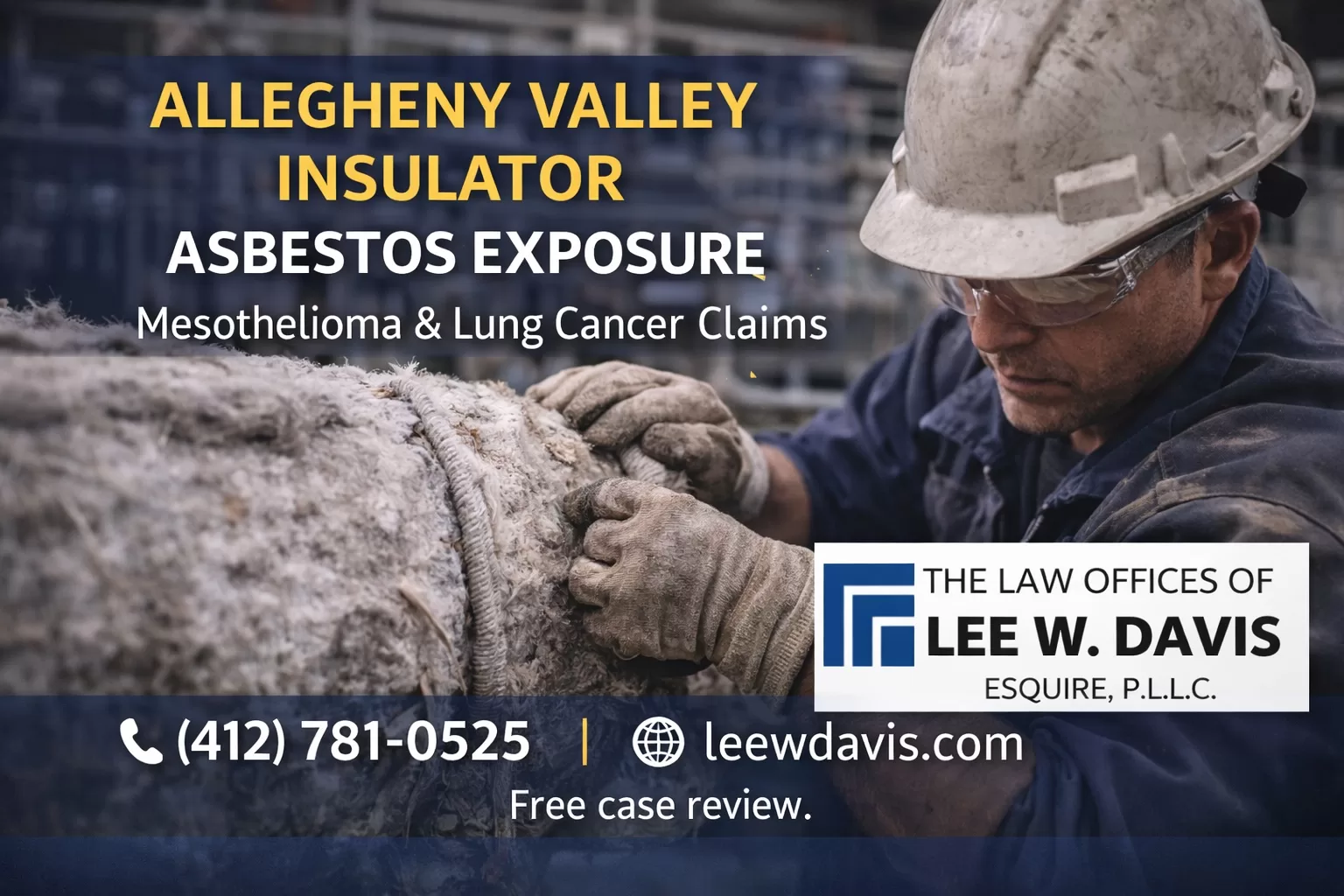
If you worked as an insulator in the Allegheny Valley and you’ve been diagnosed with mesothelioma or lung cancer, Allegheny Valley insulator asbestos exposure represents the most severe occupational asbestos exposure profile of any trade in western Pennsylvania. Insulators handled asbestos-containing materials directly as the core function of their trade — not incidentally, not as bystanders, but as the workers who cut, fitted, applied, and removed the insulation that created the dust everyone else in the facility breathed.
Mesothelioma/Asbestos Legal Help – WV, MI & PA
Speak directly with attorney Lee W. Davis. No call centers. Free, confidential review.
Why Insulators Faced the Heaviest Asbestos Exposure of Any Trade
Every other trade in the Allegheny Valley industrial corridor — pipefitters, millwrights, boilermakers, electricians — encountered asbestos through proximity to insulation work or through specific components containing asbestos. Insulators were the insulation work. The tasks that defined the trade from the first day to the last were the tasks that released the most asbestos fibers per hour of any industrial activity:
Cutting pipe covering to length with a handsaw or knife released fibers from the cut face and throughout the surrounding air. Fitting block insulation around equipment required breaking and shaping materials with fiber concentrations as high as 80 percent in pre-1980 products. Applying insulating cement and finishing cement meant working wet asbestos-containing material with bare hands while it released fibers as it dried. Removing old insulation during maintenance and outage work — stripping decades of baked, crumbled, fiber-releasing material from hot pipe and equipment surfaces — produced the highest fiber concentrations of any insulation task.
And insulators performed all of these tasks repeatedly, throughout every working day, across careers that often spanned thirty to forty years at industrial facilities throughout the Allegheny Valley corridor.
Allegheny Valley Facilities Where Insulators Were Most Heavily Exposed
Insulators working the Allegheny Valley corridor applied and removed asbestos-containing materials at every major industrial facility along the river:
Allegheny Ludlum Brackenridge — The specialty stainless steel facility at Brackenridge required extensive insulation on its process piping, annealing furnaces, steam systems, and mechanical equipment throughout the plant. Insulators who worked the Brackenridge facility applied and maintained that insulation across every department — accumulating exposure from the full range of asbestos-containing products used in specialty steel production.
Tarentum PPG Chemical Plant — Chemical plant insulation work at PPG Tarentum involved covering the process piping, reactors, heat exchangers, and steam systems supporting chemical manufacturing with asbestos-containing pipe covering, block insulation, and finishing cement throughout the facility’s operational history.
Cheswick Power Station — Power plant insulation work at Cheswick was among the most intensive insulator work in the Allegheny Valley. Turbine steam systems, boiler insulation, feedwater and condensate piping, and the full range of high-pressure, high-temperature systems throughout a generating station of Cheswick’s size required continuous insulation maintenance and periodic major re-insulation projects throughout the plant’s operational life.
Keystone Power Station — Additional generating facility in the broader Allegheny Valley corridor with equivalent insulator exposure profile to Cheswick.
Industrial construction throughout the Allegheny Valley — Insulators in construction trades worked outage and new construction projects throughout the Allegheny Valley corridor, accumulating exposure across multiple facilities over careers that spanned dozens of job sites from Pittsburgh through Kittanning.
The Products Allegheny Valley Insulators Worked With
The asbestos-containing products that insulators handled throughout their Allegheny Valley careers included pipe covering in multiple sizes and compositions, block insulation for equipment and vessel surfaces, boiler lagging for steam generating systems, insulating cement for irregular surfaces and fittings, finishing cement applied over completed insulation systems, and canvas and cloth materials used in pipe insulation jacketing. These products were manufactured and distributed by companies whose names appear repeatedly in asbestos litigation — and many of those manufacturers have established asbestos bankruptcy trusts that continue to pay claims today.
A former Allegheny Valley insulator with a mesothelioma or lung cancer diagnosis may have claims against multiple manufacturers whose products they handled across their career — not just one product from one job site but every asbestos-containing product they worked with at every Allegheny Valley facility where they were dispatched.
Union Records and the Heat and Frost Insulators Local
Allegheny Valley insulators were typically members of the Heat and Frost Insulators and Allied Workers union and dispatched to industrial job sites through their local. Union dispatch records, dues payment histories, benefit statements, and pension records establish which facilities an insulator was dispatched to and during what periods — documentation that is critical for building the exposure history across a career that may have included dozens of Allegheny Valley job sites.
If you were a union insulator in the Allegheny Valley, your union records are the most important documentation available for your asbestos claim. An experienced asbestos attorney can help you locate and preserve those records at the earliest possible stage of the claim evaluation.
Take-Home Exposure for Insulator Families
The intensity of Allegheny Valley insulators’ direct asbestos exposure meant that take-home exposure to family members was particularly significant. Insulation fibers embedded deeply in work clothing, hair, and the interior surfaces of vehicles at the end of every shift exposed spouses and children in ways that have supported successful mesothelioma claims for decades. Take-home asbestos cases arising from an insulator’s work history are among the most well-established secondary exposure claims in asbestos litigation.
What Evidence Supports an Allegheny Valley Insulator Asbestos Claim
- Diagnosis records — pathology reports, imaging, treatment summaries confirming mesothelioma or lung cancer
- Work history at Allegheny Valley facilities — job titles, years worked, specific tasks, facilities where dispatched
- Memory of the specific products, equipment, and facilities you worked at throughout the corridor
- Names of coworkers, foremen, or supervisors from your time at specific Allegheny Valley facilities
- Heat and Frost Insulators union records — referral logs, dues records, benefit statements from your local
- Social Security earnings records confirming employers and time periods across your career
For a broader overview of Allegheny Valley asbestos claims and compensation pathways see our dedicated guide. For the full Allegheny Valley mesothelioma lawyer resource see our hub page. For workers with lung cancer diagnoses see the Allegheny Valley lung cancer resource. For related trade pages see Allegheny Valley pipefitters, Allegheny Valley electricians, and Allegheny Valley boilermakers. For the broader Pennsylvania mesothelioma lawyer resource see our Pennsylvania guide. For WV insulator claims see insulators asbestos West Virginia and Insulators Local 80.
Knowledge of Allegheny Valley Insulator Asbestos Cases Since 1996
I first began researching Allegheny Valley and western Pennsylvania asbestos cases in 1989, working on asbestos mass trials across Pennsylvania and West Virginia. I have been licensed to practice law since 1996 and have handled mesothelioma and lung cancer cases from insulators throughout the Allegheny Valley industrial corridor ever since. That includes cases involving the full range of insulation products used at Allegheny Valley facilities and the full range of manufacturers whose materials caused those exposures.
When you call, you speak directly with me. No call centers. No case managers.
If you or a family member worked as an insulator in the Allegheny Valley and has been diagnosed with mesothelioma or lung cancer, time matters. Pennsylvania’s statute of limitations runs from the date of diagnosis, not from the date of your exposure decades ago.
Call (412) 781-0525 or start your confidential case review online now.
Check If Your Family Was Exposed
Get your free guide instantly + a confidential case review.
🔒 100% Confidential. No obligations.
Frequently Asked Questions
Q: I worked as an insulator at multiple Allegheny Valley facilities over my career. Does that multi-facility history strengthen my mesothelioma claim?
A: Yes significantly. A career spanning Allegheny Ludlum, PPG Tarentum, Cheswick, and other Allegheny Valley facilities means exposure from multiple distinct environments and multiple sets of asbestos-containing product manufacturers. Each facility and each product line encountered there represents a separate thread in your exposure narrative and potentially a separate defendant in your claim. Multi-facility insulator careers in the Allegheny Valley typically produce the strongest claim profiles because the total exposure is greatest and the number of potentially responsible defendants is largest.
Q: My wife was diagnosed with mesothelioma and I worked as an insulator in the Allegheny Valley throughout our marriage. Is there a take-home exposure claim?
A: Yes. Take-home asbestos exposure cases for the families of insulators are among the most well-established secondary exposure claims in asbestos litigation. Insulators carry more fiber contamination home than virtually any other trade because their work involves direct physical contact with asbestos-containing materials throughout the workday. Your wife’s mesothelioma diagnosis combined with your career as an Allegheny Valley insulator is precisely the factual pattern that has supported successful take-home exposure claims. Call to discuss what documentation we would need to evaluate the claim.
Q: How long do I have to file a mesothelioma claim in Pennsylvania connected to Allegheny Valley insulator work?
A: Pennsylvania’s statute of limitations runs from the date of diagnosis, not the date of your exposure. Wrongful death claims carry different and sometimes shorter deadlines running from the date of death. Do not assume it is too late — call as soon as a diagnosis is confirmed so we can evaluate your full Allegheny Valley work history and identify all responsible parties.
Mesothelioma/Asbestos Legal Help – WV, MI & PA
Speak directly with attorney Lee W. Davis. No call centers. Free, confidential review.