
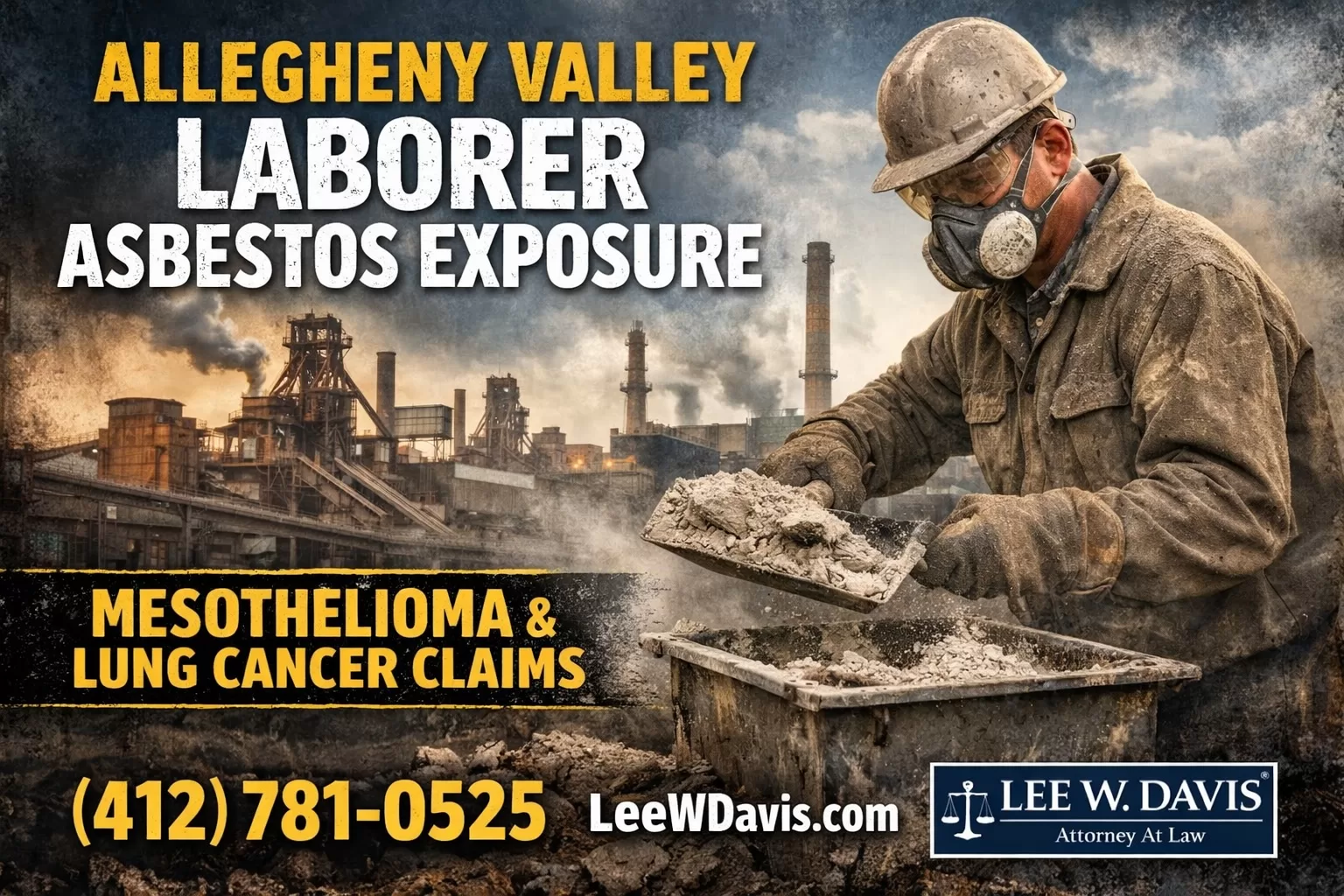
If you worked as a laborer in the Allegheny Valley and you’ve been diagnosed with mesothelioma or lung cancer, Allegheny Valley laborer asbestos exposure may be the foundation of a viable legal claim — even though laborers are among the most frequently overlooked claimants in asbestos litigation. The reason laborers are overlooked is also the reason their exposure was often the most intense of anyone on the job site: laborers were assigned to the work nobody else wanted to do, in the spaces where everyone else’s dust had settled, at the moments when the most asbestos fiber was in the air.
Mesothelioma/Asbestos Legal Help – WV, MI & PA
Speak directly with attorney Lee W. Davis. No call centers. Free, confidential review.
The Laborer’s Position in the Asbestos Exposure Hierarchy
Skilled trades workers — pipefitters, insulators, boilermakers, electricians — are the claimants most people associate with asbestos mesothelioma cases. Their exposure is well documented, their union records are detailed, and their specific contact with asbestos-containing materials is easy to describe. Laborers don’t always fit that pattern, and as a result they and their families often assume no claim exists.
That assumption is wrong. In many cases it is the laborer who was most heavily exposed.
Consider what laborers actually did during industrial outages and maintenance work at Allegheny Ludlum Brackenridge, the PPG Tarentum chemical plant, Cheswick Power Station, and throughout the Allegheny Valley industrial corridor. While the skilled trades were removing and replacing asbestos-containing materials, laborers were sweeping up the debris they left behind. While insulators were cutting pipe covering and generating asbestos dust in the air, laborers were carrying away the offcuts and cleaning the work area. While boilermakers were breaking out old furnace refractory, laborers were shoveling the rubble — the most fiber-saturated material on the job site — into containers and hauling it out.
Laborers worked at the bottom of the chain of command and at the top of the asbestos dust exposure curve. They moved constantly between work areas, they worked in the aftermath of the highest-exposure tasks, and they rarely had the protective equipment or the awareness of risk that might have prompted a skilled trades worker to take precautions. They were also, more often than not, the youngest and least experienced workers on the site — the people with the longest post-exposure lives in which mesothelioma could develop.
What Laborer Work Actually Looked Like at Allegheny Valley Industrial Facilities
Outage cleanup crews — During major maintenance outages at facilities like Cheswick Power Station or Allegheny Ludlum, laborers were assigned to cleanup crews working behind the skilled trades. As insulators stripped asbestos-containing pipe covering, laborers swept and shoveled the material. As boilermakers broke out furnace refractory, laborers hauled the rubble. The cleanup work happened while fibers were still airborne — in spaces where the air had not cleared — and laborers performed it without respiratory protection across decades of industrial outage work throughout the Allegheny Valley.
Demolition and teardown work — When sections of Allegheny Valley facilities were demolished, renovated, or modified, laborers performed the physical work of breaking down old structures — walls, ceilings, mechanical spaces — that had been built with and insulated by asbestos-containing materials over decades of plant operation. Swinging a hammer through an asbestos-insulated wall generates more fiber release than almost any other single act of physical labor.
General facility maintenance — Laborers assigned to general facility maintenance throughout Allegheny Valley plants swept floors, cleaned mechanical rooms, and maintained the physical plant in areas where asbestos-containing insulation was present on every pipe and piece of equipment in the space. The accumulated dust in those spaces — disturbed by sweeping, blowing, and routine maintenance activity — contained asbestos fibers that laborers breathed throughout every working day.
Material handling — Laborers moved asbestos-containing materials throughout Allegheny Valley facilities — carrying bags of insulating cement, moving blocks of pipe covering from storage to work areas, loading and unloading trucks delivering insulation products to the job site. That material handling work involved direct physical contact with products containing significant concentrations of asbestos.
Support for skilled trades — Laborers assigned to support skilled trades workers — holding materials, passing tools, clearing work spaces — spent their days in the immediate vicinity of the highest-exposure insulation and refractory work happening on the job site. They breathed the same air as the pipefitters, insulators, and boilermakers without the trade-specific awareness of risk that those workers sometimes had.
Why Laborer Claims Are Often Harder to Build — and How We Overcome That
Laborer asbestos claims present documentation challenges that skilled trades claims do not. Laborers often worked for multiple employers over short periods. Union membership was less universal than in the skilled trades. Employment records are harder to locate. The specific asbestos-containing products a laborer encountered are harder to identify because laborers moved between work areas rather than working within a defined trade discipline.
These challenges are real but they are not insurmountable. The evidence that matters most in laborer asbestos claims includes memory — what job sites you worked, what outage and cleanup work you did, who you worked alongside, what the conditions were like — combined with whatever employment documentation exists, Social Security earnings records confirming employer histories, and coworker testimony from skilled trades workers who can confirm the conditions and practices at specific Allegheny Valley facilities during the relevant periods.
An experienced asbestos attorney knows how to build a laborer claim from that combination of evidence. The claim is harder to construct than a pipefitter claim but it is viable, and the underlying exposure in many laborer cases was genuinely severe.
Allegheny Valley Facilities Where Laborer Asbestos Exposure Was Most Significant
- Allegheny Ludlum Brackenridge — major outage and maintenance work requiring cleanup labor throughout the specialty steel facility
- Tarentum PPG Chemical Plant — chemical plant maintenance and outage work with laborer cleanup crews throughout the facility
- Cheswick Power Station — power plant outage work with extensive laborer involvement in cleanup and demolition behind the skilled trades
- Keystone Power Station — additional generating facility in the corridor with equivalent laborer exposure profile
- Industrial construction projects throughout the Allegheny Valley corridor — new construction and major renovation work drawing laborer crews from throughout the region
What Evidence Supports an Allegheny Valley Laborer Asbestos Claim
- Diagnosis records — pathology reports, imaging, treatment summaries confirming mesothelioma or lung cancer
- Work history at Allegheny Valley facilities — employers, job sites, types of work performed, years worked
- Memory of the specific tasks you performed — cleanup, demolition, material handling, outage support work
- Names of contractors, foremen, coworkers, or skilled trades workers you remember from specific job sites
- Any union records, benefit statements, or Social Security earnings records confirming employment history
- Coworker testimony from skilled trades workers who can confirm conditions at specific facilities
For a broader overview of Allegheny Valley asbestos claims and compensation pathways see our dedicated guide. For the full Allegheny Valley mesothelioma lawyer resource see our hub page. For workers with lung cancer diagnoses see the Allegheny Valley lung cancer resource. For the broader Pennsylvania mesothelioma lawyer resource see our Pennsylvania guide.
Knowledge of Allegheny Valley Laborer Asbestos Cases Since 1989
I first began researching Allegheny Valley and western Pennsylvania asbestos cases in 1989, working on asbestos mass trials across Pennsylvania and West Virginia. I have been licensed to practice law since 1996. Laborer claims require more investigative work than skilled trades claims, but the underlying exposure in many of these cases is severe and the legal basis for recovery is sound. If you worked laborer jobs at Allegheny Valley industrial facilities and have a mesothelioma or lung cancer diagnosis, your case deserves a careful evaluation — not an assumption that laborers don’t qualify.
When you call, you speak directly with me. No call centers. No case managers.
Pennsylvania’s statute of limitations runs from the date of diagnosis, not from the date of your exposure decades ago.
Call (412) 781-0525 or start your confidential case review online now.
Check If Your Family Was Exposed
Get your free guide instantly + a confidential case review.
🔒 100% Confidential. No obligations.
Frequently Asked Questions
Q: I worked laborer jobs at several Allegheny Valley plants during outages but I was never a union member and I don’t have any paperwork. Can I still build an asbestos claim?
A: Possibly yes. The absence of union records and formal employment documentation is a challenge but not an automatic bar to a laborer asbestos claim. Social Security earnings records can often establish which employers you worked for and when. Your own memory of job sites, contractors, and working conditions — combined with coworker testimony from skilled trades workers who were on the same job sites — can establish the exposure history even without formal documentation. The earlier you begin preserving that memory and identifying potential witnesses, the stronger the foundation for your claim. Call to discuss what we can build from your specific situation.
Q: I worked cleanup during outages at Cheswick Power Station for years. The insulators and pipefitters were the ones handling the asbestos. Do I have a claim even though I didn’t touch the insulation myself?
A: Yes. Cleanup crew work during outages at a facility like Cheswick Power Station is one of the clearest laborer asbestos exposure scenarios. Sweeping and shoveling asbestos insulation debris — the offcuts, the strippings, the dust — in spaces where that material had just been disturbed by skilled trades workers puts the cleanup worker in direct contact with the highest fiber concentrations on the job site. The insulation workers generated the dust. You breathed it while cleaning it up. That exposure pathway is legally recognized and has supported successful mesothelioma claims.
Q: How long do I have to file a mesothelioma claim in Pennsylvania if I worked laborer jobs at Allegheny Valley industrial facilities?
A: Pennsylvania’s statute of limitations runs from the date of diagnosis, not the date of your exposure. Wrongful death claims carry different and sometimes shorter deadlines running from the date of death. Do not assume it is too late — call as soon as a diagnosis is confirmed so we can evaluate your work history and begin identifying the evidence available to support your claim.
Mesothelioma/Asbestos Legal Help – WV, MI & PA
Speak directly with attorney Lee W. Davis. No call centers. Free, confidential review.