
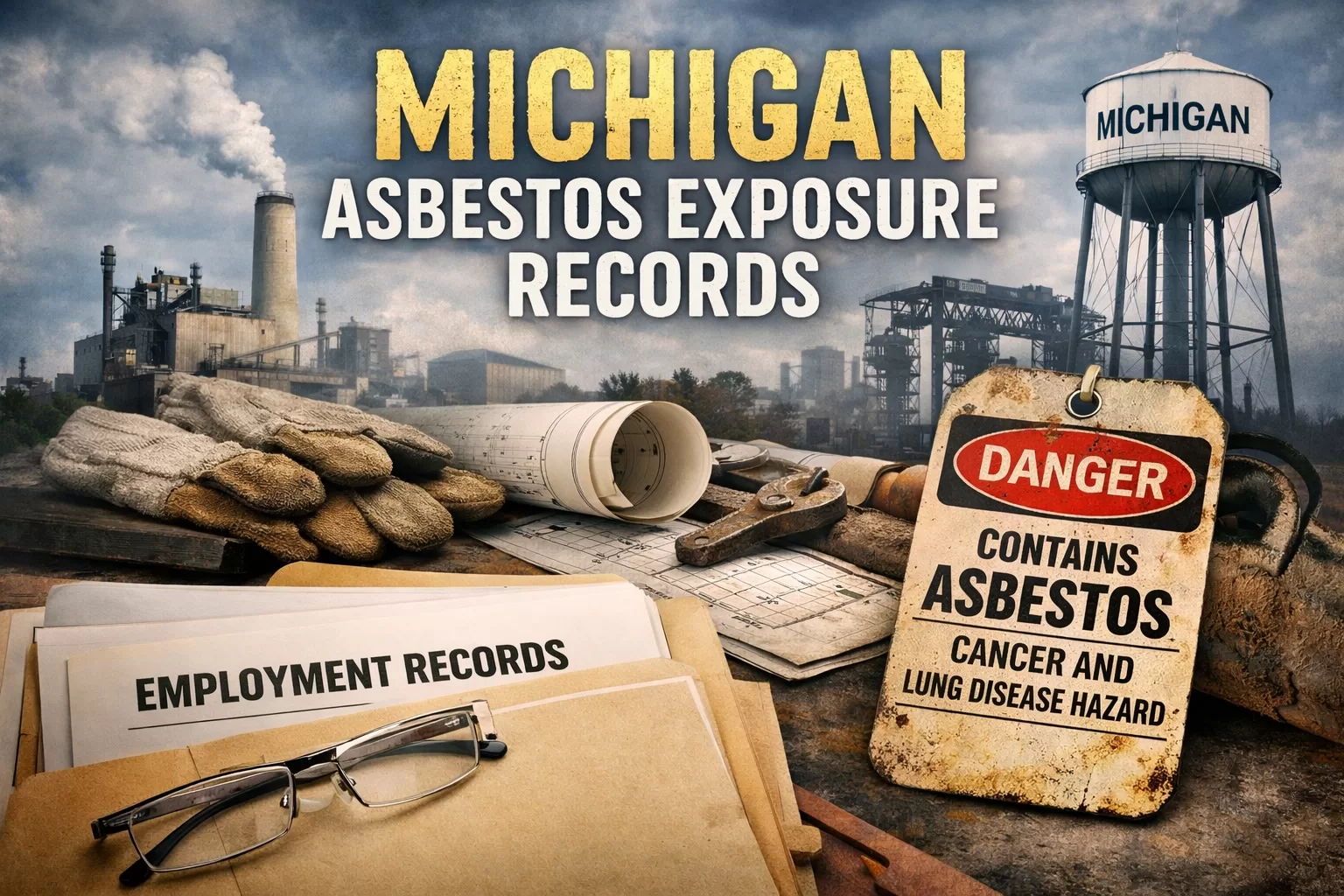
If you’re building an asbestos-related claim in Michigan, the hardest part is often not the diagnosis—it’s proving where the exposure happened and what work you did. Michigan Asbestos Exposure Records are the paper trail that can turn a “maybe” case into a documented case.
People think proof means a product box or a brand name from 1976. In real life, many strong cases are built from records that show your work location, tasks, equipment, and time period, even when no one remembers the manufacturer.
Mesothelioma/Asbestos Legal Help – WV, MI & PA
Speak directly with attorney Lee W. Davis. No call centers. Free, confidential review.
This guide explains what Michigan records to look for, where to request them, and how they help prove exposure.
What counts as Michigan Asbestos Exposure Records
The best records are the ones that show work + place + task + timeframe. Useful examples include:
- Union dispatch slips, referral records, and jobsite assignments
- Social Security “Earnings Record” and employer history
- Personnel files (job titles, departments, transfer history)
- Maintenance work orders and job tickets (especially in industrial settings)
- Shutdown/outage documentation (power plants, foundries, refineries, mills)
- Piping lists, equipment IDs, and asset logs
- Purchase orders and invoice records (materials used on site)
- Safety meeting logs and industrial hygiene records
- Blueprints, drawings, and equipment manuals
- Contractor logs and subcontractor scopes of work
Even if a record doesn’t say “asbestos,” it can still be powerful if it places you in work that commonly disturbed asbestos—gasket changes, valve packing, boiler work, refractory tear-out, insulation disturbance, pump rebuilds, or demolition/renovation.
👉 Search Asbestos Job Sites in Michigan
Why records matter more than memory
Time erases details. Companies change names. Plants close. Supervisors retire. That’s why documented records beat recollections.
Michigan Asbestos Exposure Records help establish:
- Worksite identification (exact facility, department, and time period)
- Job duties (what you physically did)
- Frequency and duration (repeat work = stronger exposure story)
- Corroboration (multiple sources pointing to the same work history)
In many cases, the winning proof is a stack of ordinary documents that all say the same thing: you were there, doing that work, during those years.
Where to request key records in Michigan
Here are common starting points:
1) Social Security work history
Your earnings history helps confirm employer names and timeframes. It’s often the backbone for reconstructing a work timeline.
2) Unions and benefit funds
If you were in a trade, union records may show dispatches, jobsite placements, locals, contractors, and dates. Pension/benefit funds often keep long-running employment verification documentation.
3) Employers and successors
Even if the original company is gone, a successor, purchaser, or records custodian may exist. HR records, safety records, and maintenance archives sometimes survive long after shutdown.
4) Public entities and archives
If the site was tied to a municipality, state project, or public contract, records can exist in public repositories—especially for major facility work, rebuilds, or demolition.
5) Coworkers and trade documentation
Old pay stubs, W-2s, apprenticeship paperwork, tool receipts, and job notebooks can fill gaps where institutional records are missing.
Read More: Michigan Mesothelioma Lawyer
The exposure “record stack” that wins cases
A strong file usually looks like this:
- Timeline proof (earnings record + job history)
- Site proof (dispatch slips / badges / HR / payroll)
- Task proof (maintenance tickets / outage sheets / job logs)
- Material inference (site era + equipment type + documented industrial use)
- Medical proof (diagnosis and causation support)
That combination is what turns “I worked around it” into a documented exposure history that can actually be pursued.
Read about Saginaw MI Foundry Asbestos Exposure
Common mistakes that weaken proof
- Waiting too long to request records (some custodians purge)
- Asking for the wrong department (HR vs. safety vs. maintenance)
- Not capturing all names of the company (mergers, subsidiaries, DBAs)
- Focusing only on brands instead of tasks and locations
- Not building a timeline first (dates matter)
What to do if the company is closed or records are “gone”
“Records don’t exist” often means “we don’t want to look” or “we don’t keep them here.”
There are still options:
- Identify successor entities and custodians
- Use union/pension records to confirm placement
- Use project records, contractor logs, and public archives
- Reconstruct the exposure story using multiple corroborating sources
The key is building the story from independent records that converge on the same worksite and work duties.
Talk to a Michigan asbestos lawyer about proving exposure
If you’re trying to build a case, don’t guess. The right records—requested the right way—can decide whether a claim stalls or moves.
For help identifying which Michigan Asbestos Exposure Records matter for your work history and what to request first, contact Law Offices of Lee W. Davis, Esquire, P.L.L.C. at (412) 781-0525. Establish credible exposure to asbestos, that’s what we do.
FAQs
What if I don’t remember the brand of asbestos product?
You usually don’t need a brand name to start. Records showing the facility, your job duties, and the timeframe can establish exposure even without product packaging.
Are union records enough to prove exposure?
They can be a strong foundation because they show jobsite placement and dates, but pairing them with task records (work orders, outage logs, maintenance tickets) makes the proof much stronger.
What if the employer says records were destroyed?
That’s common. Other sources—Social Security history, pension/benefit funds, public project records, contractor records, and coworker documentation—can still rebuild the timeline and support exposure proof.
How far back do asbestos exposure records go?
It depends on the custodian. Some archives go back decades, especially unions and benefit funds. Company record retention varies widely, which is why early requests matter.
Do I need medical records before collecting exposure records?
You can start building the work history anytime. In many situations, creating the timeline early helps you gather the right medical proof later and avoids losing key employment documentation.
Comments are closed.