
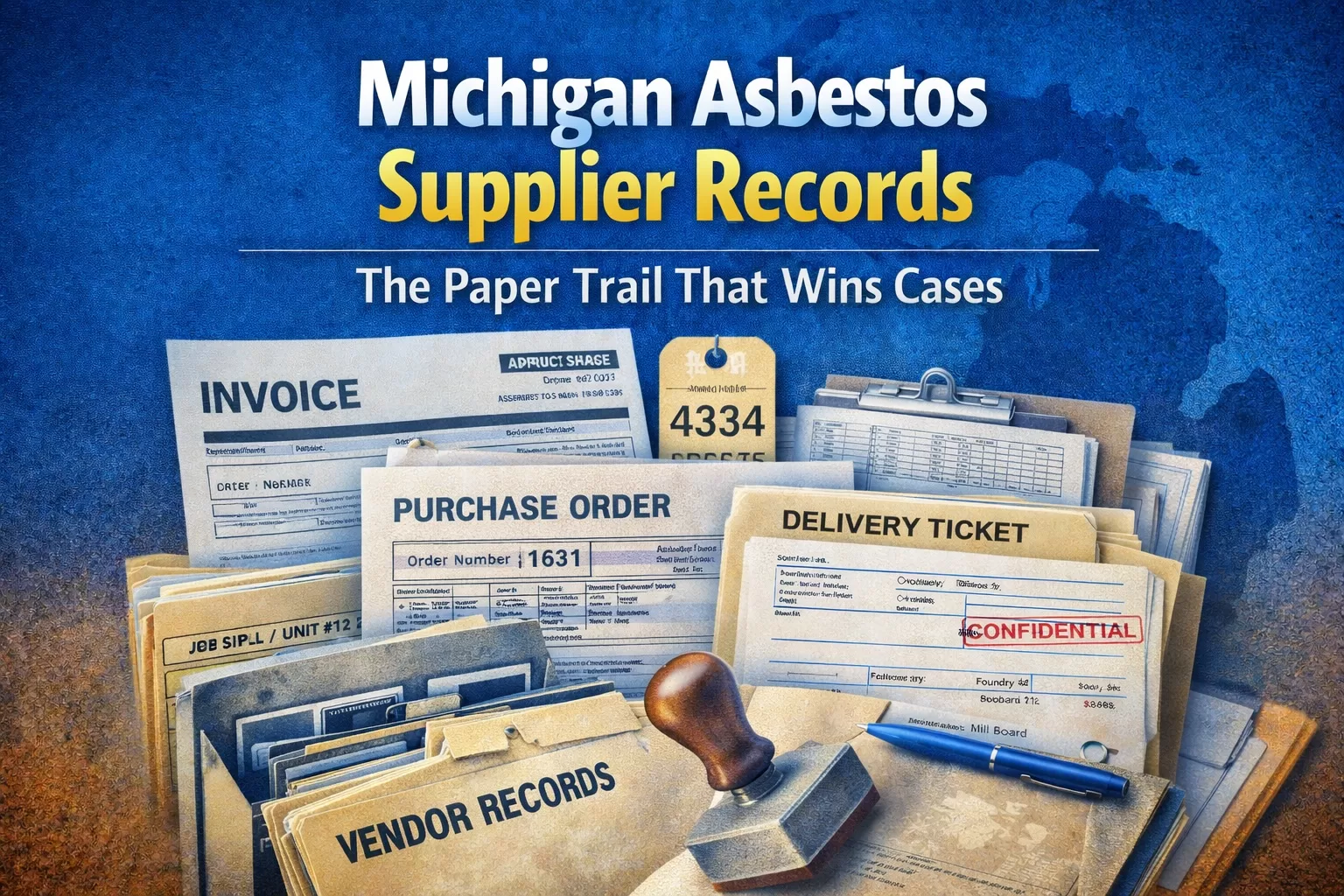
If you’re building a Michigan asbestos case, Michigan Asbestos Supplier Records can be the missing link between “I worked there” and proof that asbestos-containing materials were actually ordered, delivered, and used on your job. When a plant is gone, a contractor is dissolved, or coworkers can’t remember brand names from decades ago, supplier paperwork often survives—and it speaks with dates, quantities, job numbers, and delivery locations.
Mesothelioma/Asbestos Legal Help – WV, MI & PA
Speak directly with attorney Lee W. Davis. No call centers. Free, confidential review.
What supplier records usually show (and why it matters)
Supplier files can confirm which asbestos products were provided, when, and to whom. That matters because defendants love to argue: “No product identification, no case.” A good supplier trail helps you answer the questions that decide liability:
- Invoices (dates, quantities, product descriptions, pricing)
- Purchase orders (who ordered it, job number, department or maintenance unit)
- Delivery tickets / bills of lading (where it went, receiving signature, dock/location)
- Vendor account statements (pattern of recurring orders over time)
- Credit memos / returns (proof of ongoing supply and job activity)
- Catalog codes / SKU descriptions (often identify insulation, cement, packing, gaskets)
Even if an invoice doesn’t say “asbestos” in plain English, product descriptors, part numbers, and legacy catalog codes can still pin down what the material was—especially for older insulation, refractory products, packing, gasket sheet, and high-heat cements.
The Michigan worksites where supplier records are most valuable
Supplier records are especially strong evidence for Michigan industrial settings where maintenance and shutdown work was continuous:
- Auto plants and stamping operations
- Foundries and machine shops
- Powerhouses and utility operations
- Chemical facilities and refineries
- Steel-related facilities and heavy manufacturing
- Large institutional boiler rooms (universities, hospitals, municipal buildings)
These are the places where gasket work, valve work, pipe insulation disturbance, refractory tear-outs, boiler maintenance, and equipment rebuilds created repeated exposure—often over years.
👉 Search Asbestos Job Sites in Michigan
Who to request records from (practical targets)
People think “the employer” is the only source. In real cases, the supplier ecosystem is broader:
- Supply houses and industrial distributors (local branches matter)
- Union contractors and mechanical contractors who bought materials for jobs
- OEM equipment vendors who supplied “kits” (packing, gaskets, insulation components)
- Third-party maintenance companies (shutdown/turnaround contractors)
- Purchasing departments or accounts payable archives (when they exist)
If you already know one vendor name—an industrial supply store, a local distributor, a refractory supplier—that’s often enough to start building the paper trail.
What to ask for (request language that works)
When you request supplier records, vague requests get vague results. A tight request is better:
- Vendor account records under the facility name and common variants
- Invoices, purchase orders, delivery tickets, and statements for a defined time range
- Any job-number references, maintenance department references, or contractor billing references
- Product codes, SKU descriptions, catalog entries, and historical product sheets (if retained)
If the supplier says “we don’t have it,” sometimes the parent company, a successor entity, or a records vendor does. It’s also common for suppliers to keep financial statements longer than the underlying documents—those can still identify account numbers, branch locations, and purchase patterns.
How supplier records fit into exposure proof
Supplier records rarely stand alone. They work best when tied to:
- Your work history and job duties
- Facility shutdown periods and maintenance cycles
- Coworker testimony (“we used that gasket sheet / insulation cement”)
- Facility drawings, equipment lists, or maintenance logs
- Medical records confirming asbestos-related disease
In other words: supplier records help you move from possibility to probability—and that’s where claims get real leverage.
Read More: Michigan Mesothelioma Lawyer
If you’re missing the “brand name,” don’t stall
It’s normal for people to remember the work but not the label. Many strong cases are built from records that nobody knew existed until the right request was made. Michigan asbestos claims are often won on documentation and persistence—especially where jobsite conditions are older and the corporate story has changed hands.
If you want help identifying the best supplier targets for your Michigan work history, we can map the likely vendors and records sources based on your jobsite, trade, and years of work.
Talk directly with attorney Lee W. Davis about a Michigan asbestos claim. Call (412) 781-0525 or use the contact below or at leewdavis.com.
Check If Your Family Was Exposed
Get your free guide instantly + a confidential case review.
🔒 100% Confidential. No obligations.
FAQs (add to the bottom)
What are Michigan Asbestos Supplier Records?
They’re vendor documents—like invoices, purchase orders, and delivery tickets—that show asbestos-containing materials were ordered and delivered to a Michigan jobsite or contractor.
What if the invoice doesn’t say “asbestos”?
Many older records use product codes, legacy names, or generic descriptions. Part numbers, catalog codes, and product families can still identify asbestos materials.
How far back do suppliers keep these records?
It varies. Some keep detailed invoices for limited periods, but account statements, ledgers, tax archives, or records held by successors may go back much farther.
Mesothelioma/Asbestos Legal Help – WV, MI & PA
Speak directly with attorney Lee W. Davis. No call centers. Free, confidential review.