
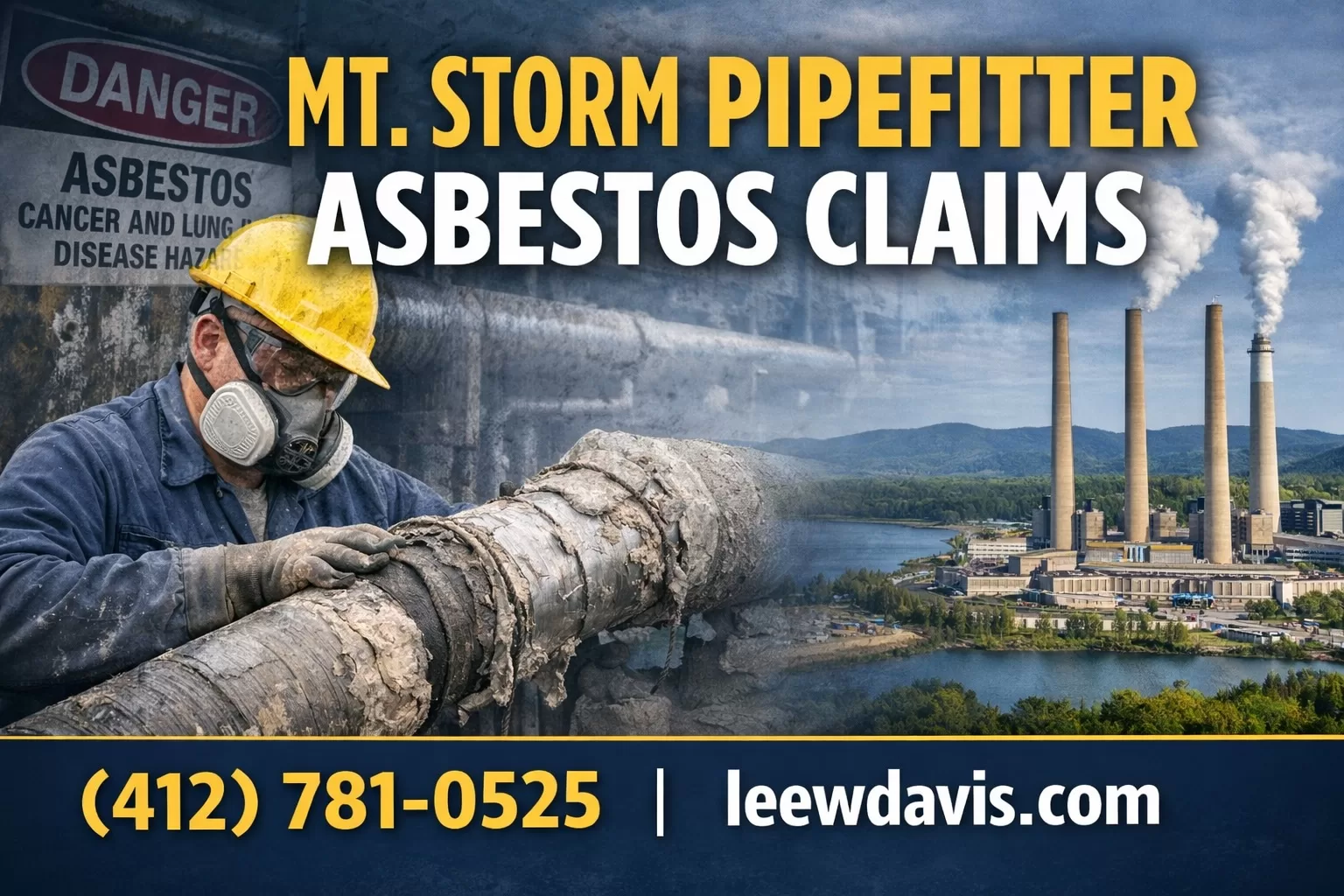
If you’re searching Mt Storm Pipefitter Asbestos, it usually means one thing: you or a family member worked around insulation, gaskets, cement, or high-heat equipment and now there’s a diagnosis—or a scare—you can’t ignore. Mt. Storm’s generating equipment, piping systems, and maintenance areas involved materials that historically were commonly asbestos-containing. Pipefitters were often directly in the zone when those materials were cut, removed, scraped, or replaced.
This page explains what matters most: how pipefitters were exposed, what proof wins these cases, and what to do next.
Mesothelioma/Asbestos Legal Help – WV, MI & PA
Speak directly with attorney Lee W. Davis. No call centers. Free, confidential review.
Where pipefitters encountered asbestos at Mt. Storm
Pipefitters weren’t exposed “in the abstract.” Exposure typically came from hands-on maintenance and shutdown work where asbestos materials were disturbed.
Common exposure points included:
- Pipe insulation and block insulation on steam lines, condensate lines, and high-temperature runs
- Valve and pump packing removed and replaced during routine maintenance
- Flange gaskets (steam, water, chemical lines) scraped and wire-brushed off
- Boiler/steam system areas where insulation and refractory materials were present
- Turbine-adjacent piping and related mechanical rooms during outages
- Cement, mud, and wraps used on pipes and fittings in older systems
The risk rises when material is disturbed and becomes dust—especially in enclosed mechanical spaces or during aggressive outage schedules.
Why pipefitters are a high-risk trade
Pipefitters are high-risk because the work combines:
- direct contact with insulation, gaskets, packing, and cement products, and
- frequent disturbance—cutting, grinding, scraping, pulling, replacing.
That is the exposure pattern juries and adjusters understand: repeated, hands-on, dusty work around heat systems, often over years.
Diagnoses commonly tied to asbestos exposure
The diagnosis changes what you can recover and how fast you should move.
Asbestos-related diseases include:
- Mesothelioma (often the strongest cases)
- Lung cancer (especially with significant occupational exposure)
- Asbestosis and other serious asbestos-related pulmonary scarring
If you have a new diagnosis and any Mt. Storm work history, do not wait to “see how it goes.” The evidence side of these claims is time-sensitive.
Mesothelioma/Asbestos Legal Help – WV, MI & PA
Speak directly with attorney Lee W. Davis. No call centers. Free, confidential review.
What evidence makes an Mt. Storm pipefitter case strong
Most people think they need a perfect paper trail. You don’t. Strong cases are built from work history + product/trade exposure + medical proof.
Key evidence usually includes:
- Work history: employer names, dates, job titles, crafts/trades, outage work
- Site details: areas worked (mechanical rooms, pipe runs, turbine/boiler areas)
- Co-worker proof: statements confirming the materials and tasks
- Medical records: diagnosis, pathology (for mesothelioma), imaging, treatment
- Exposure narrative: the “how” of dust generation—scraping, pulling insulation, grinding gaskets, etc.
If you can describe the work clearly, we can usually build the proof around it.
Can a family bring a claim?
Yes. When asbestos exposure results in death, surviving family members may have a claim depending on the circumstances and timing. If you want the family-claim path explained, start here: the mesothelioma wrongful death page on my site covers what families need to know and what records matter most.
Time matters: do not wait after diagnosis
These claims are not like a property dispute where documents sit in a file cabinet. Witnesses move, memories fade, employers disappear, and jobsite proof gets harder. The sooner we document the work history and medical timeline, the stronger the case usually becomes.
What compensation can include
Every case is different, but damages may include:
- Medical expenses and future care
- Lost income and loss of earning capacity
- Pain and suffering
- Family losses (in qualifying cases)
The goal is to build the case the right way—fast, credible, and supported—so the value reflects the harm.
FAQs
What does “Mt Storm Pipefitter Asbestos” mean for a claim?
It typically refers to pipefitter work around asbestos-containing insulation, gaskets, packing, or cement products at Mt. Storm where dust exposure occurred during maintenance or outages.
I worked outages—does that matter?
Yes. Outage work often involves intense removal and replacement tasks that disturb insulation and gaskets. Those are classic high-exposure conditions.
What if I don’t remember product names?
That’s normal. Most clients don’t. We build cases from trade tasks, areas worked, time periods, and corroboration—then match that to known product categories and proof sources.
Call Lee Now
If you have a diagnosis and Mt. Storm pipefitter work history, you should get a legal review now—before the evidence gets harder to capture.
Call (412) 781-0525 or visit leewdavis.com to request a consultation.
Helpful links
- For broader statewide guidance, you can also read my West Virginia mesothelioma lawyer page, which explains how asbestos claims are evaluated across WV worksites.
- If you want to see how Mt. Storm fits into the bigger map of exposure locations, my West Virginia asbestos job sites page lists facilities and the types of work historically tied to asbestos exposure.
Check If Your Family Was Exposed
Get your free guide instantly + a confidential case review.
🔒 100% Confidential. No obligations.