
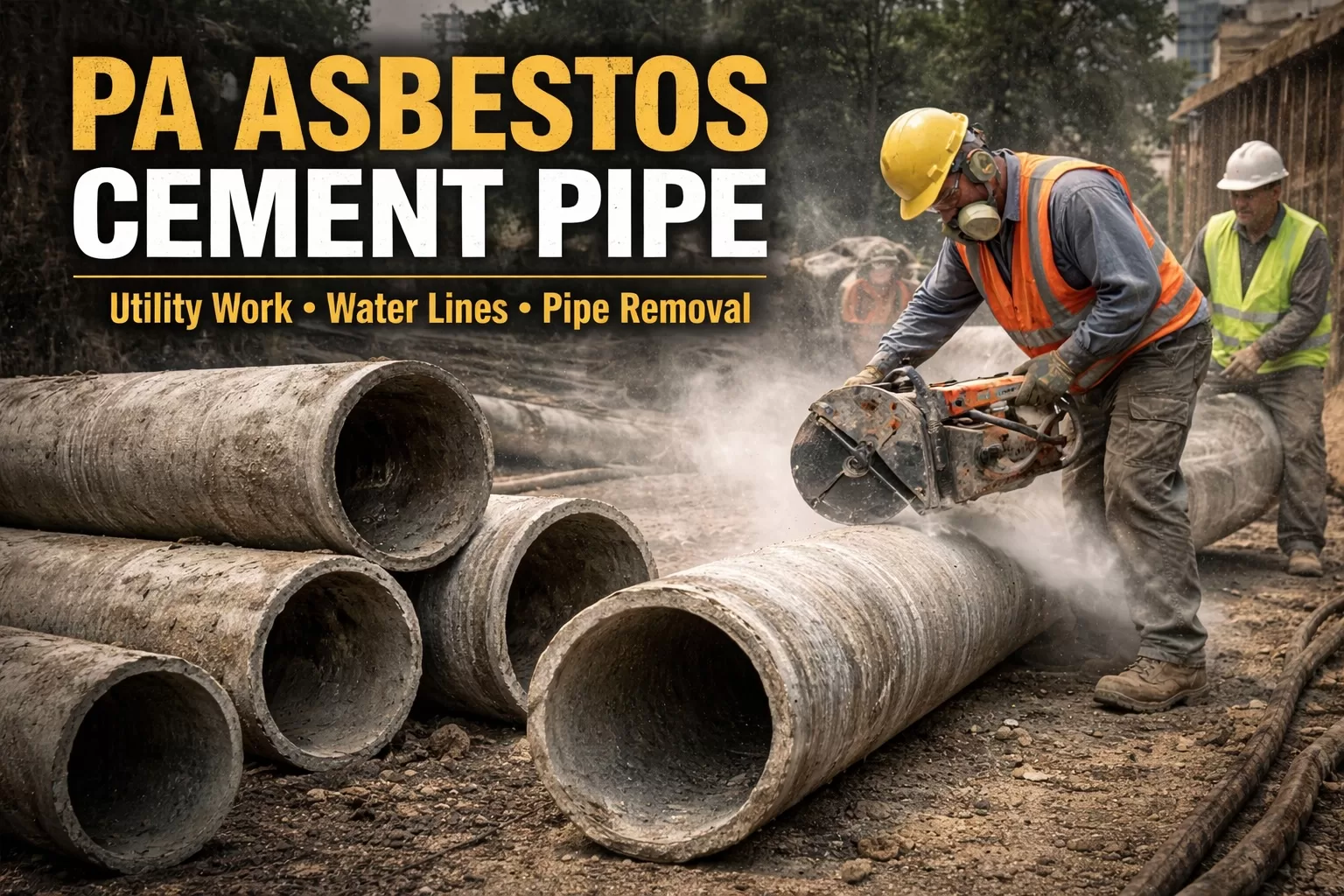
PA Asbestos Cement Pipe shows up in the exact places Pennsylvania workers didn’t expect asbestos to be hiding: buried utility lines, water systems, industrial service lines, older municipal projects, and maintenance work where dust control was never part of the plan. If you cut it, drilled it, tapped it, sawed it, ground it, or removed it, you may have inhaled asbestos fibers even if nobody ever called it “asbestos” on the job.
Mesothelioma/Asbestos Legal Help – WV, MI & PA
Speak directly with attorney Lee W. Davis. No call centers. Free, confidential review.
This isn’t a “maybe” exposure product. When asbestos cement pipe is disturbed, it can release respirable fibers—especially during dry cutting, core drilling, breaking, snapping, sanding, and disposal.
PA Asbestos Product Identification
What is asbestos cement pipe?
Asbestos cement pipe (often abbreviated AC pipe) was commonly used for water and utility applications because it was durable, corrosion-resistant, and inexpensive. The problem is what it was made with: asbestos fibers were incorporated into the cement matrix. The material can hold together when intact and undisturbed—but work that creates dust is where the danger starts.
Where PA workers typically ran into asbestos cement pipe
If you worked in any of the roles below, PA Asbestos Cement Pipe should be on your radar:
- Municipal water department and water authority crews
- Sewer and stormwater crews
- Utility contractors and laborers
- Excavation and trenching crews
- Heavy equipment operators working around pipe replacement
- Plumbers and pipefitters on older lines or tie-ins
- Road crews and public works employees encountering buried pipe during projects
- Industrial maintenance crews dealing with service lines and plant piping
And yes—some workers were exposed without “installing pipe” at all: you can get hit just being near the cut zone, handling debris, cleaning up, loading broken sections, or working downwind of dust.
The tasks that matter most in a claim
In asbestos cases, it’s rarely the job title that wins the case. It’s the task. If you did any of the following, that’s the proof pathway:
- Cutting AC pipe with a saw (especially dry cutting)
- Drilling/tapping for service connections
- Breaking or snapping pipe during removal
- Grinding ends or beveling sections to fit
- Handling broken pipe and sweeping/cleanup
- Bagging, loading, hauling, or dumping debris
- Working in trenches where dust collected
These are the activities that generate the kind of airborne dust that shows up in real-world exposure histories.
What you need to prove a Pennsylvania asbestos cement pipe claim
A strong claim is built the same way every time: credible work history + credible product exposure + credible medical proof.
1) Work history
Where you worked, what you did, and when. Dates matter because latency matters.
For the foundation of the case—where you worked and what you did—see
Pennsylvania Asbestos Work History
2) Product identification
You don’t need a perfect memory of brand names to start. But you do need a credible description of the product and the work:
- AC pipe used for water lines
- How it was cut/removed
- What dust conditions were like
- Whether PPE or wet methods were used (often “no”)
If you need a clean way to lock in your exposure facts, use Pennsylvania Asbestos Exposure Affidavit
3) Medical documentation
Diagnosis drives the claim. Mesothelioma is the clearest, but lung cancer and other asbestos-related disease claims may be viable depending on exposure and medical records.
To explain latency and why diagnosis timing matters, review Pennsylvania Asbestos Exposure Timeline
Who is responsible?
In these cases, liability often traces to:
- Manufacturers and sellers of asbestos cement pipe and related products
- Contractors who repeatedly installed/removed it across PA projects
- Other asbestos-containing materials used alongside the work (packing, gaskets, insulation, cement products)
You don’t guess your way through that. You build it from records, witness proof, and jobsite pattern evidence.
Don’t guess on timing—read PA Asbestos Claim Deadlines.
The time limit question
Pennsylvania asbestos claims usually turn on when you were diagnosed—not when you were exposed decades ago. That’s why people who worked around asbestos in the 1970s, 1980s, or 1990s can still have valid claims today after a diagnosis. If you’re reading this because you or your family just got life-changing medical news, don’t wait around for “later.”
Call to talk through PA Asbestos Cement Pipe exposure
I’ve been doing product identification work since I started in this field as a paralegal in 1988—long before “asbestos databases” and canned checklists. I’ve handled heavy-volume industrial work, including the Saginaw foundry cases, and I’ve worked directly with people in real-world Pennsylvania cases to build exposure proof that holds up—work history, tasks, products, witnesses, and medical documentation. That’s what decides whether a claim gets paid or gets discounted.
For broader guidance and a case review, visit Pittsburgh asbestos lawyer
If you believe PA Asbestos Cement Pipe dust was part of your work—and you’re now facing mesothelioma, lung cancer, or another asbestos-related diagnosis—call me. We’ll talk straight about whether you have a claim and what proof matters most.
(412) 781-0525 • leewdavis.com
Check If Your Family Was Exposed
Get your free guide instantly + a confidential case review.
🔒 100% Confidential. No obligations.