
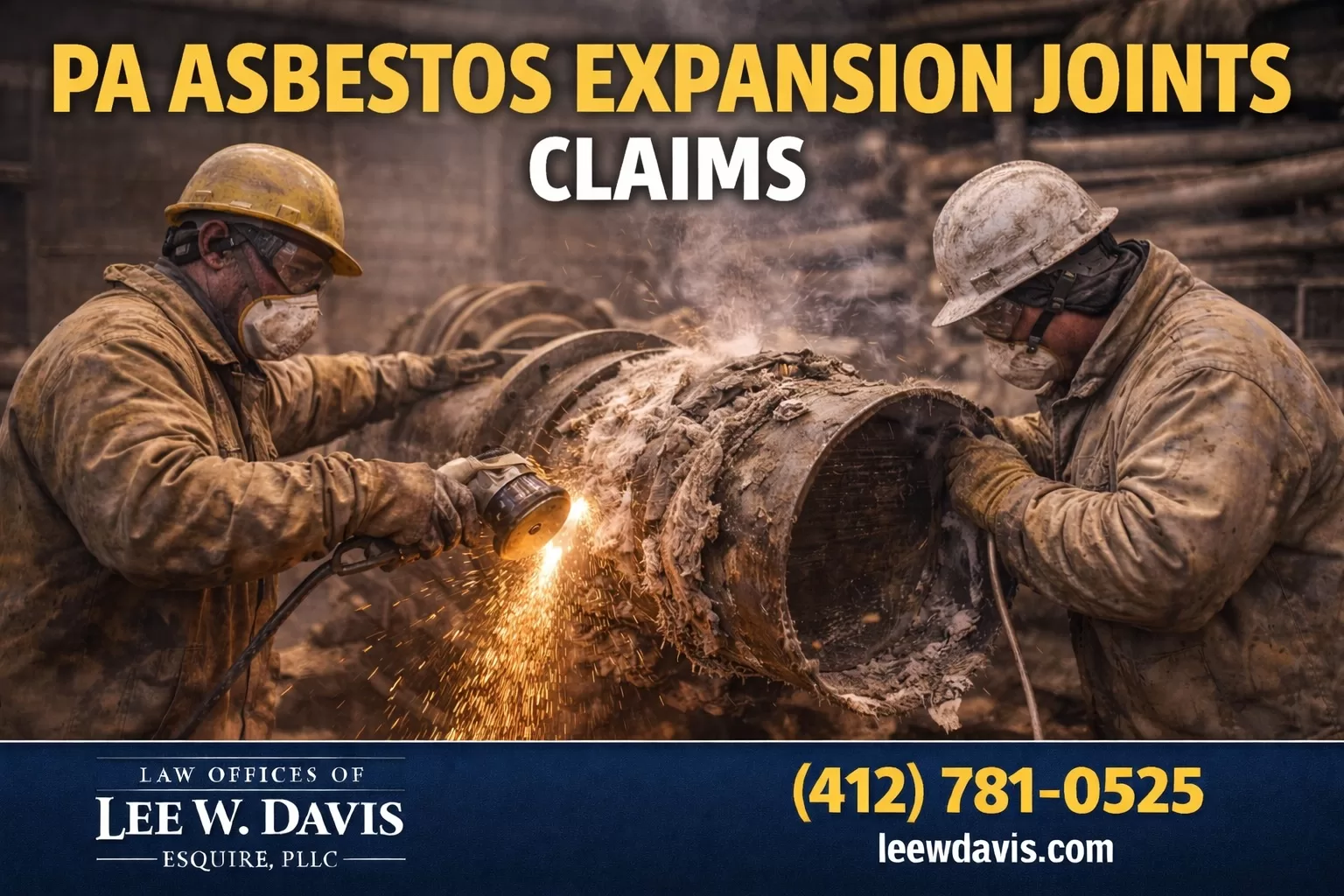
PA Asbestos Expansion Joints were used everywhere in older Pennsylvania industrial facilities—power plants, steel mills, refineries, paper mills, chemical plants, and large institutional boiler rooms. They were installed to absorb heat, vibration, and movement in piping, ductwork, boilers, turbines, and high-temperature systems.
Mesothelioma/Asbestos Legal Help – WV, MI & PA
Speak directly with attorney Lee W. Davis. No call centers. Free, confidential review.
The problem is simple: when a crew had to remove, cut out, scrape, or replace an old expansion joint, the work could release asbestos dust—especially during outages, shutdowns, and emergency repairs. If you worked maintenance, mechanical, or shutdown work in Pennsylvania and you’ve been diagnosed with mesothelioma, lung cancer, or another asbestos-related disease, you may have a valid claim.
Where expansion joints showed up in Pennsylvania facilities
Expansion joints were often found in:
- Steam and hot-water piping runs
- Turbine and boiler systems
- Ductwork and exhaust systems
- High-heat process equipment
- Flanges and connections near pumps, valves, and elbows
- Large building mechanical rooms in older schools, hospitals, and public facilities
In many older installations, expansion joints were paired with other asbestos materials—insulation, gaskets, packing, refractory, and cement products—so the exposure picture is often layered.
If you’re building the broader proof record for a Pennsylvania claim, start with Pennsylvania Asbestos Work History.
How exposure typically happened
Most people weren’t exposed because the joint “sat there.” Exposure usually occurred when a crew disturbed it, including:
- Cutting or grinding to remove old joint material
- Scraping or chiseling hardened material off metal surfaces
- Pulling out deteriorated joint fabric or filler
- Sweeping and cleanup after removal
- Working in confined areas where dust had nowhere to go
This kind of work frequently happened under time pressure—during outages, plant turnarounds, or emergency breakdowns—when multiple trades were stacked into the same area.
To show when the highest-risk work occurred (shutdowns, outages, specific years), use Pennsylvania Asbestos Exposure Timeline.
Who was most at risk
PA Asbestos Expansion Joints claims often involve workers such as:
- Pipefitters and steamfitters
- Millwrights
- Boilermakers
- Maintenance mechanics
- Turbine and outage crews
- Insulators working around disturbed material
- Foremen and supervisors who were physically present during removal
Even if you didn’t personally “do the cutting,” being in the work area during removal, cleanup, or reassembly can still be enough to support exposure.
If coworkers can confirm the type of shutdown work and materials being removed, see PA Asbestos Jobsite Witnesses.
What proof matters most in an expansion-joint case
These cases are not won with vague statements. They are won with credible detail that matches how asbestos exposure actually occurred.
The strongest proof usually includes:
- The facility and the years you worked there
- Your job title and the tasks you performed
- The type of equipment you worked on (boilers, turbines, ducting, piping)
- The kind of joint work you saw or did (remove, scrape, replace, clean up)
- Supporting employment, union, or jobsite documentation
- Medical documentation confirming diagnosis
What compensation may cover
Depending on the facts, a Pennsylvania asbestos case may seek compensation for:
- Medical treatment and related costs
- Lost wages and loss of earning capacity
- Pain and suffering
- Household services and family impact
- Wrongful death damages (where applicable)
Some claims also involve trust submissions depending on the product identification and exposure history.
If you’re also dealing with asbestos gaskets and related removal work, read PA Asbestos Gasket Removal
Call for a real case review
Expansion-joint cases come down to details—where you worked, what equipment you worked around, and when the removal work happened. If you have an asbestos-related diagnosis, I’ll evaluate your Pennsylvania work history and give you a straight answer about claim options and what evidence matters.
Start here: Pennsylvania asbestos lawyer — free case review.
Call (412) 781-0525 or reach me through leewdavis.com.
Check If Your Family Was Exposed
Get your free guide instantly + a confidential case review.
🔒 100% Confidential. No obligations.