
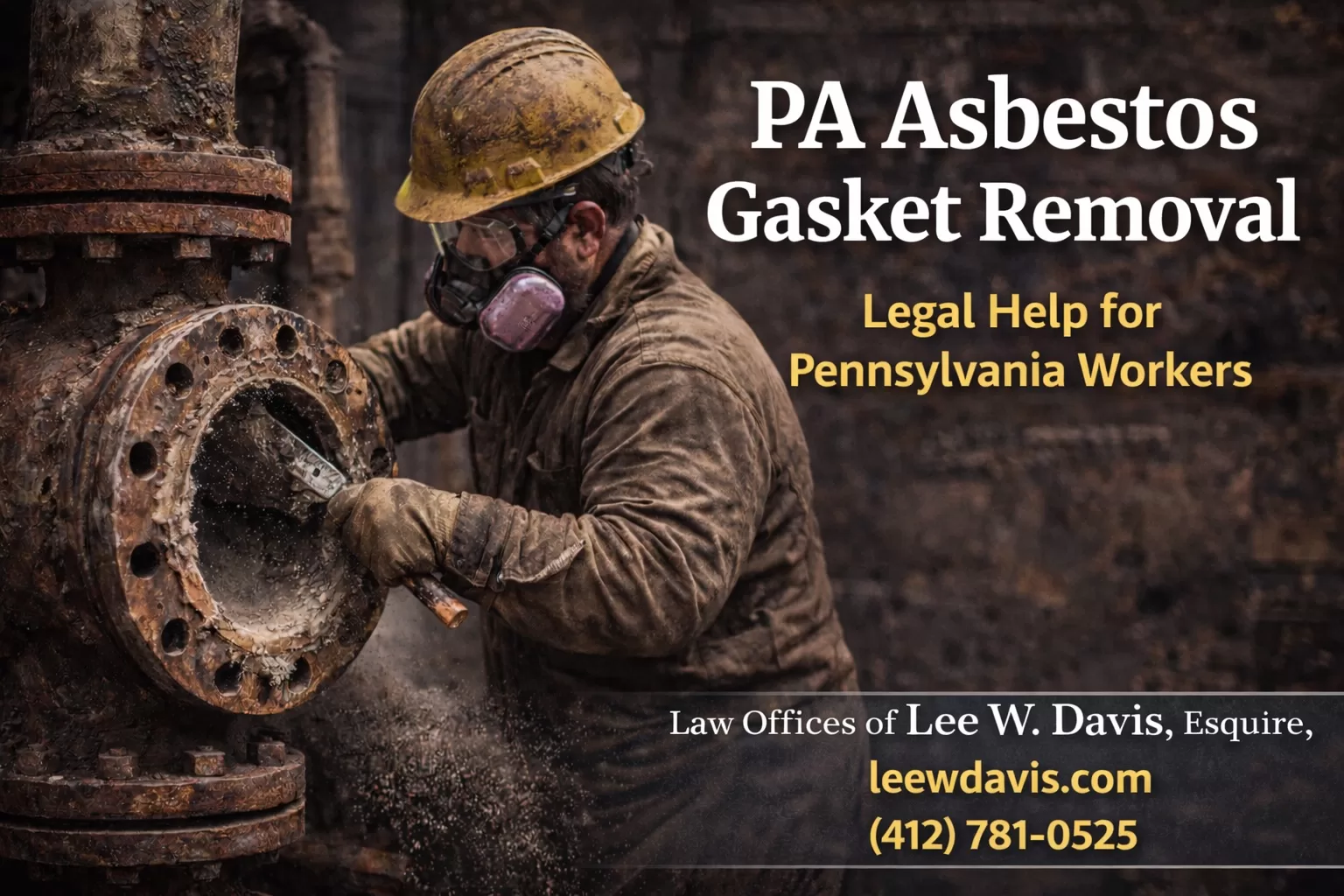
PA Asbestos Gasket Removal is one of the most common (and most provable) sources of occupational asbestos exposure in Pennsylvania industrial work. The risk isn’t “standing near asbestos.” The risk is the task: scraping, wire-brushing, cutting, grinding, or pulling old gaskets off flanges, valves, pumps, compressors, heat exchangers, and boiler doors—especially when the material is dry, brittle, and stuck like concrete. That is when the fibers release.
Mesothelioma/Asbestos Legal Help – WV, MI & PA
Speak directly with attorney Lee W. Davis. No call centers. Free, confidential review.
I’ve built cases around this exact exposure pattern for decades—because gasket work leaves a recognizable footprint in the work history, the jobsite, the equipment, and the product universe that was actually used.
Where gasket exposure happens in Pennsylvania
Gasket removal shows up across Pennsylvania in places that run hot, pressurized, or corrosive systems:
- Powerhouses and boiler rooms (steam, feedwater, blowdown, condensate)
- Steel mills, coke works, and fabrication shops
- Chemical plants and refineries (process piping, exchangers, pumps, reactors)
- Paper mills and food plants (maintenance shutdowns, washdowns, rebuilds)
- Municipal and institutional plants (schools, hospitals, universities)
If you did “maintenance,” “shutdowns,” “turnarounds,” “overhauls,” or “outage work,” gasket removal is usually part of it—even if nobody called it that.
Who is most at risk
The highest-risk roles are the trades that are actually hands-on with flanges and equipment:
- Pipefitters / steamfitters
- Millwrights and industrial maintenance mechanics
- Boiler operators and stationary engineers (when they help on outages)
- Machinists and pump/valve rebuilders
- Welders and riggers (when they prep or clean flanges)
- Laborers assigned to tear-out and cleanup
And the risk isn’t limited to one day. Gasket exposure is often repeated, routine, and spread across years, which matters when you’re proving dose and causation.
What “gasket removal” really looks like (and why it matters)
In real life, it’s not a neat “remove gasket” checkbox. It’s:
- Breaking flanges and popping old gaskets loose
- Scraping gasket faces with a razor scraper or gasket scraper
- Wire brushing residue off flange faces
- Using a grinder, Roloc disc, or emery cloth to clean the surface
- Sweeping up dust after the fact (often dry sweeping)
That last part—cleanup—often generates as much exposure as removal.
How to prove a PA gasket case without guessing
A strong PA Asbestos Gasket Removal claim is built like a workmanlike proof package, not a story.
1) Lock down the work history (where and when).
You want job titles, employers, worksites, and date ranges. If you worked through halls, locals, contractors, or outages, you want that too. Start with your base timeline and then fill gaps job-by-job.
Read More: Pennsylvania asbestos exposure timeline
2) Identify the equipment and tasks (what you touched).
Pumps, valves, turbines, compressors, boilers, exchangers, and piping systems matter because they narrow the product universe. “Worked in the powerhouse” is vague. “Rebuilt pumps and changed flange gaskets during outages” is proof.
3) Product identification: narrow it to what was actually used.
This is where most cases are won or lost. Not every gasket was asbestos—but plenty were, and many facilities used the same gasket sheet materials, packing, and brands for years. A credible case identifies the kinds of gasket materials used, the brands people actually saw, and the departments where it happened.
Read More: Pennsylvania asbestos product identification
4) Pick the right defendants and match them to the exposure.
Once you know the task + equipment + jobsite + time frame, you can identify likely manufacturers and suppliers tied to that work. This avoids “kitchen sink” pleading and keeps the case credible.
Read More: Pittsburgh asbestos lawyer
5) Decide whether an asbestos trust claim is part of the strategy.
Some gasket/product exposures line up with trust pathways depending on jobsite, era, and product. Trust claims can also provide documentation leverage and additional recovery, depending on the overall case.
Read More: Pennsylvania asbestos trust claims
Mesothelioma/Asbestos Legal Help – WV, MI & PA
Speak directly with attorney Lee W. Davis. No call centers. Free, confidential review.
Common fact patterns that are strong
If you recognize any of these, that’s usually a solid starting point:
- Outage work in a powerhouse, steel mill, or chemical plant with repeated flange breaks
- Maintenance mechanic work involving pumps/valves and shutdown cleanup
- “Gasket scraping” paired with packing removal on valves and pumps
- Work in tight mechanical rooms with poor ventilation and dust control
- Long-term trade work across multiple sites where the same tasks repeat
What to do next
If you were diagnosed with mesothelioma, lung cancer, or another asbestos-related disease and your history includes gasket removal work, don’t wait around hoping the paperwork magically appears. The claim is built by reconstructing the real work, then matching it to the right product and defendant proof.
If the case involves a death in the family, the timeline is even more critical and the claim structure changes: mesothelioma wrongful death claim
Free Case Review
If your background includes PA Asbestos Gasket Removal work—pipe, valves, pumps, boiler doors, shutdowns, scraping and cleanup—call my office and we’ll evaluate it directly and tell you what the claim needs and whether it’s viable.
Law Offices of Lee W. Davis, Esquire, PLLC
Check If Your Family Was Exposed
Get your free guide instantly + a confidential case review.
🔒 100% Confidential. No obligations.
Comments are closed.