
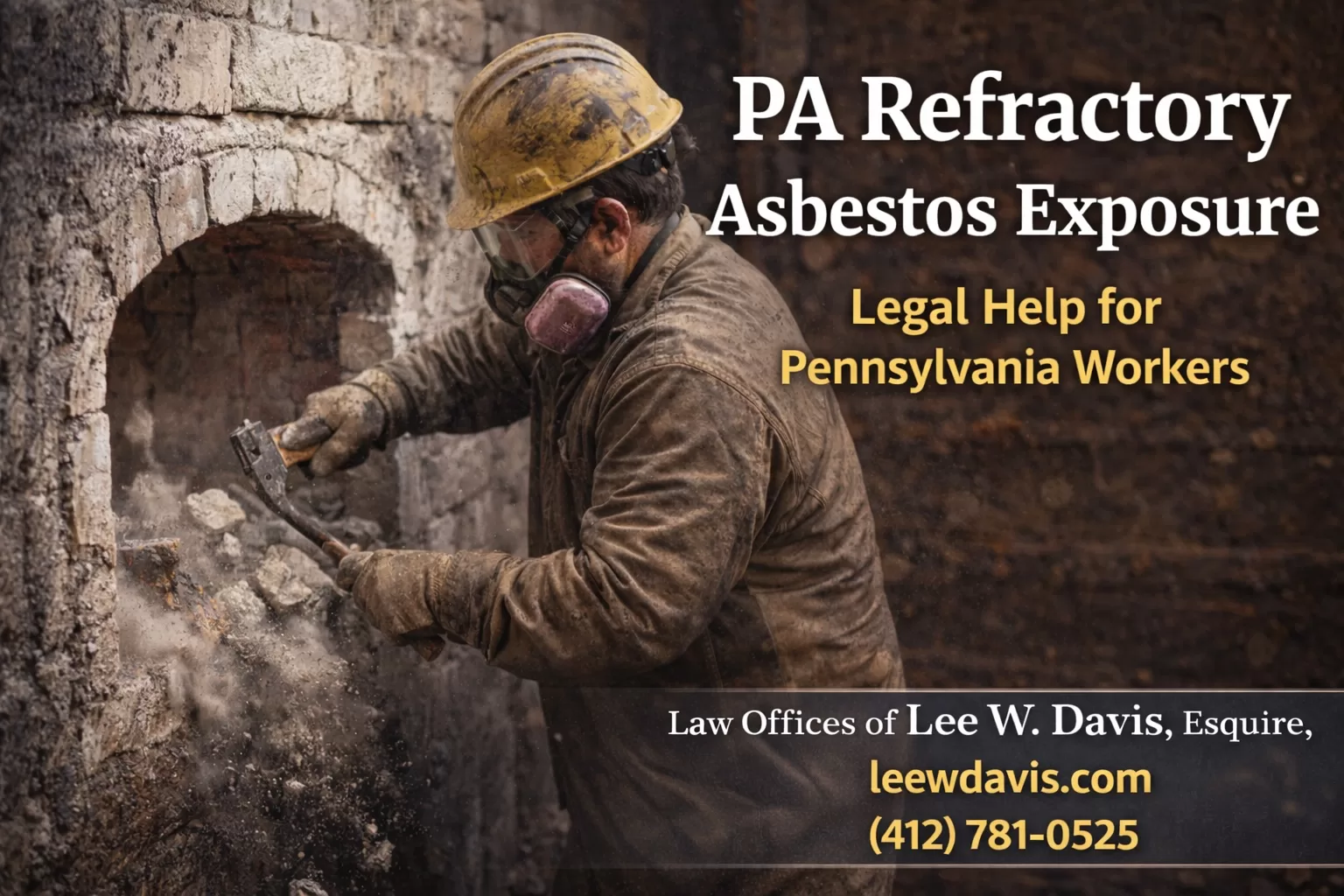
If you’re searching PA Refractory Asbestos Exposure, you’re usually not talking about one “product.” You’re talking about the hot-work trades and the high-heat areas where refractory materials were everywhere—furnaces, boilers, ladles, soaking pits, reheat ovens, kilns, coke batteries, and industrial process units that had to stay hot without burning the place down. For decades, that protection often came at a cost: asbestos fibers released during installs, repairs, tear-outs, and shutdown rebuilds.
Mesothelioma/Asbestos Legal Help – WV, MI & PA
Speak directly with attorney Lee W. Davis. No call centers. Free, confidential review.
Refractory work is one of the most overlooked (and most provable) sources of asbestos exposure in Pennsylvania because it shows up across so many industries—steel, power generation, glass, chemical plants, paper mills, and heavy manufacturing.
Read more: Pennsylvania asbestos lawyer
Where refractory asbestos exposure happens in Pennsylvania
Refractory materials are used to line and protect equipment that runs at extreme temperatures. Exposure commonly occurred during:
- Furnace and boiler rebuilds (tear-out, brick removal, patching, relining)
- Foundry and steel mill maintenance (ladles, tundishes, soaking pits, reheat furnaces)
- Kiln work in glass, brick, and cement operations (insulation boards, refractory brick, castables)
- Outage/shutdown work where multiple trades are tearing down and rebuilding high-heat systems fast
- Cleaning and demolition—sweeping debris, vacuuming dust, scraping old material, bagging rubble
Even if you weren’t a “refractory worker,” you may have inhaled fibers if you worked nearby—millwrights, pipefitters, boilermakers, electricians, laborers, insulators, welders, mechanics, and supervisors who were in the area during tear-out or rebuilds.
What “refractory” means in real terms
In asbestos litigation, the word “refractory” often includes:
- Refractory brick
- Castable refractory / refractory cement
- Mortars and refractory mixes
- Insulating firebrick
- High-heat boards, papers, and wraps
- Old insulation systems installed around high-temperature equipment
The key isn’t memorizing the labels. The key is proving what you did, where you did it, and what materials were present when the dust was created.
What makes these claims strong
Refractory exposure cases tend to have a clear pattern: a worker spends repeated time around the same high-heat equipment, shutdowns create visible dust, and multiple trades are present. When you document that pattern correctly, it becomes credible evidence.
Strong proof often comes from:
- Your work history (employer, years, departments, tasks)
- Jobsite location details (furnace house, boiler room, melt shop, power block, kiln line) 👉 Search Asbestos Job Sites in Pennsylvania
- Shutdown/outage timing (when the rebuilds occurred)
- Co-worker confirmation (even one credible witness can matter)
- Medical diagnosis records tying the disease to asbestos exposure
Other Helpful links
For broader guidance and Pennsylvania claim strategy, start here: Pennsylvania asbestos lawyer.
To establish latency and sequence clearly, use: Pennsylvania asbestos exposure timeline.
If you’re unsure what products were involved, this is the next step: Pennsylvania asbestos product identification.
If your case involves a family loss, read: Mesothelioma wrongful death claim.
Frequently asked questions
Was refractory material always asbestos?
Not always. But for decades, asbestos was widely used in many high-heat products and systems. The question is what was used at your jobsite during your years of work.
I wasn’t the person installing refractory—does that matter?
No. Many exposures occur to trades working nearby during tear-out, rebuilds, and shutdown cleanup. Proximity counts when the work created airborne dust.
What if I can’t remember brand names?
That’s common. Most people remember the equipment and the work—furnace relines, boiler rebuilds, brick tear-outs, “refractory cement,” “mud,” “firebrick,” shutdown work. With the right investigation, brand identification often follows.
How long do I have to file in Pennsylvania?
Usually the clock starts at diagnosis (or, for wrongful death, the date of death), not the year you worked. The details matter—so treat timing as urgent.
Call Lee Directly
Refractory exposure cases don’t win on buzzwords—they win on work detail, credible exposure history, and proof that holds up. That’s what I’ve done for decades: identifying exposure sources, building legitimate work histories, and translating real jobsite facts into evidence that defendants and trusts can’t dismiss.
If you have questions about PA Refractory Asbestos Exposure—or you’ve been diagnosed with mesothelioma, asbestos lung cancer, or pleural disease—call me at (412) 781-0525 or reach out through leewdavis.com for a direct, no-nonsense case review.
Check If Your Family Was Exposed
Get your free guide instantly + a confidential case review.
🔒 100% Confidential. No obligations.