
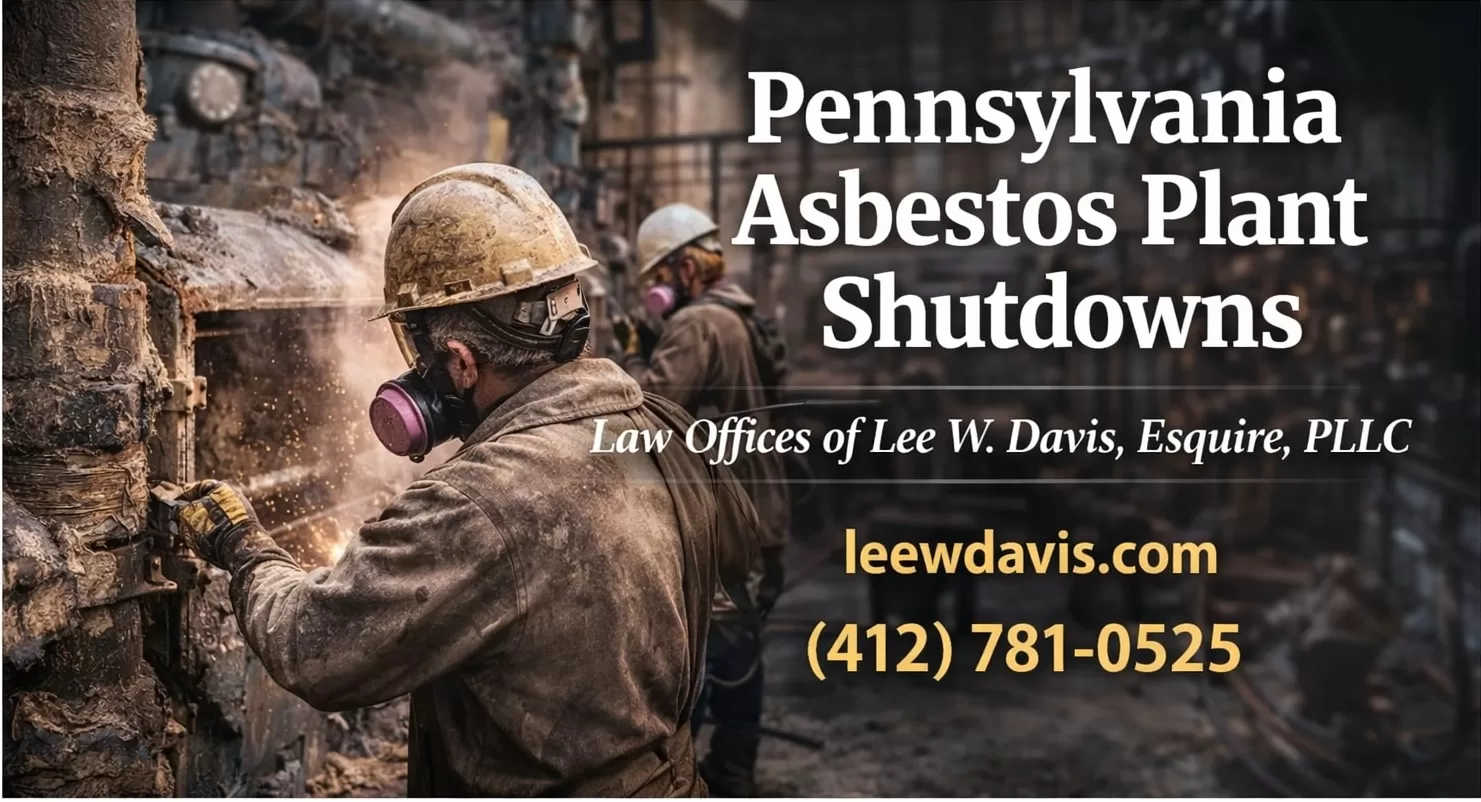
Pennsylvania asbestos plant shutdowns are one of the most common times workers get hit with the heaviest exposure. When a mill, refinery, power station, or manufacturing plant goes offline for a turnaround, everything that’s normally sealed up gets opened—insulation comes off, gaskets get scraped, refractory gets chipped out, valves and pumps are rebuilt, and old equipment gets torn down fast. If asbestos was anywhere in that system, a shutdown can turn it into dust.
Mesothelioma/Asbestos Legal Help – WV, MI & PA
Speak directly with attorney Lee W. Davis. No call centers. Free, confidential review.
If you worked shutdowns in Western Pennsylvania—or traveled job-to-job as a contractor, union trade, or maintenance worker—and later developed mesothelioma, lung cancer, or another asbestos disease, you may have a valid claim.
For broader guidance and a case review, start here: Pittsburgh asbestos lawyer
Why shutdown work is a high-exposure moment
Shutdowns create the perfect storm:
- High heat systems get opened up. Boilers, steam lines, turbines, exchangers, ovens, and process piping often had asbestos insulation or refractory nearby.
- Old parts get disturbed. Gaskets, packing, rope, cloth, cement, board, and insulation are removed and replaced.
- Multiple trades work in the same space. Even if you weren’t the person cutting insulation, you can breathe what someone else disturbed.
- Speed matters more than safety. Outages run on tight deadlines. Dust control and containment often come second.
The risk isn’t theoretical. A shutdown job can concentrate exposure into a short period—days or weeks—especially in enclosed areas like boiler rooms, pipe chases, mechanical rooms, or around process units.
What counts as a “plant shutdown” for claim purposes?
In plain English: if the facility went offline to do major work, it likely counts. That includes:
- Turnarounds / outages
- Maintenance shutdowns
- Rebuilds / retrofits
- Demolition and tear-out
- Emergency repairs after failures
The label doesn’t matter as much as what happened: materials were disturbed, and you were there.
How shutdown claims are proven
The key isn’t just “I worked there.” It’s what you worked on and what products/materials were in play.
Strong evidence usually comes from a combination of:
- Work history (where you worked, dates, job titles, trades, contractors)
- Union records or dispatch logs
- Coworker statements from people who remember the job and the materials
- Plant/jobsite documentation (maintenance records, outage schedules, contractor rosters)
- Product identification (brands and types of insulation, gaskets, packing, refractory, cement, etc.)
- Medical proof (pathology, imaging, diagnosis records)
If you want to understand the “product side” of the proof, see Pennsylvania Asbestos Product Identification. If you’re gathering sworn statements, see Pennsylvania Asbestos Exposure Affidavit. If trust claims are part of your recovery path, see Pennsylvania Asbestos Trust Claims Help.
Common shutdown exposure scenarios I see in Pennsylvania
These patterns repeat across decades of industrial work:
- Pipefitters and welders working around insulated piping and steam systems
- Millwrights and mechanics rebuilding pumps, compressors, turbines, and rotating equipment
- Electricians in dusty mechanical spaces with old insulation and panel components nearby
- Boilermakers doing tear-out and rebuild work around boilers, refractory, and insulation
- Laborers and cleanup crews sweeping, bagging, and hauling debris after tear-out
Often the person most exposed is the one doing the dirty “support work,” not the person whose name is on the work order.
Call if you worked shutdowns and were later diagnosed
I have focused on asbestos product identification and proof since I started in this field as a paralegal in 1988, through the Saginaw foundry cases, and then through years of West Virginia mesothelioma and lung cancer cases—working directly with clients to build credible exposure evidence that holds up.
If you or a loved one has been diagnosed and shutdown work is part of the history, call my office. We’ll talk through where you worked, what you did, and what evidence still exists.
Law Offices of Lee W. Davis, Esquire, PLLC
Call (412) 781-0525 for a confidential case review.
Check If Your Family Was Exposed
Get your free guide instantly + a confidential case review.
🔒 100% Confidential. No obligations.
FAQs
What if I only worked a few shutdowns years ago?
Short shutdown jobs can still matter. A concentrated exposure during a tear-out or rebuild can be enough to support a claim, especially when the work involved insulation, gaskets, packing, or refractory.
Do I need to remember exact product names?
Not always. Product identification can be developed through job records, union records, coworker proof, and known materials used in similar systems during the same era.
Can I file a claim if the plant is closed or the company is gone?
Yes. Many cases involve bankrupt manufacturers and asbestos trust claims, and others involve successor liability or remaining solvent defendants depending on the facts.
Mesothelioma/Asbestos Legal Help – WV, MI & PA
Speak directly with attorney Lee W. Davis. No call centers. Free, confidential review.