
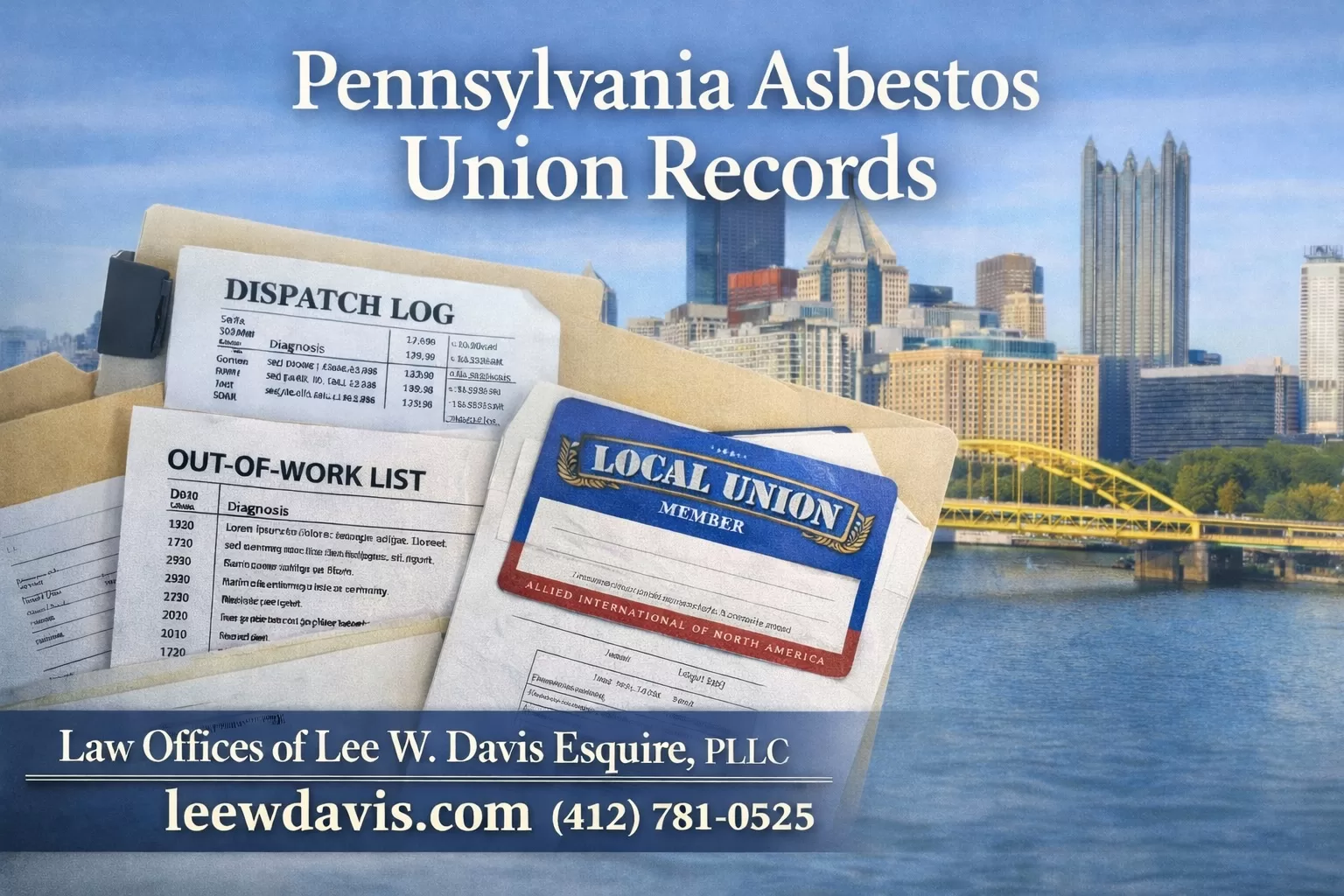
If you worked a trade in Pennsylvania, your Pennsylvania asbestos union records may be one of the cleanest ways to prove where you worked, when you worked, and what type of work you were dispatched to do—especially when an employer is gone, payroll records are missing, or the jobsite name has changed over the decades. In real asbestos cases, these records often do more than “confirm employment.” They can lock down the time period, job locations, and craft duties that put you around insulation, gaskets, packing, refractory materials, pipe covering, cement, boiler work, turbines, pumps, valves, and other high-heat equipment that historically used asbestos.
Mesothelioma/Asbestos Legal Help – WV, MI & PA
Speak directly with attorney Lee W. Davis. No call centers. Free, confidential review.
If you’re building an exposure claim, union documentation can be the backbone that makes everything else credible.
What counts as “union records” in an asbestos case
When people hear “union records,” they usually think of a membership card. In practice, the most useful records are the ones that show work assignments and time on the job. Depending on the trade and the era, that can include:
- Dispatch / referral logs (where the hall sent you and when)
- Out-of-work lists and referral histories
- Benefit fund contribution histories (pension, health & welfare, annuity)
- Dues history and membership status
- Apprenticeship or training records (showing craft and time period)
- Grievance records or jobsite-related correspondence
- Work reports or steward records (more common on some projects)
- Craft classification and local affiliation (helps identify the kind of tasks you performed)
These records don’t need to “say asbestos” to be valuable. They prove the building blocks: location + timeframe + trade duties—the exact elements courts, defendants, and trusts look for when evaluating exposure.
Why union records matter for Pennsylvania asbestos claims
Pennsylvania industrial and commercial work created repeat exposure patterns: power houses, steel mills, coke plants, chemical facilities, refineries, glass plants, shipyard-related work, and large institutional buildings. The products were often the same across many sites, and the trade tasks were predictable.
Union records help you prove the part defendants fight about most: you were actually there.
They can also solve common problems that slow cases down:
- The employer went out of business
- Payroll records are gone
- The company name changed or merged
- The jobsite has multiple names over time
- You worked through multiple contractors
- You were dispatched to short-duration shutdowns, turnarounds, or rebuilds
A solid union history can turn “I think it was 1977–1979” into “I was dispatched to that site during the outage in March 1978,” which is the difference between a vague narrative and a provable exposure timeline.
What union records can prove (without you guessing)
A strong file can support:
- Work years and continuity (helpful for latency and duration arguments)
- Specific job locations and repeats to the same facility
- Trade classification (pipefitter, electrician, boilermaker, millwright, laborer, insulator, sheet metal, etc.)
- Project cadence (shutdown work, maintenance windows, rebuild cycles)
- Which contractors you ran with (and sometimes who supervised)
- Benefit contributions tied to specific periods (supports time on the job even when employer records are missing)
Once that’s established, the next step is to identify the products typical to that craft and site during that time period.
Union records aren’t the whole case—just the backbone
Union documentation is powerful because it’s objective. But it doesn’t replace product proof. The goal is to use your union history to support a clean, credible product identification package.
If you haven’t already, these pages connect directly to the next step:
- Pennsylvania asbestos product identification (how to prove the specific materials you worked around): https://leewdavis.com/pennsylvania-asbestos-product-identification/
- Pennsylvania asbestos job sites (to pinpoint known exposure locations): https://leewdavis.com/asbestos-job-sites-in-pennsylvania/
And if your case is Pittsburgh-centered, start with the main hub:
https://leewdavis.com/pittsburgh-asbestos-lawyer/
How to request Pennsylvania union records (the practical path)
Most unions and benefit funds will not hand over a complete file based on a phone call. The clean way is a written request that identifies:
- Full name (including prior names)
- Date of birth (or last four of SSN if needed)
- Local number and trade
- Approximate membership years
- Current mailing address
- A signed authorization (and sometimes notarization)
If the worker is deceased, the request typically needs estate authority or next-of-kin documentation depending on the plan’s rules. The point is to get the right records the first time—dispatch/referral history and benefit contribution history—not just a membership confirmation letter.
Don’t let time erase your proof
In asbestos cases, delays cost evidence. Old locals merge, record systems change, funds switch administrators, and paper files disappear. If you have a diagnosis—mesothelioma, asbestos lung cancer, or other asbestos-related disease—this is not the moment to “wait and see.”
Talk to a Pennsylvania asbestos lawyer who builds proof for a living
Product identification and exposure proof has been my lane since I started doing asbestos work in 1988. I’ve done it in high-volume foundry litigation, including the Saginaw foundry cases, and I’ve carried that same discipline into individual Pennsylvania cases—tracking down the records, matching the job history to the trade work, and developing evidence that holds up when it’s challenged.
If you need help obtaining and using Pennsylvania asbestos union records, call me. We’ll take your work history seriously, build it correctly, and push the case forward.
Law Offices of Lee W. Davis, Esquire, PLLC
(412) 781-0525 — Free case review
Start here: https://leewdavis.com/pittsburgh-asbestos-lawyer/
Check If Your Family Was Exposed
Get your free guide instantly + a confidential case review.
🔒 100% Confidential. No obligations.