
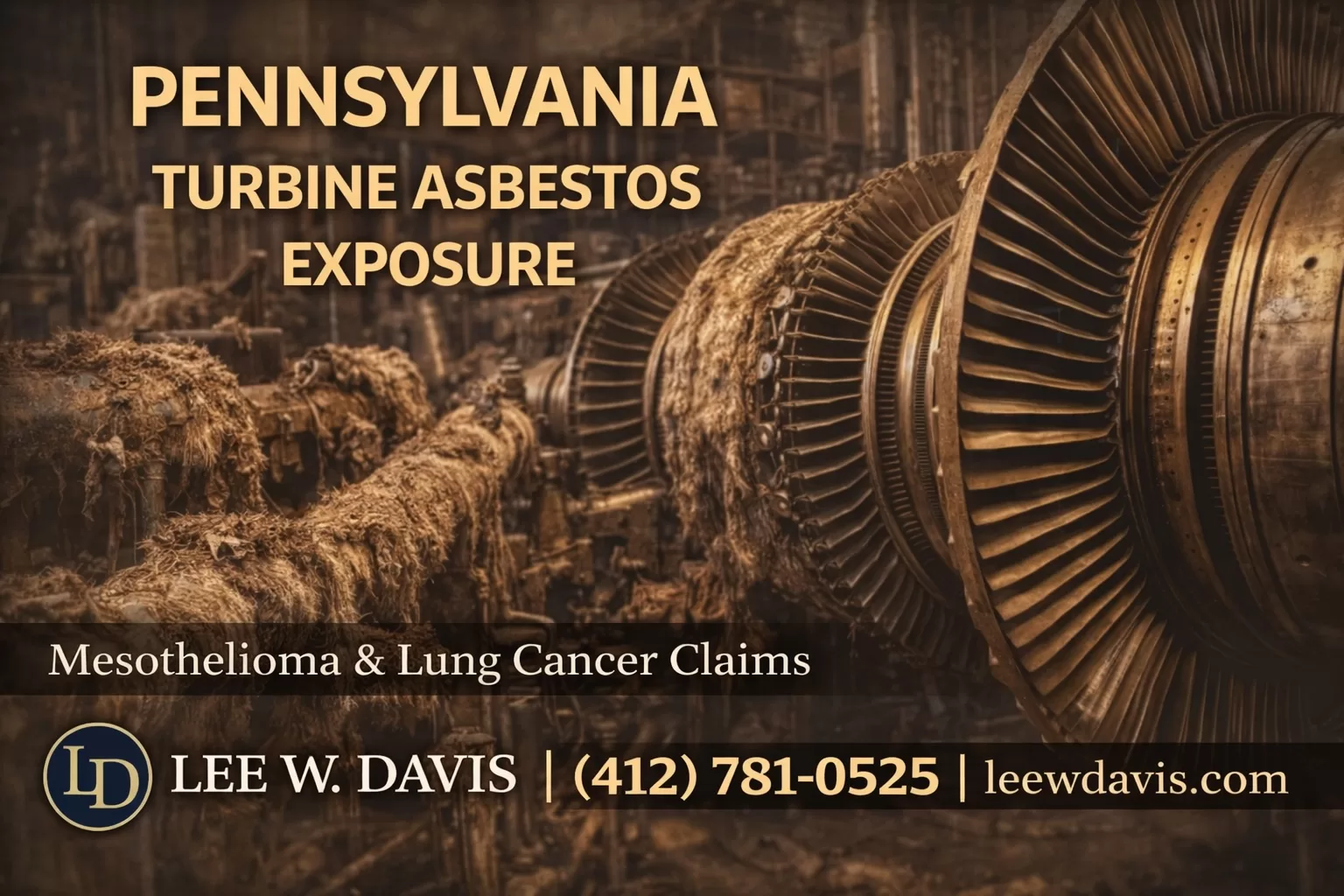
If you worked on turbine systems in Pennsylvania and you’ve been diagnosed with mesothelioma or lung cancer, Pennsylvania turbine asbestos exposure is a well-documented occupational history that has supported successful claims for power plant workers, turbine mechanics, and industrial maintenance workers throughout the state. Turbines in Pennsylvania’s coal-fired power generating stations, industrial steam systems, and turbomachinery manufacturing facilities were surrounded by asbestos-containing materials throughout their operational lives — in the thermal insulation blanketing the turbine casings, in the gaskets and packing throughout the associated steam systems, and in the materials used during turbine maintenance and overhaul work that created the most intensive turbine asbestos exposure of any regular maintenance activity at Pennsylvania industrial facilities.
Mesothelioma/Asbestos Legal Help – WV, MI & PA
Speak directly with attorney Lee W. Davis. No call centers. Free, confidential review.
Why Turbine Workers Are a Distinct and Frequently Overlooked Asbestos Claimant Population
Workers who think of themselves as turbine mechanics, turbine operators, or turbine outage workers often don’t immediately connect their work history to an asbestos claim — because the explicit connection between turbines and asbestos is less well-known than the connection between pipe insulation or furnace refractory and asbestos. That knowledge gap has caused legitimate Pennsylvania turbine asbestos claims to go unfiled.
The connection is real and well-documented. Turbines operate at the intersection of extreme heat and extreme mechanical precision — conditions that demanded the most demanding thermal insulation materials available, which throughout the pre-1980 industrial era meant asbestos-containing materials applied extensively throughout the turbine casing, the associated steam systems, and the confined turbine hall environments where maintenance and overhaul work was performed.
Workers who maintained, serviced, and overhauled turbines at Pennsylvania power plants and industrial facilities worked in direct and sustained contact with those asbestos-containing materials — during routine maintenance, during major overhauls, and in the confined turbine hall and casing environments where fiber concentrations during active maintenance were highest.
How Turbines Created Asbestos Exposure at Pennsylvania Industrial Facilities
Turbine casing insulation — The casings of steam turbines at Pennsylvania power generating stations and industrial facilities were wrapped in asbestos-containing thermal insulation throughout the pre-1980 period. That insulation maintained the extreme temperatures required for efficient turbine operation and had to be removed and replaced during every major turbine overhaul. Stripping old turbine casing insulation — dried, baked, and fiber-releasing after years of operation at high temperature — released asbestos fibers in concentrated form directly into the breathing zone of the workers performing the work.
Turbine steam inlet and exhaust systems — The high-pressure steam piping connecting boiler systems to turbine inlets and the low-pressure exhaust systems carrying spent steam to condensers both required heavy asbestos-containing insulation throughout their lengths. The gaskets at every flanged connection in those systems, the valve packing in every control valve, and the insulation on every pipe section between boiler and turbine were asbestos-containing materials that created exposure during every maintenance task performed on those systems.
Turbine internal maintenance — diaphragms, seals, and packings — Major turbine overhauls required complete disassembly of the turbine — removing turbine diaphragms, replacing shaft seals, servicing steam gland packing, and inspecting and replacing the internal components of the turbine casing. Many of those internal components — the gland packing, the diaphragm seals, and various internal sealing materials — historically contained asbestos. Mechanics performing turbine internal maintenance worked in direct contact with those asbestos-containing components in the confined space of the open turbine casing throughout every major overhaul.
Turbine hall ambient exposure — The turbine halls at Pennsylvania power generating stations and industrial facilities were environments where asbestos-containing insulation was present throughout — on the turbine casings, on the associated steam piping, on the feedwater and condensate systems surrounding the turbines, and in the insulated valve clusters throughout the turbine building. Workers who spent careers in those turbine halls accumulated continuous ambient fiber exposure from the aging insulation surrounding them throughout every working day.
Turbine outage and overhaul work — Major turbine outages at Pennsylvania generating stations and industrial facilities were the most intensive asbestos exposure events in those facilities’ operational histories. When turbines went down for planned overhaul, the insulation removal, internal disassembly, component replacement, and re-insulation work concentrated asbestos fiber release throughout the turbine building in ways that significantly exceeded ambient exposure levels. Workers performing outage work — regardless of their specific trade assignment — accumulated their highest single-event asbestos exposure during major turbine outages at Pennsylvania facilities.
Pennsylvania Facilities Where Turbine Asbestos Exposure Was Most Significant
Pennsylvania coal-fired power generating stations — Pennsylvania’s fleet of coal-fired generating stations employed turbine workers throughout facilities built around high-pressure steam turbine systems that required extensive asbestos insulation. Facilities including Cheswick Power Station, Keystone Power Station, Bruce Mansfield, Hatfield Ferry at Masontown, and the Duquesne Light power stations throughout western PA all operated turbine systems insulated with asbestos-containing materials throughout their operational histories. See the Pennsylvania power plant asbestos resource for the full statewide power plant turbine exposure profile.
Elliott Company Jeannette — Elliott’s turbomachinery manufacturing and testing operations in Westmoreland County created a distinct turbine asbestos exposure environment — workers building and testing turbines and compressors at Elliott worked with the asbestos-containing materials incorporated into the equipment during manufacturing and were exposed during the high-temperature testing that simulated installed operating conditions. Elliott turbine workers had a manufacturing and testing exposure profile that is distinct from power plant turbine maintenance exposure but equally well-documented in asbestos litigation.
Industrial steam turbines at steel mills and manufacturing facilities — Pennsylvania’s major steel mills and manufacturing facilities operated industrial steam turbines for process power and utility generation throughout their facilities. Turbine mechanics maintaining those industrial turbines at facilities like the Homestead Works, Allegheny Ludlum Brackenridge, and throughout the western PA industrial corridor accumulated turbine asbestos exposure as part of their industrial maintenance careers.
Nuclear generating stations — Pennsylvania’s nuclear generating stations — including Three Mile Island and Beaver Valley — also operated steam turbine systems requiring asbestos-containing insulation throughout the pre-1980 construction period. Workers performing maintenance on those turbine systems during the facilities’ operational histories accumulated exposure from the asbestos-containing materials used in turbine construction and insulation.
Trades Most Commonly Involved in Pennsylvania Turbine Asbestos Claims
- Boilermakers — performing turbine casing work, insulation removal and replacement, and major overhaul work throughout Pennsylvania generating stations and industrial turbine facilities
- Pipefitters and steamfitters — maintaining the high-pressure steam inlet systems and exhaust piping connected to Pennsylvania turbines
- Millwrights — performing precision alignment, internal component replacement, and mechanical maintenance throughout Pennsylvania turbine systems
- Insulators — applying and removing the asbestos-containing thermal insulation blanketing Pennsylvania turbine casings and associated steam systems
- Turbine mechanics and operators — workers whose primary job function centered on turbine operation, inspection, and routine maintenance
- Outside contractors — performing turbine outage and overhaul work at Pennsylvania generating stations and industrial facilities
What Evidence Supports a Pennsylvania Turbine Asbestos Claim
- Diagnosis records confirming mesothelioma or lung cancer
- Work history at Pennsylvania generating stations, industrial facilities, or turbine manufacturing operations — job titles, years worked, specific turbine-related tasks performed
- Memory of the specific turbine halls, casing environments, and steam system areas where you worked throughout your Pennsylvania career
- Names of coworkers, contractors, or supervisors you worked alongside during turbine maintenance and outage work
- Union records confirming employment and dispatch history at specific Pennsylvania turbine facilities
- Social Security earnings records confirming employers and time periods
For a broader overview of how Pennsylvania mesothelioma claims work see our Pennsylvania resource. For workers with lung cancer diagnoses see Pittsburgh asbestos lung cancer. For the Pennsylvania asbestos lawyer overview see our dedicated guide. For the Pennsylvania asbestos trust claims process see Pennsylvania asbestos trust claims. You can search the full list of asbestos job sites in Pennsylvania to review all documented Pennsylvania power plant and industrial turbine exposure sites.
Knowledge of Pennsylvania Turbine Asbestos Cases Since 1989
I first began researching Pennsylvania asbestos cases in 1989 as a paralegal, working on asbestos mass trials across Pennsylvania and West Virginia. I returned to Pittsburgh after supervising 3,200 GM Foundry Asbestos cases in 1999 to handle mesothelioma and lung cancer cases individually across Pennsylvania, West Virginia, and Michigan, applying decades of product identification work — tracking the specific turbine insulation manufacturers, turbine casing gasket suppliers, and turbine internal component companies whose materials created Pennsylvania turbine worker asbestos exposure — directly to every case evaluation.
Turbine asbestos cases require specific knowledge of the thermal insulation systems used on turbine casings, the gasket and sealing materials used in turbine steam systems, and the internal component materials used in turbine maintenance — a distinct product identification challenge from the pipe insulation and refractory identification central to other trade claims. This practice has handled turbine-related asbestos cases throughout Pennsylvania and has the background to evaluate a turbine worker claim with the specificity it requires.
When you call, you speak directly with me. No call centers. No case managers.
If you or a family member worked on turbine systems in Pennsylvania and has been diagnosed with mesothelioma or lung cancer, Pennsylvania’s statute of limitations runs from the date of diagnosis.
Call (412) 781-0525 or start your confidential case review online now.
Check If Your Family Was Exposed
Get your free guide instantly + a confidential case review.
🔒 100% Confidential. No obligations.
Frequently Asked Questions
Q: I worked as a turbine mechanic at a Pennsylvania power plant for many years, performing major turbine overhauls during planned outages. Does that support a mesothelioma claim?
A: Yes, potentially. A turbine mechanic career performing major turbine overhauls at a Pennsylvania power generating station represents a significant asbestos exposure history. Major turbine overhauls involve removing old asbestos-containing casing insulation — one of the more fiber-intensive activities in power plant maintenance — working inside open turbine casings where asbestos-containing internal components are accessed and replaced, and servicing the associated steam system components throughout the outage period. That work, performed repeatedly at a major Pennsylvania generating station, represents a cumulative exposure history that warrants careful legal evaluation.
Q: I worked at Elliott Company in Jeannette building and testing turbines and compressors. Is that enough to support a mesothelioma claim?
A: Yes, potentially. Workers who built and tested turbomachinery at Elliott’s Jeannette operations worked with asbestos-containing materials incorporated directly into the equipment during manufacturing — thermal insulation, gaskets, and sealing materials used in turbine and compressor construction — and in the test environments where completed equipment was run under operating conditions. That manufacturing and testing exposure profile has supported mesothelioma claims from Elliott workers. Call to discuss your specific work history and diagnosis.
Q: How long do I have to file a mesothelioma claim in Pennsylvania connected to turbine work at Pennsylvania power plants or industrial facilities?
A: Pennsylvania’s statute of limitations runs from the date of diagnosis, not the date of your exposure. Wrongful death claims carry different and sometimes shorter deadlines running from the date of death. Do not assume it is too late — call as soon as a diagnosis is confirmed so we can evaluate your full Pennsylvania turbine career history and identify all responsible parties.
Mesothelioma/Asbestos Legal Help – WV, MI & PA
Speak directly with attorney Lee W. Davis. No call centers. Free, confidential review.