
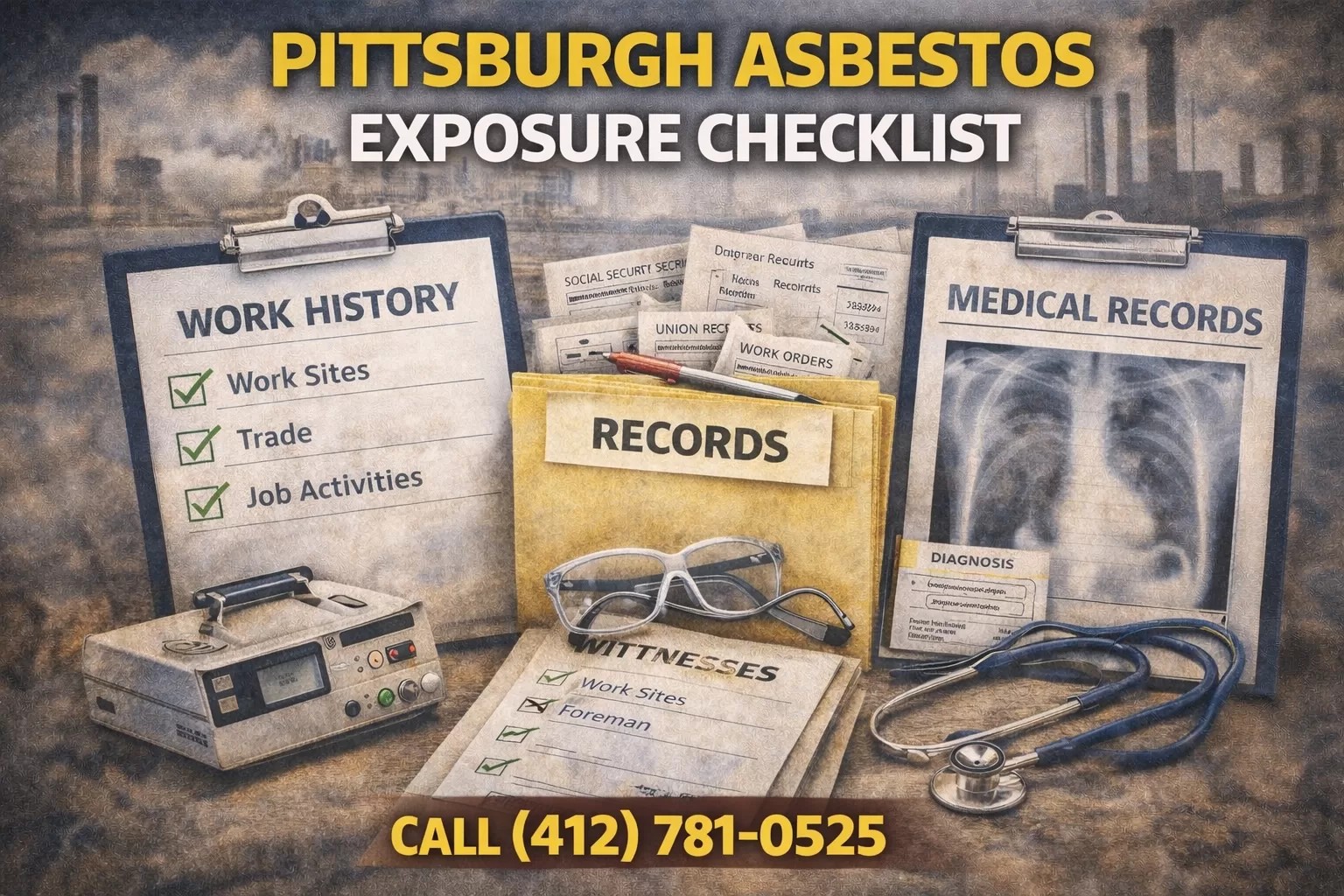
If you’re researching a possible asbestos claim in Pittsburgh or Western Pennsylvania, the hardest part is usually not the diagnosis — it’s proving where the exposure happened and what products or work activities caused it. A Pittsburgh Asbestos Exposure Checklist helps you organize the facts the way defendants and their insurers look at cases: work history, trades, sites, products, witnesses, and medical proof.
Mesothelioma/Asbestos Legal Help – WV, MI & PA
Speak directly with attorney Lee W. Davis. No call centers. Free, confidential review.
This post is a practical guide to what you should gather early so your claim doesn’t stall later.
Why a checklist matters in Pittsburgh cases
Pittsburgh-area exposure often involves long industrial timelines: mills, power plants, universities, hospitals, commercial buildings, and decades of maintenance work. Records get lost. Companies change names. Sites get demolished. A checklist forces the case into a proof-driven format that can be verified through documents.
Step 1: Start with the work history timeline
Write your work history like a timeline, not a resume.
Include:
- Employer name (and any prior names)
- Job title/trade (pipefitter, electrician, insulator, laborer, mechanic, millwright, etc.)
- Dates (even approximate ranges)
- Where the work happened (site name + city)
- Whether it was new construction, maintenance, outage work, or demolition
If you did contractor work, list the contractor and the host facility. Both can matter.
👉 Search Asbestos Job Sites in Pennsylvania
👉 Search Asbestos Job Sites in West Virginia
Step 2: List Pittsburgh-area sites, one per line
Do not lump sites together. Put each on its own line.
Examples of the kind of locations that matter:
- Steel and coke operations
- Industrial power and steam facilities
- Chemical and refinery-adjacent work
- Hospitals, universities, and older public buildings
- Boiler rooms, mechanical rooms, pump rooms, turbine decks
- Union hall dispatch sites and shutdown/outage jobs
Even if you can’t remember product names, location specificity helps reconstruct exposure through records and co-worker proof.
Step 3: Identify the “dust work” tasks
Most asbestos exposure comes from repeat tasks that created dust.
Common examples:
- Removing or disturbing insulation on piping/boilers
- Cutting, sanding, or scraping thermal insulation
- Replacing gaskets, packing, valves, pumps, turbines
- Handling refractory, firebrick, cement, or insulation blankets
- Tear-outs during outages and rebuilds
- Cleanup work after insulation removal or demolition
Write what you actually did — not what the job description says.
Step 4: Gather the “paper trail” documents
These documents often prove the case when memory fades:
- Work orders, job tickets, shutdown sheets
- Contractor logs, badge/swipe logs, site orientation records
- Union records, dispatch slips, benefit statements
- Social Security earnings statements
- Old tax returns, W-2s, pay stubs
- Training certificates and safety meeting sign-in sheets
If the only proof you have is “I was there,” the case becomes harder than it needs to be.
Step 5: Collect product and equipment identifiers
Product names help — but equipment IDs and location proof can be just as strong.
Look for:
- Equipment tags, pump/valve numbers, unit numbers
- Piping lists, isometric drawings, maintenance logs
- Material lists and procurement records
- Old manuals for plant equipment
- Abatement specs, bids, and industrial hygiene records
You don’t need to solve it alone. You just need to capture clues that can be traced.
Step 6: Witnesses and co-worker confirmation
Write down names now — not later.
Include:
- Foremen, supervisors, maintenance leads
- Co-workers on crews or outage teams
- Anyone who saw the work or remembers the site conditions
A single corroborating witness can move a claim from “possible” to “provable.”
Step 7: Medical proof (keep it simple, get it organized)
For asbestos cases, the medical documentation needs to be clean:
- Pathology (if applicable)
- Imaging reports (CT/PET/X-ray)
- Pulmonology/oncology records
- Diagnosis date and treating facility
Organize it in a folder and keep a one-page summary: diagnosis, date, provider, and where you worked.
Step 8: Do not wait to preserve records
Older job sites often have disappearing evidence. Companies merge. Contractors dissolve. Records get archived or destroyed. If you suspect asbestos exposure and you’re in the Pittsburgh region, act early to preserve the work history proof.
Talk to a Pittsburgh asbestos lawyer about your proof
If you want a real evaluation, the quickest way is to start with your timeline and checklist. I can tell you what’s missing, what matters, and what can be proven based on Pittsburgh-area jobsite history and the records that still exist.
Read More: Pittsburgh Asbestos Lawyer
Call (412) 781-0525 or contact me through leewdavis.com to discuss your situation.
Check If Your Family Was Exposed
Get your free guide instantly + a confidential case review.
🔒 100% Confidential. No obligations.
FAQs
What if I can’t remember the asbestos product name?
That’s common. Many strong cases are built from site records, work orders, and task-based exposure evidence — not a product box.
What records are most helpful for proving exposure?
Work orders, union documentation, Social Security earnings statements, and any site-specific logs or maintenance paperwork are often the fastest proof builders.
Does Pittsburgh exposure only happen in steel mills?
No. Industrial maintenance, older commercial buildings, hospitals, schools, and power/steam facilities can all involve asbestos-containing materials depending on the timeframe and the work performed.
Mesothelioma/Asbestos Legal Help – WV, MI & PA
Speak directly with attorney Lee W. Davis. No call centers. Free, confidential review.