
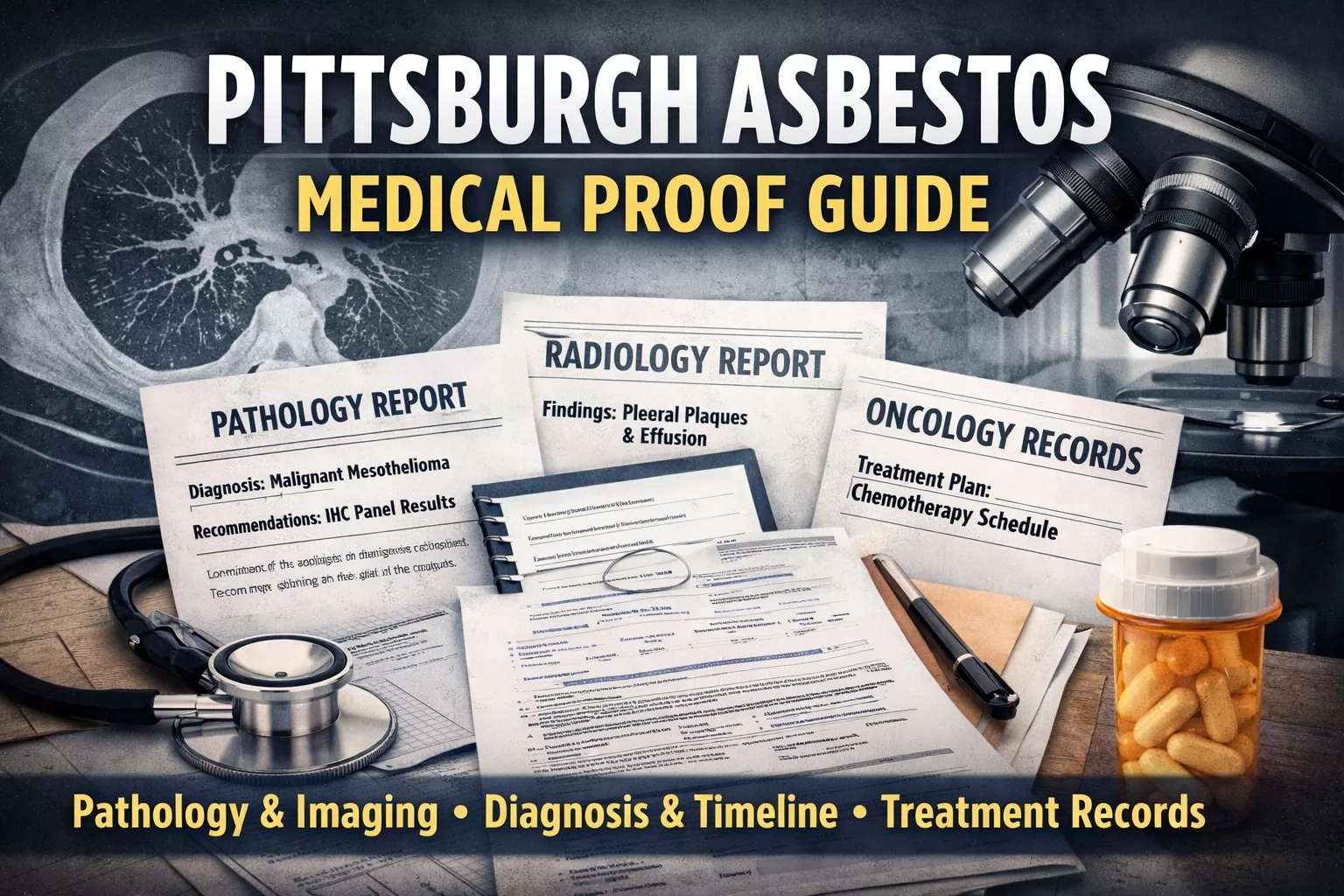
If you’re dealing with an asbestos-related diagnosis, the Pittsburgh Asbestos Medical Proof is what turns a story into a case file that insurers and defendants have to take seriously. People assume “proof” means a jobsite name or a dusty memory from decades ago. In reality, the strongest cases often start with the medical documentation—because it locks in diagnosis, timing, and causation before anyone argues over work history.
For legal representation, see Pittsburgh Asbestos Exposure Claims
Below is the medical proof that typically matters most in asbestos and mesothelioma cases tied to Pittsburgh-area work, plant maintenance, construction, steel operations, power generation, and industrial trades.
Mesothelioma/Asbestos Legal Help – WV, MI & PA
Speak directly with attorney Lee W. Davis. No call centers. Free, confidential review.
1) The pathology report (the anchor document)
A pathology report is often the single most important piece of medical proof. It can confirm:
- Mesothelioma (pleural or peritoneal)
- Asbestos-related lung cancer
- Asbestosis or pleural disease (in certain contexts)
If there was a biopsy, surgery, thoracoscopy, or cytology (fluid) testing, get:
- The final pathology report
- Any addendum reports
- The immunohistochemistry (IHC) panel results (the marker testing doctors use to confirm the diagnosis)
If you only have imaging or a preliminary note, don’t assume that’s “enough.” Get the actual pathology.
2) Imaging that shows the pattern doctors rely on
CT scans, PET scans, X-rays, and radiology reports matter because they document:
- Pleural thickening or pleural plaques
- Effusions (fluid)
- Masses, nodules, or spread patterns
- Progression over time
What helps your file move faster is not just the scan—it’s the radiology report that describes findings in medical terms that can’t be brushed off later.
3) Pulmonary records and function testing
If there’s lung impairment, obtain:
- Pulmonary function tests (PFTs)
- Pulmonology consult notes
- Oxygen prescriptions and respiratory therapy records
- Hospital discharge summaries tied to breathing compromise
These records help establish severity and day-to-day impact, which affects damages and settlement value.
4) Oncology records that lock in treatment history
For cancer and mesothelioma, treatment records show seriousness and provide a clean timeline:
- Oncology consults
- Chemotherapy/immunotherapy regimens
- Radiation records
- Surgical notes
- Follow-up and progression notes
These records also help rebut defense arguments that the condition is “uncertain” or “unrelated.”
5) The timeline matters more than people think
A well-organized chart of:
- first symptoms,
- first imaging,
- first specialist visit,
- diagnosis date,
- treatment start
…can keep your claim from getting bogged down in delay tactics. If a defendant tries to shift the clock, the medical records usually settle the timeline.
6) Smoking history doesn’t “defeat” medical proof—documentation matters
Defendants love to blur issues by focusing on smoking. The right medical proof keeps the analysis disciplined:
- What was diagnosed?
- What did pathology confirm?
- What did imaging show?
- What did the treating doctors conclude?
Your records should reflect what your physicians documented—especially when asbestos exposure is part of the differential diagnosis or causation analysis.
7) How to request records without getting stalled
When you request records, ask for complete sets:
- “All records including pathology, imaging reports, lab results, and physician notes”
- “All radiology reports and DICOM images for CT/PET/X-ray”
- “All pathology slides and tissue blocks (if needed for review)”
Hospitals can produce summaries quickly, but the summaries are not the file. The file is the proof.
8) Why medical proof is the fastest way to reduce fight and increase leverage
In a Pittsburgh asbestos case, jobsite proof can take time. Medical proof is usually available now. Once the diagnosis and timeline are locked in, the case can move while employment, union, Social Security, and contractor records are gathered in parallel.
Learn more about how long a case takes here: Pittsburgh Asbestos Case Timeline
FAQs
What is the most important medical record in an asbestos case?
Usually the pathology report (and any IHC marker testing) confirming mesothelioma or asbestos-related cancer.
If I only have scans but no biopsy, can I still start?
Yes. Imaging, pulmonology notes, and oncology records can support early evaluation, but definitive diagnosis often depends on pathology.
Do I need the actual scan files, or just the radiology report?
Both help. The report matters immediately; the images can matter later for expert review.
Will smoking history ruin my case?
Not automatically. Diagnosis, pathology, imaging patterns, and physician documentation still control the medical proof analysis.
How long does it take to get records?
Many providers can produce records within days to a few weeks, but pathology materials and imaging discs can take longer—request them early.
Talk to a Pittsburgh asbestos lawyer about your medical proof
If you want a straightforward review of your records and what’s missing, call (412) 781-0525. You’ll speak directly with attorney Lee W. Davis about the documentation that can move your case forward.
Check If Your Family Was Exposed
Get your free guide instantly + a confidential case review.
🔒 100% Confidential. No obligations.