
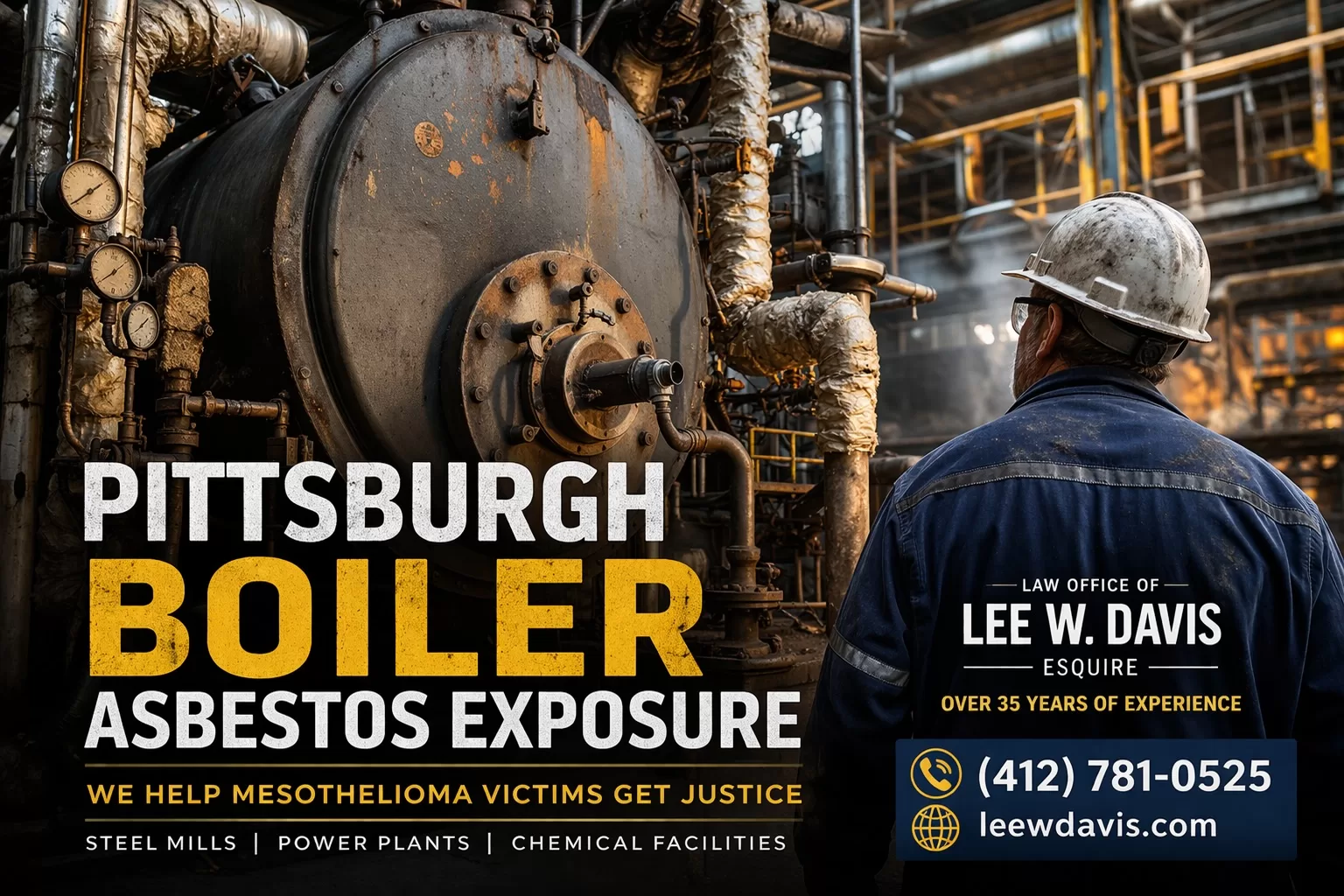
If you worked on boiler systems at a Pittsburgh area industrial facility and you’ve been diagnosed with mesothelioma or lung cancer, Pittsburgh boiler asbestos exposure is one of the most well-documented occupational exposure histories in western Pennsylvania. Boilers and steam systems in Pittsburgh’s steel mills, coke plants, power generating stations, chemical facilities, and manufacturing operations were surrounded by asbestos-containing insulation throughout their operational lives — and the workers who installed, maintained, repaired, and rebuilt those systems worked in direct and sustained contact with those materials across careers spanning decades.
Mesothelioma/Asbestos Legal Help – WV, MI & PA
Speak directly with attorney Lee W. Davis. No call centers. Free, confidential review.
Why Boiler Systems Were the Most Asbestos-Intensive Environment in Pittsburgh Industrial Facilities
Every major industrial facility in Pittsburgh and Allegheny County required steam — for process heat in steel production, for chemical reaction control, for power generation, for building heat, and for dozens of supporting utility functions throughout every plant. Generating, distributing, and maintaining that steam required boiler systems, and boiler systems required insulation.
The insulation requirements for industrial boiler systems are among the most demanding of any application — boiler shells, steam drums, feedwater systems, and the miles of high-pressure steam distribution piping throughout a major Pittsburgh industrial facility all required thick, effective thermal insulation to operate safely and efficiently. Before the late 1970s that insulation was almost universally asbestos-containing. The materials were applied in layers — block insulation on the boiler shell, pipe covering on the steam lines, insulating cement on fittings and irregular surfaces, finishing cement over the entire system — each layer containing asbestos in concentrations up to 80 percent in products used through most of the post-war industrial era.
Workers who built, maintained, and repaired those systems breathed asbestos fibers throughout their working lives. And the workers who were called in to tear out old boiler insulation and replace it — during major overhauls, after casualty events, or simply when the aging insulation had deteriorated — performed the highest-exposure boiler work of all.
The Specific Boiler-Related Tasks That Created Asbestos Exposure
Boiler insulation installation — Applying asbestos-containing block insulation to boiler shells, fitting pipe covering to steam lines, and applying insulating and finishing cements to the completed system were the foundational tasks of boiler insulation work. Every one of those tasks released asbestos fibers — from cutting and shaping block insulation, from mixing and applying cement, and from the finished surfaces of the insulation system throughout the working life of the boiler.
Boiler insulation removal during overhauls — When Pittsburgh industrial boilers required major overhaul or repair, the existing insulation had to be removed first. Old boiler insulation — dried, crumbled, and saturated with decades of heat cycling — released asbestos fibers in concentrated form when torn away from the boiler shell. Workers performing boiler strip-out during major overhauls at Pittsburgh facilities generated some of the highest fiber release rates of any maintenance task in industrial history.
Boiler repair and hot work — Repairing boiler tubes, replacing boiler components, and conducting welding and cutting work on boiler systems required working in close proximity to and often directly through the insulation surrounding those systems. Hot repair work inside confined boiler areas concentrated fiber exposure in the breathing zone of the workers performing the repairs.
Steam line maintenance — The miles of high-pressure steam distribution piping connecting boiler systems to production departments throughout Pittsburgh industrial facilities required regular maintenance — replacing gaskets at flanged connections, changing out valve packing, repairing damaged insulation sections, and servicing the steam traps and other components throughout the system. Each of those tasks involved disturbing asbestos-containing materials in the immediate work area.
Boiler inspection work — Inspecting boiler systems — entering boiler drums, examining tube sheets, conducting confined-space assessments of boiler internals — placed inspectors in the same spaces where asbestos fiber concentrations were highest, with no active disturbance required to create significant exposure.
Pittsburgh Facilities Where Boiler Asbestos Exposure Was Most Significant
Pittsburgh’s major industrial facilities all operated boiler systems requiring the heavy asbestos insulation that created occupational exposure for generations of workers:
- US Steel Homestead Works — the Mon Valley’s largest steel facility operated extensive boiler systems generating steam for steelmaking, rolling, and utility functions throughout the plant
- Clairton Coke Works and Koppers Clairton — coke production required sustained steam for by-products recovery and plant utility systems throughout the facility
- Neville Island Coke and Chemical — Ohio River industrial complex with extensive boiler and steam systems throughout chemical and coke operations
- Pittsburgh Plate Glass / PPG — glass and chemical manufacturing with steam systems requiring heavy insulation throughout the facility
- Cheswick Power Station — a power generating station is essentially a facility built entirely around boiler and steam systems — the boiler exposure environment at Cheswick was one of the most intensive in the Allegheny Valley
- Allegheny Ludlum Brackenridge — specialty steel production with extensive steam generation and distribution throughout the facility
- J&L Steel and Jones and Laughlin Pittsburgh area operations — major integrated steel facilities with full boiler and steam infrastructure throughout
Who Was Exposed to Pittsburgh Boiler Asbestos
Boiler asbestos exposure in Pittsburgh’s industrial facilities was not limited to a single trade or a single role. The workers most commonly involved in Pittsburgh boiler asbestos claims include:
Boilermakers — The trade most directly associated with boiler construction, maintenance, and repair. Boilermakers at Pittsburgh industrial facilities performed the furnace refractory, boiler shell, and pressure vessel work that involved the heaviest direct asbestos contact. See the Allegheny Valley boilermaker asbestos resource for the Allegheny Valley specific profile.
Pipefitters and steamfitters — Workers who installed and maintained the steam distribution systems connected to Pittsburgh’s industrial boilers worked throughout the miles of asbestos-insulated steam piping that ran from boiler rooms into every production department. See the Allegheny Valley pipefitters resource.
Insulators — The workers who applied and removed the asbestos-containing insulation on Pittsburgh boiler systems and steam lines. See the Allegheny Valley insulator asbestos resource.
Millwrights — Plant millwrights at Pittsburgh facilities maintained the mechanical systems associated with boiler operation — pumps, valves, drives, and auxiliary equipment — in the same spaces where boiler insulation created constant ambient fiber exposure throughout the work environment.
Plant engineers and shift engineers — Engineers responsible for Pittsburgh industrial boiler systems conducted regular inspections and oversaw maintenance and outage work in boiler environments throughout their careers. See the Pittsburgh plant engineer asbestos and Allegheny County engineer asbestos exposure resources.
Outside contractors — Contractors brought in for major boiler overhauls performed the most intensive asbestos exposure work — strip-outs, rebuilds, and system replacements — at Pittsburgh industrial facilities throughout the post-war decades.
What Evidence Supports a Pittsburgh Boiler Asbestos Claim
- Diagnosis records confirming mesothelioma or lung cancer
- Work history at Pittsburgh area facilities with boiler systems — job titles, years worked, specific boiler-related tasks performed
- Memory of the specific boiler rooms, steam systems, and work areas where you spent your career
- Names of coworkers, contractors, foremen, or supervisors you worked alongside during boiler maintenance and overhaul work
- Union records confirming employment and dispatch history at specific Pittsburgh facilities
- Social Security earnings records confirming employers and time periods
For a broader overview of Allegheny County asbestos exposure and the full range of Pittsburgh area facility resources see our Allegheny County hub page. For workers with lung cancer diagnoses see Pittsburgh asbestos lung cancer. For a broader overview of how Pennsylvania mesothelioma claims work see our Pennsylvania resource.
Knowledge of Boiler Asbestos Cases Since 1989
I first began researching Pittsburgh area asbestos cases in 1989 as a paralegal, working on asbestos mass trials across Pennsylvania and West Virginia. I returned to Pittsburgh in 1999 to handle mesothelioma and lung cancer cases individually, applying decades of product identification work — tracking the specific boiler insulation manufacturers, refractory suppliers, and gasket companies whose materials were used at Pittsburgh industrial facilities — directly to every case evaluation. Boiler-related asbestos claims are among the most thoroughly documented exposure histories in western Pennsylvania asbestos litigation and I have handled them throughout my practice.
When you call, you speak directly with me. No call centers. No case managers.
If you or a family member worked on boiler systems at Pittsburgh area industrial facilities and has been diagnosed with mesothelioma or lung cancer, time matters. Pennsylvania’s statute of limitations runs from the date of diagnosis.
Call (412) 781-0525 or start your confidential case review online now.
Check If Your Family Was Exposed
Get your free guide instantly + a confidential case review.
🔒 100% Confidential. No obligations.
Frequently Asked Questions
Q: I worked as a boilermaker at the Homestead Works doing major boiler overhauls during shutdowns for fifteen years. Is that enough to support a mesothelioma claim?
A: A fifteen-year boilermaker career at the Homestead Works performing major boiler overhauls during shutdowns is a very strong asbestos exposure profile. Major boiler overhauls during shutdowns involved stripping old asbestos-containing boiler insulation — one of the highest fiber-release activities in any industrial setting — working inside boiler drums and confined boiler spaces where fiber concentrations were most intense, and replacing gaskets and packing throughout the boiler and associated steam systems. That work, performed repeatedly over fifteen years at one of western Pennsylvania’s largest industrial facilities, represents a substantial cumulative exposure history that has supported successful mesothelioma claims.
Q: I was a shift engineer responsible for the boiler systems at a Pittsburgh area power plant. I supervised the boilermakers and inspected the boiler rooms regularly but I didn’t do the hands-on work myself. Do I have an asbestos claim?
A: Possibly yes. Regular inspection of boiler rooms and supervision of boiler maintenance work at Pittsburgh industrial facilities placed you continuously in the environments where asbestos fiber concentrations were highest — particularly during active maintenance and outage work when boiler insulation was being disturbed. Engineering and supervisory presence in those environments across a career spanning years creates a cumulative exposure history that has supported mesothelioma and lung cancer claims independent of any direct hands-on insulation contact. Call to discuss your specific career history and diagnosis.
Q: How long do I have to file a mesothelioma claim in Pennsylvania connected to Pittsburgh boiler asbestos exposure?
A: Pennsylvania’s statute of limitations runs from the date of diagnosis, not the date of your exposure. Wrongful death claims carry different and sometimes shorter deadlines running from the date of death. Do not assume it is too late — call as soon as a diagnosis is confirmed so we can evaluate your boiler work history at Pittsburgh area facilities and identify all responsible parties.