
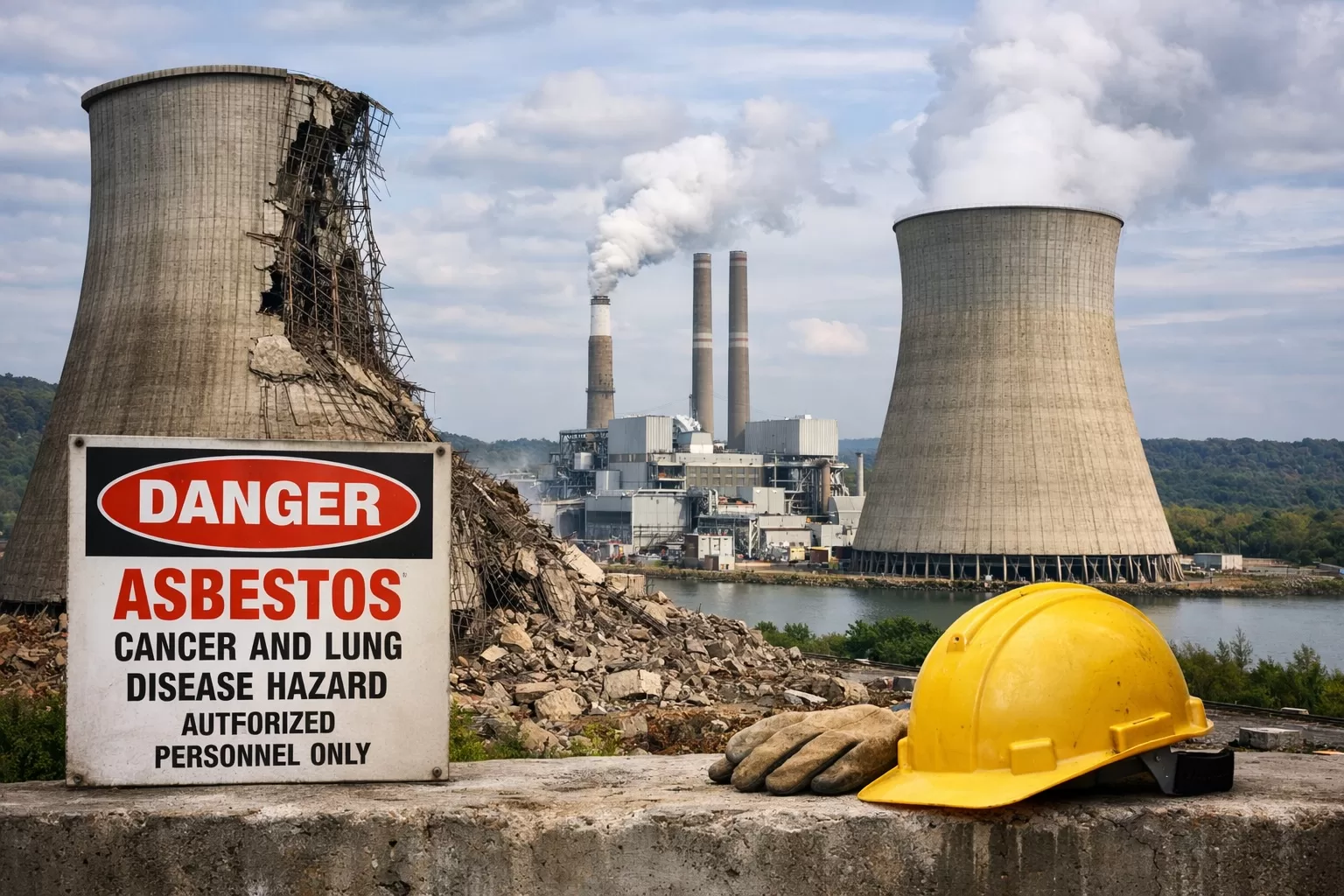
If you worked on or around the Pleasants Power Station site in Willow Island, WV between St. Mary’s, WV and Belmont, WV on Route 2. If your work was especially during construction or major maintenance—don’t assume your exposure story is “too complicated” to prove. It’s often the opposite: complicated sites create more points of exposure, more contractors, and more product categories that can be traced.
This post focuses on the Pleasants cooling tower collapse site and the broader construction/industrial work that surrounded it, because workers from multiple trades were present, and legacy asbestos materials were common across power generation and related industrial builds.
Where asbestos exposure can occur at a cooling-tower and power-station site
Even when the work looks “concrete and steel,” asbestos exposure usually comes from the systems that support the plant:
- Pipe insulation and pipe covering
- Boilers and steam lines
- Gaskets, packing, and flange work
- Turbine-area insulation
- Pumps, valves, and maintenance materials
- Fireproofing and refractory materials
- Electrical and mechanical rooms with insulated components
- Old buildings or reused equipment staged on site
Power projects also cycle through multiple contractors, and that matters—because different crews handle demo, retrofits, and maintenance where dust exposure can spike.
Who tends to have the strongest claim profiles
Claims tend to be strongest when the work was hands-on and repetitive:
- Pipefitters / steamfitters
- Boilermakers
- Millwrights
- Insulators
- Electricians and instrumentation techs
- Maintenance crews
- Contractors assigned to outages, retrofits, or teardown
If you were on-site for shutdowns, tie-ins, repairs, or cleanup, you were closer to the materials that historically contained asbestos.
What to preserve right now
For a Pleasants Cooling Tower asbestos claim, you don’t need perfect records. You need a clean timeline and credible anchors.
Start with:
- Employer/contractor name(s) and dates on site
- Job title/trade and what you actually did day-to-day
- Where you worked (unit areas, turbine deck, boiler area, pipe runs, shops)
- Names of coworkers who can confirm the work
- Any union information, if applicable
Helpful documents:
- Old pay stubs, W-2s, job dispatch slips
- Badges, safety cards, training records
- Photos, diaries, or calendars
- Social Security work history if you need it later
Why these cases become harder with time
The paper trail doesn’t just “get buried”—it disappears: contractors dissolve, project records get purged, and witnesses scatter. Waiting can cost you the proof you’ll need to make a claim real.
Talk before the trail goes cold
If you believe you had exposure connected to the Pleasants cooling tower or power station work and you’ve been diagnosed with an asbestos disease, get legal guidance early—before records and witnesses vanish.
Call (412) 781-0525 to discuss your work history and what evidence to preserve now.
Check If Your Family Was Exposed
Get your free guide instantly + a confidential case review.
🔒 100% Confidential. No obligations.
READ MORE:
- https://leewdavis.com/pleasants-power-station-asbestos/
- https://leewdavis.com/willow-island-power-station-asbestos/
- https://leewdavis.com/pleasants-county-mesothelioma-lawyer/
FAQs
1) Is this only for people who worked on the collapse event?
No. The site had broader exposure potential through power-station systems, maintenance, and retrofits.
2) What if I was a contractor for only a short period?
Short-duration work can still matter—especially if it involved teardown, insulation disturbance, or shutdown work.
3) Do I need product brand names?
Not at the start. Work history, tasks, areas, and witness confirmation often build product identification.
4) What if my exposure was decades ago?
That’s common in asbestos cases. The key is preserving proof and building the work/exposure timeline correctly.