
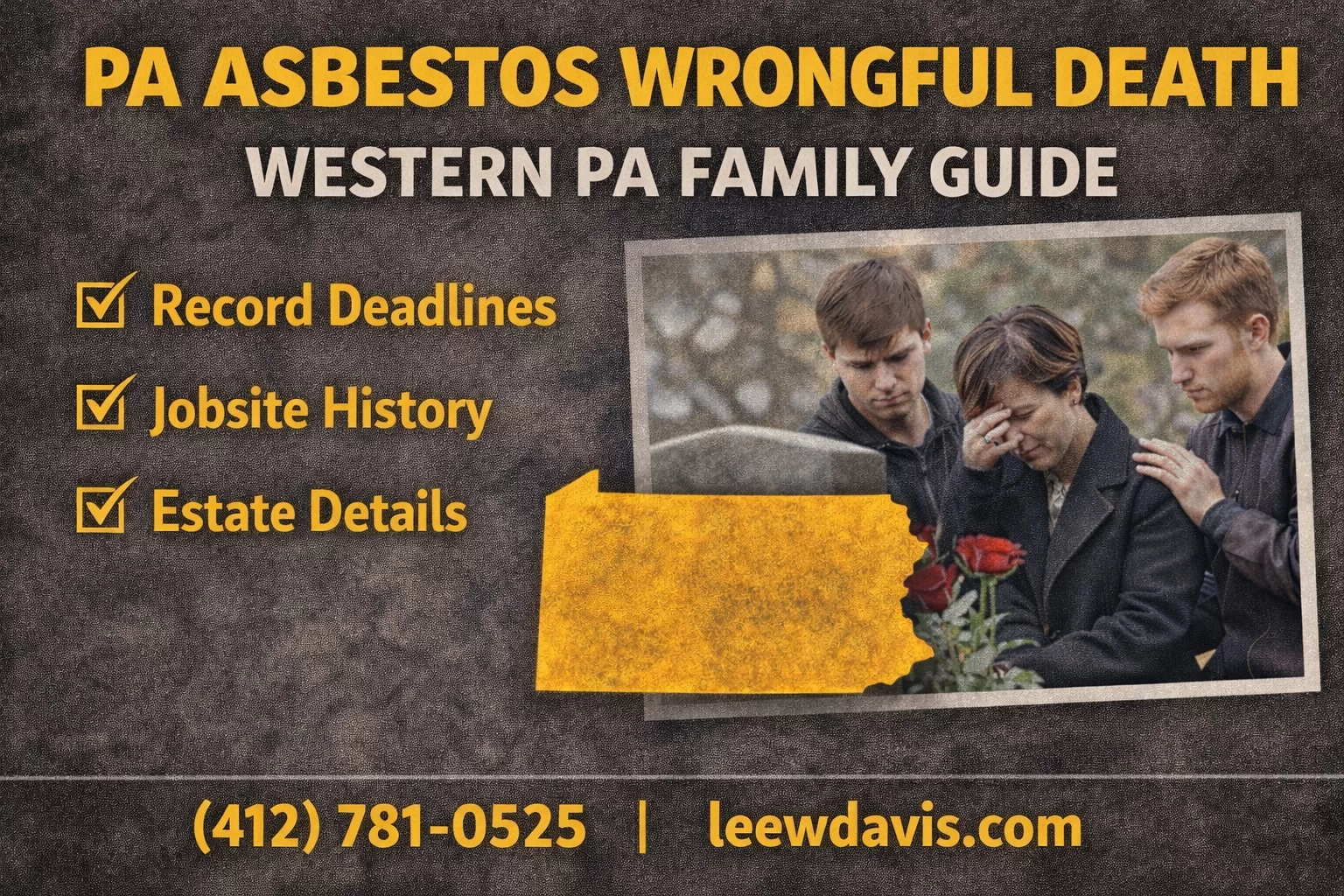
Losing a loved one to mesothelioma or another asbestos-related cancer is devastating—and families are often left with the same urgent question: Do we have a claim? A PA Asbestos Wrongful Death case focuses on accountability for the companies that supplied, specified, installed, or sold asbestos products that were used at Western Pennsylvania jobsites for decades.
This guide explains what families typically need to know, what evidence matters most, and what to do first.
1) What “wrongful death” means in an asbestos case
A wrongful death claim is a civil case brought after a death caused by someone else’s wrongful conduct. In asbestos litigation, the “wrongful conduct” is usually tied to:
- Supplying asbestos-containing products (insulation, cement, gaskets, packing, refractory, brakes, etc.)
- Selling or distributing those products
- Installing or specifying those products at industrial sites
- Failing to warn about known hazards
These cases often involve multiple defendants because exposure typically occurred across years, sites, and job tasks.
2) Common Western Pennsylvania exposure settings
Western Pennsylvania asbestos exposure often traces back to industrial and construction work, including:
- Steel mills, coke works, and foundries
- Power plants and boiler rooms
- Refineries, chemical facilities, and river terminals
- Commercial construction, schools, hospitals, and municipal buildings
- Trades like pipefitters, boilermakers, electricians, millwrights, insulators, mechanics, laborers, and maintenance crews
If your family member worked around heat, steam, boilers, turbines, pumps, valves, refractory, insulation, or heavy maintenance—there is a real chance asbestos products were involved.
👉 Search Asbestos Job Sites in Western Pennsylvania
3) Who can bring a PA Asbestos Wrongful Death claim?
In Pennsylvania, the proper claimant structure matters. Typically:
- The estate may bring a survival-type claim (focused on what the decedent experienced before death)
- Certain family beneficiaries may bring the wrongful death claim (focused on the family’s losses)
If no estate has been opened yet, that can usually be addressed early in the process. The important thing is not to delay—timing and record preservation matter.
4) What damages are typically involved
Every case is fact-specific, but wrongful death and related estate claims commonly address:
- Medical bills and treatment-related expenses
- Funeral and burial costs
- Lost income and benefits
- Loss of services, support, and companionship
- Pain and suffering experienced before death (often significant in mesothelioma cases)
The strongest cases are built with clear medical proof and a well-documented exposure history.
5) The evidence that makes or breaks these cases
Families often worry they “don’t have enough.” In reality, many strong cases start with only a few key items.
Medical proof
- Pathology reports (often the single most important document)
- Diagnostic imaging summaries
- Oncology or pulmonology records
- Death certificate and hospice records (when applicable)
Work and exposure proof
- Job titles and dates (even approximate timelines help)
- Known job sites, plant names, contractors, departments
- Trade union records, pension records, Social Security earnings
- Names of coworkers or supervisors who can confirm the work
Product and defendant proof
This is where experienced case-building matters—identifying which companies supplied products to which sites during which years. Families rarely have this on day one; it’s developed through investigation.
6) Filing deadlines and why families should act early
Wrongful death deadlines can run quickly, and delay can also cause practical problems:
- Records get harder to obtain
- Witnesses become harder to locate
- Defendant identification becomes more difficult
- Estates and beneficiary documentation can take time
Even if you are not ready to “file today,” you can protect your position by getting the case evaluated and preserving records now.
7) What to do first: a short checklist
If you’re considering a PA Asbestos Wrongful Death claim, start here:
- Gather diagnosis records (especially pathology)
- Write down job sites and approximate years
- List job duties (“what did he do day to day?”)
- Identify trades, unions, contractors, and departments
- Preserve any old photos, hard hats, badges, pay stubs, or union cards
- Make a list of coworkers or family members who can describe the work
Free, confidential case review
If your family lost someone to mesothelioma or suspected asbestos-related cancer, you don’t have to figure this out alone. A strong case starts with the right records and a focused work-history investigation.
Call the Law Offices of Lee W. Davis, Esquire, P.L.L.C. at (412) 781-0525 to discuss a PA Asbestos Wrongful Death claim and what evidence to gather first.