
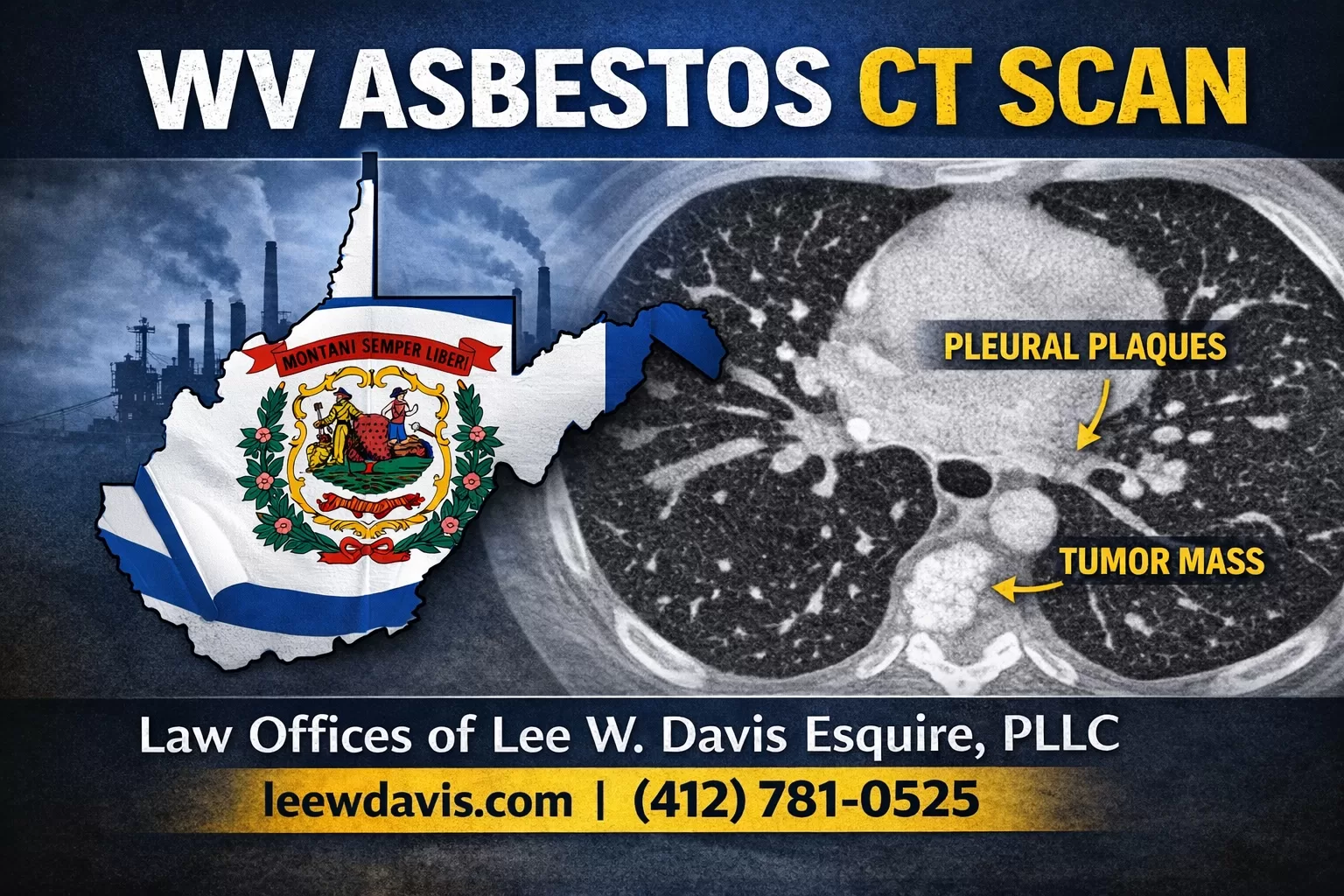
A WV Asbestos CT Scan can be one of the strongest pieces of objective proof in an asbestos case because it documents what is happening inside the chest—often before a person feels how serious it is. CT imaging is not “just medical records.” It’s visual evidence that can support a diagnosis, explain why symptoms progressed, and anchor your case timeline in a way that insurance companies and defendants can’t easily hand-wave away.
If you’ve been told your CT shows pleural changes, scarring, nodules, or “suspicious findings,” the next step is making sure those findings are properly documented and paired with a credible exposure history.
What a CT scan can prove in an asbestos claim
A CT scan is used to evaluate the lungs and pleura (the lining around the lungs). In asbestos litigation, it commonly supports proof of:
- Pleural plaques (classic marker of asbestos exposure in many cases)
- Pleural thickening (sometimes described as “diffuse pleural thickening”)
- Pleural effusion (fluid buildup that can be associated with malignancy)
- Interstitial fibrosis or scarring patterns
- Pulmonary nodules or masses that require biopsy or follow-up imaging
- Atelectasis (collapsed lung areas) that can appear alongside pleural disease
A CT alone may not “diagnose” mesothelioma, but it often provides the evidence trail that leads to biopsy, oncology referral, and the final diagnosis—while also documenting progression over time.
The CT language that matters (and what to ask for)
Radiology reports contain key phrases that can either help your case—or bury the lead. When reviewing a WV Asbestos CT Scan, you want to make sure the report clearly captures:
- Where the findings are (right/left, upper/lower, pleural vs. lung parenchyma)
- How extensive they are (diffuse vs. focal; thickness; size measurements)
- Whether progression is noted compared to earlier imaging
- Recommended next steps (PET scan, biopsy, thoracentesis, oncology consult)
Practical tip: If you have multiple CT scans over months or years, the comparison language (“increased,” “worsened,” “new”) can be crucial. That’s how imaging becomes a timeline—not just a single snapshot.
CT scans don’t replace exposure proof (they support it)
Even a strong CT scan needs to be paired with proof of where asbestos exposure happened. That usually means combining imaging with:
- WV Asbestos Work History and your jobsite and trade history
- WV Asbestos Exposure Timeline discusses product identification (insulation, gaskets, refractory, boilers, pipe covering, packing, cement, brake/clutch work, etc.)
- WV Asbestos Jobsite Witnesses discusses coworker or supervisor confirmation when available
- job records, union records, Social Security earnings, or plant documents
Common CT-related issues that can weaken a claim
A few problems show up again and again:
- A report that’s too vague (“scarring” without detail, no measurements, no comparison)
- Missing prior imaging (radiologist can’t compare, so progression isn’t documented)
- Delays in follow-up (defendants later argue the condition is unrelated or uncertain)
- The wrong label (treating pleural disease like generic “COPD changes” without deeper workup)
These are fixable in many cases—by gathering the full imaging history, pulling the actual images when needed, and aligning the medical narrative with the exposure narrative.
FAQs
Can a WV Asbestos CT Scan prove mesothelioma?
A CT scan can strongly support suspicion and document pleural disease, but mesothelioma is typically confirmed through pathology (biopsy). CT imaging often becomes the proof trail that leads to that diagnosis.
What if my CT says “pleural thickening” but no one mentioned asbestos?
That happens a lot. Pleural findings can be documented without the radiologist naming the cause. A proper legal/medical review connects the imaging findings to a credible asbestos exposure history.
Should I get copies of the actual CT images or just the report?
Start with the report, but the actual images can matter—especially when there’s a dispute about what the scan shows, progression, or the severity of pleural involvement.
Call Lee Directly – Not A Call Center
If you have a WV Asbestos CT Scan showing pleural plaques, thickening, nodules, or unexplained effusion, don’t let it sit in a chart as “just another test.” Imaging can become powerful evidence—but only if it’s tied to the right work history and product exposure proof.
I’ve focused on asbestos exposure proof and case-building for decades—starting as a paralegal in 1988, through major industrial exposure matters, and continuing with West Virginia mesothelioma and lung cancer cases where credible product identification and legitimate evidence make the difference.
Call Now: 412-781-0525
Or use this form:
Check If Your Family Was Exposed
Get your free guide instantly + a confidential case review.
🔒 100% Confidential. No obligations.
Defendants don’t “accept” asbestos exposure—they demand proof. A CT scan can document the disease process.
Start with a free West Virginia asbestos case review.
Mesothelioma/Asbestos Legal Help – WV, MI & PA
Speak directly with attorney Lee W. Davis. No call centers. Free, confidential review.