
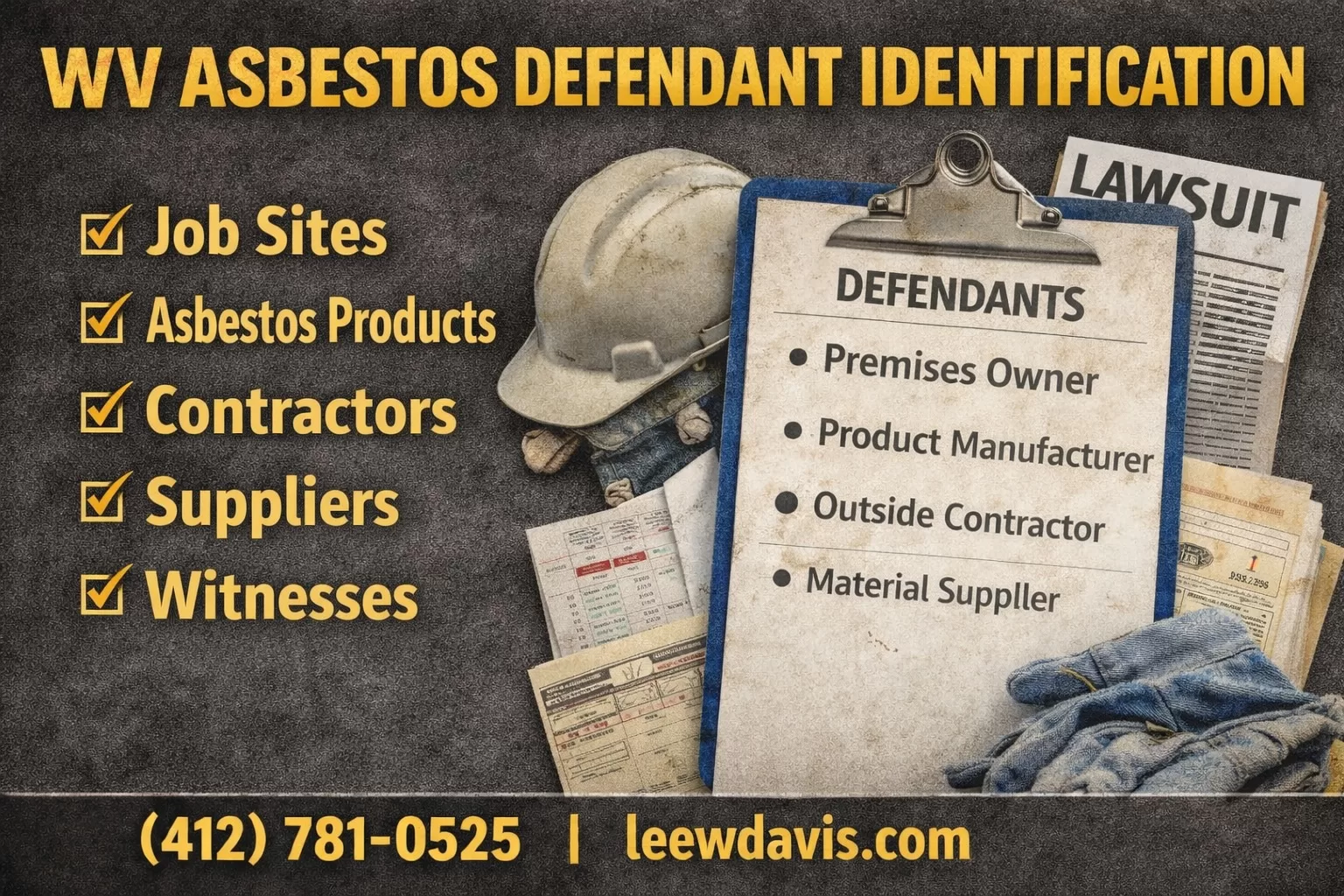
WV Asbestos Defendant Identification is the step that turns a general exposure story into a case you can actually file. In West Virginia asbestos litigation, the question is rarely “Was there asbestos?”—it’s usually which companies are legally responsible for the asbestos you breathed and the disease that followed.
Mesothelioma/Asbestos Legal Help – WV, MI & PA
Speak directly with attorney Lee W. Davis. No call centers. Free, confidential review.
This checklist is designed to help you identify potential defendants based on products, job sites, contractors, and supply chains, even if the work happened decades ago.
1) Start with your jobsite list (not your diagnosis)
Defendant ID begins with where you worked and what you did, not just what you were diagnosed with.
Create a simple timeline:
- Employer and location (plant, mine, refinery, mill, shipyard, power station)
- Your trade and tasks (pipefitter, electrician, insulator, boilermaker, mechanic, laborer)
- Years on-site (even rough ranges help)
- Departments/units (boiler room, turbine deck, maintenance shop, coke ovens, machine room)
A strong timeline helps connect you to the specific materials historically used in those areas.
👉 Search Asbestos Job Sites in West Virginia
2) Identify asbestos-containing product categories you likely encountered
You don’t always need a brand name on Day 1. You need product type + task + location.
Common product categories that generate defendants include:
- Pipe insulation and block insulation
- Boiler/turbine insulation and refractory
- Gaskets, packing, and seals
- Cement, mud, and joint compounds
- Fireproofing and spray-on insulation
- Asbestos cloth, rope, tape, and gloves
- Brake/clutch components (heavy equipment, locomotives, industrial vehicles)
Write down what you remember seeing (color, texture, packaging, nicknames on site). Small details become big later.
3) Separate “premises” from “product” defendants
West Virginia cases often involve multiple defendant types.
Typical defendant buckets:
- Premises owners/operators (who controlled the site and safety policies)
- Product manufacturers (made the asbestos-containing materials)
- Distributors/suppliers (sold or delivered the materials)
- Contractors (installed/removed insulation, performed maintenance shutdowns, demolition, abatement)
Your claim may involve one bucket—or several—depending on the jobsite and time period.
4) Use contractor shutdown history as a roadmap
Many exposures happen during:
- Turnarounds/shutdowns
- Boiler rebuilds
- Turbine outages
- Refractory tear-outs
- Demolition and retrofits
If you remember a shutdown, recall:
- Which outside contractors were there
- What they were removing/repairing
- Whether dust controls were used (often not)
- Whether your crew worked alongside them
Contractors can matter because they identify who installed what, and sometimes they controlled the work zone.
5) Don’t ignore the supply chain
Even if a product was manufactured by Company A, you may have claims tied to:
- The supplier that sold it to the facility
- The distributor that repeatedly stocked it
- The maintenance contractor that specified it
This is why purchase records, maintenance logs, and vendor lists (when available) can be valuable.
6) Witnesses and coworkers are often the missing link
If you’re unsure about brands, defendants, or even exact time frames, start building a witness list:
- Coworkers (same crew, adjacent crews, shutdown crews)
- Supervisors/foremen
- Safety officers or maintenance planners
- Union hall contacts (who can confirm contractors and assignments)
A credible witness can confirm product presence and work conditions—two keys for defendant identification.
7) “I don’t remember brands” is normal—and workable
Most clients don’t remember the name on a box from 1978. That’s why this process relies on:
- Work history + location
- Task-based exposure logic
- Jobsite knowledge and historical product use
- Witness support and records where available
The point is to build enough structure that the defendant list becomes clear.
Quick intake checklist
- Primary job sites (name + city/state)
- Years at each job site
- Trade and typical tasks
- Where you worked (boiler room, maintenance shop, etc.)
- Materials you cut/sanded/removed
- Outside contractors you remember
- Names of 3–5 coworkers who can confirm conditions
Call Now
If you want help narrowing down the right defendants, call (412) 781-0525. The sooner we map your work history and product exposure, the sooner we can identify responsible companies and move your West Virginia asbestos claim forward.
Check If Your Family Was Exposed
Get your free guide instantly + a confidential case review.
🔒 100% Confidential. No obligations.