
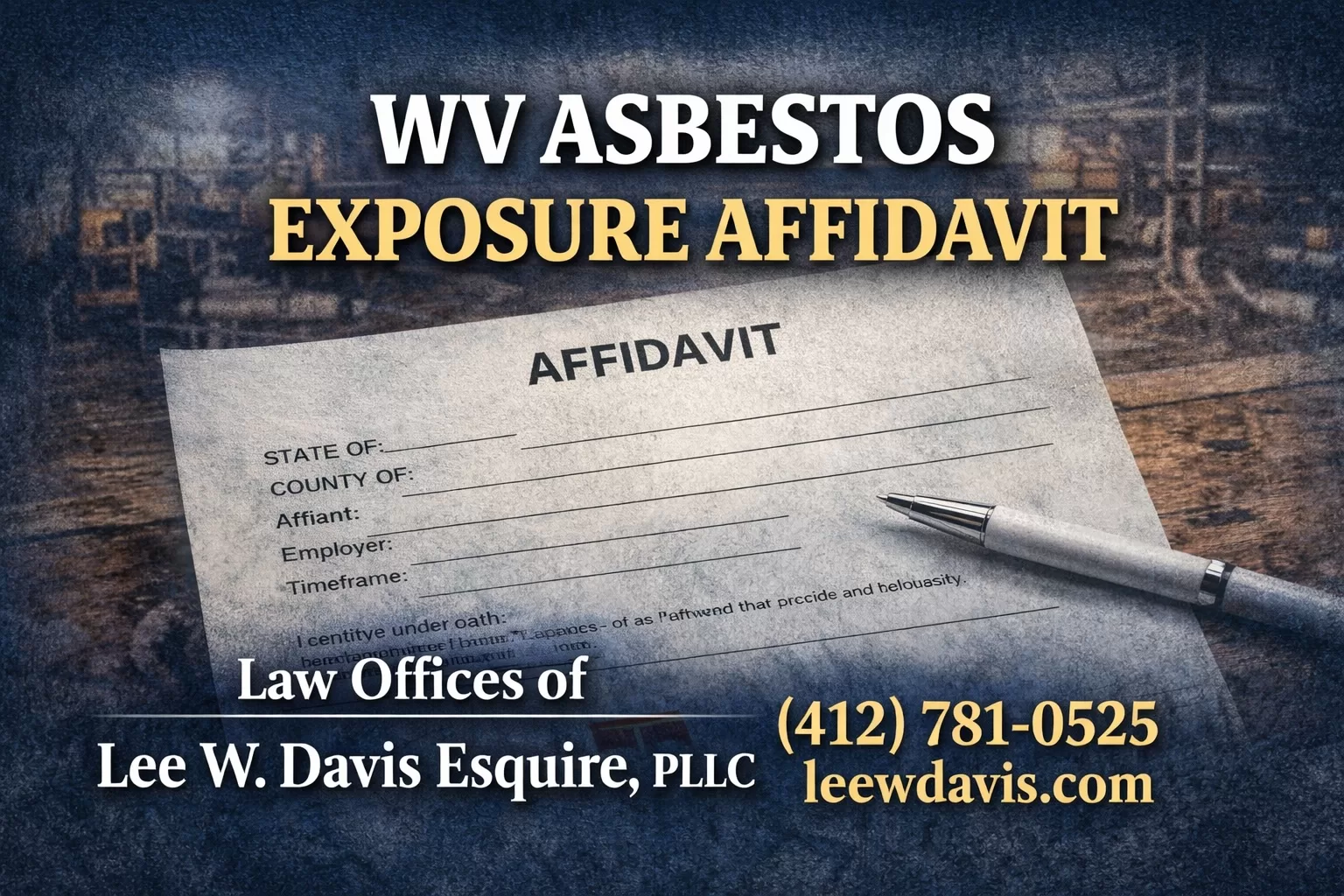
A WV Asbestos Exposure Affidavit is one of the most misunderstood pieces of an asbestos case. People think it’s a “quick statement” that says, “I worked around asbestos.” That’s not enough — and it’s exactly how weak proof gets attacked.
An affidavit is supposed to read like a true, specific account from someone with firsthand knowledge: what the job was, what the materials were, what the work conditions were, and why that person is in a position to know.
Here’s the standard I use: if the affidavit doesn’t answer the obvious follow-up questions, it’s not done.
What a usable affidavit includes
A strong affidavit should cover:
- Who: full name, job title(s), employer(s), and how the witness knows the injured worker
- Where: the actual facility/jobsite (not just “a mill” or “a plant”)
- When: timeframe (even approximate) and whether it was continuous, seasonal, shutdown work, etc.
- What work: tasks performed (insulation removal, pipe work, gasket scraping, refractory work, boiler maintenance, turbine work, etc.)
- What products/materials: insulation type, gaskets, cement, packing, refractory, block/blanket, mud, hot-tops, brand names if known
- How exposure happened: visible dust, cutting/sanding, mixing, sweeping, blowdown, compressed air, dry removal
- Why the witness knows: “I worked beside him,” “I performed the same tasks,” “I handled the material,” “I supervised the shutdown crew,” etc.
A good affidavit doesn’t try to be dramatic. It’s calm, detailed, and believable — because credibility wins.
Who can sign an affidavit
The best affidavits come from:
- coworkers who worked the same job or shutdowns
- supervisors/foremen
- maintenance partners, insulators, pipefitters, millwrights, electricians who were present
- in some cases, family members (useful for what they observed at home, not for technical product ID)
Common affidavit mistakes that hurt cases
- vague dates (“years ago”) with no timeframe at all
- generic language that reads like a form
- claiming brand names that the witness can’t actually support
- skipping the how (how dust was generated, how often, how close)
I’ve been building legitimate exposure proof since 1988 — long before anyone was doing “content” about asbestos. I learned product and jobsite identification the hard way: thousands of industrial cases, including foundry work in Michigan, and then real West Virginia mesothelioma and lung cancer case development where the proof has to hold up when the defense starts pushing.
If your case needs a WV Asbestos Exposure Affidavit, I’ll tell you what belongs in it, who the best witnesses are, and how to get statements that actually help the case.
Call (412) 781-0525 or start at leewdavis.com
Check If Your Family Was Exposed
Get your free guide instantly + a confidential case review.
🔒 100% Confidential. No obligations.
FAQs
1) Does a WV Asbestos Exposure Affidavit have to name the exact product brand?
No. Brand names help when they’re real and supportable. Task-based exposure plus material description can still be strong when it’s detailed and credible.
2) Can a family member sign an affidavit?
Yes, but it’s usually limited to what they personally observed (dusty clothes, symptoms, diagnosis timeline). Product and task details are usually strongest from coworkers or jobsite witnesses.
3) Is a notarized affidavit required?
In many settings, notarization matters. Even when not strictly required, a properly executed sworn statement is harder to dismiss and tends to carry more weight.
Mesothelioma/Asbestos Legal Help – WV, MI & PA
Speak directly with attorney Lee W. Davis. No call centers. Free, confidential review.
Read More about:
- Work records/paper trail: https://leewdavis.com/wv-asbestos-employment-records/
- Product identification: https://leewdavis.com/wv-asbestos-product-identification/
- Pathology Report Importance: https://leewdavis.com/wv-asbestos-pathology-report/
- Coworker proof: https://leewdavis.com/wv-asbestos-jobsite-witnesses/