
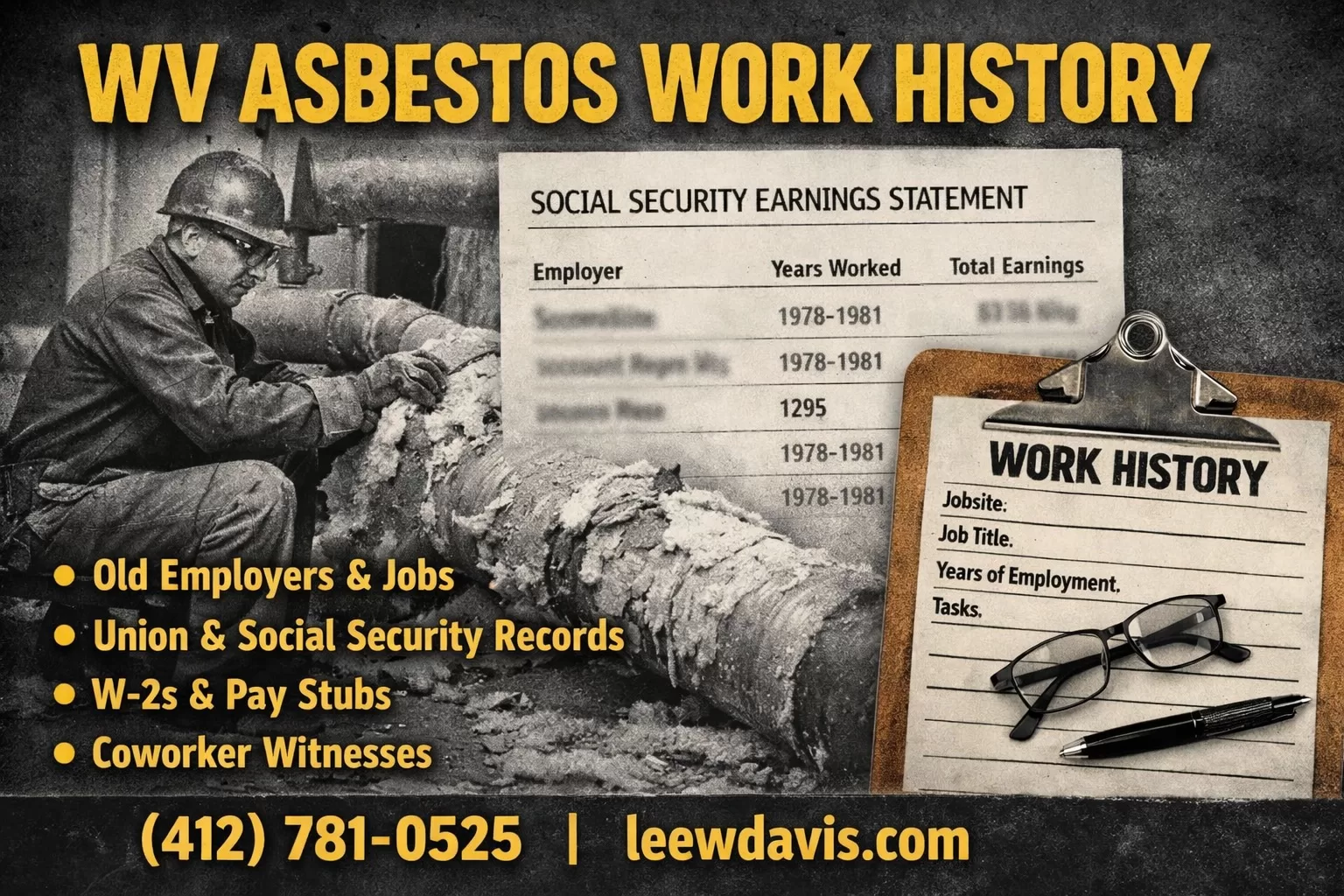
If you’re building a West Virginia asbestos claim, WV Asbestos Work History is often the backbone of the case. The diagnosis matters, but the legal question is usually practical: where did the exposure happen, what work were you doing, and who supplied the asbestos products at that jobsite? A strong work history does not have to be perfect on day one. It just has to be organized, truthful, and detailed enough to identify the most likely exposure sources.
Mesothelioma/Asbestos Legal Help – WV, MI & PA
Speak directly with attorney Lee W. Davis. No call centers. Free, confidential review.
What “work history” means in an asbestos case
In an asbestos case, your work history is more than a résumé. It’s a timeline that connects:
- Employer(s) and job locations
- Job titles and tasks (what you physically did)
- Trades and crews you worked around (pipefitters, insulators, electricians, boilermakers, laborers, maintenance)
- Products and equipment you handled or were near (insulation, gaskets, packing, cement, refractory, boilers, turbines, valves, pumps)
- Dates (even approximate ranges help)
A “good enough” work history usually includes the who, where, what, and when—and then we build the “what products” and “which defendants” from there.
👉 Search Asbestos Job Sites in West Virginia
Start with your best timeline (even if it’s incomplete)
Most people don’t remember everything at once—especially if the exposure was decades ago. Here’s how to build it fast:
1) List every employer and jobsite you can remember.
Write it in chronological order. If you’re unsure of dates, use approximate ranges (e.g., “1978–1981” or “early 1980s”).
2) Add your job title and tasks at each place.
Don’t just say “maintenance.” Say what that meant: changing gaskets, scraping flanges, replacing pipe insulation, cutting transite, sweeping debris, repairing boilers, working shutdowns/turnarounds.
3) Identify the “high-dust moments.”
Asbestos cases often turn on the messy, routine work: teardown, cleanup, grinding, wire-brushing, removing old insulation, pulling old gasket material, mixing dry powders.
4) Add coworker names.
Even one or two names per jobsite can matter. Coworkers help confirm work areas, products, and how the work was done.
Documents that help prove WV Asbestos Work History
You can prove work history in several ways. The goal is corroboration—multiple sources that line up.
- Social Security Earnings Statement (often the quickest way to confirm employers/years)
- Union records (hall dispatches, benefit records, pension records, membership history)
- W-2s, pay stubs, tax returns (even a few years help)
- Personnel files from the employer (if available)
- Safety training records or job badges
- Medical intake records that list prior employment
- Worksite records (turnaround logs, contractor logs, purchase orders—often discovered later)
If you don’t have paperwork, that does not end the case. Many legitimate claims start with memory, then get supported through records and witness proof.
The most important details to write down right now
If you do nothing else today, make sure you capture these specifics while they’re fresh:
- The exact plant name (or best description) and city/county
- Your department/area (boiler room, powerhouse, mill floor, maintenance shop, coke works, pump house)
- The type of work you did during shutdowns or repairs
- Any brands you remember (even partial names)
- Whether you worked around insulators or refractory crews
- Whether the work created visible dust
Why work history wins cases
A clear, credible WV Asbestos Work History helps your lawyer:
- Identify the right defendants (manufacturers, suppliers, contractors)
- Match you to known jobsite asbestos exposures
- Find and prepare coworker witnesses
- Build the exposure narrative that explains how asbestos was encountered
- Move faster toward settlement leverage by proving exposure sources early
Call to discuss your work history
If you have a diagnosis and even a rough job timeline, we can start organizing it into a claim-ready format.
Law Offices of Lee W. Davis, Esquire, P.L.L.C.
(412) 781-0525 | leewdavis.com
Consultations are confidential.
Check If Your Family Was Exposed
Get your free guide instantly + a confidential case review.
🔒 100% Confidential. No obligations.
FAQs
1) What if I can’t remember exact dates for each job?
That’s common. Approximate ranges are usually enough to start. Records (Social Security, union, tax) can tighten dates later.
2) What if the company is closed or the jobsite is gone?
You may still have a claim. Exposure proof often comes from jobsite history, product evidence, and coworker testimony—not just the employer’s current status.
3) Do I need proof that I personally handled asbestos?
Not always. Many cases involve working around asbestos work—insulation removal, gasket scraping, refractory tear-out, or dusty maintenance work in enclosed areas.
4) Should I write down product names even if I’m unsure?
Yes—note what you remember and mark it as “best recollection.” Partial details can still help identify the right product families and suppliers.
Mesothelioma/Asbestos Legal Help – WV, MI & PA
Speak directly with attorney Lee W. Davis. No call centers. Free, confidential review.
Comments are closed.