A WV Mesothelioma Claim Interview is often the moment a case goes from “possible” to “actionable.” People assume the key is the diagnosis. The diagnosis matters, but the interview is where the exposure story becomes clear enough to move—without months of back-and-forth.
Mesothelioma/Asbestos Legal Help – WV, MI & PA
Speak directly with attorney Lee W. Davis. No call centers. Free, confidential review.
If you’re calling a West Virginia asbestos lawyer, you can make that first review dramatically faster (and stronger) by walking in with a simple checklist. You do not need perfect memory or a stack of documents. You just need enough anchors to confirm the work history, narrow the jobsites, and identify the highest-probability exposure sources.
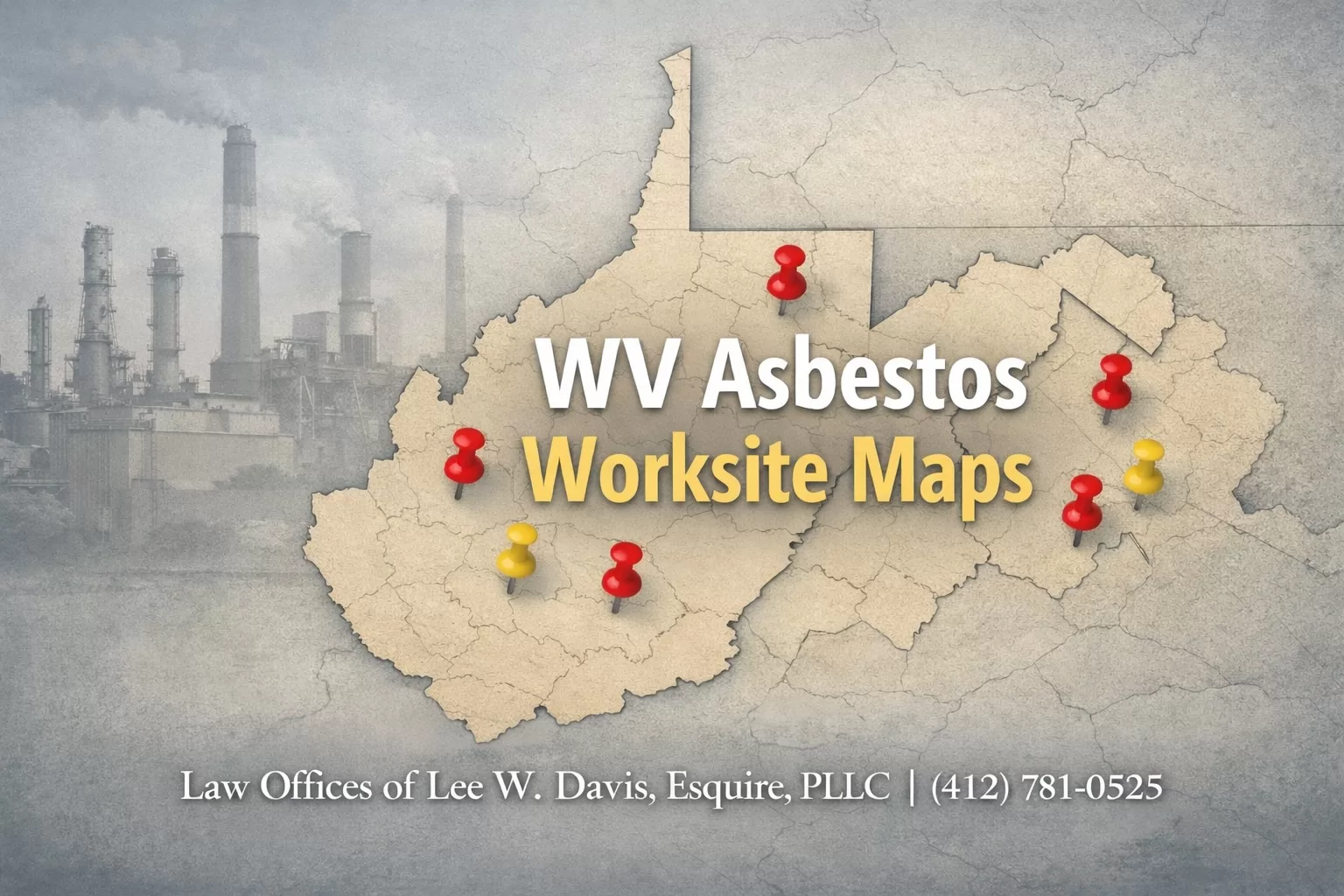
WV Asbestos Worksite Maps can be the difference between “I think it was there” and “here’s exactly where it happened.” In West Virginia, asbestos exposure often traces back to specific industrial corridors—steel, chemicals, power generation, rail, and heavy maintenance—where the same insulation, gaskets, refractory, and pipe covering appeared year after year across different contractors and trades.
Mesothelioma/Asbestos Legal Help – WV, MI & PA
Speak directly with attorney Lee W. Davis. No call centers. Free, confidential review.
If you (or your family) are trying to connect a diagnosis to a real exposure history, mapping the worksites is a practical way to organize evidence and build a clean, credible narrative—especially when memories fade, records disappear, or the work was done decades ago.
Why mapping matters in West Virginia asbestos cases
A strong claim usually needs more than a diagnosis. It needs context: where the exposure occurred, when it occurred, what the worker did there, and how asbestos fibers were released. Worksite maps help by:
Pinpointing exposure locations (plants, shops, yards, power stations, mills)
Matching job duties to known asbestos materials (insulation removal, gasket work, boiler repair, demolition, maintenance)
Connecting multiple jobsites into a single timeline (common for union trades and traveling crews)
Identifying witnesses and records (foremen, coworkers, dispatch logs, job tickets)
What a “WV asbestos worksite map” actually includes
A useful worksite map isn’t just a pin on Google. It’s a case tool that ties together:
Jobsite name + address/city/county (when known)
Years on-site (even approximate ranges)
Trade/work area (boiler room, pipe rack, turbine deck, maintenance bay)
Supporting sources (employment records, union records, SS statements, old resumes, affidavits)
This is especially important across major WV hubs like Charleston, Huntington, Parkersburg, Wheeling, Morgantown, Beckley, and Weirton, where industrial work overlapped across generations and contractors.
How maps help families in wrongful death and legacy exposure claims
Many families are building the story after a diagnosis or death—without the worker available to fill gaps. A worksite map helps survivors collect and organize:
Old work photos and badge IDs
Union membership history and dispatch lists
Coworker names and job sequences
Medical timeline vs. employment timeline
It creates a clear, persuasive “work-and-exposure footprint” that supports settlement discussions and (when needed) litigation.
What to do if you don’t remember every jobsite
You don’t need perfection to start. We often begin with three anchors:
employer name(s), 2) trade/job title, 3) a few cities or counties in WV. From there, a map can expand as records come in.
Talk to a WV asbestos lawyer about worksite mapping
If you want your claim presented with maximum clarity, worksite mapping is one of the most practical starting points. If you’re unsure whether your history fits, you can still get answers quickly—without guessing and without wasting months chasing the wrong records.
Call (412) 781-0525 or message the Law Offices of Lee W. Davis, Esquire, P.L.L.C. to discuss your WV exposure timeline and whether a mapped work history can support a claim.
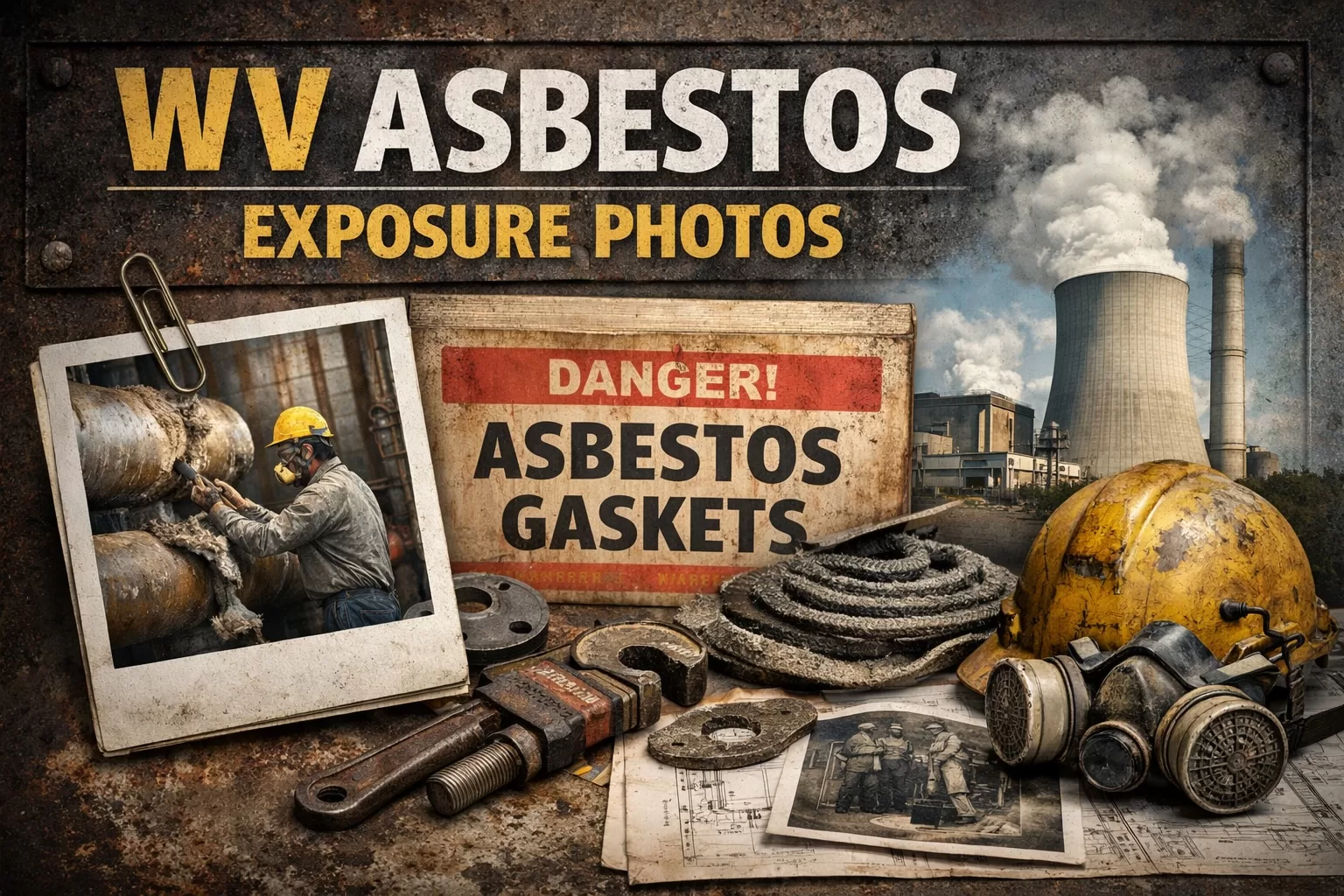
If you’re building an asbestos claim, WV asbestos exposure photos can matter—sometimes more than people realize. Photos don’t “prove” everything by themselves, but they can lock in the reality of where you worked, what you handled, and what products were present when the exposure happened. In West Virginia cases, that can mean the difference between a vague story and credible proof.
Mesothelioma/Asbestos Legal Help – WV, MI & PA
Speak directly with attorney Lee W. Davis. No call centers. Free, confidential review.
I’ve been doing product identification and exposure proof work since 1988—back when everything was paper, and “proof” meant hunting down what nobody bothered to save. The same principle still applies today: photos help corroborate your work history and the asbestos products you were around.
3) Add a simple caption file now (do this before you forget)
Create a basic notes file (or email it to yourself) titled:
“WV Asbestos Exposure Photos – Notes”
For each photo, add:
Photo number / filename
Location (jobsite + city)
Approximate date/year
What it shows (equipment + task)
Any product names seen (even partial markings)
Names of anyone pictured (or who took it)
This is how photos stop being “old pictures” and become evidence.
4) Where to find old jobsite photos
People assume they have none. Usually they do—just not where they’re looking.
Common sources:
Your phone’s cloud backups (Google Photos / iCloud)
Old Facebook albums (yours, spouse, coworkers, retired crew pages)
Text message threads with coworkers
Company newsletters, retirement books, union newsletters
Local papers / jobsite dedication photos / plant historical pages
Family photos where the jobsite is in the background (hardhat, shutdown work, gear)
Estate boxes: envelopes of prints, old disposable-camera photos
If a coworker has the photos, that still helps—because they can authenticate what the picture is and when it was taken.
5) Don’t “edit” the originals
If you have originals, preserve them:
Don’t crop originals
Don’t overwrite the original file
Don’t run filters or “enhance” the original
Save a copy if you want to zoom or highlight
If you screenshot an old photo to zoom in on a label, keep both:
Original
Screenshot/zoom copy
6) What if the photo shows something that looks harmless?
That’s fine. Remember: asbestos cases often turn on routine maintenance work, not dramatic disasters. A photo of:
A pump being rebuilt
A valve being repacked
A flange being opened
Insulation being cut back …can be extremely persuasive when paired with a short explanation of what was used and how dust was created.
7) Photos and “product identification”
You’re trying to identify:
The type of product (insulation, gasket, packing, refractory, cement board)
The brand (if visible)
The setting where those products were used (boiler rooms, powerhouses, mills, maintenance shops)
A single clear photo of a box/bag/label can matter. But even without labels, photos can show the materials and work practices that fit known asbestos-containing products.
If you have even a handful of old jobsite photos, I want to see them early. In asbestos litigation, evidence doesn’t get better with time—it disappears. I’ve focused on product identification and exposure proof since I started as a paralegal in 1988, through the Saginaw foundry cases, and then West Virginia asbestos cases where the difference between “maybe” and “credible” is proof you can defend.
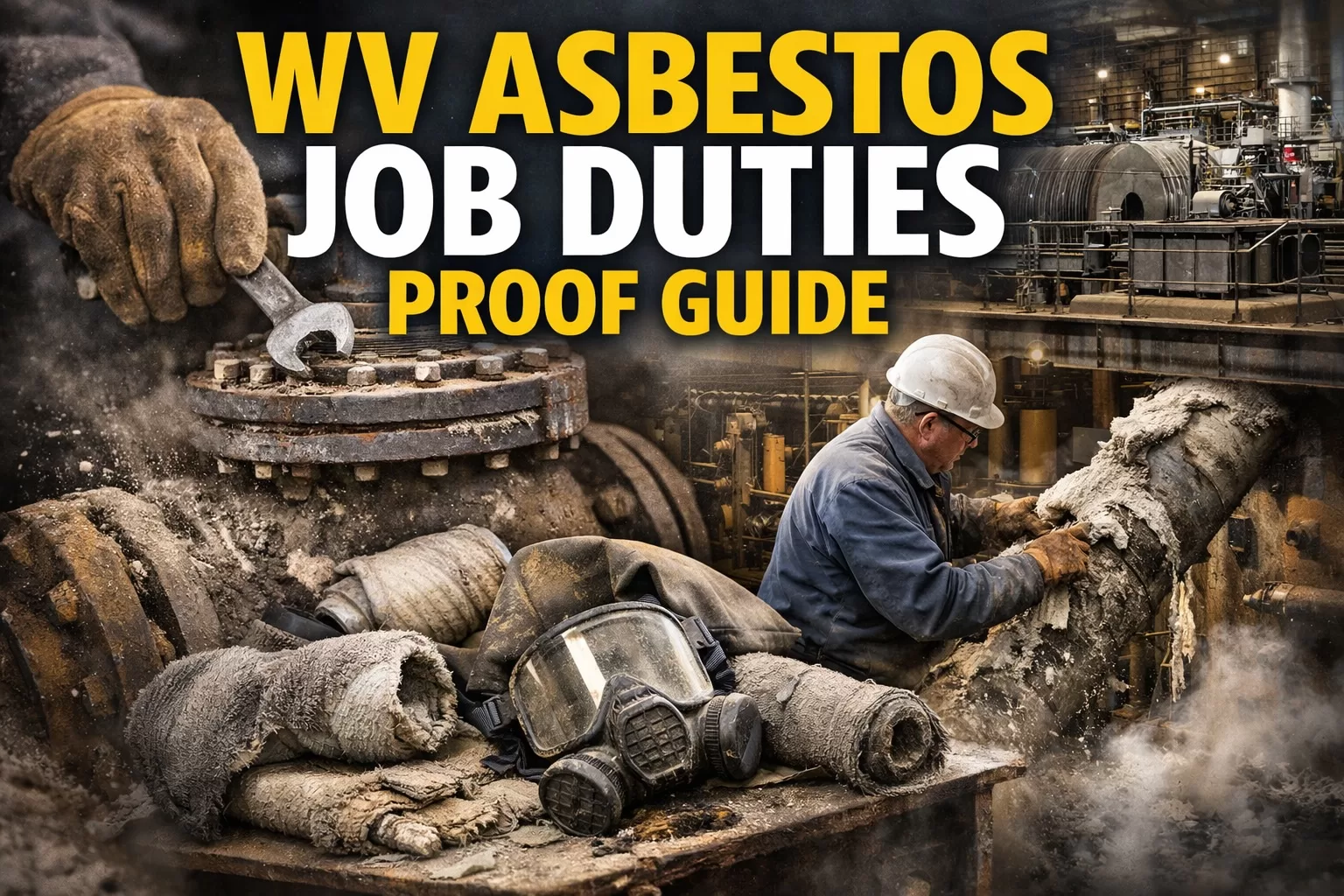
WV Asbestos Job Duties Proof is not about fancy paperwork—it’s about showing what you actually did on the job, in plain language, with enough detail that a defendant (or trust) can’t dismiss the exposure as “speculation.”
Most West Virginia asbestos cases rise or fall on one question: What job duties put you in contact with asbestos-containing materials? If you can describe the tasks clearly—where you worked, what you touched, what you cut/scraped/mixed, and who was around—you build the kind of proof that holds up.
Why job duties matter in WV asbestos claims
Job titles are broad. “Maintenance,” “pipefitter,” “electrician,” “millwright,” “laborer,” or “operator” can mean a hundred different things. But job duties show the real story:
Where the work happened (boiler room, turbine deck, pump house, powerhouse, mill, shop)
What products were present (insulation, refractory, gaskets, packing, cement, block)
How you were exposed (cutting, scraping, grinding, mixing, tearing out, sweeping dust)
Who else confirms it (coworkers, foremen, contractors working next to you)
That’s what decision-makers look for when evaluating exposure.
For site-specific exposure research, use our West Virginia asbestos job sites directory to identify facilities, contractors, and common asbestos areas.
The job-duty details that actually move the needle
If you’re documenting WV Asbestos Job Duties Proof, focus on details that are concrete and repeatable.
1) The tasks
Use action words. Examples that matter:
Cutting insulation, block, gasket sheet, or rope packing
Scraping flanges, valves, and old gasket residue
Pulling old insulation off pipe or equipment
Grinding surfaces before resealing
Mixing refractory, cement, or patch materials
Tearing out old boiler insulation during shutdowns
Sweeping or cleaning dust after demolition or maintenance
These verbs tell the exposure story without needing a scientist.
2) The materials (name what you remember)
You don’t need perfect brand names to start. Identify what you can:
Pipe insulation (wrap, block, mud, lagging)
Boiler insulation and boiler doors
Refractory (brick, cement, lining)
Gaskets (flange gaskets, manway gaskets)
Valve packing (rope packing, rings)
Asbestos cement products
High-heat cloth / tape used around equipment
If it made dust, if it was high-heat, and if it was old—those facts matter.
3) The location (where exposure happened)
Pin down the setting:
Powerhouse / boiler room / turbine area
Pump rooms and compressor stations
Steel mills, coke plants, foundries
Chemical plants, refineries, paper mills
Maintenance shops and pipe racks
Even if you worked across multiple sites, a simple “route” of your work history helps the exposure make sense.
4) The time period (old equipment matters)
Asbestos shows up heavily in older facilities and long-running industrial operations. In your notes, include:
The years you did the work
Whether it was new construction vs. maintenance
Whether you worked outages/shutdowns/turnarounds
Whether there was visible dust and poor ventilation
Shutdown work is often the highest exposure work because insulation and refractory gets disturbed.
If you or a loved one has been diagnosed with mesothelioma, lung cancer, or another asbestos disease, the next step is building credible exposure proof—starting with your job duties.
WV Asbestos Claim Denials usually come down to one thing: the file doesn’t prove exposure clearly enough for the payer to write a check. That doesn’t mean your claim is “bad.” It means the record is incomplete, unclear, or missing the specific proof they require. If you need a starting point for jobsite investigation, begin with our West Virginia asbestos job sites page to identify common facilities and trades tied to asbestos exposure.
Mesothelioma/Asbestos Legal Help – WV, MI & PA
Speak directly with attorney Lee W. Davis. No call centers. Free, confidential review.
I’ve built exposure proof packages since 1988—first as a paralegal in asbestos litigation, then through the Saginaw foundry cases, and later through West Virginia mesothelioma and lung cancer cases where product identification and credible work history made the difference. Denials are often fixable when you know exactly what to demand and how to document it.
The most common reasons asbestos claims get denied in West Virginia
1) “Insufficient exposure proof”
This is the classic denial language. It usually means you provided a diagnosis, but the file doesn’t show where you were exposed, how, and to what product(s).
What fixes it: jobsite + time period + trade/task + product ID + witnesses.
They want a link between your work and asbestos-containing products (insulation, gaskets, packing, refractory, cement pipe, boilers, turbines, expansion joints, etc.). If the file is vague (“worked around asbestos”), denials follow.
What fixes it: names of manufacturers, product types, and how you handled or disturbed the material.
3) “Work history can’t be verified”
If the payer can’t confirm employment dates or locations, the claim gets delayed or denied—especially when the exposure spans multiple employers or union halls.
What fixes it: Social Security earnings, W-2s/pay stubs, pension/union records, personnel files, and corroborating coworker statements.
4) “Diagnosis documentation is incomplete”
Sometimes they have a diagnosis summary, but not the core records that prove an asbestos-related disease.
What fixes it: pathology reports (if available), imaging reports, treating physician notes, and any occupational history documented in the medical chart.
5) “Wrong claimant/standing problems”
In wrongful death situations, a claim can be denied if the estate paperwork is incomplete or the proper representative is not established.
What fixes it: estate appointment documents and proof of authority to act, plus medical proof and exposure proof.
What you should request immediately after a denial
When you get a denial letter/email, you want to lock down the exact reason and the exact missing items. Here’s what to ask for (in writing):
The denial reason(s) in plain language, not just codes
A list of the specific documents they claim are missing
Any internal notes or reviewer comments tied to your file
The rules/criteria they used to evaluate proof
The deadline and procedure to appeal or supplement
The “proof package” that reverses most denials
A strong asbestos claim file usually includes:
Confirmed diagnosis documentation
Work history with dates, employers, and job duties
Exposure narrative describing tasks and materials disturbed
Product identification (names/brands where possible)
Supporting records (earnings, union, pension, personnel)
Coworker statements when needed
A clean timeline tying exposure period to diagnosis/latency
Denials often happen because a file has two of those items, not all of them.
Appeals: how to think about leverage and timing
A denial is not the end. It’s a signal that the payer believes it can safely say “no” based on the current record. The goal of an appeal is to remove that comfort—by making the record undeniable, organized, and consistent.
If the denial is based on “insufficient exposure proof,” you usually win by tightening the work history and product identification. If it’s based on “unable to verify,” you win by producing the employment documentation they can’t ignore.
If your claim involves a family member’s death, review our Mesothelioma wrongful deathpage for estate and family-claim basics
Call Now
If you received a denial, don’t guess. Build the record the right way—work history, product identification, and medical proof that holds up. Call (412) 781-0525or contact me through leewdavis.com for a case review.
Check If Your Family Was Exposed
Get your free guide instantly + a confidential case review.
If you or a loved one has a serious diagnosis and you suspect asbestos exposure in West Virginia, time and organization matter. This WV Asbestos Claim Checklist is designed to help you gather the right information early—so your case can be evaluated quickly and preserved properly.
Mesothelioma/Asbestos Legal Help – WV, MI & PA
Speak directly with attorney Lee W. Davis. No call centers. Free, confidential review.
Many families lose momentum because they don’t know what matters, what’s optional, and what can be obtained later. Use the list below to get the essentials first.
1) Start with the medical “core” (the essentials)
These are the documents that usually determine whether an asbestos claim can move forward:
Pathology report confirming mesothelioma or another asbestos-related cancer
Operative reports (if surgery occurred)
Oncology records (initial consult, treatment plan, staging)
Imaging: CT/PET results and radiology reports (you can request a disc later)
Hospital discharge summaries for major admissions
Death certificate and autopsy report (if a wrongful death claim is involved)
If you don’t have all of this, don’t worry—what matters is knowing where the care happened so records can be requested efficiently.
2) Build the work history timeline (even if it’s imperfect)
The most valuable exposure proof often comes from a simple timeline.
Write down, as best you can:
Employers, job sites, and years worked (even approximate)
Job titles and the type of work performed (pipefitter, electrician, millwright, mechanic, laborer, insulator)
Locations in West Virginia (plant names, mines, power stations, mills, refineries, schools, shipyards, etc.)
Supervisors or coworkers who can confirm the work
A rough timeline is enough to start. A good lawyer can refine it quickly.
3) Identify asbestos products and tasks
This is where strong cases are made. List any products you remember, and also the tasks you performed around dusty materials.
That’s common. If you know the hospital and the treating doctor, the report can be requested. You can still start building the work and exposure timeline now.
Do I need to know the exact asbestos product brand?
No. The type of work, the material involved, and the job-site history often point to the likely products and defendants.
What’s the fastest way to start?
Write a one-page timeline: where you worked, what you did, and what dusty materials you handled. Add two coworker names if possible.
Call to action
If you’re facing a serious diagnosis and believe asbestos exposure happened in West Virginia, you don’t need to figure this out alone. Call (412) 781-0525 to discuss what you already know and what can be proven quickly. Consults are confidential.
Check If Your Family Was Exposed
Get your free guide instantly + a confidential case review.
A WV Asbestos Lawyer Consultation is often the turning point between guessing and knowing whether you have a real asbestos claim. If you worked around insulation, pipe covering, gaskets, refractory, boilers, power plants, chemical facilities, refineries, steel operations, or industrial maintenance in West Virginia, a consultation can quickly clarify what claims are available and what evidence matters most.
Mesothelioma/Asbestos Legal Help – WV, MI & PA
Speak directly with attorney Lee W. Davis. No call centers. Free, confidential review.
Most people wait too long because they think they need “perfect proof” before calling. You don’t. The right consult is structured to identify exposure pathways, pin down dates and locations, and preserve the strongest record early—even if you don’t have every document yet.
What a WV asbestos consultation actually does
A consultation is not a sales pitch. It’s an intake built around evidence and timing. The goal is to answer five questions:
Is there a viable exposure story? (where, when, and how asbestos was encountered)
What medical diagnosis is involved? (mesothelioma, lung cancer, asbestosis, pleural disease)
Which claims are realistic? (personal injury, wrongful death, or both)
Who can be held responsible? (manufacturers, suppliers, contractors, premises defendants, sometimes trusts)
What is the timeline? (limitations period, probate deadlines, records requests, and next steps)
What to bring to your WV Asbestos Lawyer Consultation
Bring what you have. If you don’t have it, we can still start. Useful items include:
A simple list of jobsites and years (even approximate)
Names of employers, unions, and trades (pipefitter, boilermaker, electrician, millwright, laborer, mechanic, insulator)
Any pathology reports, imaging summaries, or diagnosis paperwork
A list of coworkers or supervisors who remember the work
Old paystubs, W-2s, Social Security printouts, or pension records if available
Notes about specific products you recall (insulation, cement, packing, gaskets, refractory, joint compound, etc.)
A good consult should leave you with clarity. Ask these:
What facts matter most for proving exposure in WV?
What defendants or bankruptcy trusts are realistically in play?
What records will we request first—and how fast can we get them?
What should my family be doing now if my health is declining?
What is the expected timeline for filing and moving the case?
If you’re calling for a family member
A WV Asbestos Lawyer Consultation is especially important when the person diagnosed is too sick to do lengthy interviews later. Family members often have key details—work history, jobsite names, and the practical story of exposure. If the case may involve a wrongful death claim, early planning helps avoid avoidable delays with estate paperwork and records access.
What happens after the consultation
If you move forward, the next steps are typically:
Work history mapping (jobsites, dates, trades, known products)
Medical record requests (diagnosis confirmation and causation support)
Defendant/trust targeting (matching exposure to responsible parties)
Witness development (coworkers, affidavits, family testimony)
Filing strategy (where to file and how to plead the exposures clearly)
Don’t wait for “perfect” proof
People lose leverage by waiting until records are hard to find or witnesses disappear. The earlier the consultation, the sooner the case is built around documents that hold up under pressure.
Call for a WV Asbestos Lawyer Consultation
If you believe asbestos exposure in West Virginia contributed to mesothelioma or another asbestos disease, call (412) 781-0525 to discuss your work history, diagnosis, and next steps.
Check If Your Family Was Exposed
Get your free guide instantly + a confidential case review.
🔒 100% Confidential. No obligations.
FAQs
How long does a WV Asbestos Lawyer Consultation take?
Most consultations take 15–30 minutes for an initial screen. More complex work histories may take longer.
What if I don’t remember product names?
That’s common. Worksite and trade details often matter more at first. Product identification can be developed through records and witness proof.
Is there a cost for the consultation?
Most asbestos consultations are offered at no upfront cost, with fees typically contingent on recovery (if a case is accepted).
Can my spouse or child attend the consultation?
Yes. Family members often help fill in jobsite timelines and exposure details, and they are essential if health is declining.
Read More:
West Virginia mesothelioma lawyer page: If you need broader help beyond this WV Asbestos Lawyer Consultation—including filing, defendant targeting, and claim strategy—visit our West Virginia mesothelioma lawyer page for a full overview.
West Virginia asbestos job sites page: For a quick way to connect your work history to known locations, review our West Virginia asbestos job sites page and note any facilities that match your timeline.
Mesothelioma wrongful death page: If your consultation involves a loved one’s passing or an estate claim, our mesothelioma wrongful death page explains how family claims work and what deadlines can apply.
Mesothelioma/Asbestos Legal Help – WV, MI & PA
Speak directly with attorney Lee W. Davis. No call centers. Free, confidential review.
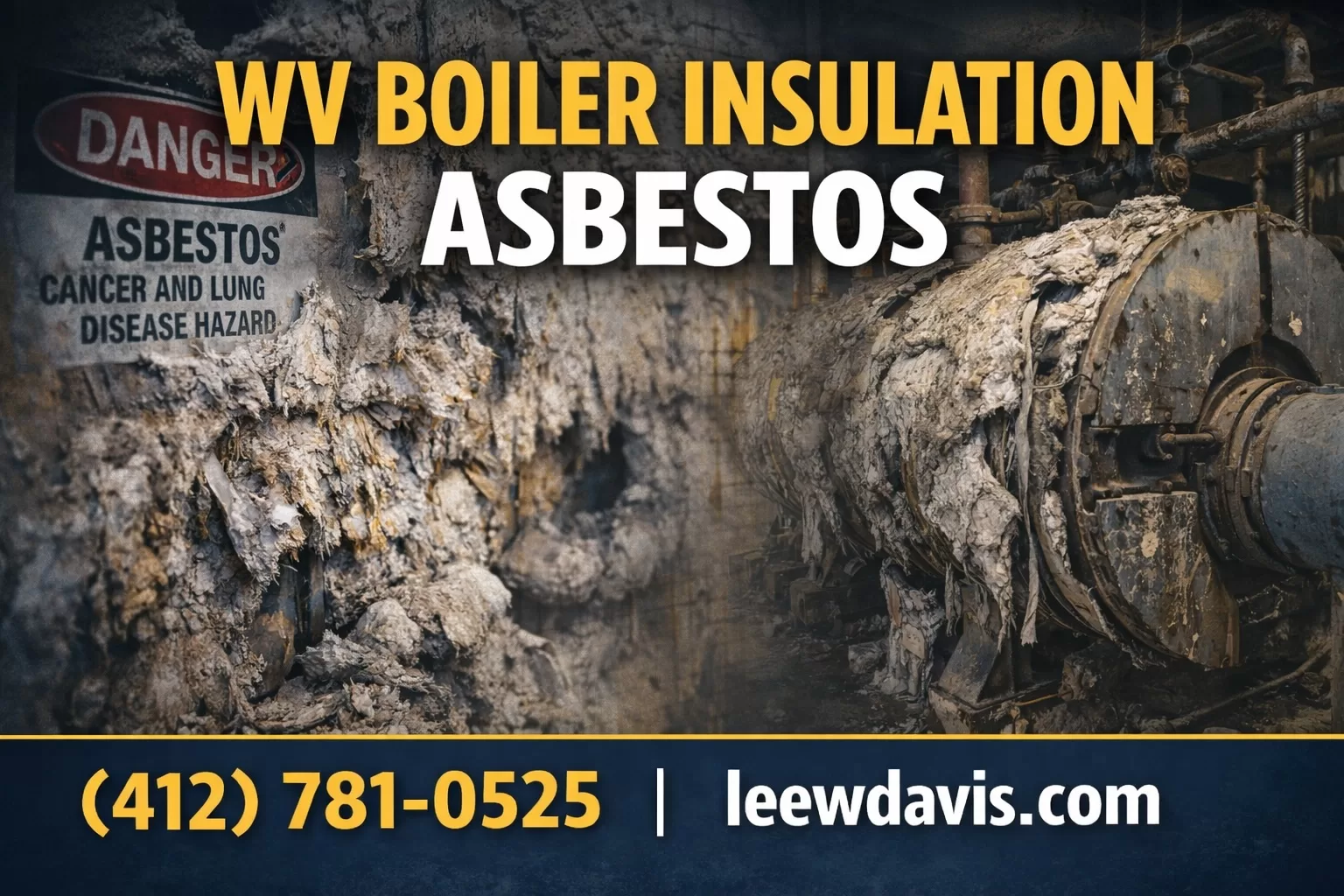
If you worked around WV Boiler Insulation Asbestos, you may have been exposed to dangerous fibers without realizing it. Boilers were commonly wrapped, packed, and repaired using insulation products that could shed dust during installation, maintenance, and tear-out. In West Virginia, that kind of day-to-day work exposure is one of the most common pathways to mesothelioma and other asbestos diseases.
Mesothelioma/Asbestos Legal Help – WV, MI & PA
Speak directly with attorney Lee W. Davis. No call centers. Free, confidential review.
Boiler insulation exposure often happened in power plants, chemical facilities, steel operations, refineries, hospitals, schools, and older commercial buildings—anywhere a boiler system had to be kept hot and efficient. The risk rises during shutdowns and major repairs, when insulation is cut, removed, scraped, or replaced.
Why boiler insulation was a major asbestos source
Boilers ran hot, and older insulation materials were built to resist heat. That’s exactly why asbestos was used. The dust risk is typically highest during:
Insulation removal or replacement (“tear-out”)
Repacking valves, flanges, and connections
Cutting or trimming insulation block/blanket wrap
Sweeping, vacuuming, or cleaning after maintenance
Outage work where multiple trades disturb old materials
Pipefitters, boilermakers, maintenance mechanics, insulators, millwrights, electricians, and laborers were often in the same work area—meaning exposure wasn’t limited to the person doing the removal. It could be in the air, on clothing, and on tools.
What makes these cases winnable
Most successful claims are built like this:
Work history (where you worked, what you did, when you did it)
Site and equipment context (boiler rooms, outages, insulation work, repairs)
Medical proof (diagnosis records, pathology if available)
Product/company identification (what insulation or components were used, who supplied them)
Witness support (co-worker statements when needed)
You do not need to remember every product name from 30–40 years ago to have a viable case. The evidence often comes from jobsite pattern proof, co-worker corroboration, historic purchasing, and trade usage.
Symptoms and timing
Asbestos diseases frequently have a long latency period—often decades between exposure and diagnosis. People usually start looking for answers only after a serious diagnosis, such as mesothelioma, lung cancer tied to asbestos exposure, or severe asbestosis. If you or a family member has been diagnosed, the most important step is preserving records and documenting your work history while details are still accessible.
West Virginia jobsite proof matters
In West Virginia, jobsite-driven evidence is often the difference between a weak claim and a strong one. If you’re trying to connect your exposure to a specific facility or region, start here:
Mesothelioma wrongful death page: If you’re pursuing a claim after a loss, there are specific steps for family claims and estate recovery.
What to do now
If you suspect WV Boiler Insulation Asbestos exposure:
Write down the sites, years, and trades involved (even rough estimates help)
Gather diagnosis records and any pathology reports
List co-workers who remember outages, boiler rebuilds, or insulation tear-outs
Don’t wait—deadlines can run quickly once a diagnosis occurs
Free Consultation
If you or a loved one has a mesothelioma or asbestos-related diagnosis and believe the exposure involved WV Boiler Insulation Asbestos, call (412) 781-0525 to discuss next steps. Time matters, and the right documentation early can significantly strengthen the claim.
Check If Your Family Was Exposed
Get your free guide instantly + a confidential case review.
🔒 100% Confidential. No obligations.
FAQs
What jobs are most associated with boiler insulation asbestos exposure?
Pipefitters, boilermakers, insulators, millwrights, maintenance mechanics, electricians, and laborers are frequently exposed—especially during outages and repair work.
I worked near the boiler room but didn’t remove insulation. Do I still have a claim?
Yes. Secondary exposure inside the work area is common when insulation is cut, disturbed, or removed, and dust spreads to nearby trades.
What records should I gather first?
Start with diagnosis records, imaging summaries, pathology reports (if available), and a basic work history list of sites and years.
Mesothelioma/Asbestos Legal Help – WV, MI & PA
Speak directly with attorney Lee W. Davis. No call centers. Free, confidential review.
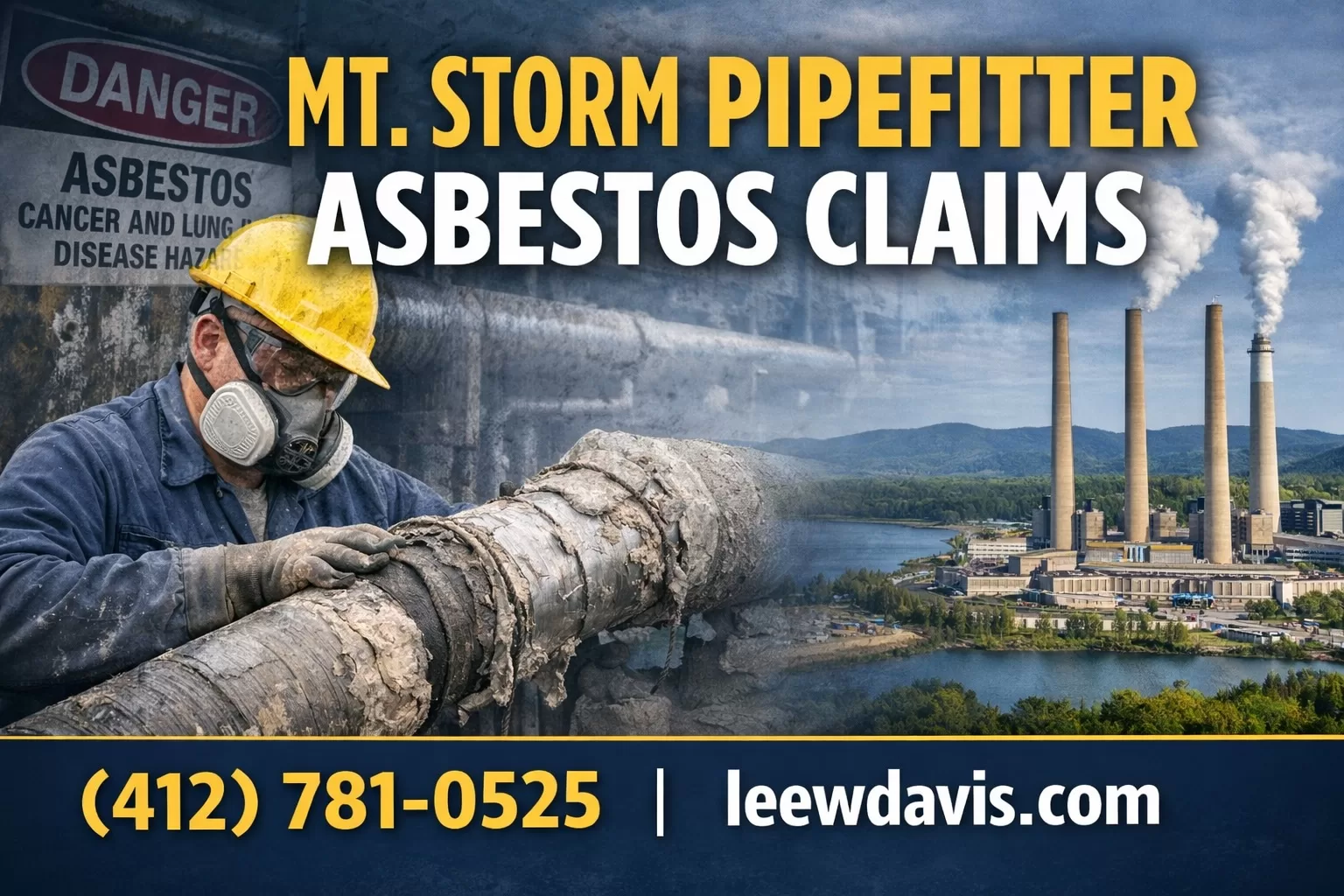
If you’re searching Mt Storm Pipefitter Asbestos, it usually means one thing: you or a family member worked around insulation, gaskets, cement, or high-heat equipment and now there’s a diagnosis—or a scare—you can’t ignore. Mt. Storm’s generating equipment, piping systems, and maintenance areas involved materials that historically were commonly asbestos-containing. Pipefitters were often directly in the zone when those materials were cut, removed, scraped, or replaced.
This page explains what matters most: how pipefitters were exposed, what proof wins these cases, and what to do next.
Mesothelioma/Asbestos Legal Help – WV, MI & PA
Speak directly with attorney Lee W. Davis. No call centers. Free, confidential review.
Where pipefitters encountered asbestos at Mt. Storm
Pipefitters weren’t exposed “in the abstract.” Exposure typically came from hands-on maintenance and shutdown work where asbestos materials were disturbed.
Common exposure points included:
Pipe insulation and block insulation on steam lines, condensate lines, and high-temperature runs
Valve and pump packing removed and replaced during routine maintenance
Flange gaskets (steam, water, chemical lines) scraped and wire-brushed off
Boiler/steam system areas where insulation and refractory materials were present
Turbine-adjacent piping and related mechanical rooms during outages
Cement, mud, and wraps used on pipes and fittings in older systems
The risk rises when material is disturbed and becomes dust—especially in enclosed mechanical spaces or during aggressive outage schedules.
Why pipefitters are a high-risk trade
Pipefitters are high-risk because the work combines:
direct contact with insulation, gaskets, packing, and cement products, and
What evidence makes an Mt. Storm pipefitter case strong
Most people think they need a perfect paper trail. You don’t. Strong cases are built from work history + product/trade exposure + medical proof.
Key evidence usually includes:
Work history: employer names, dates, job titles, crafts/trades, outage work
Site details: areas worked (mechanical rooms, pipe runs, turbine/boiler areas)
Co-worker proof: statements confirming the materials and tasks
Medical records: diagnosis, pathology (for mesothelioma), imaging, treatment
Exposure narrative: the “how” of dust generation—scraping, pulling insulation, grinding gaskets, etc.
If you can describe the work clearly, we can usually build the proof around it.
Can a family bring a claim?
Yes. When asbestos exposure results in death, surviving family members may have a claim depending on the circumstances and timing. If you want the family-claim path explained, start here: the mesothelioma wrongful death page on my site covers what families need to know and what records matter most.
Time matters: do not wait after diagnosis
These claims are not like a property dispute where documents sit in a file cabinet. Witnesses move, memories fade, employers disappear, and jobsite proof gets harder. The sooner we document the work history and medical timeline, the stronger the case usually becomes.
What compensation can include
Every case is different, but damages may include:
Medical expenses and future care
Lost income and loss of earning capacity
Pain and suffering
Family losses (in qualifying cases)
The goal is to build the case the right way—fast, credible, and supported—so the value reflects the harm.
FAQs
What does “Mt Storm Pipefitter Asbestos” mean for a claim?
It typically refers to pipefitter work around asbestos-containing insulation, gaskets, packing, or cement products at Mt. Storm where dust exposure occurred during maintenance or outages.
I worked outages—does that matter?
Yes. Outage work often involves intense removal and replacement tasks that disturb insulation and gaskets. Those are classic high-exposure conditions.
What if I don’t remember product names?
That’s normal. Most clients don’t. We build cases from trade tasks, areas worked, time periods, and corroboration—then match that to known product categories and proof sources.
Call Lee Now
If you have a diagnosis and Mt. Storm pipefitter work history, you should get a legal review now—before the evidence gets harder to capture.
For broader statewide guidance, you can also read my West Virginia mesothelioma lawyer page, which explains how asbestos claims are evaluated across WV worksites.
If you want to see how Mt. Storm fits into the bigger map of exposure locations, my West Virginia asbestos job sites page lists facilities and the types of work historically tied to asbestos exposure.
Check If Your Family Was Exposed
Get your free guide instantly + a confidential case review.
West Virginia Asbestos Products are still one of the most overlooked parts of proving an asbestos case. Many people remember the jobsite or the trade, but not the brand name on a box from 30 years ago. That’s normal. In most cases, you can still build a strong exposure story by identifying the type of product, where it was used, and who handled it.
Asbestos wasn’t just “in the air.” It was built into industrial materials because it resisted heat and corrosion. That means exposure often happened during routine maintenance—cutting, grinding, replacing, scraping, wire-brushing, or blowing out old dust.
Mesothelioma/Asbestos Legal Help – WV, MI & PA
Speak directly with attorney Lee W. Davis. No call centers. Free, confidential review.
A product can be almost anything used in industrial settings that contained asbestos fibers. The legal question is usually: what was it, where was it used, and how did the work release fibers?
Even if you can’t remember a brand name, you can often identify:
Task that disturbed it (removal, cutting, sanding, mixing, cleanup)
Time period (decades matter because product formulas changed)
Common West Virginia asbestos product categories
Thermal insulation
Industrial insulation is one of the most common sources of exposure. It was used to wrap hot systems and conserve energy, especially in power generation and heavy industry.
Typical locations:
Pipe runs, valves, elbows, flanges
Boilers and boiler rooms
Turbines and steam lines
Gaskets and packing
Gaskets and packing were used to seal systems and prevent leaks. They were often replaced during routine maintenance, and removal could create dust—especially when old material was scraped off.
Common applications:
Pumps, compressors, and motors
Valves and flanged piping
Steam and chemical systems
Refractory materials
Refractory products were built to withstand extreme heat—lining furnaces, kilns, ovens, and high-temperature industrial units. Installation and tear-out are high-dust activities.
Common applications:
Steel and metal facilities
Chemical processing units
Foundries and maintenance outages
Asbestos cement and construction materials
Asbestos cement products were used because they were durable and fire resistant. Cutting, drilling, and demolition work could release fibers.
Often found in:
Cement pipe, panels, and boards
Building and industrial structures
Mechanical rooms and older renovations
Electrical and heat-resistant components
Some older electrical equipment and heat shields contained asbestos components—especially where heat, arc, or fire resistance mattered.
Examples:
Heat shields and insulating boards
Equipment panels in older industrial settings
Some high-heat protective barriers
Vehicle and equipment friction materials
Brakes and clutches historically contained asbestos. Exposure often occurred when grinding, blowing out dust, sanding, or replacing components.
Common scenarios:
Fleet maintenance
Heavy equipment shops
Industrial vehicle service
Where these products were commonly encountered in West Virginia
West Virginia work environments frequently associated with asbestos product use include:
Power generation and boiler work
Chemical facilities and maintenance shutdowns
Steel and metal operations
Industrial maintenance departments
Pipefitting, millwright, and mechanical repair work
Construction and demolition on older industrial sites
It is also common for exposure to occur during outages, turnarounds, or shutdowns, when large numbers of trades are brought in and old materials are disturbed at once.
How to prove exposure when you don’t remember brand names
Most people don’t remember the label—especially if they were focused on getting a job done. Proof often comes from combining:
Your work history (jobs, years, duties, locations)
Coworker testimony (who used what, where, and when)
Industrial records (maintenance logs, parts lists, purchasing records when available)
Product identification patterns (what was commonly used in that kind of system and era)
Medical records linking disease to asbestos exposure
A strong case does not require perfection. It requires a credible, consistent exposure narrative supported by records and testimony.
Talk to a West Virginia mesothelioma lawyer
If you believe West Virginia Asbestos Products exposed you to asbestos and you’ve been diagnosed with mesothelioma, lung cancer, or another asbestos-related disease, you may have legal options. The key is acting promptly and preserving your work and medical history before records disappear.
Get your free guide instantly + a confidential case review.
🔒 100% Confidential. No obligations.
Read More:
For a deeper look at where exposures commonly occurred, see my West Virginia asbestos job sites page, which organizes major industries and work environments across the state.
If you’ve already been diagnosed and want to understand the legal process and timelines, my West Virginia mesothelioma lawyer pageexplains how asbestos claims are built and pursued.
When families are involved after a loss, my mesothelioma wrongful death page explains what surviving relatives can recover and how those claims differ.
FAQs
What are the most common West Virginia asbestos products?
The most common categories include thermal insulation, gaskets and packing, refractory materials, asbestos cement products, heat-resistant boards, and some older friction materials like brakes and clutches.
Do I need the brand name of the asbestos product to file a claim?
Not always. Many cases can be built through product category identification, work history, coworker testimony, and records that show what was typically used in that type of facility and time period.
Where were asbestos products most often used in West Virginia?
They were frequently used in power generation, chemical operations, steel and metal facilities, industrial maintenance work, and older construction or demolition involving mechanical rooms and high-heat systems.
Mesothelioma/Asbestos Legal Help – WV, MI & PA
Speak directly with attorney Lee W. Davis. No call centers. Free, confidential review.