Pennsylvania Asbestos Claim Deadline

Pennsylvania Asbestos Claim Deadline

The Pennsylvania asbestos claim deadline is the most misunderstood aspect of mesothelioma and asbestos lung cancer litigation — and the misunderstanding causes legitimate claims to go unfiled every year. Workers who were exposed to asbestos at Pennsylvania industrial facilities decades ago, and who have only recently received a mesothelioma or lung cancer diagnosis, frequently assume that too much time has passed to file a claim. That assumption is almost always wrong. And it is a costly mistake.

Mesothelioma/Asbestos Legal Help – WV, MI & PA

Speak directly with attorney Lee W. Davis. No call centers. Free, confidential review.

This page explains how the Pennsylvania asbestos claim deadline actually works — the two-year statute of limitations, the discovery rule that determines when that clock starts running, the separate deadlines that apply to wrongful death claims, and the common misconceptions that cause Pennsylvania asbestos claimants to abandon viable claims before they are ever evaluated.

The Fundamental Rule: Pennsylvania’s Clock Starts at Diagnosis, Not Exposure

The most important fact about the Pennsylvania asbestos claim deadline is this: Pennsylvania’s two-year statute of limitations for mesothelioma and asbestos lung cancer claims runs from the date of diagnosis — not from the date of asbestos exposure.

This matters enormously for Pennsylvania industrial workers. A steelworker who was exposed to asbestos at the Clairton Coke Works in 1968 and who received a mesothelioma diagnosis in 2024 has until 2026 to file a personal injury claim — not 1970. The fifty-six years between the exposure and the diagnosis are irrelevant to the deadline calculation. Pennsylvania law recognizes that mesothelioma has a latency period of twenty to fifty years between asbestos exposure and the onset of disease — and structures the filing deadline accordingly, starting the clock at the point when the harm becomes known rather than when the exposure occurred.

This rule applies whether the exposure occurred at Pennsylvania industrial facilities in the 1950s, 1960s, 1970s, or 1980s. Workers from the peak asbestos exposure era who are receiving diagnoses today are typically well within the Pennsylvania filing window from the date of their diagnosis.

The Discovery Rule — When Diagnosis Triggers the Clock

Pennsylvania follows the discovery rule for asbestos claims — the statute of limitations begins running when the plaintiff knew or reasonably should have known of the diagnosis and its relationship to asbestos exposure. In practical terms, that means the two-year clock typically begins at the pathology-confirmed diagnosis of mesothelioma or asbestos-related lung cancer.

Key points about the discovery rule as applied to Pennsylvania asbestos claims:

The clock runs from confirmed diagnosis, not from the first symptom. Shortness of breath, chest pain, and pleural effusion — the symptoms that commonly precede a mesothelioma diagnosis — do not start the statute of limitations clock. The clock begins when the diagnosis is confirmed, typically by pathology following a biopsy or surgical procedure.

A suspicion of mesothelioma is not a diagnosis. If a physician has indicated that mesothelioma is possible or suspected but has not confirmed the diagnosis through pathology, the statute of limitations clock may not yet be running. However, this is a fact-specific determination that requires a lawyer’s evaluation — do not rely on this general principle without speaking with an attorney.

Earlier asbestos-related diagnoses may have started a separate clock. Workers who were previously diagnosed with asbestosis or pleural plaques — conditions distinct from mesothelioma and lung cancer — may have had a separate statute of limitations clock running on those conditions. However, a later mesothelioma or lung cancer diagnosis typically triggers a new and independent limitations period. Call to discuss the specific sequence of diagnoses in your situation.


Wrongful Death Deadlines — A Separate and Often Shorter Clock

When a Pennsylvania worker dies from mesothelioma or asbestos lung cancer before a personal injury claim is resolved — or before one is filed — surviving family members may file wrongful death and survival action claims. Those claims carry their own filing deadlines, and those deadlines are different from the personal injury statute of limitations.

Pennsylvania wrongful death claims run from the date of death. Pennsylvania law gives surviving family members two years from the date of the worker’s death to file a wrongful death claim. That two-year clock runs from death — not from the date of diagnosis, and not from the date of asbestos exposure.

The practical implication is that wrongful death deadlines are often more urgent than personal injury deadlines. A worker who was diagnosed with mesothelioma and lived for eighteen months before passing away leaves surviving family members with a wrongful death deadline running from the date of death — which may be significantly shorter in practical terms than the personal injury window would have been.

Prior personal injury settlements do not necessarily bar wrongful death claims. If a worker filed and settled a personal injury asbestos claim during their lifetime, that prior settlement does not automatically bar a wrongful death claim by surviving family members. Pennsylvania law treats wrongful death and survival actions as distinct claims with distinct damages. The terms of any prior settlement should be reviewed by an attorney to determine whether a wrongful death claim remains available.

Call immediately if a family member has recently passed away. If a Pennsylvania worker died from mesothelioma or asbestos lung cancer within the past two years, the wrongful death filing window is open but running. Every month that passes without filing reduces the time available to complete the investigation and file the claim. Call as soon as possible.

Trust Fund Deadlines — A Parallel System With Its Own Timing

Pennsylvania asbestos claims involve two distinct compensation systems: civil litigation against product manufacturers in Pennsylvania courts, and trust fund claims against the asbestos bankruptcy trusts established by manufacturers who declared bankruptcy under the weight of asbestos litigation. The Pennsylvania asbestos claim deadline discussion must address both.

Trust fund claims are not governed by the same statute of limitations as civil claims. Each asbestos bankruptcy trust operates under its own trust distribution procedures, with its own claim filing requirements and timing rules. Some trusts have relatively open filing windows. Others have requirements that interact with the civil litigation timeline in ways that require careful coordination.

Filing trust claims sooner rather than later is always advisable. While trust fund claims do not always carry the same hard two-year deadline as Pennsylvania civil claims, there are practical reasons to file trust claims as early as possible — trust payment schedules can be affected by when a claim is filed relative to the trust’s current payment percentage, and some trust requirements are more easily satisfied when the claim is filed while witnesses and records are more readily available.

The interaction between trust claims and civil litigation requires attorney coordination. How trust claims are filed, in what order, and in relation to any civil litigation filing can affect the total recovery available. An experienced Pennsylvania asbestos attorney coordinates both tracks simultaneously to maximize recovery across both systems. See Pennsylvania asbestos trust claims for the full trust fund claims profile.

Mesothelioma/Asbestos Legal Help – WV, MI & PA

Speak directly with attorney Lee W. Davis. No call centers. Free, confidential review.

The Five Most Common Deadline Misconceptions That Cost Pennsylvania Claimants Their Claims

Misconception 1: “I was exposed thirty years ago — it’s too late to file.” Wrong. Pennsylvania’s statute of limitations runs from diagnosis, not exposure. Thirty, forty, or fifty years between exposure and diagnosis is legally irrelevant to the filing deadline. What matters is the date of the confirmed mesothelioma or lung cancer diagnosis — and whether two years have passed since that date.

Misconception 2: “The company I worked for went out of business — there’s no one to sue.” Wrong. Pennsylvania asbestos claims are filed against the manufacturers and suppliers of the asbestos-containing products used at industrial facilities — not against the facility or the employer. Many of those product manufacturers established bankruptcy trust funds precisely because they faced liability from products used at thousands of facilities including those in Pennsylvania. Those trusts remain active and continue paying claims regardless of whether the employing company still exists. See Pennsylvania asbestos exposure lawyer for the full product identification profile.

Misconception 3: “My husband filed a claim years ago and settled it. Our family can’t file again.” Possibly wrong. A prior personal injury settlement by the worker does not necessarily bar a wrongful death claim by surviving family members after the worker passes away from mesothelioma or asbestos lung cancer. The terms of prior settlements and Pennsylvania wrongful death law interact in ways that require an attorney’s specific evaluation. Do not assume a prior settlement bars all future claims without speaking with a Pennsylvania asbestos attorney.

Misconception 4: “I smoked, so I can’t blame asbestos for my lung cancer.” Wrong as a legal matter. Pennsylvania law does not require asbestos to be the sole or exclusive cause of lung cancer — only that it was a contributing cause. The multiplicative relationship between asbestos exposure and cigarette smoke in producing lung cancer is well-established in medical and legal literature. Pennsylvania workers with both a smoking history and documented occupational asbestos exposure at Pennsylvania industrial facilities have pursued and recovered compensation for asbestos lung cancer. See Pittsburgh asbestos lung cancer for the lung cancer claim profile.

Misconception 5: “I don’t remember enough specifics to file a claim before the deadline.” Wrong. The product identification investigation — connecting your work history at Pennsylvania industrial facilities to the specific asbestos-containing product manufacturers responsible for your exposure — is the attorney’s job, not yours. You do not need to remember product names, brand names, or specific incident dates to call before the deadline. You need to call. The investigation is built from the starting point of what you do remember, and from the accumulated documentary record of decades of Pennsylvania industrial asbestos litigation. See Pennsylvania asbestos product identification for how that investigation works.

Mesothelioma/Asbestos Legal Help – WV, MI & PA

Speak directly with attorney Lee W. Davis. No call centers. Free, confidential review.

What to Do If You Are Uncertain Whether Your Pennsylvania Deadline Has Passed

If you are uncertain whether the Pennsylvania asbestos claim deadline has passed in your specific situation — whether because of uncertainty about the date of diagnosis, uncertainty about whether a prior claim affects the current situation, or uncertainty about the wrongful death timing — the right step is to call an experienced Pennsylvania asbestos attorney immediately for a deadline evaluation.

Do not assume the deadline has passed without that evaluation. The consequences of a wrong assumption are permanent — a claim that could have been filed is permanently barred. The cost of calling and finding out the deadline has passed is zero. The cost of not calling and finding out later that the deadline had not yet passed is the claim itself.

The deadline evaluation is free. The call is direct — you speak with me, not a case manager. And the evaluation of whether your Pennsylvania asbestos claim deadline has passed or remains open can typically be made in the initial consultation.

For more on what happens after the deadline question is resolved see Pennsylvania mesothelioma claim steps. For the immediate post-diagnosis action guide see Diagnosed With Mesothelioma in Pennsylvania. For the wrongful death process for surviving families see mesothelioma wrongful death claim. For the broader Pennsylvania mesothelioma legal framework see Pennsylvania mesothelioma lawyer. For the compensation overview see Pennsylvania mesothelioma compensation claims.

Knowledge of Pennsylvania Asbestos Claim Deadlines and Filing Requirements Since 1989

I began researching Pennsylvania asbestos cases in 1989, working as a paralegal on asbestos mass trials across Pennsylvania and West Virginia. I was licensed in Pennsylvania in 1996 and in West Virginia in 2002. I returned to Pittsburgh in 1999 and have handled mesothelioma and asbestos lung cancer cases individually across Pennsylvania, West Virginia, and Michigan ever since — evaluating Pennsylvania asbestos claim deadlines, filing within those deadlines, and pursuing expedited proceedings when a patient’s medical condition requires moving faster than the standard civil timeline allows.

When you call, you speak directly with me. No call centers. No case managers.

If you are concerned that the Pennsylvania asbestos claim deadline in your situation may be approaching or may have passed, call today. The evaluation is free. The call takes minutes. The deadline does not wait.

Call (412) 781-0525 or start your confidential case review online now.

Check If Your Family Was Exposed

Get your free guide instantly + a confidential case review.

🔒 100% Confidential. No obligations.


Frequently Asked Questions

Q: I was diagnosed with mesothelioma in Pennsylvania fourteen months ago and haven’t filed a claim yet. How much time do I have left?

A: If your diagnosis was fourteen months ago and Pennsylvania’s two-year statute of limitations applies, you have approximately ten months remaining in the personal injury filing window — but that calculation assumes no complications from prior diagnoses, prior settlements, or other facts that could affect the limitations period. Call immediately. Ten months is enough time to build and file a Pennsylvania mesothelioma claim, but the investigation takes time and the remaining window narrows every week. Do not wait.

Q: My father died from mesothelioma in Pennsylvania eight months ago. He never filed a claim. Can our family still file a wrongful death claim?

A: Yes — and call immediately. Pennsylvania wrongful death claims run two years from the date of death. Eight months have elapsed, leaving approximately sixteen months in your wrongful death filing window. That window is sufficient to build and file the claim, but the investigation — identifying the Pennsylvania facilities where your father worked, the asbestos-containing products used there, and the applicable trust funds and civil defendants — takes time. Call now so that investigation can begin before the wrongful death window narrows further.

Q: How does the Pennsylvania asbestos claim deadline interact with asbestos bankruptcy trust fund claims?

A: Trust fund claims operate under their own timing rules, separate from Pennsylvania’s two-year civil statute of limitations. However, the practical advice is the same — file as early as possible. Trust payment schedules, evidentiary requirements, and the interaction between trust claims and any civil litigation filing are all managed more effectively when the claim process begins promptly after diagnosis. An experienced Pennsylvania asbestos attorney coordinates the civil and trust fund timelines simultaneously. See Pennsylvania asbestos trust claims for the full trust fund process explanation.

Mesothelioma/Asbestos Legal Help – WV, MI & PA

Speak directly with attorney Lee W. Davis. No call centers. Free, confidential review.

Pennsylvania Asbestos Exposure Lawyer

Pennsylvania Asbestos Exposure Lawyer

A Pennsylvania asbestos exposure lawyer does something that most people don’t expect is possible: reconstructs an occupational asbestos exposure history that occurred thirty, forty, or fifty years ago at industrial facilities that may no longer exist — from records, from product documentation, and from the accumulated case history of Pennsylvania industrial asbestos litigation — and connects that reconstructed history to a mesothelioma or lung cancer diagnosis today.

That reconstruction is possible. It happens in viable Pennsylvania asbestos claims every year. And it is the core skill that separates an attorney with genuine Pennsylvania industrial asbestos experience from a general personal injury lawyer or a national intake operation that gathers information and passes it elsewhere.

Mesothelioma/Asbestos Legal Help – WV, MI & PA

Speak directly with attorney Lee W. Davis. No call centers. Free, confidential review.

If you have been diagnosed with mesothelioma or lung cancer and worked at Pennsylvania industrial facilities during your career — but you don’t remember the brand names of products, don’t have employment records from facilities that closed decades ago, and are uncertain whether your claim has sufficient documentation to be viable — this page explains how a Pennsylvania asbestos exposure lawyer builds the exposure case that you cannot build yourself.

Why Pennsylvania Industrial Asbestos Exposure Is Reconstructable

Pennsylvania’s industrial asbestos history is one of the most thoroughly documented in the country — not by accident, but because Pennsylvania was one of the most industrially active states in the country during the peak decades of asbestos use, and because decades of asbestos litigation involving Pennsylvania facilities has produced an enormous body of product identification documentation, facility records, contractor records, and prior witness testimony that an experienced Pennsylvania asbestos exposure lawyer can draw on to reconstruct any specific worker’s exposure history.

The documentation that drives Pennsylvania asbestos exposure reconstruction includes:

Product identification records from prior litigation — Decades of Pennsylvania asbestos litigation have produced extensive documentation of which asbestos-containing products — which pipe insulation manufacturers, which gasket and packing suppliers, which refractory companies — supplied which Pennsylvania industrial facilities during which time periods. That documentation exists in deposition transcripts, expert reports, product identification databases, and facility-specific exposure records built up across thousands of prior cases involving Pennsylvania industrial workers. A Pennsylvania asbestos exposure lawyer with decades of case experience draws directly on that accumulated record.

Pennsylvania facility-specific exposure histories — Major Pennsylvania industrial facilities — the Clairton Coke Works, the Homestead Works, Cheswick Power Station, Armco Steel Butler Works, Crucible Steel Midland, Bethlehem Steel, and scores of others — have documented exposure histories built from decades of litigation involving workers from those specific facilities. Knowing that a worker spent their career at one of those facilities gives an experienced Pennsylvania asbestos exposure lawyer a documented starting point for product identification that does not depend on the individual worker’s memory of specific brand names.

Union records and dispatch documentation — Pennsylvania industrial workers who were members of the Boilermakers, Pipefitters UA, IBEW, United Steelworkers, or Millwrights locals left dispatch and membership records with their unions that document which facilities they were sent to and during what periods. Those records establish the work history even when the individual worker no longer has employment records from facilities that closed decades ago.

Social Security earnings records — Social Security Administration earnings records list every employer who reported wages for a worker throughout their career, with the years and amounts. For Pennsylvania industrial workers, those records can reconstruct an entire career’s employer history from a single government document available by request.

Prior witness testimony — In Pennsylvania asbestos litigation, former coworkers from specific facilities have provided depositions and affidavits documenting the conditions at those facilities — the specific insulation contractors who worked there, the products that were used, the maintenance practices that disturbed those products. That prior testimony is available to support new claims involving the same facilities and time periods.


How a Pennsylvania Asbestos Exposure Lawyer Builds Your Specific Case

The exposure investigation process for a Pennsylvania asbestos claim begins with what the claimant knows — however little that may be — and builds outward through documentary and testimonial evidence.

Step one: The work history baseline. The starting point is the claimant’s own account of where they worked in Pennsylvania, what they did, and roughly when. This does not require remembering product names, manufacturer names, or specific incident dates. It requires the facility names, job titles, counties, and approximate years that frame the career history. That baseline — even a partial one — is sufficient to begin the investigation.

Step two: Record collection to fill gaps. From the work history baseline, the attorney pursues the records that document the employment history more precisely — Social Security earnings records to confirm all employers and time periods, union dispatch records to confirm specific job site assignments, pension documentation to confirm employer relationships. These records fill the gaps in the individual’s recollection and establish the documented employment history that is the foundation of the exposure claim.

Step three: Facility-specific product identification. With the documented work history established, the attorney maps that history to the asbestos-containing products used at each Pennsylvania facility during the relevant time periods — drawing on the accumulated product identification documentation from prior Pennsylvania asbestos litigation involving those specific facilities. The result is a documented list of specific product defendants — the manufacturers and suppliers of the asbestos-containing materials the claimant encountered throughout their career at Pennsylvania industrial facilities — that could not have been compiled from the claimant’s memory alone.

Step four: Trust fund and civil defendant identification. From the product defendant list, the attorney identifies which manufacturers established asbestos bankruptcy trust funds — and files claims against every applicable trust — and which manufacturers remain as civil litigation defendants in Pennsylvania courts. This determination requires knowledge of the trust fund system that is specific to asbestos litigation practice, not general legal practice.

Step five: Exposure narrative development. The attorney synthesizes the work history, the product identification, and any available witness testimony into the exposure narrative that supports both the trust fund claims and the civil litigation — a documented account of when, where, and through which specific products the claimant was exposed to asbestos at Pennsylvania industrial facilities throughout their career.

The Pennsylvania Facilities Where Asbestos Exposure Reconstruction Is Most Thoroughly Documented

Some Pennsylvania industrial facilities have more thoroughly developed exposure documentation than others — because more prior cases have involved those specific facilities, producing more extensive product identification records and witness testimony. Workers from these facilities typically have the most thoroughly reconstructable exposure histories:

Western PA steel and coke corridor — US Steel’s Clairton, Braddock, Irvin, and Homestead operations, Jones & Laughlin’s Pittsburgh and Aliquippa facilities, Wheeling-Pittsburgh Steel, Sharon Steel, Allegheny Ludlum Brackenridge, and Armco Steel Butler are among the most thoroughly documented Pennsylvania industrial facilities in asbestos litigation.

Pennsylvania power generating stationsCheswick, Keystone, Bruce Mansfield, Hatfield Ferry, and the Duquesne Light generating stations throughout western PA have documented exposure histories from prior litigation involving those facilities. See Pennsylvania power plant asbestos for the full statewide power plant exposure profile.

Chemical and manufacturing facilitiesPPG Tarentum, Neville Island Coke and Chemical, Koppers Clairton, Babcock & Wilcox Beaver Falls, and other major Pennsylvania chemical and manufacturing facilities have documented product histories from prior asbestos litigation.

Specialty steel operationsCrucible Steel Midland and Allegheny Ludlum specialty steel operations have documented exposure histories from decades of asbestos litigation involving specialty steel workers throughout western PA.

Who a Pennsylvania Asbestos Exposure Lawyer Represents

This practice represents Pennsylvania workers across the full range of industrial exposure histories and diagnoses:

Knowledge of Pennsylvania Asbestos Exposure Cases Since 1989

I began researching Pennsylvania asbestos exposure cases in 1989, working as a paralegal on asbestos mass trials across Pennsylvania and West Virginia — building the product identification and facility exposure documentation that drove those early cases. I was licensed in Pennsylvania in 1996 and in West Virginia in 2002. I returned to Pittsburgh after supervising 3,200 GM Foundry Asbestos Cases in 1999 and have handled mesothelioma and asbestos lung cancer cases individually across Pennsylvania, West Virginia, and Michigan ever since.

The exposure reconstruction work I do for Pennsylvania asbestos claims today draws directly on more than three decades of accumulated facility knowledge, product identification experience, and Pennsylvania industrial asbestos case history. That accumulated knowledge is what makes the reconstruction viable — and what makes it more thorough for a Pennsylvania industrial worker than anything a national intake operation can provide.

When you call, you speak directly with me. No call centers. No case managers.

Call (412) 781-0525 or start your confidential case review online now.

Check If Your Family Was Exposed

Get your free guide instantly + a confidential case review.

🔒 100% Confidential. No obligations.


Frequently Asked Questions

Q: I worked at Pennsylvania industrial facilities for thirty years but I genuinely don’t remember the names of any asbestos products I was exposed to. Can a Pennsylvania asbestos exposure lawyer still build a viable claim?

A: Yes — and this is the most common situation in Pennsylvania industrial asbestos claims. Almost no claimant remembers the brand names of the asbestos-containing products they encountered decades ago at Pennsylvania facilities. The product identification work — connecting your work history at specific Pennsylvania facilities to the documented products used at those facilities during the relevant time periods — is the attorney’s investigative job, not yours. What you need to provide is the work history: the facilities, the trades, the counties, the approximate years. The product identification is reconstructed from there using accumulated case documentation from decades of Pennsylvania asbestos litigation.

Q: The Pennsylvania facility where I worked closed in the 1980s and the company that owned it went bankrupt. Is there still a viable asbestos exposure claim?

A: Frequently yes. Pennsylvania asbestos claims are filed against the manufacturers and suppliers of the asbestos-containing products used at the facility — not against the facility or its owner. Many of those product manufacturers established asbestos bankruptcy trust funds precisely because they faced massive litigation exposure from products used at facilities throughout Pennsylvania and across the country. Those trust funds remain active today and continue to pay valid claims from Pennsylvania workers whose facility closed decades ago. Facility closure and employer bankruptcy do not bar the claim against the product manufacturers.

Q: How do I know if my lung cancer — rather than mesothelioma — was caused by asbestos exposure at a Pennsylvania facility?

A: The connection between lung cancer and asbestos exposure is well-established in medical and legal literature. Pennsylvania industrial workers with significant occupational asbestos exposure histories who develop lung cancer — regardless of smoking history — have a potentially viable asbestos lung cancer claim. The legal standard does not require proving asbestos was the exclusive cause of the lung cancer, only that it was a contributing cause. An experienced Pennsylvania asbestos exposure lawyer evaluates both the diagnosis and the occupational history to determine whether a viable lung cancer claim exists. That evaluation is free and without obligation.

Mesothelioma/Asbestos Legal Help – WV, MI & PA

Speak directly with attorney Lee W. Davis. No call centers. Free, confidential review.

Pennsylvania Industrial Asbestos Exposure

Pennsylvania Industrial Asbestos Exposure

Pennsylvania industrial asbestos exposure created one of the most concentrated mesothelioma and asbestos lung cancer legacies in the United States. From the steel and coke corridor along the Mon Valley and Ohio River through the Lehigh Valley’s integrated steel operations, the Delaware Valley’s shipyards and refineries, the anthracite coal region’s preparation and processing facilities, the natural gas and chemical operations of central Pennsylvania, and the paper mills, glass plants, and manufacturing facilities distributed across the Commonwealth — Pennsylvania industrial workers at facilities throughout the state were placed in contact with asbestos-containing materials throughout their careers, without warning and without protection, across the most productive decades of Pennsylvania’s industrial economy.

If you worked at a Pennsylvania industrial facility and have been diagnosed with mesothelioma or lung cancer, you may have a viable legal claim against the manufacturers of the asbestos-containing products that caused your exposure. The claim is typically not against your former employer — it is against the product manufacturers who supplied the insulation, gaskets, refractory, and asbestos-containing equipment components that created your exposure throughout your career at Pennsylvania industrial facilities.

Pennsylvania’s Industrial Asbestos Legacy — Statewide and Multi-Sector

Pennsylvania’s industrial asbestos history spans the full state and includes every major sector of American industrial production:

Steel and coke production — Western Pennsylvania’s integrated steel operations along the Mon Valley, Ohio River, and Allegheny Valley were among the most asbestos-intensive industrial environments in the country. The Homestead Works, Clairton Coke Works, Allegheny Ludlum Brackenridge, Sharon Steel, Armco Steel Butler Works, and Crucible Steel Midland represent the western PA steel sector at its most documented. Bethlehem Steel’s massive Lehigh Valley operations extended Pennsylvania’s steel asbestos legacy across the state.

Power generation — Pennsylvania’s coal-fired generating stations — Cheswick, Keystone, Bruce Mansfield, Hatfield Ferry, and the Duquesne Light stations throughout western PA, along with generating facilities throughout the state — employed workers at facilities built entirely around boiler and turbine systems that required heavy asbestos insulation. See Pennsylvania power plant asbestos for the full statewide power generation profile.

Chemical manufacturing — The chemical plants and refineries concentrated in the Delaware Valley — including major DuPont, Sunoco, and petrochemical operations — and distributed across Pennsylvania’s industrial geography employed workers on process piping systems carrying high-temperature, high-pressure materials through asbestos-insulated systems throughout their operational histories.

Shipbuilding — Pennsylvania’s Delaware River shipyards built naval vessels, tankers, and commercial ships for generations. Shipyard workers — particularly boilermakers, pipefitters, and insulators working in the confined interior spaces of ship hulls — accumulated among the most severe asbestos exposure of any industrial sector in the state.

Glass manufacturing — PPG Industries glass plants at Creighton, Ford City, and Meadville, together with the specialty glass operations at facilities throughout Westmoreland, Fayette, and Armstrong Counties, exposed generations of workers to asbestos-containing insulation, refractory, and furnace materials throughout Pennsylvania’s glass manufacturing economy.

Coal mining and preparation — Pennsylvania’s bituminous coal region in the southwest and the anthracite region in the northeast both operated preparation plants, utility steam systems, and surface plant mechanical infrastructure that required asbestos-containing insulation and gasket materials throughout their operational lives.

Manufacturing and fabrication statewide — Pennsylvania’s manufacturing economy — from the PPG chemical plant at Neville Island, to the Koppers operations at Clairton and Bridgeville, to the specialty manufacturing facilities distributed across the Commonwealth — employed industrial workers throughout facilities where asbestos-containing materials were present in every utility system, every piece of heat-intensive process equipment, and every mechanical installation throughout the facility.

The Trades Most Commonly Involved in Pennsylvania Industrial Asbestos Claims

Pennsylvania industrial asbestos exposure affected workers across every trade and every role in the industrial workforce. The trade-specific pages in this practice cover the most common claim pathways for Pennsylvania industrial workers:

Boilermakers — Workers who built, maintained, and rebuilt boilers, furnaces, and pressure vessels throughout Pennsylvania industrial facilities. See Pennsylvania boilermaker asbestos.

Pipefitters and steamfitters — Workers who installed and maintained the steam and process piping systems running throughout Pennsylvania industrial facilities. See Pennsylvania pipefitter asbestos.

Electricians — Workers who maintained electrical systems, panels, and switchgear throughout Pennsylvania industrial facilities, with exposure from asbestos-containing arc suppression components and surrounding insulation. See Pennsylvania electrician asbestos.

Millwrights — Workers who maintained the mechanical systems and equipment throughout Pennsylvania industrial facilities on a plant-wide basis. See Pennsylvania millwright asbestos.

Turbine workers — Workers who maintained turbine systems at Pennsylvania power generating stations and industrial facilities, with exposure from turbine casing insulation and associated steam system components. See Pennsylvania turbine asbestos.

Plant engineers and supervisors — Salaried engineering and supervisory personnel who oversaw Pennsylvania industrial operations and accumulated asbestos exposure through continuous plant presence and maintenance oversight. See Pennsylvania plant engineer asbestos.

Insulators — The trade most directly associated with applying and removing asbestos-containing insulation at Pennsylvania industrial facilities.

Steelworkers and production workers — Production workers throughout Pennsylvania’s steel, glass, and manufacturing facilities who accumulated exposure from the asbestos-containing materials surrounding them throughout their working environments.

County-Specific Pennsylvania Industrial Asbestos Resources

Our practice has built a comprehensive set of county-specific resources for the Pennsylvania counties with the most concentrated industrial asbestos exposure histories. If your work was centered in a specific Pennsylvania county, the county-specific resources provide the most detailed facility and trade information for your region:

Allegheny CountyAllegheny County asbestos exposure | Allegheny County boiler asbestos | Pittsburgh industrial asbestos

Westmoreland CountyWestmoreland County asbestos lawsuit | Westmoreland County boiler asbestos | Westmoreland County plant engineer asbestos

Beaver CountyBeaver County boiler asbestos | Beaver County plant engineer asbestos

Washington CountyWashington County asbestos lawyer | Washington County boiler asbestos

Butler CountyButler County boiler asbestos

Greene CountyGreene County asbestos lawsuit | Greene County boiler asbestos

Fayette CountyFayette County asbestos lawsuit | Fayette County plant engineer asbestos

How Pennsylvania Industrial Asbestos Claims Work

Most Pennsylvania industrial asbestos claims are filed against the manufacturers and suppliers of the asbestos-containing products used at the industrial facilities where exposure occurred — not against the facilities themselves or the former employers. Those product manufacturers supplied the pipe insulation, boiler insulation, gaskets, valve packing, refractory materials, and asbestos-containing equipment components that created industrial worker exposure throughout Pennsylvania’s industrial facilities.

Many of those manufacturers declared bankruptcy and established asbestos compensation trusts. More than sixty trusts remain active and continue to pay valid claims. The Pennsylvania asbestos trust claims resource explains how trust claims work and what evidence is required.

For facilities and product manufacturers that did not go through bankruptcy, civil litigation in Pennsylvania courts — under the well-established legal framework that governs Pennsylvania asbestos claims — provides the path to recovery. The Pennsylvania asbestos lawyer resource provides a broader overview of the Pennsylvania legal framework for industrial asbestos claims.

Pennsylvania’s statute of limitations runs from the date of diagnosis — not the date of exposure decades earlier. That means workers who were exposed at Pennsylvania industrial facilities throughout the 1950s, 1960s, 1970s, and 1980s and who have only recently received a mesothelioma or lung cancer diagnosis are typically still within the filing window. Do not assume it is too late.

Knowledge of Pennsylvania Industrial Asbestos Cases Since 1989

I first began researching Pennsylvania industrial asbestos cases in 1989, working as a paralegal on asbestos mass trials across Pennsylvania and West Virginia — building the exposure documentation and product identification work that drove those cases from their earliest stages. I was licensed in Pennsylvania in 1996 and in West Virginia in 2002, and I returned to Pittsburgh in 1999 to handle mesothelioma and lung cancer cases individually, applying decades of Pennsylvania industrial facility knowledge and product identification directly to every case evaluation.

Pennsylvania industrial asbestos cases require knowledge that a national call center cannot provide — knowledge of the specific facilities, the specific products used at those facilities during the relevant time periods, the corporate succession history of the product manufacturers, and the trust claim and litigation pathways that are appropriate for each specific exposure history. That knowledge comes from thirty-five years of working Pennsylvania industrial asbestos cases specifically, not from a generalist national practice.

When you call, you speak directly with me. No call centers. No case managers.

Call (412) 781-0525 or start your confidential case review online now.

Check If Your Family Was Exposed

Get your free guide instantly + a confidential case review.

🔒 100% Confidential. No obligations.


Frequently Asked Questions

Q: I worked at a Pennsylvania industrial facility for thirty years but in a maintenance or supervisory role rather than as a pipefitter or boilermaker. Do I have an asbestos claim?

A: Possibly yes. Pennsylvania industrial asbestos claims are not limited to the skilled trades whose direct contact with insulation is most obvious. Plant engineers, shift supervisors, maintenance mechanics, and other workers who spent careers in Pennsylvania industrial environments accumulated asbestos exposure through continuous presence in environments saturated with asbestos-containing materials, through supervision of maintenance and outage work involving active asbestos disturbance, and through regular inspection of mechanical spaces where ambient fiber concentrations from aging insulation were highest. The specific role matters less than the occupational history — where you worked, what you did, and how long you spent in environments containing asbestos-containing materials. Call to discuss your specific work history and diagnosis.

Q: The Pennsylvania facility where I worked has been closed for years. Can I still file an asbestos claim for exposure at that facility?

A: Yes. Pennsylvania asbestos claims are filed against the manufacturers and suppliers of the asbestos-containing products used at the facility — not against the facility itself. Even if the facility has been demolished and the company that operated it has ceased to exist, the product manufacturers whose insulation, gaskets, refractory, and equipment components created your exposure may still be viable defendants in litigation or may have established bankruptcy trust funds that remain open to valid claims. Facility closure does not bar your claim.

Q: How long do I have to file a mesothelioma or lung cancer claim connected to Pennsylvania industrial asbestos exposure?

A: Pennsylvania’s statute of limitations runs from the date of diagnosis, not the date of your exposure. Wrongful death claims carry different and sometimes shorter deadlines running from the date of death. Do not assume it is too late — call as soon as a diagnosis is confirmed so we can begin evaluating your Pennsylvania industrial work history and identifying all responsible parties before records and witnesses become harder to locate.

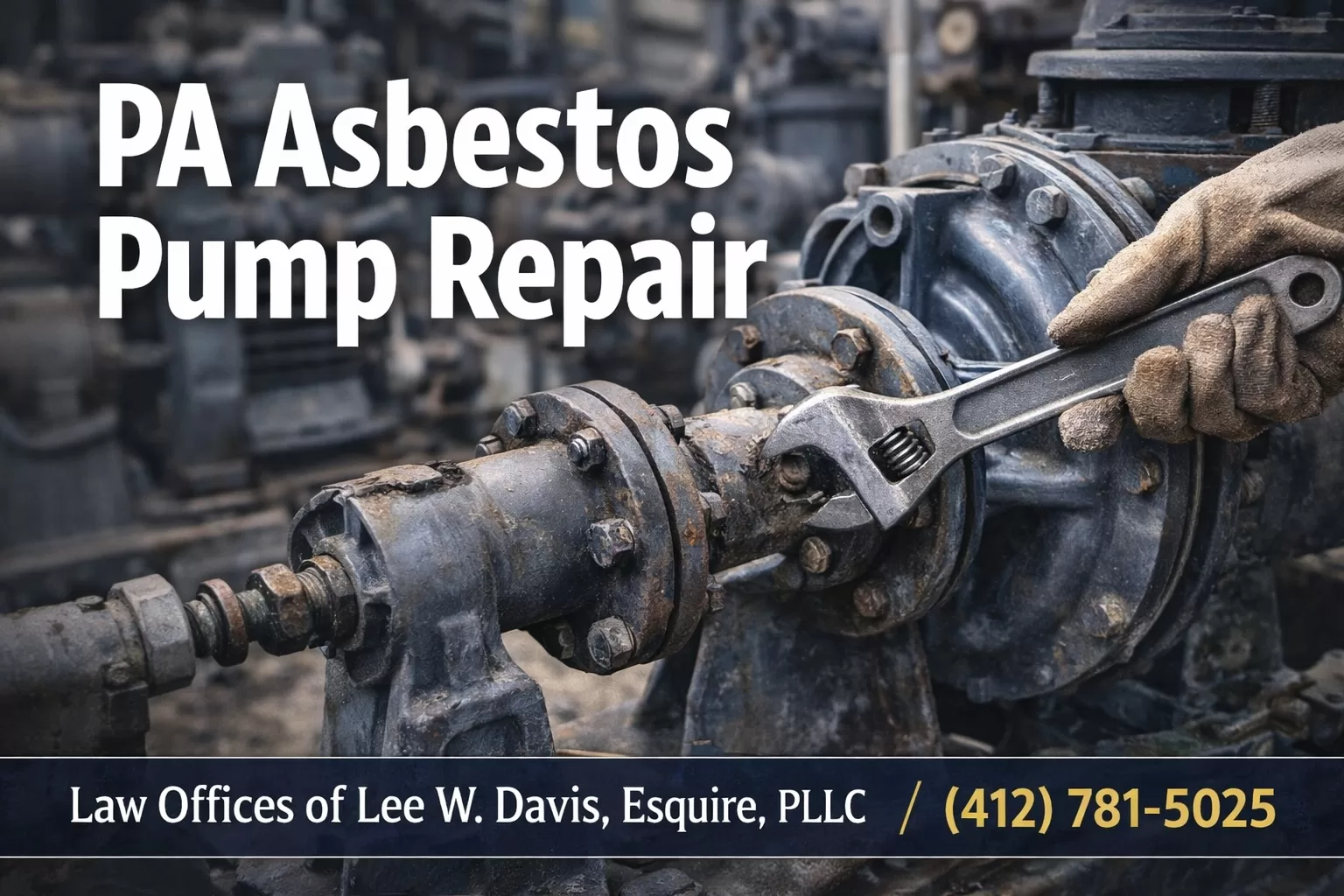
Pennsylvania Pump Asbestos Exposure

Pennsylvania Pump Asbestos Exposure

If you worked on or around industrial pump systems and have been diagnosed with mesothelioma or lung cancer, Pennsylvania pump asbestos exposure is a well-documented source of occupational asbestos exposure across the state’s steel mills, power plants, chemical facilities, refineries, and manufacturing operations. Pumps were not isolated pieces of equipment—they were integrated into high-temperature, high-pressure systems that required asbestos-containing gaskets, packing, and insulation throughout their operation.

Across Pennsylvania’s industrial geography—from the Pittsburgh steel corridor to the Delaware Valley refineries—pump systems were essential to moving steam, chemicals, water, and process fluids. Every one of those systems created repeated opportunities for direct asbestos exposure.


Mesothelioma/Asbestos Legal Help – WV, MI & PA

Speak directly with attorney Lee W. Davis. No call centers. Free, confidential review.

Why Pump Systems Created Consistent Asbestos Exposure

Industrial pumps operated under extreme conditions. To maintain pressure, prevent leaks, and withstand heat, manufacturers relied heavily on asbestos-containing materials. These included:

  • Pump flange gaskets
  • Valve and pump packing materials
  • Thermal insulation on connected piping systems
  • Sealing components within pump housings

Workers maintaining pumps did not encounter asbestos occasionally—they encountered it every time a system was opened, repaired, or rebuilt.


The Trades Most Affected by Pump Asbestos Exposure

Pump systems brought together multiple trades working in the same space:

  • Pipefitters removing insulation and replacing gaskets on connected piping
  • Millwrights disassembling pumps and servicing internal components
  • Boilermakers working in adjacent high-temperature systems
  • Electricians maintaining pump motors in asbestos-contaminated environments

Because pumps are distributed throughout entire facilities, exposure was not limited to one department. Workers encountered asbestos in mechanical rooms, turbine halls, processing areas, and confined spaces across Pennsylvania industrial sites.


High-Risk Tasks Involving Pump Systems

The most dangerous asbestos exposure occurred during routine maintenance:

Gasket removal and replacement

Scraping hardened asbestos gaskets from pump flanges released concentrated fibers directly into the breathing zone.

Packing removal and repacking

Removing old packing from pump shafts required pulling and cutting asbestos-containing material, often dry and deteriorated.

Pump rebuilds and overhauls

Full disassembly exposed workers to internal asbestos components and surrounding insulation.

Work in confined mechanical spaces

Pump systems were often located in tight mechanical rooms where airborne asbestos fibers accumulated.


Pennsylvania Industrial Sites Where Pump Exposure Occurred

Pump asbestos exposure was widespread across Pennsylvania, including:

  • Steel mills in Allegheny, Beaver, and Westmoreland Counties
  • Power generating stations throughout western and central Pennsylvania
  • Chemical plants and refineries in the Delaware Valley
  • Paper mills and manufacturing facilities statewide

Because pumps were part of every major industrial system, workers often encountered asbestos exposure across multiple facilities over the course of their careers.

👉 Search Asbestos Job Sites in Pennsylvania


Evidence Supporting a Pennsylvania Pump Asbestos Claim

A strong claim typically includes:

  • Diagnosis of mesothelioma or asbestos-related lung cancer
  • Work history involving pump maintenance or industrial systems
  • Identification of job sites and equipment worked on
  • Coworker and supervisor testimony
  • Union records and Social Security employment history

Decades of Experience Handling Pennsylvania Asbestos Cases

I began working on asbestos litigation in 1989 and have handled thousands of industrial exposure cases across Pennsylvania, West Virginia, and Michigan. Pump-related exposure is one of the most consistent patterns seen across multiple trades and facilities.

When you call, you speak directly with me—no call centers, no intake staff.

If you or a family member worked around industrial pumps and have been diagnosed with mesothelioma or lung cancer, time matters.

📞 Call (412) 781-0525 or visit leewdavis.com for a confidential case review.

Check If Your Family Was Exposed

Get your free guide instantly + a confidential case review.

🔒 100% Confidential. No obligations.


Frequently Asked Questions

Q: Do industrial pumps contain asbestos materials?

A: Yes. Pumps used asbestos gaskets, packing, and insulation to handle high heat and pressure, making them a common exposure source.

Q: Which workers were most exposed to pump asbestos?

A: Pipefitters, millwrights, mechanics, and maintenance workers faced the highest exposure during pump repairs and rebuilds.

Q: How long do I have to file a Pennsylvania asbestos claim?

A: The statute of limitations runs from the date of diagnosis, not the exposure. Prompt evaluation is critical.

Mesothelioma/Asbestos Legal Help – WV, MI & PA

Speak directly with attorney Lee W. Davis. No call centers. Free, confidential review.

Pennsylvania Turbine Asbestos Exposure

Pennsylvania Turbine Asbestos Exposure

If you worked on turbine systems in Pennsylvania and you’ve been diagnosed with mesothelioma or lung cancer, Pennsylvania turbine asbestos exposure is a well-documented occupational history that has supported successful claims for power plant workers, turbine mechanics, and industrial maintenance workers throughout the state. Turbines in Pennsylvania’s coal-fired power generating stations, industrial steam systems, and turbomachinery manufacturing facilities were surrounded by asbestos-containing materials throughout their operational lives — in the thermal insulation blanketing the turbine casings, in the gaskets and packing throughout the associated steam systems, and in the materials used during turbine maintenance and overhaul work that created the most intensive turbine asbestos exposure of any regular maintenance activity at Pennsylvania industrial facilities.

Mesothelioma/Asbestos Legal Help – WV, MI & PA

Speak directly with attorney Lee W. Davis. No call centers. Free, confidential review.

Why Turbine Workers Are a Distinct and Frequently Overlooked Asbestos Claimant Population

Workers who think of themselves as turbine mechanics, turbine operators, or turbine outage workers often don’t immediately connect their work history to an asbestos claim — because the explicit connection between turbines and asbestos is less well-known than the connection between pipe insulation or furnace refractory and asbestos. That knowledge gap has caused legitimate Pennsylvania turbine asbestos claims to go unfiled.

The connection is real and well-documented. Turbines operate at the intersection of extreme heat and extreme mechanical precision — conditions that demanded the most demanding thermal insulation materials available, which throughout the pre-1980 industrial era meant asbestos-containing materials applied extensively throughout the turbine casing, the associated steam systems, and the confined turbine hall environments where maintenance and overhaul work was performed.

Workers who maintained, serviced, and overhauled turbines at Pennsylvania power plants and industrial facilities worked in direct and sustained contact with those asbestos-containing materials — during routine maintenance, during major overhauls, and in the confined turbine hall and casing environments where fiber concentrations during active maintenance were highest.

How Turbines Created Asbestos Exposure at Pennsylvania Industrial Facilities

Turbine casing insulation — The casings of steam turbines at Pennsylvania power generating stations and industrial facilities were wrapped in asbestos-containing thermal insulation throughout the pre-1980 period. That insulation maintained the extreme temperatures required for efficient turbine operation and had to be removed and replaced during every major turbine overhaul. Stripping old turbine casing insulation — dried, baked, and fiber-releasing after years of operation at high temperature — released asbestos fibers in concentrated form directly into the breathing zone of the workers performing the work.

Turbine steam inlet and exhaust systems — The high-pressure steam piping connecting boiler systems to turbine inlets and the low-pressure exhaust systems carrying spent steam to condensers both required heavy asbestos-containing insulation throughout their lengths. The gaskets at every flanged connection in those systems, the valve packing in every control valve, and the insulation on every pipe section between boiler and turbine were asbestos-containing materials that created exposure during every maintenance task performed on those systems.

Turbine internal maintenance — diaphragms, seals, and packings — Major turbine overhauls required complete disassembly of the turbine — removing turbine diaphragms, replacing shaft seals, servicing steam gland packing, and inspecting and replacing the internal components of the turbine casing. Many of those internal components — the gland packing, the diaphragm seals, and various internal sealing materials — historically contained asbestos. Mechanics performing turbine internal maintenance worked in direct contact with those asbestos-containing components in the confined space of the open turbine casing throughout every major overhaul.

Turbine hall ambient exposure — The turbine halls at Pennsylvania power generating stations and industrial facilities were environments where asbestos-containing insulation was present throughout — on the turbine casings, on the associated steam piping, on the feedwater and condensate systems surrounding the turbines, and in the insulated valve clusters throughout the turbine building. Workers who spent careers in those turbine halls accumulated continuous ambient fiber exposure from the aging insulation surrounding them throughout every working day.

Turbine outage and overhaul work — Major turbine outages at Pennsylvania generating stations and industrial facilities were the most intensive asbestos exposure events in those facilities’ operational histories. When turbines went down for planned overhaul, the insulation removal, internal disassembly, component replacement, and re-insulation work concentrated asbestos fiber release throughout the turbine building in ways that significantly exceeded ambient exposure levels. Workers performing outage work — regardless of their specific trade assignment — accumulated their highest single-event asbestos exposure during major turbine outages at Pennsylvania facilities.


Pennsylvania Facilities Where Turbine Asbestos Exposure Was Most Significant

Pennsylvania coal-fired power generating stations — Pennsylvania’s fleet of coal-fired generating stations employed turbine workers throughout facilities built around high-pressure steam turbine systems that required extensive asbestos insulation. Facilities including Cheswick Power Station, Keystone Power Station, Bruce Mansfield, Hatfield Ferry at Masontown, and the Duquesne Light power stations throughout western PA all operated turbine systems insulated with asbestos-containing materials throughout their operational histories. See the Pennsylvania power plant asbestos resource for the full statewide power plant turbine exposure profile.

Elliott Company Jeannette — Elliott’s turbomachinery manufacturing and testing operations in Westmoreland County created a distinct turbine asbestos exposure environment — workers building and testing turbines and compressors at Elliott worked with the asbestos-containing materials incorporated into the equipment during manufacturing and were exposed during the high-temperature testing that simulated installed operating conditions. Elliott turbine workers had a manufacturing and testing exposure profile that is distinct from power plant turbine maintenance exposure but equally well-documented in asbestos litigation.

Industrial steam turbines at steel mills and manufacturing facilities — Pennsylvania’s major steel mills and manufacturing facilities operated industrial steam turbines for process power and utility generation throughout their facilities. Turbine mechanics maintaining those industrial turbines at facilities like the Homestead Works, Allegheny Ludlum Brackenridge, and throughout the western PA industrial corridor accumulated turbine asbestos exposure as part of their industrial maintenance careers.

Nuclear generating stations — Pennsylvania’s nuclear generating stations — including Three Mile Island and Beaver Valley — also operated steam turbine systems requiring asbestos-containing insulation throughout the pre-1980 construction period. Workers performing maintenance on those turbine systems during the facilities’ operational histories accumulated exposure from the asbestos-containing materials used in turbine construction and insulation.

Trades Most Commonly Involved in Pennsylvania Turbine Asbestos Claims

  • Boilermakers — performing turbine casing work, insulation removal and replacement, and major overhaul work throughout Pennsylvania generating stations and industrial turbine facilities
  • Pipefitters and steamfitters — maintaining the high-pressure steam inlet systems and exhaust piping connected to Pennsylvania turbines
  • Millwrights — performing precision alignment, internal component replacement, and mechanical maintenance throughout Pennsylvania turbine systems
  • Insulators — applying and removing the asbestos-containing thermal insulation blanketing Pennsylvania turbine casings and associated steam systems
  • Turbine mechanics and operators — workers whose primary job function centered on turbine operation, inspection, and routine maintenance
  • Outside contractors — performing turbine outage and overhaul work at Pennsylvania generating stations and industrial facilities

What Evidence Supports a Pennsylvania Turbine Asbestos Claim

  • Diagnosis records confirming mesothelioma or lung cancer
  • Work history at Pennsylvania generating stations, industrial facilities, or turbine manufacturing operations — job titles, years worked, specific turbine-related tasks performed
  • Memory of the specific turbine halls, casing environments, and steam system areas where you worked throughout your Pennsylvania career
  • Names of coworkers, contractors, or supervisors you worked alongside during turbine maintenance and outage work
  • Union records confirming employment and dispatch history at specific Pennsylvania turbine facilities
  • Social Security earnings records confirming employers and time periods

For a broader overview of how Pennsylvania mesothelioma claims work see our Pennsylvania resource. For workers with lung cancer diagnoses see Pittsburgh asbestos lung cancer. For the Pennsylvania asbestos lawyer overview see our dedicated guide. For the Pennsylvania asbestos trust claims process see Pennsylvania asbestos trust claims. You can search the full list of asbestos job sites in Pennsylvania to review all documented Pennsylvania power plant and industrial turbine exposure sites.

Knowledge of Pennsylvania Turbine Asbestos Cases Since 1989

I first began researching Pennsylvania asbestos cases in 1989 as a paralegal, working on asbestos mass trials across Pennsylvania and West Virginia. I returned to Pittsburgh after supervising 3,200 GM Foundry Asbestos cases in 1999 to handle mesothelioma and lung cancer cases individually across Pennsylvania, West Virginia, and Michigan, applying decades of product identification work — tracking the specific turbine insulation manufacturers, turbine casing gasket suppliers, and turbine internal component companies whose materials created Pennsylvania turbine worker asbestos exposure — directly to every case evaluation.

Turbine asbestos cases require specific knowledge of the thermal insulation systems used on turbine casings, the gasket and sealing materials used in turbine steam systems, and the internal component materials used in turbine maintenance — a distinct product identification challenge from the pipe insulation and refractory identification central to other trade claims. This practice has handled turbine-related asbestos cases throughout Pennsylvania and has the background to evaluate a turbine worker claim with the specificity it requires.

When you call, you speak directly with me. No call centers. No case managers.

If you or a family member worked on turbine systems in Pennsylvania and has been diagnosed with mesothelioma or lung cancer, Pennsylvania’s statute of limitations runs from the date of diagnosis.

Call (412) 781-0525 or start your confidential case review online now.

Check If Your Family Was Exposed

Get your free guide instantly + a confidential case review.

🔒 100% Confidential. No obligations.


Frequently Asked Questions

Q: I worked as a turbine mechanic at a Pennsylvania power plant for many years, performing major turbine overhauls during planned outages. Does that support a mesothelioma claim?

A: Yes, potentially. A turbine mechanic career performing major turbine overhauls at a Pennsylvania power generating station represents a significant asbestos exposure history. Major turbine overhauls involve removing old asbestos-containing casing insulation — one of the more fiber-intensive activities in power plant maintenance — working inside open turbine casings where asbestos-containing internal components are accessed and replaced, and servicing the associated steam system components throughout the outage period. That work, performed repeatedly at a major Pennsylvania generating station, represents a cumulative exposure history that warrants careful legal evaluation.

Q: I worked at Elliott Company in Jeannette building and testing turbines and compressors. Is that enough to support a mesothelioma claim?

A: Yes, potentially. Workers who built and tested turbomachinery at Elliott’s Jeannette operations worked with asbestos-containing materials incorporated directly into the equipment during manufacturing — thermal insulation, gaskets, and sealing materials used in turbine and compressor construction — and in the test environments where completed equipment was run under operating conditions. That manufacturing and testing exposure profile has supported mesothelioma claims from Elliott workers. Call to discuss your specific work history and diagnosis.

Q: How long do I have to file a mesothelioma claim in Pennsylvania connected to turbine work at Pennsylvania power plants or industrial facilities?

A: Pennsylvania’s statute of limitations runs from the date of diagnosis, not the date of your exposure. Wrongful death claims carry different and sometimes shorter deadlines running from the date of death. Do not assume it is too late — call as soon as a diagnosis is confirmed so we can evaluate your full Pennsylvania turbine career history and identify all responsible parties.

Mesothelioma/Asbestos Legal Help – WV, MI & PA

Speak directly with attorney Lee W. Davis. No call centers. Free, confidential review.

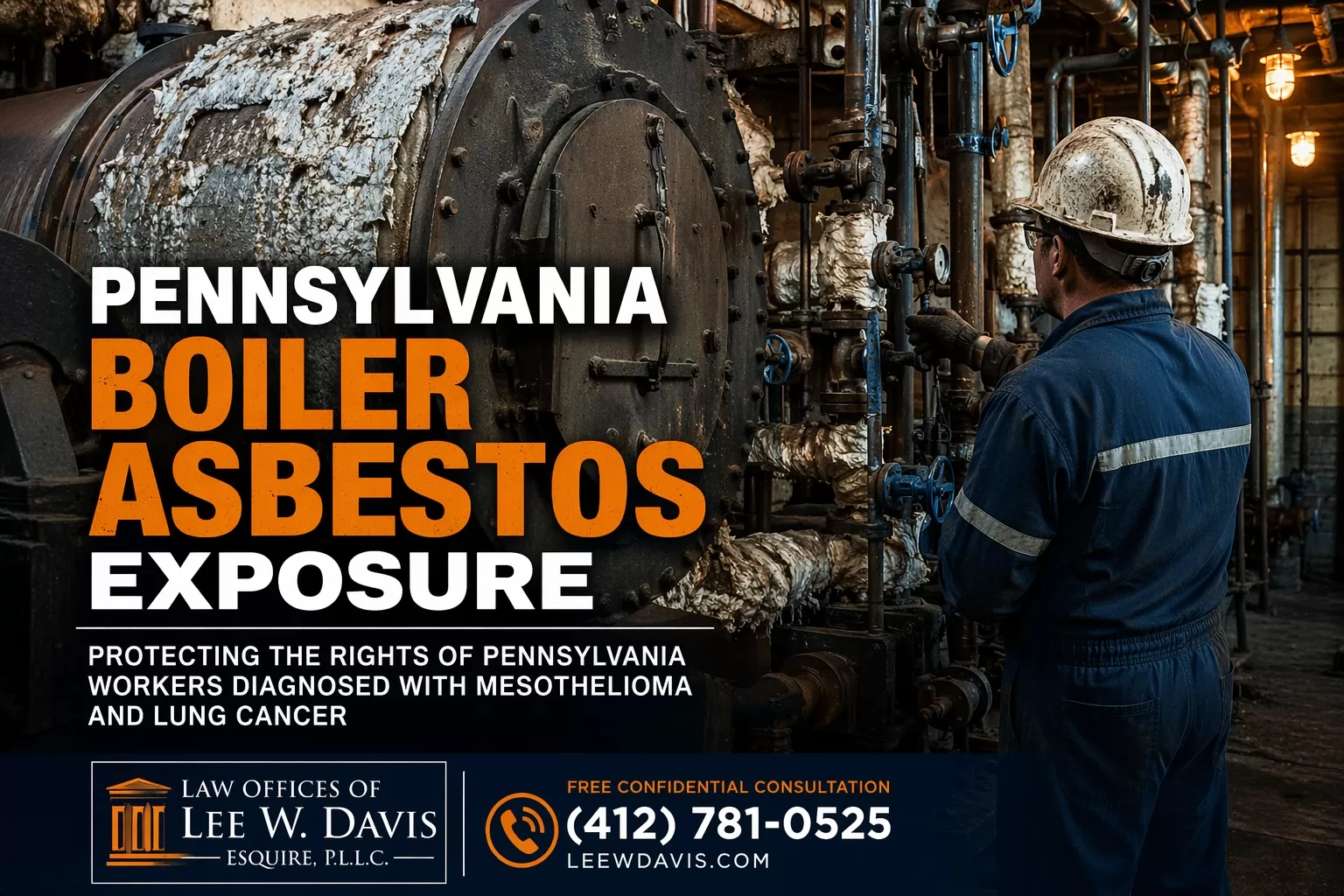
Pennsylvania Boiler Asbestos Exposure 

Pennsylvania Boiler Asbestos Exposure

Pennsylvania boiler asbestos exposure is one of the most well-documented occupational causes of mesothelioma and asbestos-related lung cancer across the state’s industrial history. From Pittsburgh steel mills to power plants, chemical facilities, and manufacturing operations throughout Pennsylvania, boiler systems were insulated with asbestos-containing materials that exposed workers across multiple trades for decades.

If you worked on, around, or near industrial boiler systems in Pennsylvania and have been diagnosed with mesothelioma or lung cancer, your exposure history may be directly tied to those environments.


Mesothelioma/Asbestos Legal Help – WV, MI & PA

Speak directly with attorney Lee W. Davis. No call centers. Free, confidential review.


Why Boiler Systems Created the Highest Asbestos Exposure Risk

Industrial boilers required extreme heat retention and energy efficiency. To achieve that, manufacturers and contractors used asbestos insulation extensively:

  • Block insulation on boiler shells
  • Pipe covering on steam distribution lines
  • Insulating cement on fittings and joints
  • Gaskets and packing inside valves and pumps

Many of these materials contained high concentrations of asbestos. When installed, repaired, or removed, they released fibers into the air—often in confined spaces where workers had no protection.


Pennsylvania Industries Where Boiler Asbestos Exposure Occurred

Boiler asbestos exposure was not limited to one industry. It existed across Pennsylvania’s entire industrial economy:

  • Steel mills and foundries
  • Power generation plants
  • Chemical processing facilities
  • Manufacturing plants
  • Glass and refractory production facilities

These systems operated continuously, meaning workers encountered asbestos daily—sometimes for decades.

👉 Search Asbestos Job Sites in Pennsylvania


Pennsylvania Counties With Documented Boiler Exposure

Boiler asbestos exposure has been identified across multiple counties in western Pennsylvania. For more detailed information, see:

Each location had its own facilities, but the exposure pattern remains the same—boiler systems insulated with asbestos materials that deteriorated over time and released fibers into the work environment.


Workers Most at Risk

Pennsylvania boiler asbestos exposure affected more than just one trade. Workers most commonly impacted include:

  • Boilermakers
  • Pipefitters and steamfitters
  • Insulators
  • Millwrights
  • Plant engineers and maintenance supervisors

Even workers who did not directly handle insulation were exposed simply by working nearby during maintenance or outages.


How Exposure Occurred

The most dangerous exposure events often happened during:

  • Boiler installation and insulation work
  • Maintenance and repair operations
  • Outage shutdowns
  • Insulation removal and replacement
  • Confined space entry inside boiler systems

These activities disturbed asbestos materials and released fibers into the air, where they could be inhaled.


Filing a Pennsylvania Boiler Asbestos Claim

Pennsylvania law allows individuals diagnosed with mesothelioma or asbestos-related lung cancer to pursue compensation. Importantly:

  • The statute of limitations begins at diagnosis—not exposure
  • Claims may involve multiple defendants tied to different products
  • Work history across multiple job sites can strengthen a case

Early evaluation is critical to preserve evidence and identify responsible parties.


Decades of Pennsylvania Asbestos Case Experience

I began working on asbestos litigation in 1989 as a paralegal and have handled cases involving Pennsylvania industrial exposure since returning to Pittsburgh in 1999 after supervising 3,200 GM Foundry cases in Saginaw, MI. Boiler system exposure is one of the most common and most well-understood pathways in these cases.

When you call, you speak directly with me.

No call centers. No case managers.


Call for a Confidential Case Review

If you or a family member worked around boiler systems in Pennsylvania and has been diagnosed with mesothelioma or lung cancer, time matters.

Call (412) 781-0525 or visit leewdavis.com to start your confidential case review.


Frequently Asked Questions

Q: Do I need to have worked directly on a boiler to have a claim?

A: No. Many workers were exposed simply by working near boiler systems during maintenance or outages.


Q: What diseases are linked to boiler asbestos exposure?

A: Mesothelioma and asbestos-related lung cancer are the most serious conditions associated with boiler exposure.


Q: How long do I have to file a claim in Pennsylvania?

A: The statute of limitations begins at diagnosis, so it is important to act quickly once a condition is confirmed.

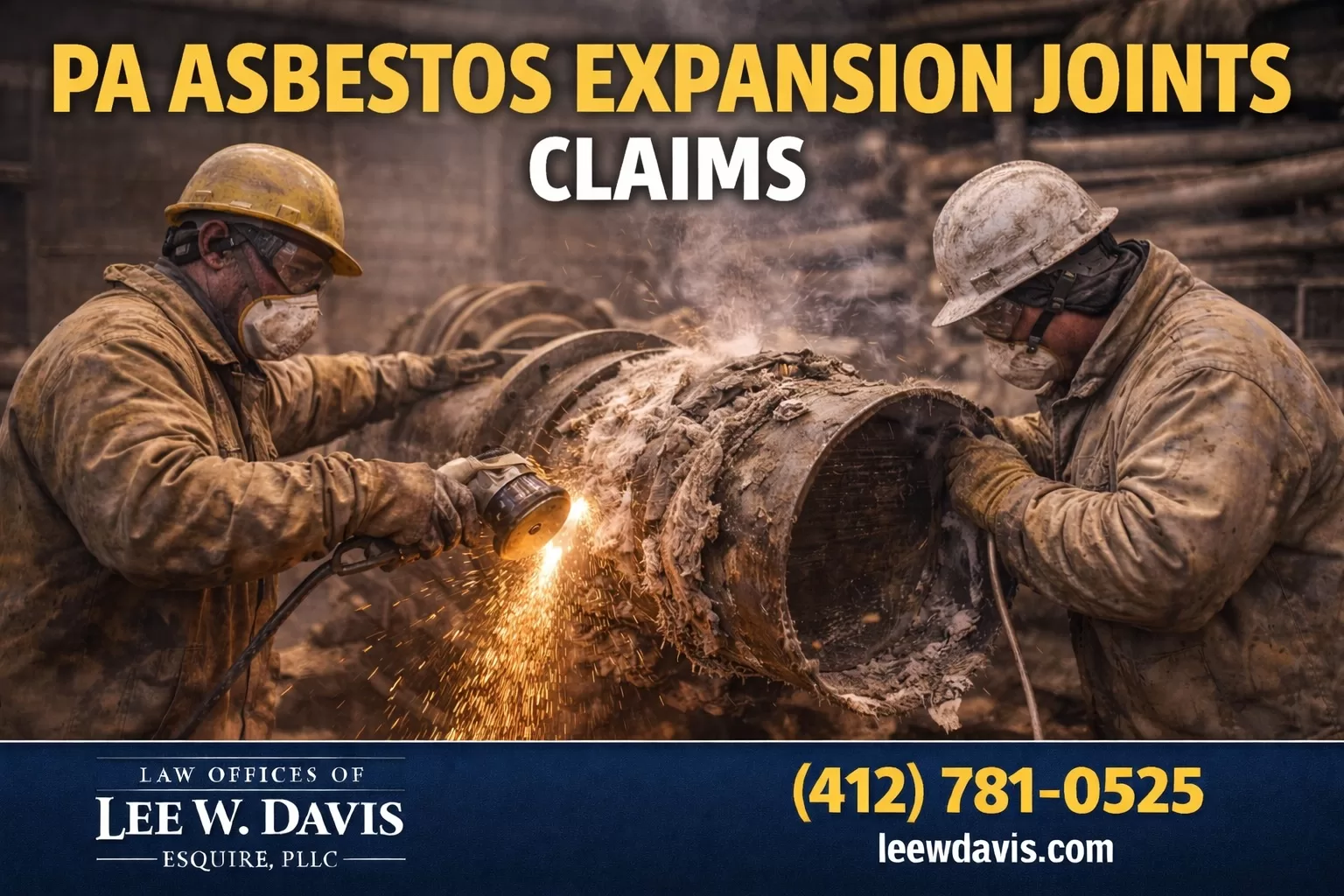
PA Asbestos Expansion Joints

PA Asbestos Expansion Joints Claims

PA Asbestos Expansion Joints were used everywhere in older Pennsylvania industrial facilities—power plants, steel mills, refineries, paper mills, chemical plants, and large institutional boiler rooms. They were installed to absorb heat, vibration, and movement in piping, ductwork, boilers, turbines, and high-temperature systems.

Mesothelioma/Asbestos Legal Help – WV, MI & PA

Speak directly with attorney Lee W. Davis. No call centers. Free, confidential review.

The problem is simple: when a crew had to remove, cut out, scrape, or replace an old expansion joint, the work could release asbestos dust—especially during outages, shutdowns, and emergency repairs. If you worked maintenance, mechanical, or shutdown work in Pennsylvania and you’ve been diagnosed with mesothelioma, lung cancer, or another asbestos-related disease, you may have a valid claim.

Where expansion joints showed up in Pennsylvania facilities

Expansion joints were often found in:

  • Steam and hot-water piping runs
  • Turbine and boiler systems
  • Ductwork and exhaust systems
  • High-heat process equipment
  • Flanges and connections near pumps, valves, and elbows
  • Large building mechanical rooms in older schools, hospitals, and public facilities

In many older installations, expansion joints were paired with other asbestos materials—insulation, gaskets, packing, refractory, and cement products—so the exposure picture is often layered.

If you’re building the broader proof record for a Pennsylvania claim, start with Pennsylvania Asbestos Work History.

How exposure typically happened

Most people weren’t exposed because the joint “sat there.” Exposure usually occurred when a crew disturbed it, including:

  • Cutting or grinding to remove old joint material
  • Scraping or chiseling hardened material off metal surfaces
  • Pulling out deteriorated joint fabric or filler
  • Sweeping and cleanup after removal
  • Working in confined areas where dust had nowhere to go

This kind of work frequently happened under time pressure—during outages, plant turnarounds, or emergency breakdowns—when multiple trades were stacked into the same area.

To show when the highest-risk work occurred (shutdowns, outages, specific years), use Pennsylvania Asbestos Exposure Timeline.


Who was most at risk

PA Asbestos Expansion Joints claims often involve workers such as:

  • Pipefitters and steamfitters
  • Millwrights
  • Boilermakers
  • Maintenance mechanics
  • Turbine and outage crews
  • Insulators working around disturbed material
  • Foremen and supervisors who were physically present during removal

Even if you didn’t personally “do the cutting,” being in the work area during removal, cleanup, or reassembly can still be enough to support exposure.

If coworkers can confirm the type of shutdown work and materials being removed, see PA Asbestos Jobsite Witnesses.

What proof matters most in an expansion-joint case

These cases are not won with vague statements. They are won with credible detail that matches how asbestos exposure actually occurred.

The strongest proof usually includes:

  • The facility and the years you worked there
  • Your job title and the tasks you performed
  • The type of equipment you worked on (boilers, turbines, ducting, piping)
  • The kind of joint work you saw or did (remove, scrape, replace, clean up)
  • Supporting employment, union, or jobsite documentation
  • Medical documentation confirming diagnosis

What compensation may cover

Depending on the facts, a Pennsylvania asbestos case may seek compensation for:

  • Medical treatment and related costs
  • Lost wages and loss of earning capacity
  • Pain and suffering
  • Household services and family impact
  • Wrongful death damages (where applicable)

Some claims also involve trust submissions depending on the product identification and exposure history.

If you’re also dealing with asbestos gaskets and related removal work, read PA Asbestos Gasket Removal

Call for a real case review

Expansion-joint cases come down to details—where you worked, what equipment you worked around, and when the removal work happened. If you have an asbestos-related diagnosis, I’ll evaluate your Pennsylvania work history and give you a straight answer about claim options and what evidence matters.

Start here: Pennsylvania asbestos lawyer — free case review.

Call (412) 781-0525 or reach me through leewdavis.com.

Check If Your Family Was Exposed

Get your free guide instantly + a confidential case review.

🔒 100% Confidential. No obligations.

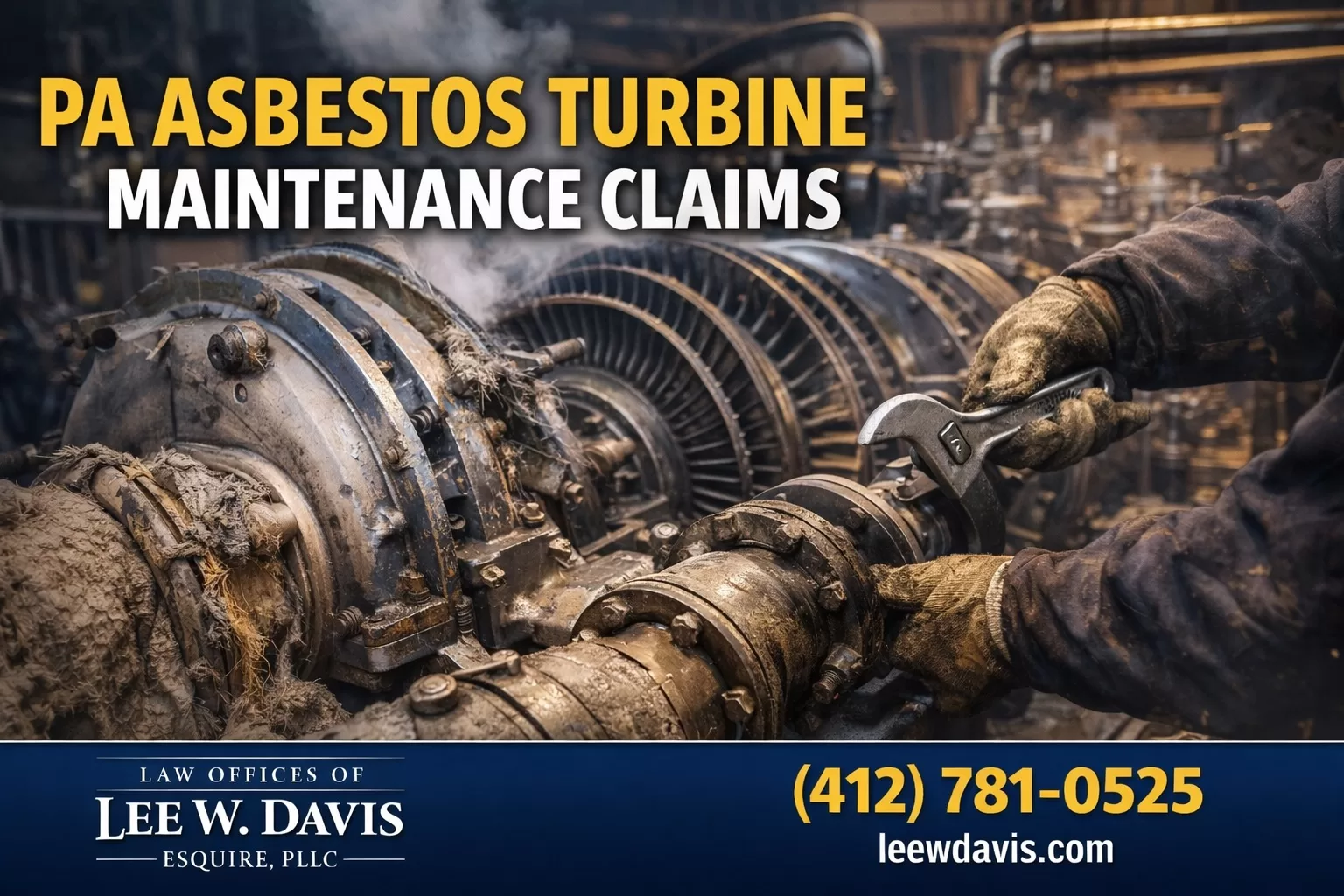
PA Asbestos Turbine Maintenance

PA Asbestos Turbine Maintenance Claims

PA Asbestos Turbine Maintenance work is one of the most common industrial exposure patterns I see in Pennsylvania: outages, tight schedules, heavy insulation, and repeated hands-on contact with materials that historically contained asbestos. Turbine work often overlaps with boiler rooms, pump rooms, valve stations, and high-heat mechanical spaces—exactly where asbestos products were used for decades because they handled heat and pressure.

Mesothelioma/Asbestos Legal Help – WV, MI & PA

Speak directly with attorney Lee W. Davis. No call centers. Free, confidential review.

If you worked maintenance on turbines—steam or power generation—or you supported turnarounds as a millwright, mechanic, electrician, pipefitter, or boilermaker, you may have a valid claim if you later developed mesothelioma, asbestos lung cancer, or another asbestos disease.

Where turbine asbestos exposure usually happened

Turbine maintenance isn’t one task—it’s a cluster of jobs done in the worst possible environment for dust control:

  • Opening turbine casings during outages and overhauls
  • Scraping, wire-brushing, and cleaning flange faces
  • Removing and replacing gaskets and packing
  • Working around insulation on steam lines, turbine blankets, and adjacent piping
  • Cutting, grinding, or disturbing old lagging during access work
  • Rebuilding or servicing connected components (valves, pumps, condensate systems)

The exposure risk isn’t “mystery.” It’s usually the same few product categories showing up repeatedly in turbine areas.

Read more: Pennsylvania asbestos lawyer

What products matter in turbine claims


Most turbine cases come down to proving the asbestos-containing products you were around. The usual suspects:

  • High-temperature insulation (pipes, turbine areas, adjacent steam systems)
  • Gaskets on flanges and access covers
  • Valve packing / pump packing in connected systems
  • Cement and refractory materials in industrial settings (depending on the plant)
  • Thermal blankets and insulation wraps in some facilities

You don’t have to know brand names on day one. The goal is to narrow what you worked on, where you worked, and which product types were being used at that site and time.

The proof that actually moves a turbine case

A turbine case gets stronger when the proof package is built around work reality:

  • Job title(s) and date ranges
  • Plant/location history and departments
  • Outage/turnaround work details (what you touched, how often, where)
  • Coworker confirmation when available (even one credible witness helps)
  • Medical diagnosis documentation (pathology and treating records)
  • Any work history documents you still have (union, pension, W-2, Social Security, pay stubs, etc.)

Read more about Pennsylvania Asbestos Work History

If you have none of that in hand right now, that does not kill the case. It just tells us what we need to request and how to frame the work history so it’s consistent and provable.

👉 Search Asbestos Job Sites in Pennsylvania

What damages and defendants can look like

Turbine cases often involve multiple responsible parties, depending on the site and era:

  • Premises/plant operators (varies by facts and state law)
  • Product manufacturers (gaskets/packing/insulation/refractory)
  • Contractors or maintenance companies tied to specific work
  • Bankruptcy trusts, when applicable (for certain product lines)

A good turbine claim isn’t “one defendant.” It’s usually a layered recovery strategy that matches the exposure history.

Deadlines and timing

Pennsylvania asbestos claims are deadline-driven. In most cases, the clock is tied to diagnosis (and wrongful death has its own deadline structure). If you’re reading this because a diagnosis is fresh—or a family member has passed—move sooner rather than later. Evidence gets harder with time, not easier.

Pennsylvania Asbestos Exposure Timeline

Who this is for

This page is for Pennsylvania workers (and families) who were around turbines in:

  • Power plants and generation facilities
  • Steel mills and heavy industrial plants
  • Chemical and refinery-adjacent operations
  • Large institutional boiler/turbine systems

If your work included outages, turnarounds, or mechanical maintenance in high-heat areas, you’re exactly the kind of work history that fits turbine exposure.


Talk to a Pennsylvania asbestos lawyer who knows plant work

I’ve handled asbestos cases since 1988, and I’ve seen the same maintenance exposures repeat across decades—especially in turbine and outage work. If you have a diagnosis (or you’re calling for your family), we’ll talk through your work history, identify the most likely product exposures, and lay out a claim strategy that fits your facts.

Call (412) 781-0525 or use the contact form below to get started.

Check If Your Family Was Exposed

Get your free guide instantly + a confidential case review.

🔒 100% Confidential. No obligations.

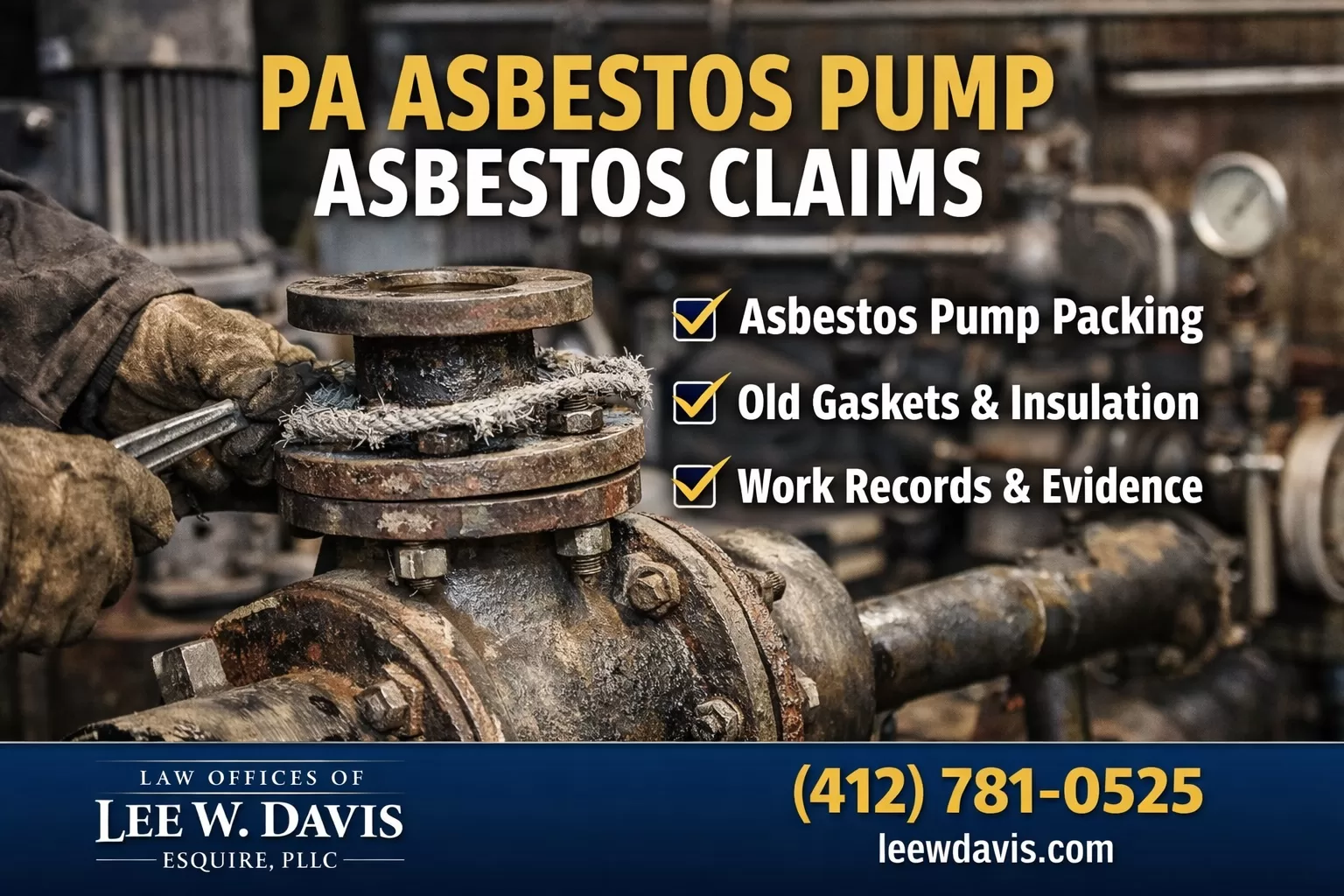
PA Asbestos Pump Asbestos

PA Asbestos Pump Asbestos | Claim Evidence Help

PA Asbestos Pump Asbestos exposure is one of the most common—and most overlooked—sources of occupational asbestos exposure in Pennsylvania’s industrial and utility workplaces. Pumps weren’t “just pumps.” They were systems wrapped in asbestos-containing parts that had to be opened, scraped, rebuilt, and sealed back up—often in tight boiler rooms, mechanical spaces, basements, and plant maintenance shops.

Mesothelioma/Asbestos Legal Help – WV, MI & PA

Speak directly with attorney Lee W. Davis. No call centers. Free, confidential review.

If you worked around pumps in a steel mill, power station, refinery, paper mill, chemical plant, water facility, or large commercial building, asbestos exposure may have come from the components you handled, not just the room you worked in.

For broader guidance on Pennsylvania asbestos claims, visit our Pennsylvania asbestos lawyer page

Where PA pump workers were exposed to asbestos

Asbestos exposure during pump work typically came from routine maintenance tasks—exactly the jobs that created dust:

  • Opening flanges and housings that were sealed with asbestos gaskets
  • Removing old packing from pump glands and stuffing boxes
  • Scraping, wire-brushing, or sanding residue off metal surfaces
  • Blowing out parts with air or sweeping settled debris
  • Working beside insulated piping and valves that released dust when disturbed

This is why pump work shows up across so many Pennsylvania asbestos cases: maintenance work repeats, parts fail, and the same dusty steps happen over and over.

You can also search known locations on our Asbestos Job Sites in Pennsylvania directory.

The asbestos products that show up in pump jobs

In pump-related exposure cases, the evidence often traces back to the same categories of materials:

  • Pump packing (often braided) used to seal moving shafts
  • Sheet and flange gaskets used to seal connections
  • Insulation on nearby lines and equipment in pump rooms and mechanical areas
  • Valve packing and gaskets used on related equipment in the same system

Even when the pump itself wasn’t “asbestos,” the surrounding repair materials frequently were.


Pump work often overlaps with PA Asbestos Gasket Removal and PA Asbestos Valve Packing exposures.

What makes a pump-asbestos claim strong

Most people don’t have a receipt for a gasket they scraped off 30 years ago. Real asbestos cases are built the way they’ve always been built—through credible work history and corroborating proof.

A strong claim typically includes:

  • A clear work history (who you worked for, where, and what you did)
  • A timeframe showing long-term exposure and medically consistent latency
  • Jobsite context (type of facility, department, maintenance schedule)
  • Supporting records (union, pension, Social Security, personnel, or contractor logs)
  • Medical confirmation (diagnosis and supporting imaging/pathology)

You don’t need perfection. You need credibility and enough detail to make the exposure story real.

Pump work doesn’t have to be “heavy industry” to count

Some of the most common pump exposure work happened outside mills and refineries:

  • Large commercial buildings with boiler rooms and mechanical systems
  • Hospitals, universities, and schools with legacy mechanical plants
  • Municipal water and wastewater facilities
  • Facilities maintenance for property management companies

If you were the person who got called when a pump leaked, seized, or failed, you may have been exposed—especially if you were the one scraping out old packing or cutting gasket material.

Timing matters in PA asbestos cases

Pennsylvania asbestos claims are typically driven by diagnosis-based deadlines, not the date of exposure. The legal clock often starts when you learn you have an asbestos disease—not when the work happened decades earlier. That said, waiting can still hurt a case because records disappear and witnesses become harder to find.

If you’ve been diagnosed—or you’re being evaluated—protect the evidence early.

See how latency and diagnosis timing matters on our Pennsylvania Asbestos Exposure Timeline page


Call Now

If you or a loved one has been diagnosed with mesothelioma, lung cancer, or another asbestos-related disease and your work involved pumps, I can evaluate whether PA Asbestos Pump Asbestos exposure fits your work history and what proof is realistically available.

If you’re also exploring trust options, start with Pennsylvania Asbestos Trust Claims Help

Call (412) 781-0525 or contact me through leewdavis.com for a confidential case review.

Check If Your Family Was Exposed

Get your free guide instantly + a confidential case review.

🔒 100% Confidential. No obligations.

PA Asbestos Pump Repair

PA Asbestos Pump Repair | Exposure Risks

PA Asbestos Pump Repair is one of the most common ways industrial workers get hit with asbestos exposure—because pumps are serviced constantly, often under time pressure, and the work routinely disturbs old sealing materials and insulation nearby.

Mesothelioma/Asbestos Legal Help – WV, MI & PA

Speak directly with attorney Lee W. Davis. No call centers. Free, confidential review.

In Pennsylvania plants, power stations, refineries, steel facilities, and water operations, pump repair typically means opening equipment that has been sealed for years. That’s when asbestos-containing packing, gaskets, and adjacent high-heat materials can release dust—especially during tear-down, scraping, wire-brushing, or compressed-air cleanup.

Read more: Pittsburgh asbestos lawyer

Where asbestos shows up during pump work

Pump work rarely happens in a clean, isolated area. Asbestos exposure can come from:

  • Valve and pump packing removed from stuffing boxes and glands
  • Flange gaskets cut, scraped, or sanded off mating surfaces
  • Insulation and refractory nearby (hot lines, elbows, boiler room areas) disturbed during access and rigging
  • Old maintenance debris swept, vacuumed improperly, or blown out with air

High-risk pump repair tasks

If you’ve done pump work in PA, these are the moments that matter:

  • Pulling old packing rings and cleaning the stuffing box
  • Scraping gasket material off flanges (especially “baked-on” gasket faces)
  • Wire-wheeling, sanding, or using a gasket remover wheel
  • Seal swaps and teardown during shutdowns
  • Sweeping/cleanup after repair work or insulation removal nearby


What makes a pump-repair asbestos claim credible

Pump exposure cases win on specifics. The strongest proof usually comes from:

  • Work history (where you worked, what you maintained, what years)
  • Task detail (packing removal, gasket scraping, seal work, shutdown work)
  • Product/brand identification when available (even partial is useful)
  • Coworker confirmation for the same tasks and areas
  • Medical proof tying disease to occupational exposure history

Learn More: Pennsylvania Asbestos Product Identification

I’ve been building product-and-task identification the hard way since I started as a paralegal in 1988—through high-volume foundry litigation in Saginaw, and then through years of direct client work developing legitimate exposure proof in individual asbestos cases. Pump repair work is not “generic.” It’s concrete. It leaves a pattern. And when the evidence is built correctly, it holds up.

Link Western Pennsylvania Pump Asbestos → https://leewdavis.com/western-pennsylvania-pump-asbestos/

FAQs

1) Is pump packing always asbestos?

Not always. But older installations and older maintenance cycles frequently involved asbestos-containing packing and gasket materials—especially in high-heat or industrial settings.

2) Does it count if I didn’t handle insulation?

Yes. Pump repair exposure often comes from packing and gasket work, and from dust in the immediate maintenance area—even if you weren’t the insulation crew.

3) What if I can’t remember product names?

That’s common. Claims can still be proven through task detail, facility type, time period, maintenance routines, and coworker confirmation.


Call to talk it through

If you worked pump maintenance or shutdown repairs and you’re now facing mesothelioma, lung cancer, or another asbestos disease, call my office. I’ll evaluate whether your pump repair tasks and work history support a legitimate Pennsylvania asbestos claim.

Law Offices of Lee W. Davis, Esquire, PLLC

(412) 781-0525 | leewdavis.com