
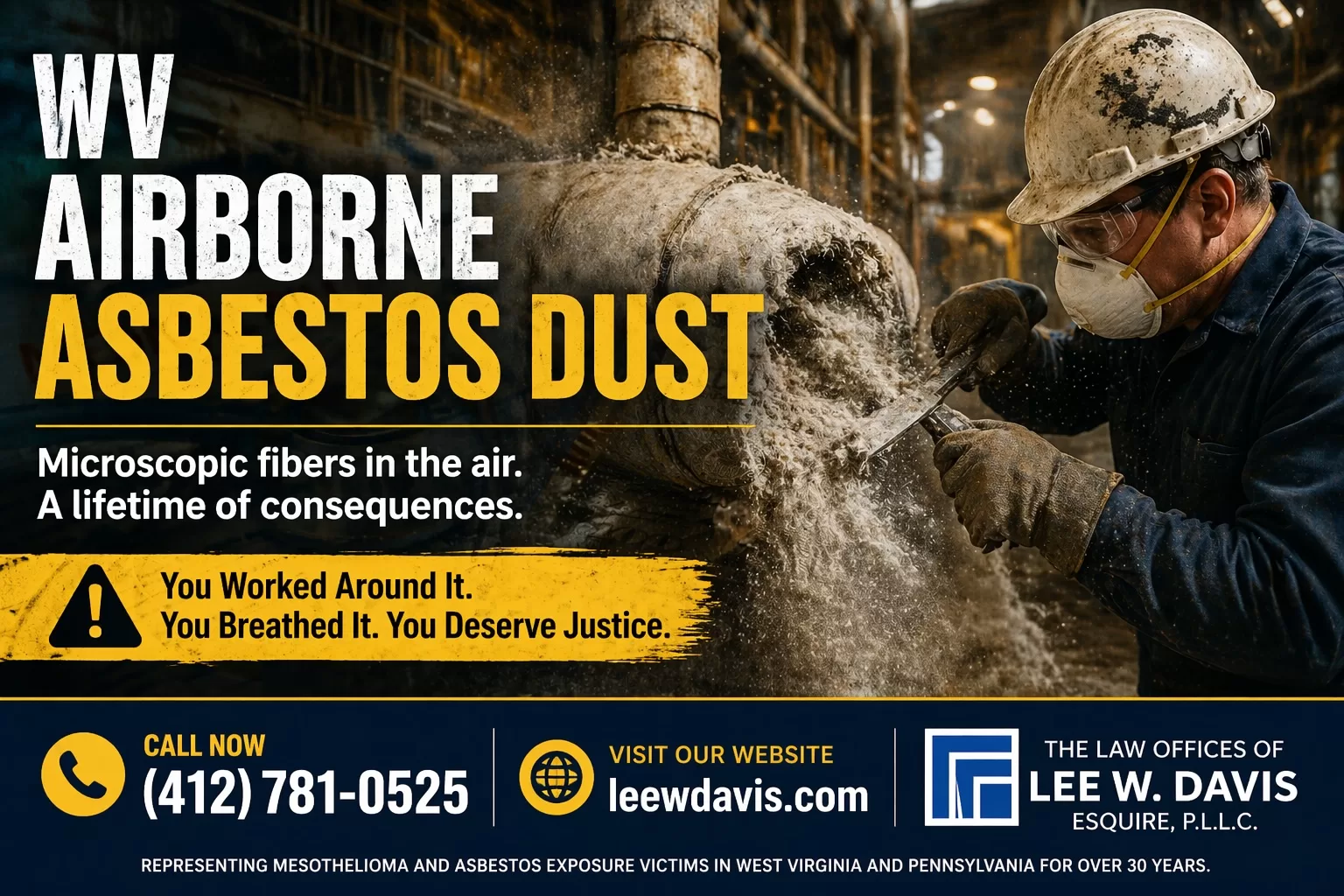
WV airborne asbestos dust caused mesothelioma and lung cancer in workers who never touched a piece of insulation, never broke open a flange, and never considered themselves to be asbestos workers at all. Throughout West Virginia’s industrial history — at chemical plants along the Kanawha Valley, at power generating stations on the Ohio and Kanawha Rivers, at steel operations in Weirton and the northern panhandle, and at the manufacturing and mining facilities throughout the state — asbestos dust became airborne and remained suspended in the work environment continuously, exposing every worker in those environments regardless of their specific trade or role.
The legal significance of WV airborne asbestos dust exposure is thoroughly established in West Virginia asbestos litigation. A West Virginia worker does not need to have been the person installing or removing insulation to have accumulated legally significant asbestos exposure. The worker who spent a career in the same building, the same mechanical room, or the same production department as the insulation and maintenance work does not need to have touched a fiber directly. What matters is whether they were in an environment where asbestos fibers were airborne — and whether their cumulative exposure in that environment contributed to a mesothelioma or lung cancer diagnosis.
Mesothelioma/Asbestos Legal Help – WV, MI & PA
Speak directly with attorney Lee W. Davis. No call centers. Free, confidential review.
Why Asbestos Dust Becomes Airborne and Stays That Way
Understanding why WV airborne asbestos dust was so pervasive at West Virginia industrial facilities requires understanding the physical properties of asbestos fibers and the industrial environments that created and sustained airborne contamination.
Asbestos insulation, refractory, and gasket materials release fibers when disturbed — cut, scraped, broken, abraded, or simply deteriorated by heat cycling and age. Those fibers are microscopic. The longest are still invisible to the naked eye. They are light enough to remain suspended in still air for hours. They travel on air currents throughout enclosed industrial spaces — through mechanical rooms, down pipe chases, into adjacent work areas — and they settle slowly onto every horizontal surface in the space, where they can be resuspended by foot traffic, equipment vibration, or air movement. They accumulate in the dust that coats every surface in an industrial facility that used asbestos-containing materials over years of operation.
A West Virginia industrial worker who walked through a mechanical room where insulation work had been performed that morning — even hours after the work was done — breathed airborne asbestos fibers resuspended from the settled dust. A production worker who swept the floor at the end of a shift in a WV chemical plant or steel mill resuspended the settled asbestos dust from that surface into the breathing zone throughout the cleanup task. A worker who worked for thirty years in a building where asbestos-containing materials were regularly disturbed accumulated thirty years of airborne asbestos fiber exposure — not from any single task, but from the continuous ambient contamination of the work environment throughout their career.
The WV Industrial Environments Where Airborne Asbestos Dust Was Most Pervasive
Kanawha Valley chemical plants — The enclosed process units, instrumentation rooms, pipe chases, and maintenance areas throughout Union Carbide Institute, DuPont Belle, and the broader Kanawha Valley chemical plant corridor were environments where asbestos-containing pipe insulation, valve packing, and gasket materials were present throughout and where routine maintenance work continuously disturbed those materials. Workers across every role in those plants — operators, instrument technicians, maintenance mechanics, laborers — spent careers in environments where airborne asbestos dust from continuous maintenance activity was a permanent feature of the work environment.
West Virginia power generating stations — The boiler rooms, turbine halls, and mechanical spaces throughout West Virginia’s coal-fired power plants — including Mountaineer Power Plant, Kammer, Mitchell, and Mount Storm — were among the most heavily asbestos-contaminated enclosed work environments in the state. Heavy asbestos insulation on boilers, turbine casings, and steam distribution systems continuously shed fibers into those enclosed spaces throughout the operational life of the facilities. Power plant workers who spent careers in those buildings — regardless of whether their specific job involved touching insulation — accumulated significant ambient fiber exposure from the contaminated air throughout those structures.
Weirton Steel and Ohio River steel operations — The production buildings, mill facilities, and mechanical spaces at Weirton Steel and the Ohio River corridor steel operations contained asbestos-containing materials throughout — on steam systems, in furnace insulation and refractory, on the mechanical equipment throughout every production department. Steel workers across every production role spent careers in those buildings, breathing the ambient dust that included asbestos fibers from deteriorating insulation and refractory throughout the facility.
Steel mill powerhouses — The enclosed powerhouse buildings serving West Virginia steel operations concentrated boiler and steam system asbestos contamination into some of the most heavily contaminated enclosed work environments at those facilities. Every worker who entered the powerhouse — not just the boilermakers and pipefitters who performed maintenance — breathed the airborne asbestos dust from the deteriorating insulation throughout those spaces. See steel mill powerhouse asbestos for the full powerhouse ambient exposure profile.
Industrial construction sites — WV industrial construction sites where asbestos-containing insulation was being installed generated airborne asbestos dust that contaminated the entire construction environment — affecting every trade on site, not only the insulators doing the installation work. Ironworkers, structural workers, electricians, and laborers working on the same construction site as active insulation installation accumulated airborne asbestos exposure from the contaminated construction environment throughout the project.
The Workers Most Commonly Affected by WV Airborne Asbestos Dust Exposure
Production workers and operators — Chemical operators, steel production workers, and the production employees across West Virginia’s industrial facilities who spent careers in production buildings saturated with ambient asbestos dust from the maintenance and insulation work occurring continuously throughout those environments.
Laborers and cleanup workers — West Virginia industrial laborers who swept floors, moved materials, and performed cleanup work in asbestos-contaminated facilities resuspended settled asbestos dust throughout every cleanup task — accumulating exposure from the ambient contamination of the work environment and from the active resuspension of settled fibers throughout their daily work. See laborers asbestos exposure WV for the full laborer ambient exposure profile.
Ironworkers — West Virginia ironworkers who erected structures and installed equipment at industrial facilities where asbestos-containing insulation was simultaneously being installed worked in construction environments contaminated with airborne asbestos dust from the insulation work occurring throughout the site. See WV ironworker asbestos exposure for the ironworker-specific profile.
Electricians and instrument technicians — Workers whose trades took them throughout industrial facilities — into mechanical rooms, through pipe chases, into equipment areas — accumulated ambient asbestos exposure from every contaminated space they entered throughout their careers at West Virginia industrial facilities. Their daily movement through asbestos-saturated industrial environments produced sustained cumulative exposure from the airborne dust in those spaces.
Maintenance mechanics and millwrights — Workers who maintained industrial equipment throughout WV facilities spent careers in mechanical rooms and equipment areas where asbestos-containing insulation on surrounding pipe and equipment systems continuously shed fibers into the ambient air. Even when their own maintenance tasks did not involve disturbing insulation, they worked in environments where other trades’ work and the natural deterioration of aged insulation maintained continuous ambient fiber concentrations.
Supervisors and plant engineers — Engineering and supervisory personnel whose inspection and management roles took them throughout West Virginia industrial facilities accumulated ambient asbestos exposure from every production department, mechanical room, and utility area they visited throughout their careers. The plant-wide nature of engineering and supervisory roles meant plant-wide ambient asbestos exposure at WV industrial facilities.
Ambient Exposure and the Legal Standard in West Virginia Asbestos Claims
West Virginia asbestos litigation recognizes ambient and bystander asbestos exposure as a legally viable exposure pathway — not merely as context for a primary hands-on exposure claim, but as a standalone basis for a mesothelioma or lung cancer claim when the cumulative ambient exposure was sufficient and the diagnosis is established.
The legal question is whether the claimant’s total asbestos fiber dose — accumulated through whatever combination of direct contact, bystander proximity, and ambient exposure their career produced — was sufficient to have contributed to the mesothelioma or lung cancer diagnosis. For West Virginia workers who spent careers in the heavily contaminated industrial environments of the state’s chemical plants, power stations, and steel operations, the ambient fiber dose accumulated through daily workplace presence in those environments is frequently legally significant — even when no single dramatic exposure event can be identified.
Building an ambient exposure claim requires demonstrating the conditions at the specific West Virginia industrial facilities where the claimant worked — the asbestos-containing materials present, the maintenance and disturbance activities that were ongoing throughout the claimant’s employment, and the industrial hygiene conditions that allowed airborne fiber concentrations to accumulate in the enclosed work environments where the claimant spent their career. An experienced West Virginia asbestos attorney with facility-specific knowledge of WV industrial sites builds that ambient exposure narrative from the accumulated case documentation of decades of West Virginia asbestos litigation.
Check If Your Family Was Exposed
Get your free guide instantly + a confidential case review.
🔒 100% Confidential. No obligations.
What Evidence Supports a WV Airborne Asbestos Dust Claim
- Diagnosis records confirming mesothelioma or lung cancer
- Work history at West Virginia industrial facilities — facilities, job titles, departments, and years worked — establishing the duration and location of ambient exposure throughout the career
- Memory of the specific buildings, work areas, and conditions at WV facilities where you spent your career — the presence of insulation work, the visible dust, the maintenance activity occurring throughout the facility during your employment
- Names of coworkers, supervisors, or contractors who worked at the same WV facilities during the same periods
- Union records or Social Security earnings records confirming employment at specific West Virginia industrial facilities
For the broader WV mesothelioma legal framework see West Virginia mesothelioma lawyer. For lung cancer claims from WV ambient exposure see West Virginia lung cancer. For take-home dust exposure affecting WV families see West Virginia take-home asbestos. For the shutdown and outage work profile that created the most concentrated airborne dust events see WV asbestos exposure shutdown work. For the pipe leak repair profile see WV asbestos pipe leaks. You can search the full list of asbestos job sites in West Virginia to identify the specific WV facilities where you worked.
Knowledge of West Virginia Airborne Asbestos Exposure Cases Since 1988
I began researching West Virginia asbestos cases in 1988, working as a paralegal on the original West Virginia asbestos mass trials — cases that included workers whose mesothelioma and lung cancer traced to ambient and bystander exposure at WV chemical plants, steel operations, and power stations, not only to the hands-on insulation and boiler work that is most immediately associated with asbestos exposure. I was licensed in West Virginia in 2002 and have represented West Virginia mesothelioma and asbestos lung cancer claimants — including ambient and bystander exposure claimants — since my return to Pittsburgh in 1999.
West Virginia ambient asbestos exposure claims require facility-specific documentation of the conditions at the WV industrial sites where the claimant worked — the kind of documentation that comes from decades of WV industrial asbestos case history, not from a general personal injury practice.
When you call, you speak directly with me. No call centers. No case managers.
West Virginia’s statute of limitations runs from the date of diagnosis. If you worked at a West Virginia industrial facility and have been diagnosed with mesothelioma or lung cancer — whether or not you ever directly handled asbestos-containing materials — call to discuss your work history and diagnosis.
Call (412) 781-0525 or start your confidential case review online now.
Frequently Asked Questions
Q: I worked as a chemical operator at a Kanawha Valley plant for over twenty years but never personally handled asbestos insulation or gaskets. My mesothelioma diagnosis was just confirmed. Do I have a viable West Virginia asbestos claim?
A: Yes, potentially. A twenty-year career as a chemical operator at a Kanawha Valley chemical plant placed you continuously in an environment where asbestos-containing pipe insulation, gaskets, and valve packing were present throughout every process unit and where routine maintenance work continuously disturbed those materials. Chemical operators in those facilities breathed the airborne asbestos dust from that continuous maintenance activity throughout their working careers — accumulating ambient fiber exposure that is legally significant regardless of whether they personally handled asbestos-containing materials. West Virginia asbestos law recognizes ambient exposure as a viable claim pathway. Call to discuss your specific facility history and diagnosis.
Q: I swept floors and did cleanup work at a West Virginia steel mill for many years. I was never a tradesperson. Does that career support a mesothelioma claim?
A: Yes, potentially. Floor sweeping and cleanup work at a West Virginia steel mill is one of the ambient exposure pathways most thoroughly recognized in WV asbestos litigation — because sweeping resuspends settled asbestos dust from surfaces throughout the work area directly into the breathing zone of the worker performing the cleanup. Laborers and cleanup workers at West Virginia steel mills, chemical plants, and power stations accumulated significant asbestos exposure through that resuspension pathway across careers spent performing cleanup in asbestos-contaminated industrial environments. Call to discuss your specific work history and diagnosis.
Q: How long do I have to file a mesothelioma claim in West Virginia based on ambient asbestos dust exposure at WV industrial facilities?
A: West Virginia’s statute of limitations runs from the date of diagnosis — not from the date of any specific exposure event or the beginning of your work history at WV facilities. The ambient nature of the exposure does not affect the limitations period calculation. Wrongful death claims for surviving family members carry different deadlines running from the date of death. Call as soon as a diagnosis is confirmed so we can begin evaluating your West Virginia work history and the ambient exposure conditions at the facilities where you spent your career.
Mesothelioma/Asbestos Legal Help – WV, MI & PA
Speak directly with attorney Lee W. Davis. No call centers. Free, confidential review.