Pittsburgh Boiler Asbestos Exposure

Pittsburgh Boiler Asbestos Exposure
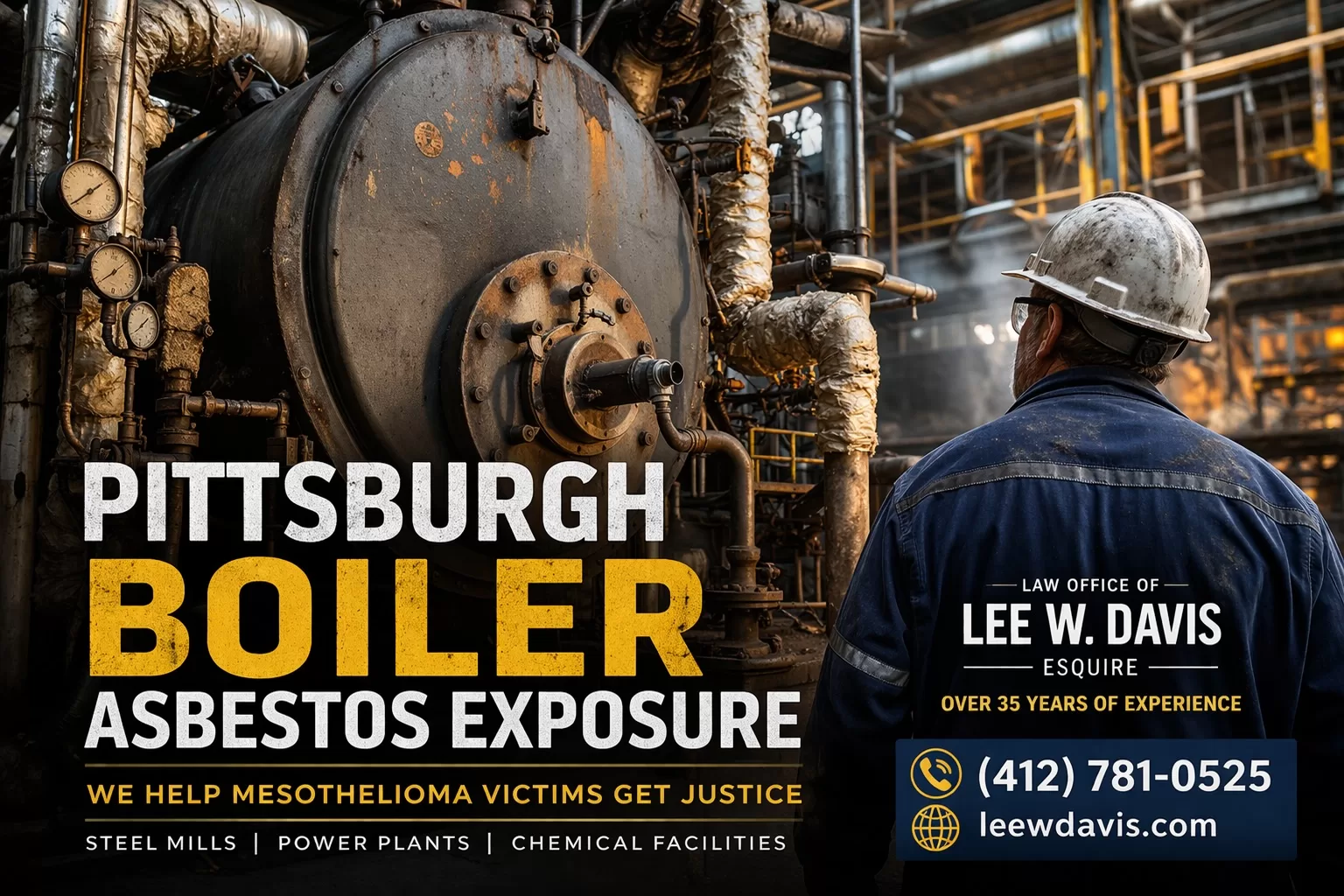
If you worked on boiler systems at a Pittsburgh area industrial facility and you’ve been diagnosed with mesothelioma or lung cancer, Pittsburgh boiler asbestos exposure is one of the most well-documented occupational exposure histories in western Pennsylvania. Boilers and steam systems in Pittsburgh’s steel mills, coke plants, power generating stations, chemical facilities, and manufacturing operations were surrounded by asbestos-containing insulation throughout their operational lives — and the workers who installed, maintained, repaired, and rebuilt those systems worked in direct and sustained contact with those materials across careers spanning decades.

Mesothelioma/Asbestos Legal Help – WV, MI & PA

Speak directly with attorney Lee W. Davis. No call centers. Free, confidential review.

Why Boiler Systems Were the Most Asbestos-Intensive Environment in Pittsburgh Industrial Facilities

Every major industrial facility in Pittsburgh and Allegheny County required steam — for process heat in steel production, for chemical reaction control, for power generation, for building heat, and for dozens of supporting utility functions throughout every plant. Generating, distributing, and maintaining that steam required boiler systems, and boiler systems required insulation.

The insulation requirements for industrial boiler systems are among the most demanding of any application — boiler shells, steam drums, feedwater systems, and the miles of high-pressure steam distribution piping throughout a major Pittsburgh industrial facility all required thick, effective thermal insulation to operate safely and efficiently. Before the late 1970s that insulation was almost universally asbestos-containing. The materials were applied in layers — block insulation on the boiler shell, pipe covering on the steam lines, insulating cement on fittings and irregular surfaces, finishing cement over the entire system — each layer containing asbestos in concentrations up to 80 percent in products used through most of the post-war industrial era.

Workers who built, maintained, and repaired those systems breathed asbestos fibers throughout their working lives. And the workers who were called in to tear out old boiler insulation and replace it — during major overhauls, after casualty events, or simply when the aging insulation had deteriorated — performed the highest-exposure boiler work of all.

The Specific Boiler-Related Tasks That Created Asbestos Exposure

Boiler insulation installation — Applying asbestos-containing block insulation to boiler shells, fitting pipe covering to steam lines, and applying insulating and finishing cements to the completed system were the foundational tasks of boiler insulation work. Every one of those tasks released asbestos fibers — from cutting and shaping block insulation, from mixing and applying cement, and from the finished surfaces of the insulation system throughout the working life of the boiler.

Boiler insulation removal during overhauls — When Pittsburgh industrial boilers required major overhaul or repair, the existing insulation had to be removed first. Old boiler insulation — dried, crumbled, and saturated with decades of heat cycling — released asbestos fibers in concentrated form when torn away from the boiler shell. Workers performing boiler strip-out during major overhauls at Pittsburgh facilities generated some of the highest fiber release rates of any maintenance task in industrial history.

Boiler repair and hot work — Repairing boiler tubes, replacing boiler components, and conducting welding and cutting work on boiler systems required working in close proximity to and often directly through the insulation surrounding those systems. Hot repair work inside confined boiler areas concentrated fiber exposure in the breathing zone of the workers performing the repairs.

Steam line maintenance — The miles of high-pressure steam distribution piping connecting boiler systems to production departments throughout Pittsburgh industrial facilities required regular maintenance — replacing gaskets at flanged connections, changing out valve packing, repairing damaged insulation sections, and servicing the steam traps and other components throughout the system. Each of those tasks involved disturbing asbestos-containing materials in the immediate work area.

Boiler inspection work — Inspecting boiler systems — entering boiler drums, examining tube sheets, conducting confined-space assessments of boiler internals — placed inspectors in the same spaces where asbestos fiber concentrations were highest, with no active disturbance required to create significant exposure.


Pittsburgh Facilities Where Boiler Asbestos Exposure Was Most Significant

Pittsburgh’s major industrial facilities all operated boiler systems requiring the heavy asbestos insulation that created occupational exposure for generations of workers:

  • US Steel Homestead Works — the Mon Valley’s largest steel facility operated extensive boiler systems generating steam for steelmaking, rolling, and utility functions throughout the plant
  • Clairton Coke Works and Koppers Clairton — coke production required sustained steam for by-products recovery and plant utility systems throughout the facility
  • Neville Island Coke and Chemical — Ohio River industrial complex with extensive boiler and steam systems throughout chemical and coke operations
  • Pittsburgh Plate Glass / PPG — glass and chemical manufacturing with steam systems requiring heavy insulation throughout the facility
  • Cheswick Power Station — a power generating station is essentially a facility built entirely around boiler and steam systems — the boiler exposure environment at Cheswick was one of the most intensive in the Allegheny Valley
  • Allegheny Ludlum Brackenridge — specialty steel production with extensive steam generation and distribution throughout the facility
  • J&L Steel and Jones and Laughlin Pittsburgh area operations — major integrated steel facilities with full boiler and steam infrastructure throughout


Who Was Exposed to Pittsburgh Boiler Asbestos

Boiler asbestos exposure in Pittsburgh’s industrial facilities was not limited to a single trade or a single role. The workers most commonly involved in Pittsburgh boiler asbestos claims include:

Boilermakers — The trade most directly associated with boiler construction, maintenance, and repair. Boilermakers at Pittsburgh industrial facilities performed the furnace refractory, boiler shell, and pressure vessel work that involved the heaviest direct asbestos contact. See the Allegheny Valley boilermaker asbestos resource for the Allegheny Valley specific profile.

Pipefitters and steamfitters — Workers who installed and maintained the steam distribution systems connected to Pittsburgh’s industrial boilers worked throughout the miles of asbestos-insulated steam piping that ran from boiler rooms into every production department. See the Allegheny Valley pipefitters resource.

Insulators — The workers who applied and removed the asbestos-containing insulation on Pittsburgh boiler systems and steam lines. See the Allegheny Valley insulator asbestos resource.

Millwrights — Plant millwrights at Pittsburgh facilities maintained the mechanical systems associated with boiler operation — pumps, valves, drives, and auxiliary equipment — in the same spaces where boiler insulation created constant ambient fiber exposure throughout the work environment.

Plant engineers and shift engineers — Engineers responsible for Pittsburgh industrial boiler systems conducted regular inspections and oversaw maintenance and outage work in boiler environments throughout their careers. See the Pittsburgh plant engineer asbestos and Allegheny County engineer asbestos exposure resources.

Outside contractors — Contractors brought in for major boiler overhauls performed the most intensive asbestos exposure work — strip-outs, rebuilds, and system replacements — at Pittsburgh industrial facilities throughout the post-war decades.

What Evidence Supports a Pittsburgh Boiler Asbestos Claim

  • Diagnosis records confirming mesothelioma or lung cancer
  • Work history at Pittsburgh area facilities with boiler systems — job titles, years worked, specific boiler-related tasks performed
  • Memory of the specific boiler rooms, steam systems, and work areas where you spent your career
  • Names of coworkers, contractors, foremen, or supervisors you worked alongside during boiler maintenance and overhaul work
  • Union records confirming employment and dispatch history at specific Pittsburgh facilities
  • Social Security earnings records confirming employers and time periods

For a broader overview of Allegheny County asbestos exposure and the full range of Pittsburgh area facility resources see our Allegheny County hub page. For workers with lung cancer diagnoses see Pittsburgh asbestos lung cancer. For a broader overview of how Pennsylvania mesothelioma claims work see our Pennsylvania resource.

Knowledge of Boiler Asbestos Cases Since 1989

I first began researching Pittsburgh area asbestos cases in 1989 as a paralegal, working on asbestos mass trials across Pennsylvania and West Virginia. I returned to Pittsburgh in 1999 to handle mesothelioma and lung cancer cases individually, applying decades of product identification work — tracking the specific boiler insulation manufacturers, refractory suppliers, and gasket companies whose materials were used at Pittsburgh industrial facilities — directly to every case evaluation. Boiler-related asbestos claims are among the most thoroughly documented exposure histories in western Pennsylvania asbestos litigation and I have handled them throughout my practice.

When you call, you speak directly with me. No call centers. No case managers.

If you or a family member worked on boiler systems at Pittsburgh area industrial facilities and has been diagnosed with mesothelioma or lung cancer, time matters. Pennsylvania’s statute of limitations runs from the date of diagnosis.

Call (412) 781-0525 or start your confidential case review online now.

Check If Your Family Was Exposed

Get your free guide instantly + a confidential case review.

🔒 100% Confidential. No obligations.


Frequently Asked Questions

Q: I worked as a boilermaker at the Homestead Works doing major boiler overhauls during shutdowns for fifteen years. Is that enough to support a mesothelioma claim?

A: A fifteen-year boilermaker career at the Homestead Works performing major boiler overhauls during shutdowns is a very strong asbestos exposure profile. Major boiler overhauls during shutdowns involved stripping old asbestos-containing boiler insulation — one of the highest fiber-release activities in any industrial setting — working inside boiler drums and confined boiler spaces where fiber concentrations were most intense, and replacing gaskets and packing throughout the boiler and associated steam systems. That work, performed repeatedly over fifteen years at one of western Pennsylvania’s largest industrial facilities, represents a substantial cumulative exposure history that has supported successful mesothelioma claims.

Q: I was a shift engineer responsible for the boiler systems at a Pittsburgh area power plant. I supervised the boilermakers and inspected the boiler rooms regularly but I didn’t do the hands-on work myself. Do I have an asbestos claim?

A: Possibly yes. Regular inspection of boiler rooms and supervision of boiler maintenance work at Pittsburgh industrial facilities placed you continuously in the environments where asbestos fiber concentrations were highest — particularly during active maintenance and outage work when boiler insulation was being disturbed. Engineering and supervisory presence in those environments across a career spanning years creates a cumulative exposure history that has supported mesothelioma and lung cancer claims independent of any direct hands-on insulation contact. Call to discuss your specific career history and diagnosis.

Q: How long do I have to file a mesothelioma claim in Pennsylvania connected to Pittsburgh boiler asbestos exposure?

A: Pennsylvania’s statute of limitations runs from the date of diagnosis, not the date of your exposure. Wrongful death claims carry different and sometimes shorter deadlines running from the date of death. Do not assume it is too late — call as soon as a diagnosis is confirmed so we can evaluate your boiler work history at Pittsburgh area facilities and identify all responsible parties.

Pittsburgh Plant Engineer Asbestos Exposure

Pittsburgh Plant Engineer Asbestos Exposure

If you worked as a plant engineer at a Pittsburgh area industrial facility and you’ve been diagnosed with mesothelioma or lung cancer, Pittsburgh plant engineer asbestos exposure is a legitimate and frequently overlooked occupational history that has supported successful claims for industrial engineers and their families in Allegheny County and throughout the Pittsburgh metro region. Pittsburgh’s steel mills, coke plants, chemical facilities, power generating stations, and glass works employed generations of plant engineers whose careers took them into every corner of facilities saturated with asbestos-containing materials — not as trades workers handling insulation directly but as the engineers whose role required continuous physical presence throughout those environments across decades of industrial employment.

Mesothelioma/Asbestos Legal Help – WV, MI & PA

Speak directly with attorney Lee W. Davis. No call centers. Free, confidential review.

Pittsburgh’s Industrial Legacy and the Plant Engineer’s Role

Pittsburgh’s industrial identity was built on the Mon Valley steel corridor, the Ohio River chemical and manufacturing operations, the Allegheny Valley specialty steel and power generation facilities, and the glass and chemical works that defined Allegheny County’s industrial geography for most of the twentieth century. Every one of those facilities relied heavily on asbestos-containing materials throughout its operations — in the insulation on steam and process piping, in the refractory materials lining furnaces and coke ovens, in the gaskets and packing throughout mechanical systems, and in the construction and maintenance materials used across decades of continuous plant operation.

Plant engineers at Pittsburgh area facilities were not peripheral to that environment. They were the people responsible for it. Their role required walking every department, supervising every maintenance function, overseeing every outage, and inspecting every mechanical system throughout their facilities — in the same spaces, breathing the same air, as the trades workers whose direct contact with asbestos-containing materials is most commonly associated with mesothelioma and lung cancer claims.

The Pittsburgh Plant Engineer’s Specific Exposure Pathways

Maintenance oversight at Pittsburgh steel facilities — Plant engineers at facilities like US Steel Homestead Works, the Mon Valley steel operations, and the Pittsburgh-area US Steel complex supervised the maintenance and repair work that involved the most intensive disturbance of asbestos-containing materials at those facilities. Standing in the blast furnace area during hot repair work, walking the rolling mill during equipment maintenance, reviewing boiler systems during service outages — each of those supervisory activities placed the plant engineer in direct proximity to active asbestos fiber release throughout a career at a Pittsburgh steel facility.

Coke plant engineering — Plant engineers at Clairton Coke Works and Koppers Clairton oversaw operations in one of the most asbestos-intensive industrial environments in western Pennsylvania. The coke battery operations, the by-products recovery systems, and the mechanical infrastructure throughout a coke facility of Clairton’s scale required continuous engineering oversight — and continuous exposure to asbestos-containing materials throughout every production and maintenance phase.

Chemical and glass facility engineering — Plant engineers at Pittsburgh Plate Glass / PPG and Neville Island chemical operations oversaw process engineering in environments where asbestos-containing insulation covered virtually every pipe, reactor, and piece of process equipment throughout the facility. The engineering inspection and oversight role at a chemical facility required walking those spaces continuously — accumulating ambient fiber exposure from the insulated environment itself in addition to exposure during active maintenance work.

Power plant engineering — Plant engineers at Pittsburgh area power generating stations including Cheswick Power Station oversaw the turbine systems, boiler operations, and mechanical infrastructure in environments with some of the heaviest asbestos insulation concentrations of any industrial facility type. Power plant engineering required detailed technical knowledge of those systems and regular hands-on inspection of the equipment — bringing engineers into direct proximity with the insulated turbines, boilers, and steam systems that defined the power plant asbestos exposure environment.

Outage engineering oversight — Major maintenance outages at Pittsburgh area facilities represented the most intensive asbestos exposure periods of any phase of plant operation — and plant engineers were present throughout. Overseeing the shutdown, coordinating the maintenance contractors, approving progress on furnace rebuilds and boiler overhauls, and conducting engineering acceptance inspections of completed work all required continuous plant presence during the period of maximum asbestos fiber disturbance.

Pittsburgh Area Facilities Where Plant Engineer Exposure Was Most Significant

How Pittsburgh Plant Engineer Claims Differ From Trades Claims

The documentation and investigative approach for a Pittsburgh plant engineer asbestos claim differs from a skilled trades claim in important ways that an experienced asbestos attorney needs to understand from the outset.

Salaried plant engineers typically have more complete individual employment records than union trades workers — personnel files, engineering department records, pension documentation — but lack the union dispatch records that provide the multi-facility exposure timeline for skilled trades claimants. The exposure narrative for an engineer is built differently — from the engineer’s own detailed account of their supervisory responsibilities, the facilities and departments they managed, the maintenance and outage work they oversaw, and the specific conditions they worked in throughout their career.

The product identification work for plant engineer claims also differs. Rather than identifying specific products that the engineer personally handled, the claim requires establishing which asbestos-containing products were in use throughout the facilities the engineer supervised — and demonstrating that the engineer’s supervisory presence in those facilities created the kind of sustained fiber exposure that has caused mesothelioma and lung cancer in Pittsburgh’s industrial workforce.


What Evidence Supports a Pittsburgh Plant Engineer Asbestos Claim

  • Diagnosis records — pathology reports, imaging, treatment summaries confirming mesothelioma or lung cancer
  • Employment history at Pittsburgh area industrial facilities — job titles, engineering responsibilities, departments supervised, years worked
  • Memory of specific maintenance work, outage periods, and plant areas you oversaw throughout your career
  • Names of trades workers, maintenance contractors, and supervisors you worked with at specific Pittsburgh facilities
  • Personnel records, engineering documentation, or pension records confirming employment timeline
  • Social Security earnings records confirming employers and time periods

For a broader overview of Pennsylvania mesothelioma claims see our Pennsylvania resource. For workers with lung cancer diagnoses see the Pittsburgh asbestos lung cancer resource. For the broader western PA plant engineer page see Pennsylvania plant engineer asbestos. You can search the full list of asbestos job sites in Pennsylvania to review all documented Pittsburgh area exposure sites.

Knowledge of Pittsburgh Industrial Asbestos Cases Since 1989

I first began researching Pittsburgh area asbestos cases in 1989, working on asbestos mass trials across Pennsylvania and West Virginia. I returned to Pittsburgh in 1999 to handle mesothelioma and lung cancer cases individually, applying decades of product identification work and facility knowledge — tracking the contractors, manufacturers, and asbestos product lines specific to Pittsburgh area facilities — directly to every case evaluation. That includes plant engineer and supervisory role cases where the exposure arose from engineering oversight rather than direct trades work.

When you call, you speak directly with me. No call centers. No case managers.

If you worked as a plant engineer at a Pittsburgh area industrial facility and have been diagnosed with mesothelioma or lung cancer, your supervisory role does not disqualify your claim. Pennsylvania’s statute of limitations runs from the date of diagnosis.

Call (412) 781-0525 or start your confidential case review online now.

Check If Your Family Was Exposed

Get your free guide instantly + a confidential case review.

🔒 100% Confidential. No obligations.


Frequently Asked Questions

Q: I was a plant engineer at the Homestead Works for over twenty years overseeing maintenance and outage work. I never handled asbestos directly. Do I have a mesothelioma claim?

A: Possibly yes. Direct physical contact with asbestos-containing materials is not a legal requirement for a mesothelioma claim. A twenty-year career at the Homestead Works overseeing maintenance and outage work placed you continuously in the environments where asbestos fiber concentrations were highest — during furnace repair work, boiler maintenance, pipe system overhauls, and the major outage periods when multiple maintenance activities were occurring simultaneously throughout the plant. That sustained engineering presence in the most active asbestos disturbance environments at one of western Pennsylvania’s largest industrial facilities constitutes a significant cumulative exposure history that warrants careful legal evaluation.

Q: I was a shift engineer at a Pittsburgh area power plant and spent every shift walking the turbine floor, boiler room, and mechanical areas. Is that enough asbestos exposure to support a claim?

A: Yes, potentially. Shift engineers at Pittsburgh area power plants spent their working careers in the most asbestos-intensive spaces in those facilities — the turbine hall with its heavily insulated steam systems, the boiler room with its insulated boiler and feedwater systems, and the mechanical areas housing the pumps, valves, and heat exchangers that carried asbestos-containing gaskets and packing throughout their service lives. Walking those spaces every shift for a career spanning decades represents sustained ambient exposure that has supported successful mesothelioma and lung cancer claims independent of any direct insulation contact.

Q: How long do I have to file a mesothelioma claim in Pennsylvania connected to Pittsburgh plant engineering work?

A: Pennsylvania’s statute of limitations runs from the date of diagnosis, not the date of your exposure. Wrongful death claims carry different and sometimes shorter deadlines running from the date of death. Do not assume it is too late — call as soon as a diagnosis is confirmed so we can evaluate your engineering career history and identify all responsible parties.

Mesothelioma/Asbestos Legal Help – WV, MI & PA

Speak directly with attorney Lee W. Davis. No call centers. Free, confidential review.

Homestead Works Asbestos Exposure

Homestead Works Asbestos Exposure

If you worked at the Homestead Works and you’ve been diagnosed with mesothelioma or lung cancer, Homestead Works asbestos exposure is one of the most significant occupational exposure histories in the entire Mon Valley. The Homestead Works was one of the largest and most complex steel facilities in American history, and asbestos-containing materials were present throughout every phase of its operations — from the blast furnaces and open hearths through the rolling mills, finishing lines, and the mechanical systems that kept the entire plant running.

Mesothelioma/Asbestos Legal Help – WV, MI & PA

Speak directly with attorney Lee W. Davis. No call centers. Free, confidential review.

The Homestead Works — Scale and Industrial History

The Homestead Works of United States Steel Corporation stretched for miles along the south bank of the Monongahela River in Homestead, Munhall, and Whitaker. At its peak it employed tens of thousands of workers across a facility so large that it functioned as a self-contained industrial city — with its own power generation, its own rail systems, its own machine shops, and its own construction and maintenance operations running continuously alongside production.

That scale meant Pittsburgh asbestos exposure was not isolated to one department or one trade at the Homestead Works. It was plant-wide, continuous, and cumulative. Workers who spent careers at the Homestead Works — whether in steelmaking, finishing, maintenance, or construction — were exposed to asbestos-containing materials as a routine feature of the work environment throughout the facility’s operational life.

Where Asbestos Exposure Occurred at the Homestead Works

The Homestead Works used asbestos-containing materials throughout its operations. The most significant exposure environments included:

Blast furnaces and steelmaking — The blast furnaces and open hearth furnaces at Homestead required massive refractory systems for construction and ongoing repair. The blocks, boards, ramming materials, and cements used in furnace repair and maintenance near the shell were asbestos-containing products. Workers involved in furnace maintenance, hot repairs, and outage rebuilds faced direct and sustained exposure to these materials.

Steam and process piping systems — The Homestead Works operated extensive steam generation and distribution systems throughout the facility. The insulation on those steam lines, process piping, valves, and mechanical systems historically contained asbestos. Pipefitters and steamfitters maintaining those systems worked in direct contact with asbestos-containing insulation on a daily basis.

Rolling mills and finishing operations — The hot strip mill, plate mill, and finishing operations at Homestead required sustained high heat and continuous mechanical maintenance. Insulation on the rolling equipment, the reheating furnaces, and the mechanical drives throughout the finishing departments was present throughout workers’ careers and was disturbed regularly during maintenance and outage work.


Boiler rooms and power generation — The Homestead Works generated its own power through boiler systems that required heavy insulation throughout. Boilermakers and maintenance mechanics working in those environments faced significant asbestos exposure from the insulation on boilers, steam lines, and associated mechanical systems.

Machine shops and fabrication — The plant’s internal machine shops and fabrication operations used asbestos-containing materials in equipment repair, gasket replacement, and packing work throughout their operations.

Construction and shutdown work — Outside contractors and heavy construction workers brought in for major shutdowns, rebuilds, and capital projects at the Homestead Works performed the tear-out and replacement work that generated the heaviest asbestos dust of any activity at the plant.

Trades Most Commonly Involved in Homestead Works Asbestos Claims

Workers across every major industrial trade were exposed to asbestos-containing materials at the Homestead Works. The trades most commonly involved in Pittsburgh mesothelioma claims from the Homestead Works include:

  • Pipefitters and steamfitters on the plant-wide steam and process piping systems
  • Millwrights maintaining rolling equipment, drives, and mechanical systems throughout the facility
  • Boilermakers on furnace, boiler, and heat exchanger maintenance and repair
  • Insulators — direct handlers of asbestos-containing insulation materials throughout the plant
  • Electricians working around asbestos-containing electrical components and control systems
  • Ironworkers and heavy construction trades on shutdown and major rebuild work
  • Laborers on demolition, teardown, and outage crews
  • Machinists and mechanics on equipment repair and gasket work in the machine shops
  • Outside contractors brought in for plant shutdowns, capital projects, and major repairs

The Homestead Works Corporate History and Liability

The Homestead Works operated under United States Steel Corporation for most of its history before closure in 1986. The liability landscape for Homestead Works asbestos claims involves both the corporate history of US Steel and the product manufacturer defendants whose asbestos-containing insulation, refractory, and gasket materials were used throughout the facility. Many of those product manufacturers have established asbestos bankruptcy trusts that continue to pay claims today.

Understanding which defendants and trust funds apply to your specific work history and exposure timeline at the Homestead Works requires the kind of product identification knowledge that comes from decades of handling these specific cases. For an overview of how Pittsburgh mesothelioma lawsuits work see our dedicated guide.

Related Pittsburgh Area Asbestos Exposure Sites

The Homestead Works was the largest but not the only significant asbestos exposure site along the Mon Valley corridor. Workers who spent time at multiple facilities along the river — or whose family members did — should also review:

You can search the full list of asbestos job sites in Pennsylvania to check whether your former workplace appears in the documented exposure database.

What Evidence Supports a Homestead Works Asbestos Claim

You do not need complete records or perfect memory to begin evaluating your claim. The evidence that matters most includes:

  • Diagnosis records — pathology reports, imaging, treatment summaries confirming mesothelioma or lung cancer
  • Work history at the Homestead Works — department, job title, years worked, specific tasks and equipment
  • Memory of the areas of the plant where you worked and what maintenance and repair work occurred around you
  • Names of coworkers, supervisors, foremen, or contractors you remember from your time at the plant
  • Union records from your local — referral logs, dues records, benefit statements confirming employment and time periods
  • Social Security earnings records confirming employers and dates

For a broader overview of how mesothelioma cases in Pennsylvania are evaluated and pursued see our Pennsylvania mesothelioma resource.

Mesothelioma/Asbestos Legal Help – WV, MI & PA

Speak directly with attorney Lee W. Davis. No call centers. Free, confidential review.

Knowledge of Mon Valley Asbestos Cases Since 1989

I first began researching Mon Valley and Pittsburgh area asbestos cases in 1989, working on asbestos mass trials across Pennsylvania and West Virginia. I returned to Pittsburgh in 1999 to handle mesothelioma and lung cancer cases individually across western Pennsylvania and West Virginia. I have been licensed to practice law since 1996 and that depth of product identification work — tracking contractors, manufacturers, and asbestos product lines specific to western Pennsylvania facilities — is applied directly to every Homestead Works case evaluation.

When you call, you speak directly with me. No call centers. No case managers.

If you or a family member worked at the Homestead Works and has been diagnosed with mesothelioma or lung cancer, time matters. Pennsylvania’s statute of limitations runs from the date of diagnosis, not from the date of your exposure decades ago.

Call (412) 781-0525 or start your confidential case review online now.

Check If Your Family Was Exposed

Get your free guide instantly + a confidential case review.

🔒 100% Confidential. No obligations.


Frequently Asked Questions

Q: The Homestead Works closed in 1986. Can I still file a mesothelioma claim from working there?

A: Yes. Pennsylvania’s statute of limitations for mesothelioma runs from the date of diagnosis — not the date of your exposure or the date the plant closed. Workers exposed at the Homestead Works in the 1950s, 1960s, 1970s, and 1980s are receiving mesothelioma and lung cancer diagnoses today and filing viable claims. The plant’s closure does not affect your ability to pursue compensation from the manufacturers of the asbestos-containing products used there.

Q: I worked at the Homestead Works as an outside contractor during shutdowns, not as a US Steel employee. Do I have a claim?

A: Yes. Outside contractors who worked Homestead Works shutdowns and major rebuilds often faced heavier asbestos exposure than direct employees because their work involved the tear-out and replacement of asbestos-containing materials. Your employment status as a contractor rather than a direct US Steel employee does not disqualify your claim. The product manufacturer defendants whose materials caused your exposure are the primary targets in these cases regardless of who signed your paycheck.

Q: How long do I have to file a mesothelioma claim in Pennsylvania connected to Homestead Works exposure?

A: Pennsylvania’s statute of limitations runs from the date of diagnosis, not the date of exposure. Wrongful death claims carry different and sometimes shorter deadlines running from the date of death. Do not assume it is too late — call as soon as a diagnosis is confirmed so we can evaluate your work history and identify the responsible parties before records and witnesses become harder to locate.

Mesothelioma/Asbestos Legal Help – WV, MI & PA

Speak directly with attorney Lee W. Davis. No call centers. Free, confidential review.

Pittsburgh Asbestos Lung Cancer

Pittsburgh Asbestos Lung Cancer Lawyer

If you were diagnosed with Pittsburgh asbestos lung cancer after working in the region’s steel mills, coke plants, power plants, or industrial facilities along the Mon, Allegheny, or Ohio rivers, your work history may be the foundation of a viable legal claim. Asbestos-related lung cancer is the most common long-term consequence of industrial asbestos exposure in the Pittsburgh region — more common than mesothelioma — and it is fully compensable under Pennsylvania law.


Pittsburgh’s Industrial History and Asbestos Exposure

The Pittsburgh region was one of the most heavily industrialized areas in American history. The steel mills, coke plants, glass works, and heavy manufacturing facilities that lined the Mon Valley, the Allegheny Valley, and the Ohio River corridor employed generations of Allegheny County workers in environments saturated with asbestos-containing materials.

Asbestos appeared in virtually every industrial facility in the Pittsburgh region — in the insulation on steam and process piping, in the refractory materials used in furnaces and coke ovens, in the gaskets and packing used in mechanical systems, and in the protective and electrical materials used throughout plant operations. Workers in those facilities breathed asbestos fibers routinely over careers that spanned decades, and the lung cancer diagnoses that result are appearing today — thirty, forty, and fifty years after the exposure occurred.

The Smoking History Question — and Why It Does Not Bar Your Claim

This is the first question most Pittsburgh asbestos lung cancer claimants raise and the one most often handled poorly by lawyers without specific asbestos experience.

If you smoked and you worked around asbestos in Pittsburgh’s industrial facilities, you may have been told your smoking history disqualifies your claim. That is not accurate under Pennsylvania law or under the product liability standards that govern asbestos cases in Allegheny County and throughout western PA.

The legal question is not whether you smoked. The legal question is whether asbestos exposure was a contributing cause of your lung cancer. Pennsylvania’s contributing cause standard allows recovery where asbestos exposure contributed to the development of lung cancer — not as the only cause, not even as the primary cause, but as a real contributing factor that would not have been present without the asbestos exposure your work history involved.

The science supports this standard. Smoking and asbestos exposure do not simply add together in lung cancer risk — they multiply each other. A worker who both smoked and was exposed to asbestos faces lung cancer risk many times higher than a worker who only smoked. That multiplicative relationship is well established in the medical literature and is recognized throughout Pennsylvania asbestos litigation.

Do not assume your smoking history bars your claim. Discuss your full work history and medical record with an experienced asbestos attorney before drawing that conclusion.

Pittsburgh Area Industrial Sites With Significant Asbestos Exposure

The facilities most commonly associated with asbestos lung cancer claims in the Pittsburgh region include:

  • Clairton Coke Works — the largest coke plant in the western hemisphere at its peak, with asbestos exposure across the battery operations, by-products recovery, and mechanical systems throughout the facility
  • Neville Island Coke and Chemical — Ohio River coke and chemical facility within Allegheny County with documented asbestos exposure across battery operations, chemical processing, and maintenance trades
  • US Steel Homestead Works — one of the most historically significant steel facilities in western PA, with asbestos exposure across every production department along the Mon Valley
  • Crucible Steel Midland Works — specialty steel facility in Beaver County with documented asbestos use in refractory and insulation systems
  • Pittsburgh Plate Glass / PPG — chemical and glass manufacturing with asbestos exposure across plant operations including the Pittsburgh Corning connection
  • Cheswick Power Station — Springdale generating station with asbestos insulation throughout mechanical and steam systems
  • Keystone Power Station — Armstrong County generation facility with documented asbestos exposure
  • Mon Valley steel facilities — Duquesne, McKeesport, and the broader US Steel operations along the Mon River corridor

You can search the full list of asbestos job sites in Pennsylvania to check whether your former workplace appears in the documented exposure database. For a broader Pittsburgh-area exposure overview see Pittsburgh asbestos exposure claims.

Trades Most Commonly Involved in Pittsburgh Asbestos Lung Cancer Claims

The trades with the strongest asbestos lung cancer claim profiles in the Pittsburgh region include:

  • Pipefitters and steamfitters on process and utility systems
  • Millwrights maintaining industrial equipment throughout plant operations
  • Boilermakers on furnace and boiler maintenance and repair
  • Insulators — direct handlers of asbestos-containing insulation materials
  • Electricians working around asbestos-containing electrical components
  • Ironworkers and heavy construction trades on shutdown and rebuild work
  • Laborers on demolition, teardown, and outage crews
  • Outside contractors brought in for plant shutdowns and major repairs

What Evidence Supports a Pittsburgh Asbestos Lung Cancer Claim

The evidence that matters most in a Pittsburgh asbestos lung cancer claim includes:

  • Pathology and diagnosis records confirming lung cancer diagnosis and cell type
  • Detailed work history — facilities, departments, job titles, specific tasks, years worked
  • Exposure narrative — what you worked on, what materials surrounded you, how often insulation or refractory was disturbed in your work environment
  • Union records, Social Security earnings records, or employment documentation confirming work at specific Pittsburgh area facilities
  • Medical records documenting smoking history — relevant to the legal analysis and should be disclosed fully rather than avoided
  • Prior pulmonary testing showing asbestos-related changes such as pleural plaques or pleural thickening, which support the causal connection between asbestos exposure and lung cancer

For a broader overview of how Pennsylvania asbestos claims work see the Pennsylvania mesothelioma lawyer page and the Pennsylvania asbestos lawyer resource.

Knowledge of Pittsburgh Asbestos Cases Going Back to 1989

I first began researching Pittsburgh area asbestos cases in 1989, working on asbestos mass trials across Pennsylvania and West Virginia. I have been licensed to practice law since 1996 and have handled asbestos-related lung cancer and mesothelioma cases across Pennsylvania, West Virginia, and Michigan ever since. That includes cases from workers at the Mon Valley steel facilities, the Allegheny Valley coke and power plants, the Ohio River corridor industrial sites, and the chemical and manufacturing facilities throughout Allegheny County and surrounding counties.

When you call, you speak directly with me. No call centers. No case managers.

If you have been diagnosed with lung cancer and have a history of working around asbestos in Pittsburgh’s industrial facilities, your case deserves a careful evaluation regardless of your smoking history. Pennsylvania’s statute of limitations runs from the date of diagnosis.

Call (412) 781-0525 or start your confidential case review online now.


Frequently Asked Questions

Q: I worked at the Clairton Coke Works for twenty years and smoked. My pulmonologist says my lung cancer is smoking-related. Can I still pursue an asbestos claim?

A: Yes, potentially. A clinical attribution to smoking does not end the legal analysis. Pennsylvania’s contributing cause standard asks whether asbestos exposure contributed to your lung cancer — not whether it was the sole or primary cause. Coke plant workers at Clairton faced sustained and heavy asbestos exposure across the battery operations, the by-products recovery systems, and the mechanical maintenance work throughout the facility. That exposure history, combined with a lung cancer diagnosis, warrants a careful legal evaluation regardless of your smoking history or your doctor’s clinical attribution.

Q: What is the difference between filing a Pittsburgh asbestos lung cancer claim and a mesothelioma claim?

A: Both follow similar legal pathways — product liability claims against manufacturers of asbestos-containing materials and claims against asbestos bankruptcy trusts. The key distinction is evidentiary. Mesothelioma is almost exclusively caused by asbestos, making causation direct. Lung cancer requires additional evidence establishing asbestos as a contributing factor given the existence of other potential causes. Compensation amounts and case dynamics differ as well. An experienced Pittsburgh asbestos attorney handles both claim types and can evaluate the specific value and strategy for your lung cancer case based on your work history and diagnosis.

Q: How long do I have to file an asbestos lung cancer claim in Pennsylvania?

A: Pennsylvania’s statute of limitations for asbestos-related lung cancer runs from the date of diagnosis — not the date of your asbestos exposure decades earlier. Wrongful death claims carry different and sometimes shorter deadlines running from the date of death. Do not assume it is too late without speaking to an attorney — call as soon as a diagnosis is confirmed.

Pittsburgh Mesothelioma Lawsuit – Legal Options After Asbestos Exposure

Pittsburgh Mesothelioma Lawsuit | Asbestos Compensation Guide

A Pittsburgh mesothelioma lawsuit may allow victims of asbestos exposure to recover compensation for medical expenses, lost income, and other damages caused by this aggressive cancer.

For much of the twentieth century, Pittsburgh and the surrounding industrial corridor relied heavily on asbestos-containing materials. Steel mills, power plants, manufacturing facilities, and construction projects used asbestos insulation to control heat and protect industrial equipment.

Workers who handled these materials were often unaware of the long-term health risks. Decades later, many of those workers — along with some who worked nearby — have developed mesothelioma.


How Asbestos Exposure Occurred in Pittsburgh Workplaces

Industrial asbestos exposure typically occurred when workers handled or disturbed materials designed to contain asbestos fibers.

Common sources of exposure included:

• Pipe insulation

• Boiler insulation

• Thermal block insulation

• Industrial gaskets and packing materials

• Refractory materials used in steel production

• Spray-applied fireproofing

When these products were cut, drilled, or removed during maintenance, asbestos fibers could become airborne.

Once inhaled, the fibers may remain in lung tissue for decades before causing disease.


Pittsburgh Job Sites Linked to Asbestos Exposure

Pittsburgh’s industrial economy created many workplaces where asbestos products were widely used.

Examples of high-risk job sites historically associated with asbestos exposure include:

• Steel mills throughout the Pittsburgh region

• Power generation facilities

• Chemical manufacturing plants

• Oil and gas processing facilities

• Industrial machine shops

• Construction and mechanical trades projects

Workers in these environments often encountered asbestos daily during normal job duties.


Mesothelioma and Long Latency Periods

Mesothelioma is strongly associated with asbestos exposure. One of the most challenging aspects of the disease is its long latency period.

Symptoms often appear 20 to 50 years after exposure.

Because of this delay, many individuals diagnosed today were exposed to asbestos decades earlier while working in industrial trades.

Common symptoms may include:

• Shortness of breath

• Chest pain

• Persistent cough

• Fluid buildup around the lungs

• Fatigue or unexplained weight loss

A diagnosis of mesothelioma often leads patients and families to begin investigating their occupational exposure history.


Filing a Pittsburgh Mesothelioma Lawsuit

A mesothelioma lawsuit generally targets the manufacturers and suppliers of asbestos-containing products, rather than the worker’s employer.

Claims may involve:

• Product liability

• Negligence

• Failure to warn

• Asbestos bankruptcy trust claims

Compensation from these claims may help cover:

• Medical treatment costs

• Lost wages and future income

• Travel expenses for specialized cancer care

• Pain and suffering damages

Wrongful death damages for surviving family members

Pennsylvania law limits the time available to file an asbestos claim after diagnosis, making it important to evaluate legal options promptly.

Read More about a Pittsburgh Asbestos Lawyer


Why Asbestos Litigation Exists

Internal corporate documents revealed during litigation have shown that many asbestos manufacturers knew about the health risks of asbestos exposure long before warnings were provided to workers.

Holding these companies accountable is a key reason asbestos litigation continues today.

For many families affected by mesothelioma, these claims provide financial support during an extremely difficult medical battle.


Frequently Asked Questions

How long after asbestos exposure does mesothelioma appear?

Mesothelioma typically develops between 20 and 50 years after exposure.

Who can file a Pittsburgh mesothelioma lawsuit?

Individuals diagnosed with mesothelioma due to occupational asbestos exposure may be able to file a lawsuit. Families may also bring wrongful death claims.

Do asbestos cases always go to trial?

Many asbestos cases resolve through settlements or asbestos bankruptcy trust claims rather than full trials.

Is there an upfront cost for filing a claim?

Most mesothelioma cases are handled on a contingency basis, meaning legal fees are paid only if compensation is recovered.


If you or a loved one has been diagnosed with mesothelioma after working in Pittsburgh industrial facilities, legal options may be available.

📞 1-412-781-0525

🌐 https://leewdavis.com

Pittsburgh Industrial Asbestos Exposure

Pittsburgh Industrial Asbestos Exposure – What Workers Should Know

Pittsburgh Industrial Asbestos Exposure has impacted workers across steel mills, power plants, chemical facilities, refineries, and manufacturing sites throughout Western Pennsylvania. For decades, asbestos was widely used in industrial settings because of its heat resistance and durability.

Many Pittsburgh-area facilities relied on asbestos-containing materials in:

  • Steam lines and pipe insulation
  • Boilers and turbines
  • Gaskets and packing materials
  • Pumps and valves
  • Fireproofing and refractory products
  • Protective clothing

Workers often encountered visible dust during maintenance, repairs, shutdowns, and demolition projects. At the time, the health risks were frequently minimized or not fully disclosed.

Mesothelioma/Asbestos Legal Help – WV, MI & PA

Speak directly with attorney Lee W. Davis. No call centers. Free, confidential review.

Where Exposure Commonly Occurred

Industrial exposure in Pittsburgh typically occurred in heavy industry environments such as:

  • Steel production facilities
  • Coke works
  • Power generation plants
  • Riverfront manufacturing sites
  • Chemical processing plants

Multiple trades often worked side by side, including pipefitters, boilermakers, electricians, laborers, and maintenance crews. In many cases, asbestos materials were disturbed during routine repair work.

👉 Search Asbestos Job Sites in Pennsylvania

Exposure did not always come from a single source. It could result from:

  • Removing old insulation
  • Cutting asbestos gaskets
  • Handling packing materials
  • Working near contractors performing insulation removal


Why Diagnosis Happens Decades Later

Mesothelioma and asbestos-related lung cancer typically develop 20 to 50 years after exposure. Many Pittsburgh workers were exposed in the 1960s, 70s, and 80s but were not diagnosed until much later.

This long latency period often means:

  • Records are incomplete
  • Facilities have closed
  • Companies have merged or restructured
  • Co-workers are retired

Despite these challenges, industrial asbestos cases can still be built through employment records, testimony, and historical documentation.

Legal Options After Pittsburgh Industrial Asbestos Exposure

Legal claims may involve:

  • Product manufacturers
  • Contractors
  • Premises owners
  • Corporate successors

Each case depends on the specific work history and exposure timeline.

If you or a family member worked at an industrial facility in Pittsburgh and later received a mesothelioma or asbestos-related lung cancer diagnosis, it is important to evaluate the history of exposure carefully.

Read More: Pittsburgh Asbestos Lawyer


Call Now

If you are facing a diagnosis connected to Pittsburgh Industrial Asbestos Exposure, early legal review can help preserve evidence and identify responsible parties.

📞 (412) 781-0525

🌐 https://leewdavis.com/

Check If Your Family Was Exposed

Get your free guide instantly + a confidential case review.

🔒 100% Confidential. No obligations.


FAQs

How long after exposure does mesothelioma appear?

Symptoms often appear 20 to 50 years after initial asbestos exposure.

What if the Pittsburgh facility is closed?

Claims may still be pursued through product manufacturers, contractors, or corporate successors.

Do I need employment records to file a claim?

Employment records help, but co-worker testimony and other documentation can also support exposure history.

Mesothelioma/Asbestos Legal Help – WV, MI & PA

Speak directly with attorney Lee W. Davis. No call centers. Free, confidential review.

Pittsburgh Asbestos Pension Records: Why They Matter

Pittsburgh Asbestos Pension Records | Proof Help

Pittsburgh Asbestos Pension Records can be one of the strongest “quiet” proof sources in an asbestos case—especially when the exposure happened decades ago and the jobsite is gone, the employer merged, or coworkers are no longer available.

A pension file often contains the exact details that insurers and defendants fight over: who your employer was, where you were dispatched, your covered job classifications, and the time periods you worked. For union trades and industrial workers around Pittsburgh, those records can anchor your work history when payroll stubs, tax returns, or personnel files have disappeared.

Why your complete Work History is important: Asbestos Work Records

Mesothelioma/Asbestos Legal Help – WV, MI & PA

Speak directly with attorney Lee W. Davis. No call centers. Free, confidential review.

What pension records can show

Depending on the plan, you may see:

  • Employer contribution histories (which employers paid into the plan and when)
  • Hours and covered employment periods
  • Job classifications (trade title / craft)
  • Work location or local information tied to dispatch or contributions
  • Plan documents or correspondence that confirms employment continuity

Why that proof helps in asbestos claims

Pittsburgh asbestos cases are frequently built from work history + jobsite identification + product/operation linkage. Pension records can:

  • Confirm exposure time windows (key for liability and damages)
  • Corroborate jobsite presence when memories are fuzzy
  • Identify employer entities that changed names, merged, or dissolved
  • Support claims involving shutdown crews, maintenance rosters, and contractor work

Learn about other records that may be helpful: Asbestos Badge Records


What to request (practical list)

When requesting pension documentation, ask for:

  • Participant statement / work history printout
  • Employer contribution history
  • Benefit calculation worksheets
  • Covered employment periods and job classifications
  • Any dispatch-related records held by the plan (if applicable)

Preserve it early

These records can take time to obtain. If you’re diagnosed with mesothelioma or another serious asbestos disease, get the request started early so the proof trail is preserved while other evidence is still recoverable.

If you want help identifying what to request and how to use it to prove a Pittsburgh exposure history, call (412) 781-0525.

Check If Your Family Was Exposed

Get your free guide instantly + a confidential case review.

🔒 100% Confidential. No obligations.


FAQs

1) If I don’t remember every jobsite, can pension records still help?

Yes. They often supply dates and employer identifiers that help rebuild a reliable timeline.

2) Are pension records enough by themselves to win a case?

They’re usually not the only proof, but they can be a core “anchor” record that supports the rest of the exposure evidence.

3) What if my employer no longer exists?

Pension contribution histories can still identify the employer name used at the time and help trace successor entities or insurers.

Mesothelioma/Asbestos Legal Help – WV, MI & PA

Speak directly with attorney Lee W. Davis. No call centers. Free, confidential review.

Pittsburgh Asbestos Badge Records

Pittsburgh Asbestos Badge Records

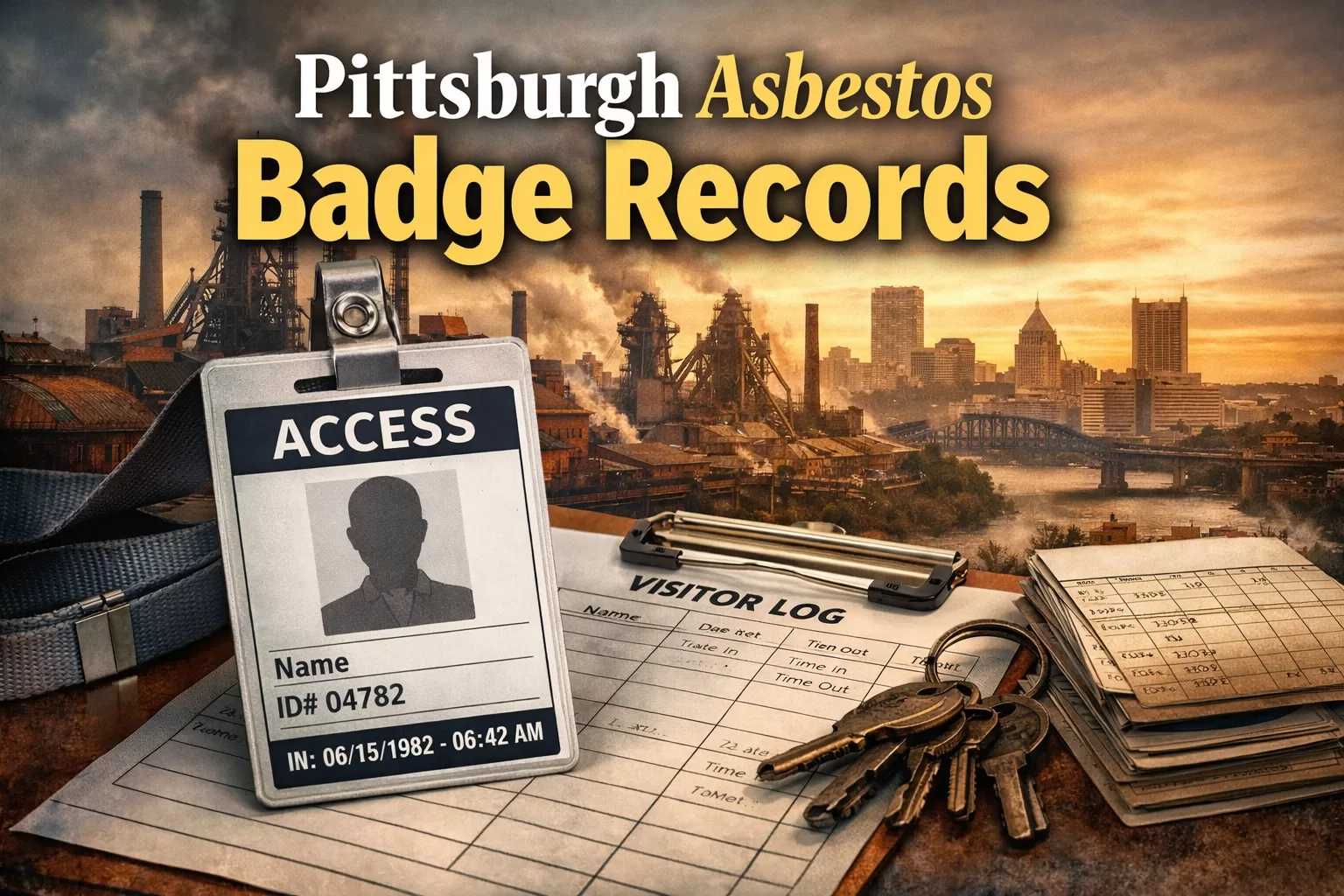
Pittsburgh asbestos badge records are one of the most underrated pieces of exposure proof—because they don’t rely on memory, and they don’t require a brand name on an insulation box from 1978.

Learn More at Pittsburgh Asbestos Lawyer

Mesothelioma/Asbestos Legal Help – WV, MI & PA

Speak directly with attorney Lee W. Davis. No call centers. Free, confidential review.

If you worked at (or moved through) industrial facilities in the Pittsburgh area—steel, glass, power generation, coke works, chemical operations, refineries, hospitals, schools, or large commercial sites—there’s a decent chance you were issued some kind of access credential at some point:

  • plant badge / ID badge
  • contractor badge
  • security gate log / entry roster
  • sign-in sheets for outages or special projects
  • electronic access logs (turnstiles, gates, doors)
  • visitor management logs (especially post-2001)

These records can do something that a lot of “work history” paperwork can’t: prove physical presence inside a specific facility during a specific timeframe—which is often exactly what a claim needs when the exposure happened during shutdowns, rebuilds, tear-outs, and maintenance surges.

How long does a case take? Read Pittsburgh Asbestos Case Timeline

What badge and access records can prove

Badge and access records may show:

  • dates of entry and exit (daily logs, shift windows, outage periods)
  • which gates or buildings you accessed (depending on the system)
  • contractor affiliation or crew assignment tied to a vendor
  • repeated access patterns that match recurring work (outages, maintenance cycles)


That matters because many Pittsburgh exposure cases aren’t “one employer for 30 years.” They’re:

  • contractor rotations
  • multi-site work
  • short high-exposure periods during projects
  • jobs where HR files exist but don’t prove where you actually worked inside the facility

Where badge records usually live

Depending on the site and the era, badge/access records may be held by:

  • the facility owner (security/HR/risk)
  • a third-party security vendor
  • an on-site contractor management platform
  • corporate archives (especially after acquisitions/mergers)
  • IT/security departments (for electronic logs)

A key practical point: these records can be deleted on routine retention schedules. If you suspect they exist, it’s worth moving quickly.

Read why a Work History is important in an Asbestos case HERE

What to request

You’re looking for records like:

  • badge issuance logs (badge number, issue date, expiration)
  • gate entry logs / access reports for your name and known variations
  • contractor rosters tied to your vendor/employer
  • outage sign-in sheets, safety orientation logs, site-specific training logs
  • visitor management exports (if you were “non-employee” onsite)

Even if the records don’t show every day, a partial set can still corroborate the core facts: you were there, in the window that matters.

Bottom line

When a case stalls because someone says “prove you were inside the facility,” badge and access records can be the cleanest answer. They don’t argue. They timestamp.

If you want help identifying which Pittsburgh-area facilities and owners are most likely to have retained access records—and how to target the request efficiently—call (412) 781-0525.

Check If Your Family Was Exposed

Get your free guide instantly + a confidential case review.

🔒 100% Confidential. No obligations.


FAQs

What if I don’t remember the badge number?

That’s common. Badge issuance logs are often searchable by name, date of birth, employer/vendor, or Social Security last four digits (depending on the system).

Do old facilities still have these records?

Sometimes yes—especially if the site was acquired by a larger company that kept centralized security systems. Other times records are purged. The value is acting fast once you suspect they exist.

Can badge records help if I was a contractor, not an employee?

Yes. Contractor badges, gate logs, and orientation rosters often capture contractors more reliably than HR employment files.

Mesothelioma/Asbestos Legal Help – WV, MI & PA

Speak directly with attorney Lee W. Davis. No call centers. Free, confidential review.

Pittsburgh Asbestos Medical Proof: What Records Actually Move a Case

Pittsburgh Asbestos Medical Proof Guide

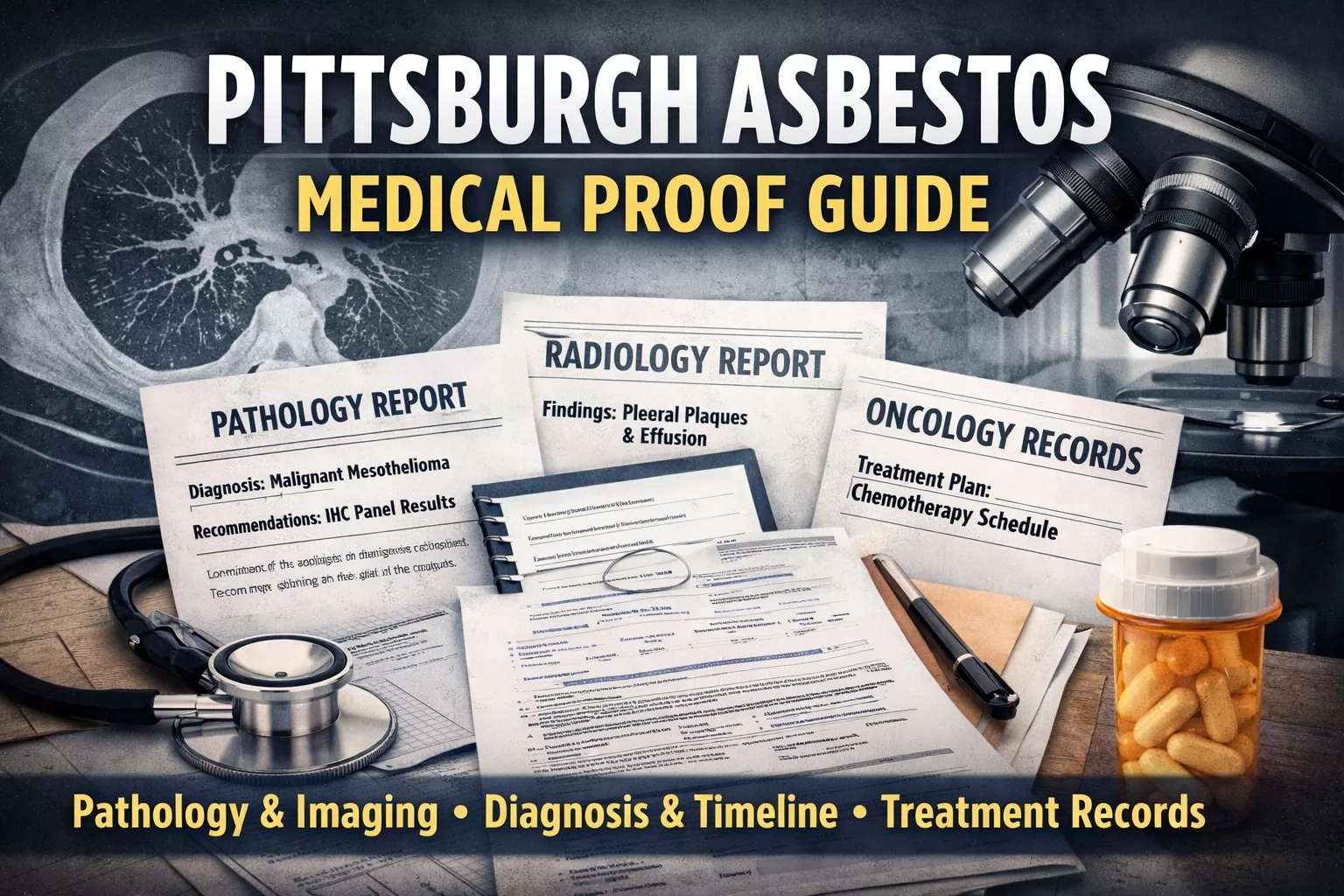
If you’re dealing with an asbestos-related diagnosis, the Pittsburgh Asbestos Medical Proof is what turns a story into a case file that insurers and defendants have to take seriously. People assume “proof” means a jobsite name or a dusty memory from decades ago. In reality, the strongest cases often start with the medical documentation—because it locks in diagnosis, timing, and causation before anyone argues over work history.

For legal representation, see Pittsburgh Asbestos Exposure Claims

Below is the medical proof that typically matters most in asbestos and mesothelioma cases tied to Pittsburgh-area work, plant maintenance, construction, steel operations, power generation, and industrial trades.

Mesothelioma/Asbestos Legal Help – WV, MI & PA

Speak directly with attorney Lee W. Davis. No call centers. Free, confidential review.

1) The pathology report (the anchor document)

A pathology report is often the single most important piece of medical proof. It can confirm:

  • Mesothelioma (pleural or peritoneal)
  • Asbestos-related lung cancer
  • Asbestosis or pleural disease (in certain contexts)

If there was a biopsy, surgery, thoracoscopy, or cytology (fluid) testing, get:

  • The final pathology report
  • Any addendum reports
  • The immunohistochemistry (IHC) panel results (the marker testing doctors use to confirm the diagnosis)

If you only have imaging or a preliminary note, don’t assume that’s “enough.” Get the actual pathology.

2) Imaging that shows the pattern doctors rely on

CT scans, PET scans, X-rays, and radiology reports matter because they document:

  • Pleural thickening or pleural plaques
  • Effusions (fluid)
  • Masses, nodules, or spread patterns
  • Progression over time

What helps your file move faster is not just the scan—it’s the radiology report that describes findings in medical terms that can’t be brushed off later.

3) Pulmonary records and function testing

If there’s lung impairment, obtain:

  • Pulmonary function tests (PFTs)
  • Pulmonology consult notes
  • Oxygen prescriptions and respiratory therapy records
  • Hospital discharge summaries tied to breathing compromise

These records help establish severity and day-to-day impact, which affects damages and settlement value.

4) Oncology records that lock in treatment history

For cancer and mesothelioma, treatment records show seriousness and provide a clean timeline:

  • Oncology consults
  • Chemotherapy/immunotherapy regimens
  • Radiation records
  • Surgical notes
  • Follow-up and progression notes

These records also help rebut defense arguments that the condition is “uncertain” or “unrelated.”

5) The timeline matters more than people think

A well-organized chart of:

  • first symptoms,
  • first imaging,
  • first specialist visit,
  • diagnosis date,
  • treatment start

…can keep your claim from getting bogged down in delay tactics. If a defendant tries to shift the clock, the medical records usually settle the timeline.

6) Smoking history doesn’t “defeat” medical proof—documentation matters

Defendants love to blur issues by focusing on smoking. The right medical proof keeps the analysis disciplined:

  • What was diagnosed?
  • What did pathology confirm?
  • What did imaging show?
  • What did the treating doctors conclude?

Your records should reflect what your physicians documented—especially when asbestos exposure is part of the differential diagnosis or causation analysis.

7) How to request records without getting stalled

When you request records, ask for complete sets:

  • “All records including pathology, imaging reports, lab results, and physician notes”
  • “All radiology reports and DICOM images for CT/PET/X-ray”
  • “All pathology slides and tissue blocks (if needed for review)”

Hospitals can produce summaries quickly, but the summaries are not the file. The file is the proof.

8) Why medical proof is the fastest way to reduce fight and increase leverage

In a Pittsburgh asbestos case, jobsite proof can take time. Medical proof is usually available now. Once the diagnosis and timeline are locked in, the case can move while employment, union, Social Security, and contractor records are gathered in parallel.

Learn more about how long a case takes here: Pittsburgh Asbestos Case Timeline


FAQs

What is the most important medical record in an asbestos case?

Usually the pathology report (and any IHC marker testing) confirming mesothelioma or asbestos-related cancer.

If I only have scans but no biopsy, can I still start?

Yes. Imaging, pulmonology notes, and oncology records can support early evaluation, but definitive diagnosis often depends on pathology.

Do I need the actual scan files, or just the radiology report?

Both help. The report matters immediately; the images can matter later for expert review.

Will smoking history ruin my case?

Not automatically. Diagnosis, pathology, imaging patterns, and physician documentation still control the medical proof analysis.

How long does it take to get records?

Many providers can produce records within days to a few weeks, but pathology materials and imaging discs can take longer—request them early.


Talk to a Pittsburgh asbestos lawyer about your medical proof

If you want a straightforward review of your records and what’s missing, call (412) 781-0525. You’ll speak directly with attorney Lee W. Davis about the documentation that can move your case forward.

Check If Your Family Was Exposed

Get your free guide instantly + a confidential case review.

🔒 100% Confidential. No obligations.

Pittsburgh Asbestos Work History Guide

Pittsburgh Asbestos Work History Guide

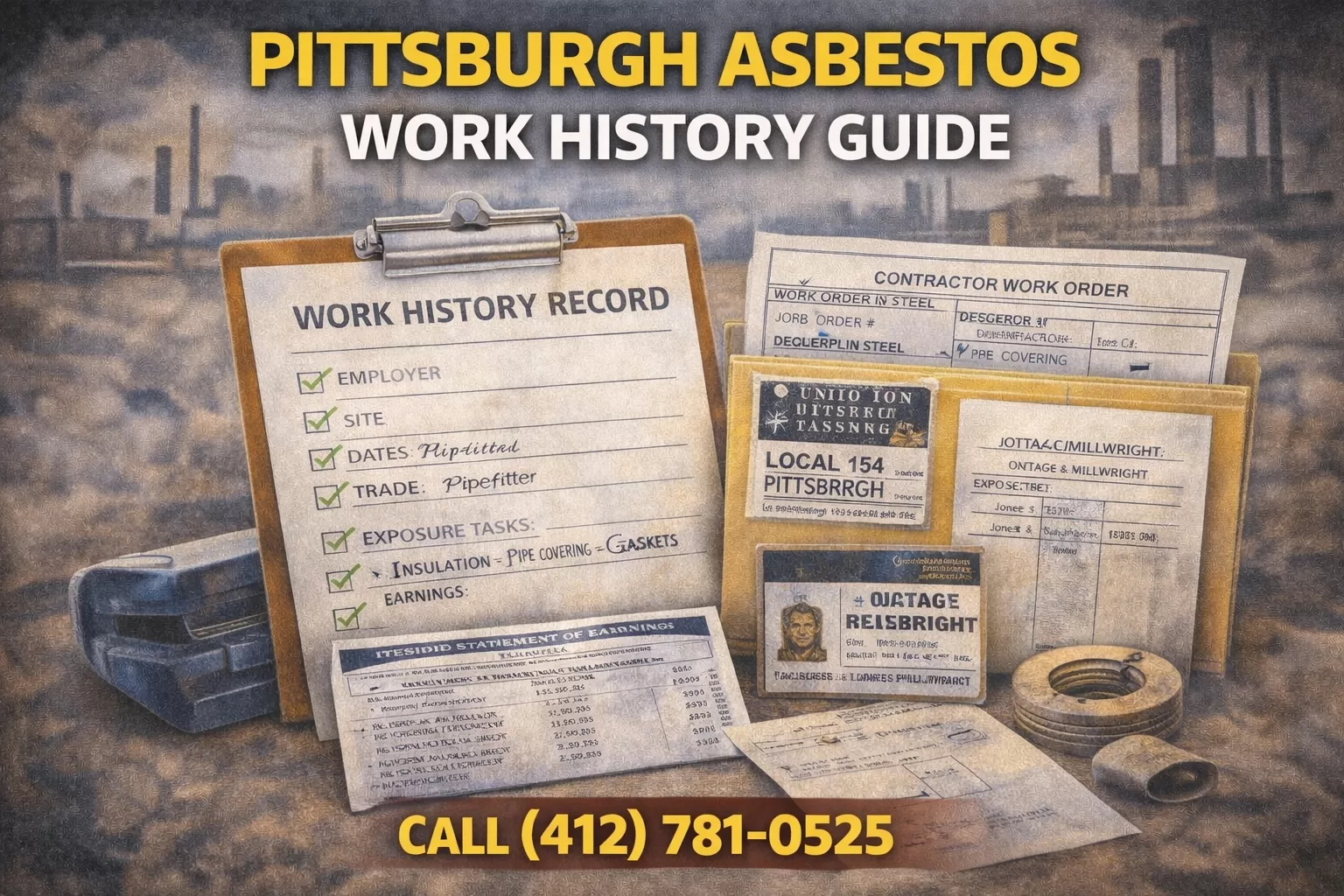
If you’re pursuing an asbestos-related claim in Pittsburgh or Western Pennsylvania, your work history is often the single most important piece of evidence. People assume the case turns on remembering a brand name. In reality, many strong claims are built by reconstructing where you worked, what you did, and what materials you handled—even if the product labels are long gone.

Mesothelioma/Asbestos Legal Help – WV, MI & PA

Speak directly with attorney Lee W. Davis. No call centers. Free, confidential review.

A Pittsburgh asbestos work history is more than a résumé. It’s a timeline that connects your job duties to asbestos-containing materials used in industrial settings across the region: power generation, steel, heavy manufacturing, rail, commercial construction, maintenance shutdowns, and equipment repair. When the work history is detailed and supported by records, claims move faster and defense arguments get weaker.

What “work history” really means in an asbestos claim

A usable work history has three parts:

  1. Employer + location (company name, plant/site, city, and dates).
  2. Your trade and tasks (pipefitter, boilermaker, electrician, millwright, mechanic, laborer, insulator, maintenance, etc.).
  3. Exposure context (where asbestos was likely disturbed: insulation, gaskets, packing, refractory, boilers, turbines, pumps, valves, pipe covering, electrical arc chutes, drywall/compound, floor tile/mastic, roofing, cement products).

The goal is not perfection. The goal is credibility and detail—enough that the story matches the way industrial work is actually performed.

👉 Search Asbestos Job Sites in Pennsylvania

How to rebuild a Pittsburgh-area work history when records are missing

If you don’t have a neat binder of documents, that’s normal. Here are the records that most often help reconstruct a clean work timeline:

  • Social Security “Itemized Statement of Earnings” (helps confirm employers and time periods)
  • Union records (locals, dispatch logs, referral slips, benefit statements)
  • W-2s / tax returns / pay stubs
  • Personnel files (HR records, job classifications, safety training)
  • Work orders / outage schedules / maintenance logs (especially for plant or industrial maintenance work)
  • Contractor badge logs / site access records
  • Old job notebooks, calendars, or photographs (even one photo can anchor a time period)
  • Coworker statements (who remembers the job, the areas, and the materials)

When you combine two or three sources—earnings records + union dispatch + a plant outage period—you can often lock in dates and locations tightly enough to make the exposure story hard to dispute.

The Pittsburgh details that matter most

Defense lawyers look for gaps: “Which building?” “Which unit?” “Which shutdown?” “What equipment?” The more specific you can be, the better. Helpful details include:

  • Unit numbers, departments, or line assignments
  • Names of equipment (boilers, turbines, heat exchangers, compressors, pumps, valves)
  • Types of work performed (tear-out, rebuilds, gasket changes, packing, insulation disturbance)
  • Whether the work was routine, seasonal, or tied to outages/turnarounds
  • Whether you worked alongside insulators or around newly cut/damaged insulation

This is why work history wins cases. It turns a broad claim into a defensible timeline.

What to do next

If you’re trying to build a Pittsburgh asbestos case, start with a simple timeline: employer, site, dates, trade, and tasks. Then add the documents you still have—one record at a time. If you want help organizing it into a claim-ready exposure narrative, call (412) 781-0525. You’ll speak directly with attorney Lee W. Davis.

Check If Your Family Was Exposed

Get your free guide instantly + a confidential case review.

🔒 100% Confidential. No obligations.


FAQs

What if I can’t remember exact dates for a Pittsburgh asbestos job?

That’s common. Earnings records, union dispatch documents, and project/outage schedules can often narrow time periods enough to support a claim.

Do I need to prove the exact asbestos product I handled?

Not always. Many claims are proven through jobsite/location evidence and task-based exposure—especially where asbestos use was routine in industrial maintenance.

What records should I gather first?

Start with Social Security earnings history, union/benefits records, and any pay/tax documents. Those usually create the quickest backbone timeline.

Mesothelioma/Asbestos Legal Help – WV, MI & PA

Speak directly with attorney Lee W. Davis. No call centers. Free, confidential review.