Pennsylvania Mesothelioma Claim Timeline

Pennsylvania Mesothelioma Claim Timeline

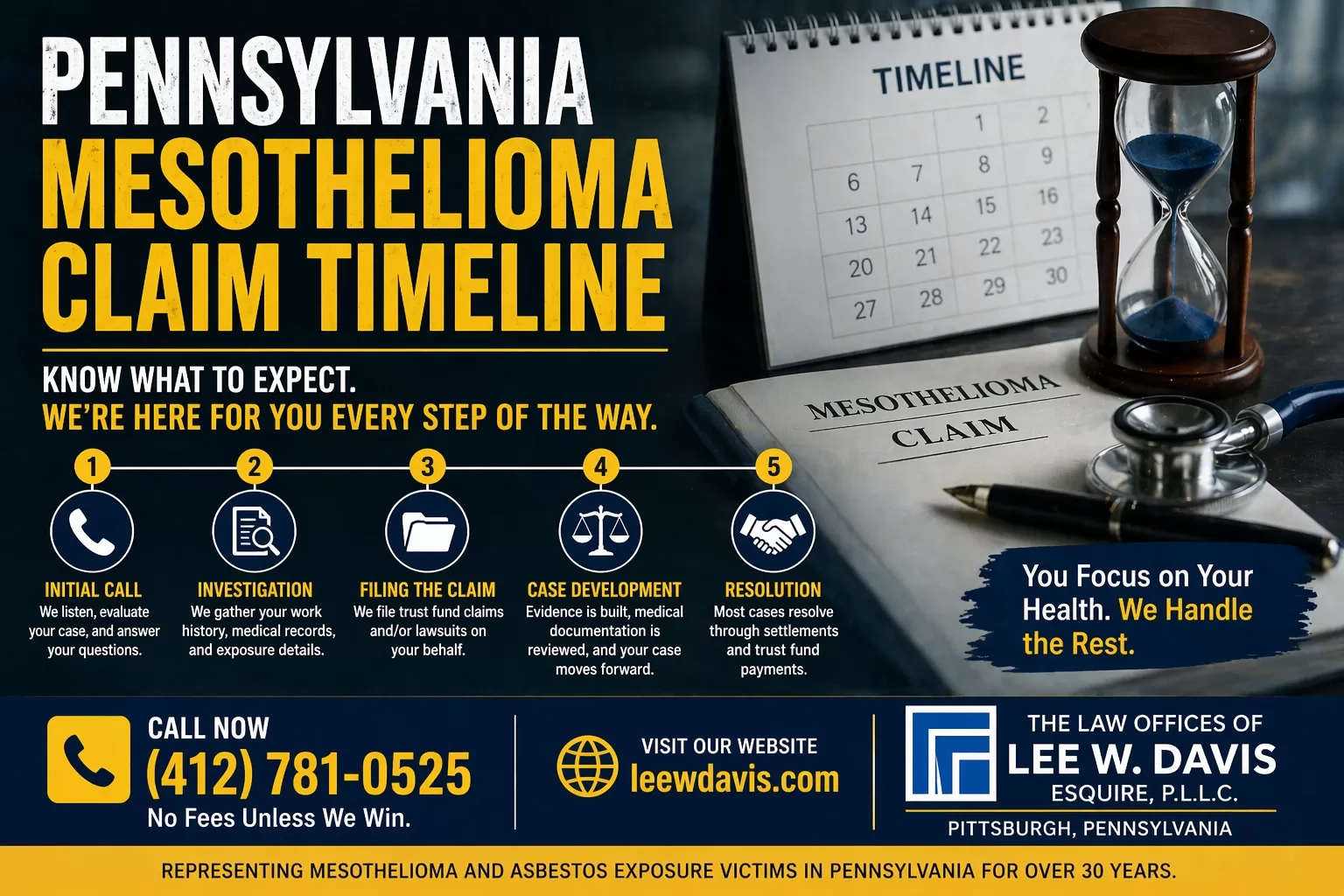
The Pennsylvania mesothelioma claim timeline is one of the most practically important questions a newly diagnosed patient or their family faces — and one of the least thoroughly answered by most legal resources. Knowing that a claim exists is important. Understanding how long it takes from first call to compensation, how trust fund payments and civil settlements differ in timing, and whether expedited proceedings are available when a patient’s health requires faster resolution — that is the information that a patient and family need to plan.


This page addresses the Pennsylvania mesothelioma claim timeline specifically and honestly — what the realistic calendar looks like at each phase of the claim, what factors accelerate or extend the timeline, and what a seriously ill Pennsylvania mesothelioma patient can do to move the process forward when time is genuinely short.

The Two Parallel Timelines: Trust Fund Claims and Civil Litigation

Every Pennsylvania mesothelioma claim involves two distinct compensation systems with two distinct timelines — asbestos bankruptcy trust fund claims and civil litigation against product manufacturers who did not go through bankruptcy. Understanding the timeline of a Pennsylvania mesothelioma claim requires understanding both tracks and how they run simultaneously.

Trust fund claims may move faster than civil litigation. Asbestos bankruptcy trusts are administrative claims processing operations — not courts. They receive claim packages, verify that the submitted documentation meets their exposure criteria, and pay claims at their established payment percentage without the delays of civil discovery, depositions, and litigation scheduling. For many trust funds, a well-prepared Pennsylvania mesothelioma claim can be filed and paid within three to six months of submission. Some trusts move faster; some move slower depending on their processing backlog and evidentiary requirements.

Civil litigation moves on a court calendar. Pennsylvania civil asbestos cases proceed through complaint filing, service on defendants, answer and discovery, depositions, expert designation, and ultimately to settlement negotiations or trial. That process — in Allegheny County, Beaver County, Washington County, and the other western Pennsylvania venues most commonly used for industrial asbestos claims — typically spans one to three years from filing to resolution in an unaccelerated case. The specific timeline depends on the number of defendants, the complexity of the exposure history, the court’s docket management, and whether settlement is reached before trial.

Most Pennsylvania mesothelioma claims receive some compensation before the civil litigation fully resolves. Because trust fund claims move faster than civil litigation, many Pennsylvania mesothelioma patients and families receive the first trust fund payments while the civil case is still in active litigation. The total recovery arrives in stages — trust fund payments first, civil settlements as the litigation progresses — rather than as a single lump sum at the end of the process.

Month-by-Month: What the Pennsylvania Mesothelioma Claim Timeline Looks Like

Weeks 1-4: Initial consultation and investigation begins. The claim process begins with the first call — the initial consultation in which the attorney assesses the diagnosis and the work history. If the claim appears viable, the representation agreement is signed and the exposure investigation begins immediately. Social Security earnings records are requested. Union records are sought. The product identification research connecting the Pennsylvania work history to specific asbestos-containing product manufacturers begins from day one.

Months 1-3: Exposure investigation and record collection. The exposure investigation — building the documented record of which asbestos-containing products were used at the specific Pennsylvania facilities in the claimant’s work history — is typically the most time-intensive phase of the early claim. Record collection, union record research, and product identification research run simultaneously during this period. For Pennsylvania industrial workers with careers at well-documented facilities — the Mon Valley steel mills, the western PA power stations, the Kanawha Valley chemical plants — this investigation benefits from the accumulated case documentation of decades of prior Pennsylvania asbestos litigation, which can significantly accelerate the product identification work.

Months 2-4: Deposition or recorded statement. In Pennsylvania mesothelioma civil claims, the patient’s recorded statement or deposition — documenting the work history, specific job duties, and exposure conditions — is typically scheduled during the early months of the claim, while the patient’s health and memory are best suited for the task. The attorney prepares the patient in advance. The deposition is typically conducted at the patient’s home or another location they choose. This is often the most personal demand the legal process makes on the patient, and it is managed carefully by an experienced attorney to minimize burden.

Months 3-6: Trust fund claim filing. With the exposure investigation substantially complete and the documentation assembled, trust fund claims are submitted to each applicable asbestos bankruptcy trust. Filing across the full range of applicable trusts — not only the most obvious ones — is one of the most important work products of the exposure investigation. Each trust receives a claim package meeting its specific evidentiary requirements.

Months 4-8: First trust fund payments. Many asbestos bankruptcy trusts process and maypay claims within three to six months of submission for well-documented Pennsylvania mesothelioma claims. The first trust fund payments typically may begin arriving in this window, providing initial financial relief while the civil litigation continues.

Months 3-6: Civil complaint filing. The civil complaint identifying the civil litigation defendants — product manufacturers who did not establish bankruptcy trusts — is filed in the appropriate Pennsylvania venue during the early phase of the claim. In Allegheny County and other western Pennsylvania venues, the asbestos litigation docket is established and the complaint enters a case management process familiar to the court and to experienced Pennsylvania asbestos attorneys.

Months 6-18: Civil discovery and litigation. The civil case proceeds through discovery — defendant responses, evidence exchange, and the expert designation process. Additional trust fund claims may be filed as product identification work continues to identify applicable trusts. Settlement discussions with civil defendants often begin during the discovery phase, and some defendants may settle before discovery is complete.

Months 12-36: Civil settlement and resolution. The majority of Pennsylvania mesothelioma civil cases settle within one to three years of filing, most without trial. The settlement timeline depends heavily on the number of defendants, the strength of the documented exposure record, and the aggressiveness of the defendants’ litigation posture. Cases with stronger exposure documentation — particularly those involving well-documented Pennsylvania facilities with extensive prior litigation history — often reach settlement faster than cases requiring novel product identification work.

Expedited Proceedings — When the Patient’s Health Requires Moving Faster

Pennsylvania courts and asbestos litigation defendants recognize that mesothelioma patients are seriously ill and that delay in resolving their claims has consequences that are different from delay in ordinary civil litigation. Expedited trial scheduling is available in Pennsylvania asbestos cases when a patient’s medical condition warrants it — and an experienced Pennsylvania mesothelioma attorney actively pursues expedited scheduling when the patient’s health makes the standard civil timeline inadequate.

Preference scheduling in Pennsylvania. Pennsylvania courts can grant trial preference to mesothelioma cases involving seriously ill plaintiffs. An experienced Pennsylvania asbestos attorney requests preference scheduling when the patient’s prognosis makes standard civil timelines unrealistic and documents the medical basis for the expedited request.

Deposition preservation for terminal patients. When a Pennsylvania mesothelioma patient’s health makes it uncertain they will survive through the civil litigation, preservation depositions can be taken immediately to preserve their testimony for use at trial or in settlement negotiations after the patient has passed away. An experienced Pennsylvania asbestos attorney pursues preservation depositions proactively when the patient’s condition warrants it.

What this means practically. For a Pennsylvania mesothelioma patient with a serious diagnosis and a prognosis measured in months rather than years, the realistic goal of the civil litigation is not trial — it is early settlement driven by expedited scheduling and preservation deposition. An experienced Pennsylvania asbestos attorney structures the case from the outset to create the conditions for that expedited resolution.

Factors That Affect the Pennsylvania Mesothelioma Claim Timeline

Facility documentation depth. Claims involving Pennsylvania facilities with extensive prior litigation documentation — well-documented product identification, prior witness testimony, established defendant history — typically move through the investigation and trust filing phases faster than claims involving less-documented facilities. Workers from the Mon Valley steel mills, the major western PA power stations, and the Kanawha Valley chemical plants benefit from the accumulated documentation of decades of prior Pennsylvania asbestos litigation.

Number of defendants. Claims against a larger number of civil defendants typically take longer to resolve than claims against fewer defendants — because each defendant must be served, must respond, and must separately participate in the settlement negotiation process.

Defendant litigation posture. Some asbestos product defendants are more aggressive litigators than others. The defendants identified in a specific Pennsylvania mesothelioma claim — based on the specific products used at the specific facilities in the claimant’s work history — directly affect how quickly civil settlement can be reached.

Trust fund processing backlogs. Individual asbestos bankruptcy trusts have varying processing times based on their current claim volume and administrative capacity. An experienced Pennsylvania asbestos attorney monitors trust processing timelines and advises on which trusts to prioritize based on current processing conditions.

Patient health and participation capacity. The patient’s health directly affects what can be accomplished in the early phase of the claim — particularly the deposition or recorded statement that is central to the civil case. Preserving that testimony early, before the patient’s condition deteriorates, is one of the most timeline-sensitive decisions in the entire claim process.

Related Pennsylvania Mesothelioma Resources

For the step-by-step process explanation see Pennsylvania mesothelioma claim steps. For the filing deadline analysis see Pennsylvania asbestos claim deadline. For the cost structure see Pennsylvania mesothelioma claim cost. For immediate post-diagnosis steps see Diagnosed With Mesothelioma in Pennsylvania. For the compensation overview see Pennsylvania mesothelioma compensation claims. For the trust fund claims process see Pennsylvania asbestos trust claims. For the broader Pennsylvania mesothelioma legal framework see Pennsylvania mesothelioma lawyer.

Knowledge of Pennsylvania Mesothelioma Claim Timelines Since 1988

I began researching Pennsylvania asbestos cases in 1988, working as a paralegal on asbestos mass trials across Pennsylvania and West Virginia. I was licensed in Pennsylvania in 1996 and in West Virginia in 2002. I returned to Pittsburgh in 1999 and have handled mesothelioma and asbestos lung cancer cases individually across Pennsylvania, West Virginia, and Michigan ever since — managing the trust fund filing timeline, the civil litigation calendar, and the expedited proceedings that seriously ill patients require throughout decades of Pennsylvania mesothelioma practice.

I am proud have personally represented hundreds of asbestos victims at their depositions.

Timeline management in Pennsylvania mesothelioma claims is not a clerical function — it requires knowing which trusts process fastest, which Pennsylvania courts move most efficiently, when to push for expedited scheduling, and how to structure the investigation and deposition phases to protect the patient’s testimony before health conditions advance. That knowledge comes from decades of managing actual Pennsylvania mesothelioma claim timelines, not from a national intake operation processing cases from another state.

When you call, you speak directly with me. No call centers. No case managers.

Call (412) 781-0525 or start your confidential case review online now.

Check If Your Family Was Exposed

Get your free guide instantly + a confidential case review.

🔒 100% Confidential. No obligations.


Frequently Asked Questions

Q: My husband was just diagnosed with mesothelioma in Pennsylvania and his prognosis is very serious. How quickly can a claim be filed and can we get any compensation before the civil case resolves?

A: Yes — and acting quickly is critical in your situation. Call immediately so the exposure investigation can begin and the deposition preserving your husband’s testimony can be scheduled before his health advances further. Trust fund claims can begin paying within months of filing — often well before the civil litigation resolves. Expedited trial scheduling can be pursued in Pennsylvania courts based on your husband’s medical condition, creating pressure for earlier civil settlement. The entire claim strategy for a seriously ill Pennsylvania mesothelioma patient is structured from the outset to move as quickly as the legal process allows while protecting every avenue for maximum recovery.

Q: How long do asbestos trust fund claims typically take to pay out in Pennsylvania mesothelioma cases?

A: Trust fund payment timelines vary by trust. Well-prepared claims submitted to trusts with efficient processing operations can receive payment within three to six months of filing. Some trusts move faster; others have longer processing backlogs. An experienced Pennsylvania mesothelioma attorney monitors current trust processing timelines and prioritizes filing with the fastest-processing applicable trusts when timeline is a concern. Filing across the full range of applicable trusts — not just the fastest ones — maximizes total recovery while the civil litigation continues.

Q: If my Pennsylvania mesothelioma civil case goes to trial, how long does that add to the total timeline?

A: Most Pennsylvania mesothelioma civil cases do not go to trial — they settle, typically within one to three years of filing. If a case does proceed to trial, the trial itself adds weeks to months to the timeline depending on its complexity. The more practically significant timeline effect of a potential trial is that the credible threat of a scheduled trial date — particularly when expedited scheduling has been obtained — accelerates the settlement negotiations that produce resolution without the delay of actual trial. An experienced Pennsylvania mesothelioma attorney uses the trial date as a settlement tool throughout the negotiation process.

Mesothelioma/Asbestos Legal Help – WV, MI & PA

Speak directly with attorney Lee W. Davis. No call centers. Free, confidential review.

WV Airborne Asbestos Dust

WV Airborne Asbestos Dust

WV airborne asbestos dust caused mesothelioma and lung cancer in workers who never touched a piece of insulation, never broke open a flange, and never considered themselves to be asbestos workers at all. Throughout West Virginia’s industrial history — at chemical plants along the Kanawha Valley, at power generating stations on the Ohio and Kanawha Rivers, at steel operations in Weirton and the northern panhandle, and at the manufacturing and mining facilities throughout the state — asbestos dust became airborne and remained suspended in the work environment continuously, exposing every worker in those environments regardless of their specific trade or role.

The legal significance of WV airborne asbestos dust exposure is thoroughly established in West Virginia asbestos litigation. A West Virginia worker does not need to have been the person installing or removing insulation to have accumulated legally significant asbestos exposure. The worker who spent a career in the same building, the same mechanical room, or the same production department as the insulation and maintenance work does not need to have touched a fiber directly. What matters is whether they were in an environment where asbestos fibers were airborne — and whether their cumulative exposure in that environment contributed to a mesothelioma or lung cancer diagnosis.

Mesothelioma/Asbestos Legal Help – WV, MI & PA

Speak directly with attorney Lee W. Davis. No call centers. Free, confidential review.

Why Asbestos Dust Becomes Airborne and Stays That Way

Understanding why WV airborne asbestos dust was so pervasive at West Virginia industrial facilities requires understanding the physical properties of asbestos fibers and the industrial environments that created and sustained airborne contamination.

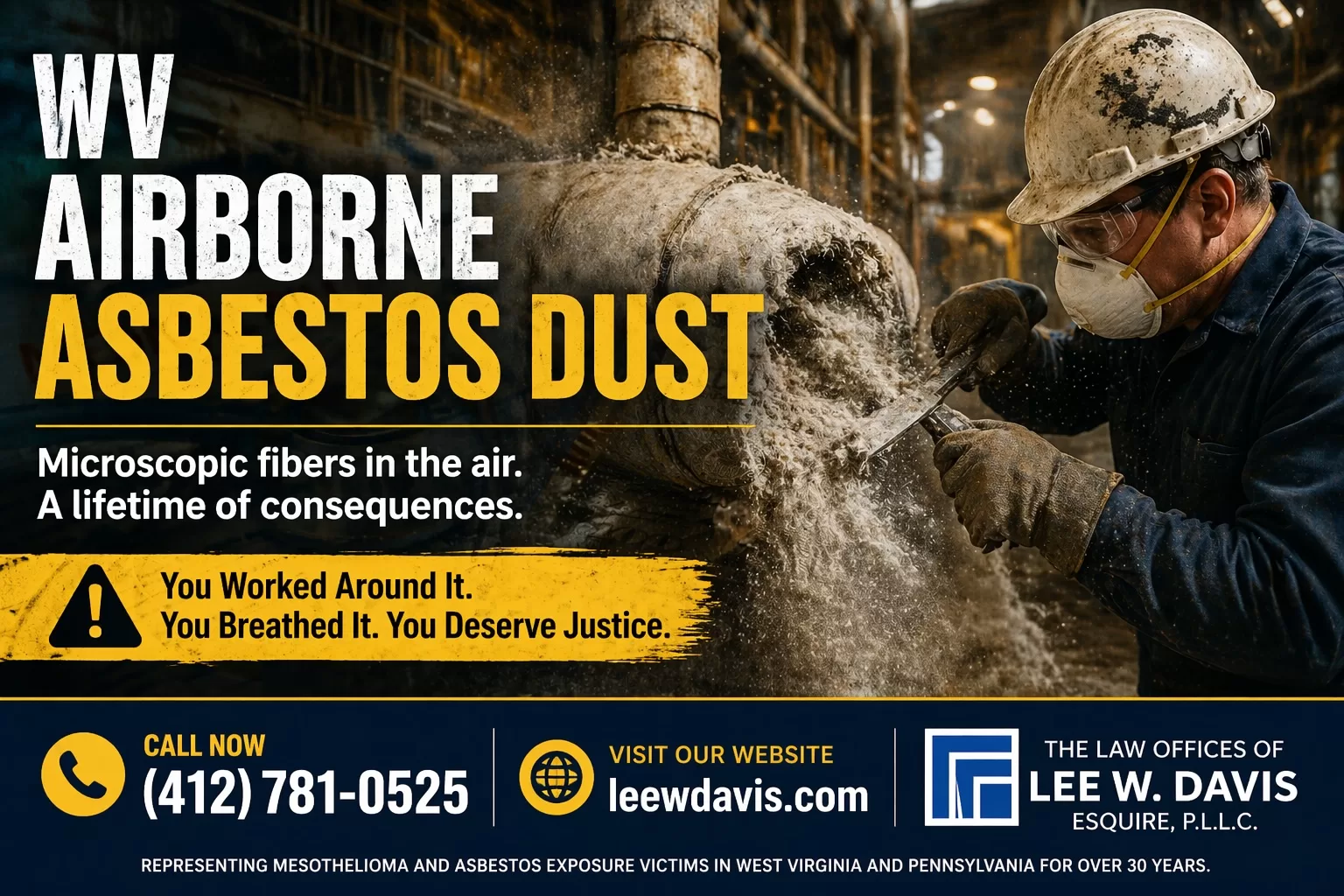
Asbestos insulation, refractory, and gasket materials release fibers when disturbed — cut, scraped, broken, abraded, or simply deteriorated by heat cycling and age. Those fibers are microscopic. The longest are still invisible to the naked eye. They are light enough to remain suspended in still air for hours. They travel on air currents throughout enclosed industrial spaces — through mechanical rooms, down pipe chases, into adjacent work areas — and they settle slowly onto every horizontal surface in the space, where they can be resuspended by foot traffic, equipment vibration, or air movement. They accumulate in the dust that coats every surface in an industrial facility that used asbestos-containing materials over years of operation.

A West Virginia industrial worker who walked through a mechanical room where insulation work had been performed that morning — even hours after the work was done — breathed airborne asbestos fibers resuspended from the settled dust. A production worker who swept the floor at the end of a shift in a WV chemical plant or steel mill resuspended the settled asbestos dust from that surface into the breathing zone throughout the cleanup task. A worker who worked for thirty years in a building where asbestos-containing materials were regularly disturbed accumulated thirty years of airborne asbestos fiber exposure — not from any single task, but from the continuous ambient contamination of the work environment throughout their career.

The WV Industrial Environments Where Airborne Asbestos Dust Was Most Pervasive

Kanawha Valley chemical plants — The enclosed process units, instrumentation rooms, pipe chases, and maintenance areas throughout Union Carbide Institute, DuPont Belle, and the broader Kanawha Valley chemical plant corridor were environments where asbestos-containing pipe insulation, valve packing, and gasket materials were present throughout and where routine maintenance work continuously disturbed those materials. Workers across every role in those plants — operators, instrument technicians, maintenance mechanics, laborers — spent careers in environments where airborne asbestos dust from continuous maintenance activity was a permanent feature of the work environment.

West Virginia power generating stations — The boiler rooms, turbine halls, and mechanical spaces throughout West Virginia’s coal-fired power plants — including Mountaineer Power Plant, Kammer, Mitchell, and Mount Storm — were among the most heavily asbestos-contaminated enclosed work environments in the state. Heavy asbestos insulation on boilers, turbine casings, and steam distribution systems continuously shed fibers into those enclosed spaces throughout the operational life of the facilities. Power plant workers who spent careers in those buildings — regardless of whether their specific job involved touching insulation — accumulated significant ambient fiber exposure from the contaminated air throughout those structures.

Weirton Steel and Ohio River steel operations — The production buildings, mill facilities, and mechanical spaces at Weirton Steel and the Ohio River corridor steel operations contained asbestos-containing materials throughout — on steam systems, in furnace insulation and refractory, on the mechanical equipment throughout every production department. Steel workers across every production role spent careers in those buildings, breathing the ambient dust that included asbestos fibers from deteriorating insulation and refractory throughout the facility.

Steel mill powerhouses — The enclosed powerhouse buildings serving West Virginia steel operations concentrated boiler and steam system asbestos contamination into some of the most heavily contaminated enclosed work environments at those facilities. Every worker who entered the powerhouse — not just the boilermakers and pipefitters who performed maintenance — breathed the airborne asbestos dust from the deteriorating insulation throughout those spaces. See steel mill powerhouse asbestos for the full powerhouse ambient exposure profile.

Industrial construction sites — WV industrial construction sites where asbestos-containing insulation was being installed generated airborne asbestos dust that contaminated the entire construction environment — affecting every trade on site, not only the insulators doing the installation work. Ironworkers, structural workers, electricians, and laborers working on the same construction site as active insulation installation accumulated airborne asbestos exposure from the contaminated construction environment throughout the project.


The Workers Most Commonly Affected by WV Airborne Asbestos Dust Exposure

Production workers and operators — Chemical operators, steel production workers, and the production employees across West Virginia’s industrial facilities who spent careers in production buildings saturated with ambient asbestos dust from the maintenance and insulation work occurring continuously throughout those environments.

Laborers and cleanup workers — West Virginia industrial laborers who swept floors, moved materials, and performed cleanup work in asbestos-contaminated facilities resuspended settled asbestos dust throughout every cleanup task — accumulating exposure from the ambient contamination of the work environment and from the active resuspension of settled fibers throughout their daily work. See laborers asbestos exposure WV for the full laborer ambient exposure profile.

Ironworkers — West Virginia ironworkers who erected structures and installed equipment at industrial facilities where asbestos-containing insulation was simultaneously being installed worked in construction environments contaminated with airborne asbestos dust from the insulation work occurring throughout the site. See WV ironworker asbestos exposure for the ironworker-specific profile.

Electricians and instrument technicians — Workers whose trades took them throughout industrial facilities — into mechanical rooms, through pipe chases, into equipment areas — accumulated ambient asbestos exposure from every contaminated space they entered throughout their careers at West Virginia industrial facilities. Their daily movement through asbestos-saturated industrial environments produced sustained cumulative exposure from the airborne dust in those spaces.

Maintenance mechanics and millwrights — Workers who maintained industrial equipment throughout WV facilities spent careers in mechanical rooms and equipment areas where asbestos-containing insulation on surrounding pipe and equipment systems continuously shed fibers into the ambient air. Even when their own maintenance tasks did not involve disturbing insulation, they worked in environments where other trades’ work and the natural deterioration of aged insulation maintained continuous ambient fiber concentrations.

Supervisors and plant engineers — Engineering and supervisory personnel whose inspection and management roles took them throughout West Virginia industrial facilities accumulated ambient asbestos exposure from every production department, mechanical room, and utility area they visited throughout their careers. The plant-wide nature of engineering and supervisory roles meant plant-wide ambient asbestos exposure at WV industrial facilities.

Ambient Exposure and the Legal Standard in West Virginia Asbestos Claims

West Virginia asbestos litigation recognizes ambient and bystander asbestos exposure as a legally viable exposure pathway — not merely as context for a primary hands-on exposure claim, but as a standalone basis for a mesothelioma or lung cancer claim when the cumulative ambient exposure was sufficient and the diagnosis is established.

The legal question is whether the claimant’s total asbestos fiber dose — accumulated through whatever combination of direct contact, bystander proximity, and ambient exposure their career produced — was sufficient to have contributed to the mesothelioma or lung cancer diagnosis. For West Virginia workers who spent careers in the heavily contaminated industrial environments of the state’s chemical plants, power stations, and steel operations, the ambient fiber dose accumulated through daily workplace presence in those environments is frequently legally significant — even when no single dramatic exposure event can be identified.

Building an ambient exposure claim requires demonstrating the conditions at the specific West Virginia industrial facilities where the claimant worked — the asbestos-containing materials present, the maintenance and disturbance activities that were ongoing throughout the claimant’s employment, and the industrial hygiene conditions that allowed airborne fiber concentrations to accumulate in the enclosed work environments where the claimant spent their career. An experienced West Virginia asbestos attorney with facility-specific knowledge of WV industrial sites builds that ambient exposure narrative from the accumulated case documentation of decades of West Virginia asbestos litigation.

Check If Your Family Was Exposed

Get your free guide instantly + a confidential case review.

🔒 100% Confidential. No obligations.

What Evidence Supports a WV Airborne Asbestos Dust Claim

  • Diagnosis records confirming mesothelioma or lung cancer
  • Work history at West Virginia industrial facilities — facilities, job titles, departments, and years worked — establishing the duration and location of ambient exposure throughout the career
  • Memory of the specific buildings, work areas, and conditions at WV facilities where you spent your career — the presence of insulation work, the visible dust, the maintenance activity occurring throughout the facility during your employment
  • Names of coworkers, supervisors, or contractors who worked at the same WV facilities during the same periods
  • Union records or Social Security earnings records confirming employment at specific West Virginia industrial facilities

For the broader WV mesothelioma legal framework see West Virginia mesothelioma lawyer. For lung cancer claims from WV ambient exposure see West Virginia lung cancer. For take-home dust exposure affecting WV families see West Virginia take-home asbestos. For the shutdown and outage work profile that created the most concentrated airborne dust events see WV asbestos exposure shutdown work. For the pipe leak repair profile see WV asbestos pipe leaks. You can search the full list of asbestos job sites in West Virginia to identify the specific WV facilities where you worked.

Knowledge of West Virginia Airborne Asbestos Exposure Cases Since 1988

I began researching West Virginia asbestos cases in 1988, working as a paralegal on the original West Virginia asbestos mass trials — cases that included workers whose mesothelioma and lung cancer traced to ambient and bystander exposure at WV chemical plants, steel operations, and power stations, not only to the hands-on insulation and boiler work that is most immediately associated with asbestos exposure. I was licensed in West Virginia in 2002 and have represented West Virginia mesothelioma and asbestos lung cancer claimants — including ambient and bystander exposure claimants — since my return to Pittsburgh in 1999.

West Virginia ambient asbestos exposure claims require facility-specific documentation of the conditions at the WV industrial sites where the claimant worked — the kind of documentation that comes from decades of WV industrial asbestos case history, not from a general personal injury practice.

When you call, you speak directly with me. No call centers. No case managers.

West Virginia’s statute of limitations runs from the date of diagnosis. If you worked at a West Virginia industrial facility and have been diagnosed with mesothelioma or lung cancer — whether or not you ever directly handled asbestos-containing materials — call to discuss your work history and diagnosis.

Call (412) 781-0525 or start your confidential case review online now.


Frequently Asked Questions

Q: I worked as a chemical operator at a Kanawha Valley plant for over twenty years but never personally handled asbestos insulation or gaskets. My mesothelioma diagnosis was just confirmed. Do I have a viable West Virginia asbestos claim?

A: Yes, potentially. A twenty-year career as a chemical operator at a Kanawha Valley chemical plant placed you continuously in an environment where asbestos-containing pipe insulation, gaskets, and valve packing were present throughout every process unit and where routine maintenance work continuously disturbed those materials. Chemical operators in those facilities breathed the airborne asbestos dust from that continuous maintenance activity throughout their working careers — accumulating ambient fiber exposure that is legally significant regardless of whether they personally handled asbestos-containing materials. West Virginia asbestos law recognizes ambient exposure as a viable claim pathway. Call to discuss your specific facility history and diagnosis.

Q: I swept floors and did cleanup work at a West Virginia steel mill for many years. I was never a tradesperson. Does that career support a mesothelioma claim?

A: Yes, potentially. Floor sweeping and cleanup work at a West Virginia steel mill is one of the ambient exposure pathways most thoroughly recognized in WV asbestos litigation — because sweeping resuspends settled asbestos dust from surfaces throughout the work area directly into the breathing zone of the worker performing the cleanup. Laborers and cleanup workers at West Virginia steel mills, chemical plants, and power stations accumulated significant asbestos exposure through that resuspension pathway across careers spent performing cleanup in asbestos-contaminated industrial environments. Call to discuss your specific work history and diagnosis.

Q: How long do I have to file a mesothelioma claim in West Virginia based on ambient asbestos dust exposure at WV industrial facilities?

A: West Virginia’s statute of limitations runs from the date of diagnosis — not from the date of any specific exposure event or the beginning of your work history at WV facilities. The ambient nature of the exposure does not affect the limitations period calculation. Wrongful death claims for surviving family members carry different deadlines running from the date of death. Call as soon as a diagnosis is confirmed so we can begin evaluating your West Virginia work history and the ambient exposure conditions at the facilities where you spent your career.

Mesothelioma/Asbestos Legal Help – WV, MI & PA

Speak directly with attorney Lee W. Davis. No call centers. Free, confidential review.

Pennsylvania Mesothelioma Claim Cost

Pennsylvania Mesothelioma Claim Cost

The Pennsylvania mesothelioma claim cost question is one of the first concerns many patients and families have — and it is the concern that most frequently prevents people from making the call that could begin the process of recovering compensation. The answer is straightforward: pursuing a Pennsylvania mesothelioma claim costs nothing upfront, nothing out of pocket during the claim, and nothing at all unless compensation is recovered.

Mesothelioma/Asbestos Legal Help – WV, MI & PA

Speak directly with attorney Lee W. Davis. No call centers. Free, confidential review.

This page explains exactly how the cost structure of a Pennsylvania mesothelioma claim works — what contingency fee representation means in practice, how case expenses are handled, what the total cost of the claim looks like from first call through resolution, and why cost should not be a barrier to calling an experienced Pennsylvania mesothelioma attorney as soon as a diagnosis is confirmed.

The Contingency Fee — What It Means and Why It Exists

Pennsylvania mesothelioma claims are handled on a contingency fee basis. That means the attorney’s fee is contingent on the outcome — if no compensation is recovered, no attorney fee is owed. The attorney assumes the financial risk of the representation, not the client.

The contingency fee structure exists in mesothelioma and asbestos litigation for two reasons. First, it makes legal representation accessible to people who could not otherwise afford to pay hourly legal fees during a medical crisis. A Pennsylvania industrial worker or their family facing a mesothelioma diagnosis is dealing with medical costs, lost income, and the full financial disruption that a terminal illness brings — they should not also face the prospect of paying legal fees by the hour to pursue a legitimate claim for compensation. Second, the contingency fee aligns the attorney’s financial interest with the client’s — the attorney is paid only if the claim succeeds and only in proportion to what is recovered. An attorney working on contingency has every financial incentive to build the strongest possible claim and pursue the maximum recovery.

The contingency fee in Pennsylvania mesothelioma cases is a percentage of the total compensation recovered — calculated at the end of the case, paid from the recovery, and explained fully in the representation agreement before the attorney begins work. The specific percentage is discussed openly at the initial consultation. No representation agreement should be signed without a clear understanding of the fee structure.


What the Contingency Fee Covers — and What It Does Not

The contingency fee covers the attorney’s time and legal work throughout the entire claim — the exposure investigation, the product identification research, the trust fund claim preparation and filing, the civil complaint drafting and filing, the deposition preparation and management, the settlement negotiations, and every other aspect of the legal representation from first call through final resolution.

The contingency fee does not cover case expenses — the out-of-pocket costs incurred in building and pursuing the claim that are separate from attorney time. Case expenses in Pennsylvania mesothelioma claims typically include:

Court filing fees — The cost of filing a civil complaint in Pennsylvania court.

Expert witness fees — Pennsylvania mesothelioma civil litigation frequently requires expert testimony on medical causation and industrial hygiene. Expert witnesses charge fees for their work, and those fees are case expenses separate from the attorney’s contingency fee.

Record collection costs — Obtaining Social Security earnings records, union records, medical records, and other documentation in support of the claim.

Deposition transcript costs — Court reporter and transcript fees for depositions taken during the claim.

Investigation costs — Travel and documentation costs associated with the exposure investigation and product identification research.

How Case Expenses Are Handled in Pennsylvania Mesothelioma Claims

Case expense handling is one of the most important practical questions in the Pennsylvania mesothelioma claim cost structure — and one of the least consistently explained by attorneys discussing their fee arrangements.

In this practice, case expenses are advanced by the firm throughout the claim — the client does not pay case expenses as they are incurred. If no compensation is recovered, the client owes nothing for case expenses advanced during the representation. If compensation is recovered, case expenses are reimbursed from the recovery — typically deducted from the gross recovery are explained clearly in the representation agreement.

The practical result is that a Pennsylvania mesothelioma patient or their family pays nothing — no attorney fees, no case expenses, no out-of-pocket costs — from the moment of the initial consultation through the resolution of the claim. The entire cost of the representation is contingent on the outcome and satisfied from the recovery.

What the Total Cost Looks Like at the End of a Resolved Pennsylvania Mesothelioma Claim

At the resolution of a Pennsylvania mesothelioma claim — whether through trust fund payments, civil settlement, or both — the total amount recovered is distributed in a defined sequence that the client understands before the representation begins:

Gross recovery — The total compensation recovered from all trust fund claims and civil settlements combined.

Case expense reimbursement — The documented case expenses advanced by the firm throughout the claim are reimbursed from the gross recovery.

Net recovery — The gross recovery minus case expense reimbursement.

Contingency fee — The attorney’s fee calculated as a percentage of the net recovery (or gross recovery, depending on the specific fee agreement — this is explained clearly before the representation agreement is signed).

Client recovery — The amount the client receives after expense reimbursement and attorney fee.

Every element of this distribution should be explained clearly and documented in the representation agreement before the attorney begins work. A client should never be surprised by any deduction from their recovery.

Why the Contingency Fee Structure Makes Sense for Pennsylvania Mesothelioma Claims

Pennsylvania mesothelioma claims are complex, expensive to build, and time-intensive. The exposure investigation — identifying the product manufacturers whose asbestos-containing materials were used at specific Pennsylvania industrial facilities during specific decades — requires specialized knowledge and extensive research. Expert witnesses must be retained, prepared, and compensated. Trust fund claims require careful preparation and filing across multiple trusts simultaneously. Civil litigation requires ongoing attorney involvement through discovery, depositions, and settlement negotiations.

An hourly fee arrangement for that level of work would be financially prohibitive for most Pennsylvania mesothelioma patients and families — particularly during the period of maximum medical cost and disrupted income that a mesothelioma diagnosis brings. The contingency fee structure transfers the financial risk entirely to the attorney and makes the full value of experienced Pennsylvania mesothelioma representation available without any upfront financial commitment from the patient or family.

It also means that an attorney working a Pennsylvania mesothelioma claim on contingency has a direct financial incentive to maximize the recovery — every additional dollar recovered benefits both the client and the attorney proportionally.

Mesothelioma/Asbestos Legal Help – WV, MI & PA

Speak directly with attorney Lee W. Davis. No call centers. Free, confidential review.

The Initial Consultation Is Always Free

The initial consultation — the first conversation with the attorney about the diagnosis, the work history, and whether a Pennsylvania mesothelioma claim appears viable — is free, confidential, and without obligation. There is no cost to calling. There is no cost to learning whether a claim exists. There is no obligation to proceed with representation after the initial consultation.

The consultation is the starting point for the claim evaluation — not a commitment to retain the attorney or to pursue a claim. If the initial assessment suggests a viable Pennsylvania mesothelioma claim, the attorney explains the representation terms, the fee structure, and the next steps. If the assessment suggests a claim is not viable, that assessment is provided honestly and without charge.

No Pennsylvania mesothelioma patient or family should avoid calling an experienced attorney because of uncertainty about what it will cost. The cost of calling is zero. The cost of representation, if a claim is pursued, is contingent on the outcome. The cost of not calling — if a viable claim exists — is the claim itself.

Check If Your Family Was Exposed

Get your free guide instantly + a confidential case review.

🔒 100% Confidential. No obligations.

What the Cost Structure Does Not Mean

It does not mean the attorney takes the same percentage regardless of case complexity. Pennsylvania mesothelioma claim fee arrangements vary based on the complexity of the case, the stage at which the claim resolves, and the specific terms negotiated at the outset of the representation. Fee arrangements for cases that resolve entirely through trust fund claims may differ from fee arrangements for cases that proceed through contested civil litigation.

It does not mean the attorney controls the decision to settle. The contingency fee structure gives the attorney a financial interest in the outcome — but the decision to accept or reject any settlement offer always belongs to the client. No Pennsylvania mesothelioma claim should be settled without the client’s informed consent, regardless of the fee arrangement.

It does not mean all Pennsylvania mesothelioma attorneys charge the same fee. Contingency percentages vary among Pennsylvania mesothelioma attorneys. The specific fee should be discussed openly and documented clearly before the representation agreement is signed.

Related Pennsylvania Mesothelioma Resources

For the step-by-step claim process see Pennsylvania mesothelioma claim steps. For immediate post-diagnosis steps see Diagnosed With Mesothelioma in Pennsylvania. For the compensation overview see Pennsylvania mesothelioma compensation claims. For the trust fund claims process see Pennsylvania asbestos trust claims. For attorney selection guidance see Pennsylvania mesothelioma claim lawyer. For help navigating the process as a family member see Pennsylvania mesothelioma claim help. For the broader Pennsylvania legal framework see Pennsylvania mesothelioma lawyer.

Knowledge of Pennsylvania Mesothelioma Claims and Fee Arrangements Since 1988

I began researching Pennsylvania asbestos cases in 1988, working as a paralegal on asbestos mass trials across Pennsylvania and West Virginia. I was licensed in Pennsylvania in 1996 and in West Virginia in 2002. I returned to Pittsburgh in 1999 and have handled mesothelioma and asbestos lung cancer cases individually across Pennsylvania, West Virginia, and Michigan ever since — always on a contingency fee basis, always with full transparency about the fee structure and case expense arrangement before any representation agreement is signed.

The cost of a Pennsylvania mesothelioma claim should never be a barrier to calling. The consultation is free. The representation costs nothing unless compensation is recovered. And the alternative — not pursuing a viable Pennsylvania mesothelioma claim because of uncertainty about cost — means leaving compensation that exists, that the responsible product manufacturers owe, on the table.

When you call, you speak directly with me. No call centers. No case managers.

Call (412) 781-0525 or start your confidential case review online now.


Frequently Asked Questions

Q: I am worried about the cost of hiring a Pennsylvania mesothelioma attorney while my husband is undergoing treatment and our medical bills are mounting. How does the cost structure actually work?

A: The cost structure is designed precisely for this situation. You pay nothing upfront. You pay nothing during the claim process. You pay nothing — in attorney fees or case expenses — unless compensation is recovered. If the claim resolves successfully, the attorney fee and reimbursed case expenses are paid from the recovery, not from your own funds. The full explanation of the fee percentage and expense arrangement is provided before any representation agreement is signed, so you know exactly what the total cost looks like before you commit to anything. The first call is free and without obligation — it costs nothing to learn whether a claim exists.

Q: If we recover compensation from both asbestos trust funds and a civil settlement, is the contingency fee calculated on the total combined recovery?

A: The specific calculation depends on the terms of the representation agreement — which is why the fee arrangement should be explained clearly and in writing before representation begins. In general, the contingency fee is calculated on the total compensation recovered, whether that recovery comes from trust fund claims, civil settlements, or both. The specific percentage and the basis of the calculation — whether applied to gross recovery or net recovery after expense reimbursement — should be documented in the representation agreement and explained fully at the initial consultation. Ask directly before signing anything.

Q: Is there any situation where I would owe money to a Pennsylvania mesothelioma attorney even if no compensation is recovered?

A: In this practice, no. If no compensation is recovered, you owe nothing — no attorney fees and no reimbursement of case expenses that were advanced during the representation. This is the standard contingency arrangement for mesothelioma claims in this practice and should be confirmed in writing in the representation agreement before the representation begins. Any representation agreement that requires payment of fees or expenses regardless of outcome should be reviewed carefully and questioned directly before signing.

Mesothelioma/Asbestos Legal Help – WV, MI & PA

Speak directly with attorney Lee W. Davis. No call centers. Free, confidential review.

WV Asbestos Pipe Leaks

WV Asbestos Pipe Leaks

WV asbestos pipe leaks created one of the most concentrated and most overlooked asbestos exposure pathways in West Virginia industrial history. At chemical plants throughout the Kanawha Valley, at power generating stations along the Ohio and Kanawha Rivers, and at steel and manufacturing facilities throughout the state, pipe leaks were a constant feature of industrial plant operations — and responding to those leaks meant breaking open flanged connections, removing deteriorated asbestos-containing gaskets, stripping damaged pipe insulation, and working in direct contact with aged, friable asbestos-containing materials under conditions far more hazardous than the planned work of a scheduled maintenance outage.

Workers who spent careers responding to pipe leaks at West Virginia industrial facilities — pipefitters, maintenance mechanics, instrument technicians, chemical operators, and the skilled trades who answered leak calls throughout their plant careers — accumulated asbestos exposure through a pathway that is less commonly recognized than insulation installation or boiler overhaul work, but that produced some of the most significant single-event fiber exposures of any maintenance activity at WV industrial facilities.

Why Pipe Leak Response Created Especially Hazardous Asbestos Exposure

Planned maintenance work at West Virginia industrial facilities — the scheduled insulation replacement, the outage-window gasket changes — had at least some degree of preparation. Workers could position themselves, ventilate the work area, and manage the pace of the work.

Pipe leak response was different. When a process line or steam system developed a leak at a West Virginia chemical plant or power station, the response was immediate. Workers went directly to the leak — into confined pipe chases, into crowded pipe racks, into poorly ventilated mechanical rooms — to assess and repair the failure. In those environments, the aged asbestos-containing gasket or insulation that had failed was already disturbed. It was already releasing fibers. And the workers breaking open the flanged joint to replace the gasket, or cutting away the damaged insulation to access the pipe beneath, were working in that fiber-saturated environment without the benefit of preparation or ventilation management.

Aged asbestos-containing materials are more hazardous than new ones. Gaskets that had been compressed under flange bolts at high temperature and pressure for years — and that had then failed, releasing the process fluid or steam that created the leak — were friable, deteriorated, and releasing fibers at higher rates than intact materials. Insulation that had been wetted by a process fluid leak, dried, and crumbled around the pipe it once protected shed fibers throughout the repair work area. Workers responding to those pipe leak conditions worked in the worst possible asbestos exposure environment that routine plant maintenance could create.

The Pipe Systems That Created Asbestos Exposure at WV Industrial Facilities

High-pressure steam systems at WV power plants — The high-pressure steam systems at West Virginia’s coal-fired power generating stations — Mountaineer Power Plant, the Kammer and Mitchell plants on the Ohio River, Mount Storm, and the WV power plant fleet throughout the state — operated at temperatures and pressures that placed enormous stress on the gaskets at every flanged connection throughout the system. Steam line leaks at those flanges required immediate response — workers breaking open flange connections where aged asbestos spiral-wound gaskets had failed under operating conditions, replacing them with new gaskets, and re-torquing the flange under live plant conditions. That work, performed repeatedly throughout careers at West Virginia power stations, accumulated asbestos exposure from the full length of the steam system gasket inventory.

Process piping at Kanawha Valley chemical plants — The process piping systems at Union Carbide Institute, DuPont Belle, FMC South Charleston, Monsanto, and the chemical plant corridor throughout the Kanawha Valley carried chemical process fluids at elevated temperatures and pressures through miles of insulated, flanged piping systems. Process pipe leaks at those facilities created immediate emergency response requirements — workers entering confined process areas where damaged and deteriorated asbestos gaskets and insulation were actively releasing fibers, responding under time pressure that did not permit the kind of exposure management possible in planned maintenance settings.

Steam distribution at WV steel facilities — The steam distribution systems serving production departments throughout Weirton Steel and the Ohio River corridor steel operations ran through every production area of those facilities, with flanged connections distributed throughout. Steam line leaks in production areas of West Virginia steel facilities required immediate response by the maintenance pipefitting crew — working in active production environments, around hot equipment, in the pipe trenches and overhead pipe racks where aging asbestos gaskets and insulation were present throughout.

Utility piping at WV industrial facilities statewide — Every West Virginia industrial facility operated utility piping systems — compressed air, cooling water, hot oil, chemical feed lines — with asbestos-containing gaskets and, in high-temperature applications, asbestos pipe insulation throughout. Maintenance workers who responded to utility piping leaks throughout West Virginia industrial facilities accumulated pipe leak asbestos exposure as a routine feature of their plant maintenance careers.

The Workers Most Commonly Involved in WV Pipe Leak Asbestos Exposure

Pipefitters and steamfitters — The primary trade called to WV pipe leak response. West Virginia pipefitters who spent careers maintaining steam and process piping at power plants, chemical facilities, and steel operations responded to thousands of pipe leak calls over their careers — each requiring direct contact with the deteriorated asbestos-containing gaskets and insulation at the leak site. The existing WV pipefitter asbestos lawyer and WV steamfitters asbestos resources cover the broader trade profile — this page addresses the pipe leak response scenario specifically.

Maintenance mechanics and millwrights — Plant maintenance mechanics and millwrights at West Virginia industrial facilities were often called to pipe leak responses alongside or instead of the pipefitting trade — particularly at facilities where the maintenance department handled routine leak work rather than calling in trade union pipefitters for every repair. Mechanics who spent careers responding to process and utility pipe leaks at WV chemical plants and industrial facilities accumulated the same gasket and insulation exposure as pipefitters, through the same direct repair work.

Chemical operators and process workers — At West Virginia chemical plants, process operators were often the first workers to arrive at a pipe leak — assessing the situation, isolating the line, and sometimes performing temporary repairs while waiting for the maintenance crew. That initial response work placed process operators in the immediate vicinity of the most hazardous asbestos exposure conditions at the leak site — the deteriorated gasket failure and the disturbed pipe insulation around it.

Instrument technicians — Instrument and control technicians at West Virginia industrial facilities frequently worked in confined instrumentation rooms and process areas where process piping leaks occurred. Responding to and working around active pipe leak conditions to access instruments and control equipment placed instrument technicians in the same fiber-releasing environments as the maintenance trades performing the actual pipe repair.

Laborers and helpers — Cleanup and support work at WV pipe leak repair sites — removing insulation debris, cleaning up process fluid, staging replacement materials — placed laborers and trade helpers in the immediate work area throughout the pipe leak response and repair, accumulating asbestos exposure from the disturbed gasket and insulation materials throughout the repair period.

Connecting WV Pipe Leak Exposure to a Mesothelioma or Lung Cancer Claim

Workers who accumulated asbestos exposure through pipe leak response at West Virginia industrial facilities often present differently than workers whose exposure came primarily from planned insulation or boiler work — because their exposure was episodic, spread across many individual leak response events at many locations throughout the facility, and accumulated from the full range of gasket and insulation manufacturers whose products were distributed throughout the pipe systems of a given West Virginia industrial facility.

That episodic, distributed exposure pattern produces a distinctive claim profile. The product defendants in a pipe leak exposure claim include every gasket manufacturer and pipe insulation manufacturer whose products were present throughout the process and steam piping systems at the West Virginia facilities where the worker responded to leaks — potentially a larger and more varied defendant set than a worker whose exposure was concentrated on specific boiler systems or specific insulated pipe runs.

Building that claim requires knowing which gasket and insulation manufacturers supplied the specific West Virginia facilities in the worker’s career — facility-specific product identification that draws on decades of accumulated West Virginia industrial asbestos case documentation.

What Evidence Supports a WV Pipe Leak Asbestos Claim

  • Diagnosis records confirming mesothelioma or lung cancer
  • Work history at West Virginia industrial facilities — job titles, years worked, facilities, departments, the specific piping systems and pipe leak response work you performed
  • Memory of the specific types of pipe systems, flanges, process areas, and leak response work you did throughout your West Virginia industrial career
  • Names of coworkers, maintenance supervisors, or foremen from your time at specific West Virginia facilities
  • Union dispatch records from West Virginia Pipefitters UA, Steamfitters, Millwrights, or Laborers locals confirming facilities and time periods
  • Social Security earnings records confirming West Virginia industrial employers across your career

For the broader WV pipefitter profile see WV pipefitter asbestos lawyer and WV steamfitters asbestos exposure. For the pump and pump room exposure profile at WV facilities see West Virginia pump asbestos and WV pump room asbestos. For WV shutdown and outage work exposure see WV asbestos exposure shutdown work. For the Kanawha Valley chemical plant profile see chemical plant asbestos WV and Union Carbide asbestos WV. For the WV power plant exposure profile see WV power plant asbestos exposure. For the broader WV mesothelioma legal framework see West Virginia mesothelioma lawyer. For lung cancer claims from WV pipe exposure see West Virginia lung cancer. You can search the full list of asbestos job sites in West Virginia to identify the specific WV facilities in your pipe maintenance career.

Knowledge of West Virginia Pipe Asbestos Cases Since 1989

I began researching West Virginia asbestos cases in 1989, working as a paralegal on the original West Virginia asbestos mass trials — cases built on the pipe and gasket exposure histories of West Virginia chemical plant, power station, and steel facility workers across the full range of WV industrial facilities. I was licensed in West Virginia in 2002 and have represented West Virginia mesothelioma and asbestos lung cancer claimants since my return to Pittsburgh in 1999.

West Virginia pipe leak asbestos claims require specific knowledge of the gasket manufacturers and pipe insulation suppliers whose products were distributed throughout the process and steam piping systems at specific WV industrial facilities during specific time periods. That product identification work — connecting a pipe maintenance career at WV chemical plants or power stations to the specific manufacturers responsible for the gasket and insulation products encountered throughout those systems — draws on decades of accumulated West Virginia industrial asbestos case documentation that is not available from a general personal injury practice.

When you call, you speak directly with me. No call centers. No case managers.

West Virginia’s statute of limitations runs from the date of diagnosis, not from the date of any specific pipe leak event or the beginning of the exposure period.

Call (412) 781-0525 or start your confidential case review online now.


Frequently Asked Questions

Q: I worked as a maintenance pipefitter at a Kanawha Valley chemical plant for over twenty years, responding to process pipe leaks throughout the facility. I was never involved in major overhauls — just routine leak repair. Does that career support a mesothelioma claim?

A: Yes, potentially. A twenty-year pipefitter career responding to process pipe leaks throughout a Kanawha Valley chemical plant represents repeated, direct contact with the deteriorated asbestos-containing gaskets at every flanged connection that failed during your career — some of the most fiber-intensive contact conditions of any routine pipefitting work. You did not need to work major overhauls to accumulate significant asbestos exposure at a Kanawha Valley chemical plant. Routine leak response throughout the full extent of an asbestos-gasketted process piping system, repeated over twenty years, is a significant cumulative exposure history that warrants careful legal evaluation.

Q: I was a chemical operator at a WV plant and I regularly worked around pipe leaks — isolating lines, doing initial assessment, and working in the area while the maintenance crew repaired the leak. Does operator proximity to pipe leak repair support a mesothelioma claim?

A: Yes, potentially. Chemical operators who regularly worked in the immediate vicinity of active pipe leak repair — isolating process lines, assessing leak conditions, and remaining in the area throughout the maintenance repair — were in direct proximity to the most asbestos-intensive conditions of routine plant maintenance. The deteriorated gasket material at a leak site releases fibers throughout the area immediately surrounding the repair work, not only in the hands of the pipefitter doing the work. Operator exposure from regular proximity to pipe leak repair at WV chemical plants represents a real and legally cognizable asbestos exposure history that warrants evaluation.

Q: How long do I have to file a mesothelioma claim in West Virginia connected to pipe leak asbestos exposure at WV industrial facilities?

A: West Virginia’s statute of limitations runs from the date of diagnosis, not from the date of any specific pipe leak exposure event or the beginning of your work history at WV facilities. Wrongful death claims for surviving family members carry different deadlines running from the date of death. Do not assume it is too late — call as soon as a diagnosis is confirmed so we can begin evaluating your West Virginia pipe maintenance career and identifying all responsible gasket and insulation product defendants across the full range of WV facilities where you worked.

Pennsylvania Asbestos Claim Deadline

Pennsylvania Asbestos Claim Deadline

The Pennsylvania asbestos claim deadline is the most misunderstood aspect of mesothelioma and asbestos lung cancer litigation — and the misunderstanding causes legitimate claims to go unfiled every year. Workers who were exposed to asbestos at Pennsylvania industrial facilities decades ago, and who have only recently received a mesothelioma or lung cancer diagnosis, frequently assume that too much time has passed to file a claim. That assumption is almost always wrong. And it is a costly mistake.

Mesothelioma/Asbestos Legal Help – WV, MI & PA

Speak directly with attorney Lee W. Davis. No call centers. Free, confidential review.

This page explains how the Pennsylvania asbestos claim deadline actually works — the two-year statute of limitations, the discovery rule that determines when that clock starts running, the separate deadlines that apply to wrongful death claims, and the common misconceptions that cause Pennsylvania asbestos claimants to abandon viable claims before they are ever evaluated.

The Fundamental Rule: Pennsylvania’s Clock Starts at Diagnosis, Not Exposure

The most important fact about the Pennsylvania asbestos claim deadline is this: Pennsylvania’s two-year statute of limitations for mesothelioma and asbestos lung cancer claims runs from the date of diagnosis — not from the date of asbestos exposure.

This matters enormously for Pennsylvania industrial workers. A steelworker who was exposed to asbestos at the Clairton Coke Works in 1968 and who received a mesothelioma diagnosis in 2024 has until 2026 to file a personal injury claim — not 1970. The fifty-six years between the exposure and the diagnosis are irrelevant to the deadline calculation. Pennsylvania law recognizes that mesothelioma has a latency period of twenty to fifty years between asbestos exposure and the onset of disease — and structures the filing deadline accordingly, starting the clock at the point when the harm becomes known rather than when the exposure occurred.

This rule applies whether the exposure occurred at Pennsylvania industrial facilities in the 1950s, 1960s, 1970s, or 1980s. Workers from the peak asbestos exposure era who are receiving diagnoses today are typically well within the Pennsylvania filing window from the date of their diagnosis.

The Discovery Rule — When Diagnosis Triggers the Clock

Pennsylvania follows the discovery rule for asbestos claims — the statute of limitations begins running when the plaintiff knew or reasonably should have known of the diagnosis and its relationship to asbestos exposure. In practical terms, that means the two-year clock typically begins at the pathology-confirmed diagnosis of mesothelioma or asbestos-related lung cancer.

Key points about the discovery rule as applied to Pennsylvania asbestos claims:

The clock runs from confirmed diagnosis, not from the first symptom. Shortness of breath, chest pain, and pleural effusion — the symptoms that commonly precede a mesothelioma diagnosis — do not start the statute of limitations clock. The clock begins when the diagnosis is confirmed, typically by pathology following a biopsy or surgical procedure.

A suspicion of mesothelioma is not a diagnosis. If a physician has indicated that mesothelioma is possible or suspected but has not confirmed the diagnosis through pathology, the statute of limitations clock may not yet be running. However, this is a fact-specific determination that requires a lawyer’s evaluation — do not rely on this general principle without speaking with an attorney.

Earlier asbestos-related diagnoses may have started a separate clock. Workers who were previously diagnosed with asbestosis or pleural plaques — conditions distinct from mesothelioma and lung cancer — may have had a separate statute of limitations clock running on those conditions. However, a later mesothelioma or lung cancer diagnosis typically triggers a new and independent limitations period. Call to discuss the specific sequence of diagnoses in your situation.


Wrongful Death Deadlines — A Separate and Often Shorter Clock

When a Pennsylvania worker dies from mesothelioma or asbestos lung cancer before a personal injury claim is resolved — or before one is filed — surviving family members may file wrongful death and survival action claims. Those claims carry their own filing deadlines, and those deadlines are different from the personal injury statute of limitations.

Pennsylvania wrongful death claims run from the date of death. Pennsylvania law gives surviving family members two years from the date of the worker’s death to file a wrongful death claim. That two-year clock runs from death — not from the date of diagnosis, and not from the date of asbestos exposure.

The practical implication is that wrongful death deadlines are often more urgent than personal injury deadlines. A worker who was diagnosed with mesothelioma and lived for eighteen months before passing away leaves surviving family members with a wrongful death deadline running from the date of death — which may be significantly shorter in practical terms than the personal injury window would have been.

Prior personal injury settlements do not necessarily bar wrongful death claims. If a worker filed and settled a personal injury asbestos claim during their lifetime, that prior settlement does not automatically bar a wrongful death claim by surviving family members. Pennsylvania law treats wrongful death and survival actions as distinct claims with distinct damages. The terms of any prior settlement should be reviewed by an attorney to determine whether a wrongful death claim remains available.

Call immediately if a family member has recently passed away. If a Pennsylvania worker died from mesothelioma or asbestos lung cancer within the past two years, the wrongful death filing window is open but running. Every month that passes without filing reduces the time available to complete the investigation and file the claim. Call as soon as possible.

Trust Fund Deadlines — A Parallel System With Its Own Timing

Pennsylvania asbestos claims involve two distinct compensation systems: civil litigation against product manufacturers in Pennsylvania courts, and trust fund claims against the asbestos bankruptcy trusts established by manufacturers who declared bankruptcy under the weight of asbestos litigation. The Pennsylvania asbestos claim deadline discussion must address both.

Trust fund claims are not governed by the same statute of limitations as civil claims. Each asbestos bankruptcy trust operates under its own trust distribution procedures, with its own claim filing requirements and timing rules. Some trusts have relatively open filing windows. Others have requirements that interact with the civil litigation timeline in ways that require careful coordination.

Filing trust claims sooner rather than later is always advisable. While trust fund claims do not always carry the same hard two-year deadline as Pennsylvania civil claims, there are practical reasons to file trust claims as early as possible — trust payment schedules can be affected by when a claim is filed relative to the trust’s current payment percentage, and some trust requirements are more easily satisfied when the claim is filed while witnesses and records are more readily available.

The interaction between trust claims and civil litigation requires attorney coordination. How trust claims are filed, in what order, and in relation to any civil litigation filing can affect the total recovery available. An experienced Pennsylvania asbestos attorney coordinates both tracks simultaneously to maximize recovery across both systems. See Pennsylvania asbestos trust claims for the full trust fund claims profile.

Mesothelioma/Asbestos Legal Help – WV, MI & PA

Speak directly with attorney Lee W. Davis. No call centers. Free, confidential review.

The Five Most Common Deadline Misconceptions That Cost Pennsylvania Claimants Their Claims

Misconception 1: “I was exposed thirty years ago — it’s too late to file.” Wrong. Pennsylvania’s statute of limitations runs from diagnosis, not exposure. Thirty, forty, or fifty years between exposure and diagnosis is legally irrelevant to the filing deadline. What matters is the date of the confirmed mesothelioma or lung cancer diagnosis — and whether two years have passed since that date.

Misconception 2: “The company I worked for went out of business — there’s no one to sue.” Wrong. Pennsylvania asbestos claims are filed against the manufacturers and suppliers of the asbestos-containing products used at industrial facilities — not against the facility or the employer. Many of those product manufacturers established bankruptcy trust funds precisely because they faced liability from products used at thousands of facilities including those in Pennsylvania. Those trusts remain active and continue paying claims regardless of whether the employing company still exists. See Pennsylvania asbestos exposure lawyer for the full product identification profile.

Misconception 3: “My husband filed a claim years ago and settled it. Our family can’t file again.” Possibly wrong. A prior personal injury settlement by the worker does not necessarily bar a wrongful death claim by surviving family members after the worker passes away from mesothelioma or asbestos lung cancer. The terms of prior settlements and Pennsylvania wrongful death law interact in ways that require an attorney’s specific evaluation. Do not assume a prior settlement bars all future claims without speaking with a Pennsylvania asbestos attorney.

Misconception 4: “I smoked, so I can’t blame asbestos for my lung cancer.” Wrong as a legal matter. Pennsylvania law does not require asbestos to be the sole or exclusive cause of lung cancer — only that it was a contributing cause. The multiplicative relationship between asbestos exposure and cigarette smoke in producing lung cancer is well-established in medical and legal literature. Pennsylvania workers with both a smoking history and documented occupational asbestos exposure at Pennsylvania industrial facilities have pursued and recovered compensation for asbestos lung cancer. See Pittsburgh asbestos lung cancer for the lung cancer claim profile.

Misconception 5: “I don’t remember enough specifics to file a claim before the deadline.” Wrong. The product identification investigation — connecting your work history at Pennsylvania industrial facilities to the specific asbestos-containing product manufacturers responsible for your exposure — is the attorney’s job, not yours. You do not need to remember product names, brand names, or specific incident dates to call before the deadline. You need to call. The investigation is built from the starting point of what you do remember, and from the accumulated documentary record of decades of Pennsylvania industrial asbestos litigation. See Pennsylvania asbestos product identification for how that investigation works.

Mesothelioma/Asbestos Legal Help – WV, MI & PA

Speak directly with attorney Lee W. Davis. No call centers. Free, confidential review.

What to Do If You Are Uncertain Whether Your Pennsylvania Deadline Has Passed

If you are uncertain whether the Pennsylvania asbestos claim deadline has passed in your specific situation — whether because of uncertainty about the date of diagnosis, uncertainty about whether a prior claim affects the current situation, or uncertainty about the wrongful death timing — the right step is to call an experienced Pennsylvania asbestos attorney immediately for a deadline evaluation.

Do not assume the deadline has passed without that evaluation. The consequences of a wrong assumption are permanent — a claim that could have been filed is permanently barred. The cost of calling and finding out the deadline has passed is zero. The cost of not calling and finding out later that the deadline had not yet passed is the claim itself.

The deadline evaluation is free. The call is direct — you speak with me, not a case manager. And the evaluation of whether your Pennsylvania asbestos claim deadline has passed or remains open can typically be made in the initial consultation.

For more on what happens after the deadline question is resolved see Pennsylvania mesothelioma claim steps. For the immediate post-diagnosis action guide see Diagnosed With Mesothelioma in Pennsylvania. For the wrongful death process for surviving families see mesothelioma wrongful death claim. For the broader Pennsylvania mesothelioma legal framework see Pennsylvania mesothelioma lawyer. For the compensation overview see Pennsylvania mesothelioma compensation claims.

Knowledge of Pennsylvania Asbestos Claim Deadlines and Filing Requirements Since 1989

I began researching Pennsylvania asbestos cases in 1989, working as a paralegal on asbestos mass trials across Pennsylvania and West Virginia. I was licensed in Pennsylvania in 1996 and in West Virginia in 2002. I returned to Pittsburgh in 1999 and have handled mesothelioma and asbestos lung cancer cases individually across Pennsylvania, West Virginia, and Michigan ever since — evaluating Pennsylvania asbestos claim deadlines, filing within those deadlines, and pursuing expedited proceedings when a patient’s medical condition requires moving faster than the standard civil timeline allows.

When you call, you speak directly with me. No call centers. No case managers.

If you are concerned that the Pennsylvania asbestos claim deadline in your situation may be approaching or may have passed, call today. The evaluation is free. The call takes minutes. The deadline does not wait.

Call (412) 781-0525 or start your confidential case review online now.

Check If Your Family Was Exposed

Get your free guide instantly + a confidential case review.

🔒 100% Confidential. No obligations.


Frequently Asked Questions

Q: I was diagnosed with mesothelioma in Pennsylvania fourteen months ago and haven’t filed a claim yet. How much time do I have left?

A: If your diagnosis was fourteen months ago and Pennsylvania’s two-year statute of limitations applies, you have approximately ten months remaining in the personal injury filing window — but that calculation assumes no complications from prior diagnoses, prior settlements, or other facts that could affect the limitations period. Call immediately. Ten months is enough time to build and file a Pennsylvania mesothelioma claim, but the investigation takes time and the remaining window narrows every week. Do not wait.

Q: My father died from mesothelioma in Pennsylvania eight months ago. He never filed a claim. Can our family still file a wrongful death claim?

A: Yes — and call immediately. Pennsylvania wrongful death claims run two years from the date of death. Eight months have elapsed, leaving approximately sixteen months in your wrongful death filing window. That window is sufficient to build and file the claim, but the investigation — identifying the Pennsylvania facilities where your father worked, the asbestos-containing products used there, and the applicable trust funds and civil defendants — takes time. Call now so that investigation can begin before the wrongful death window narrows further.

Q: How does the Pennsylvania asbestos claim deadline interact with asbestos bankruptcy trust fund claims?

A: Trust fund claims operate under their own timing rules, separate from Pennsylvania’s two-year civil statute of limitations. However, the practical advice is the same — file as early as possible. Trust payment schedules, evidentiary requirements, and the interaction between trust claims and any civil litigation filing are all managed more effectively when the claim process begins promptly after diagnosis. An experienced Pennsylvania asbestos attorney coordinates the civil and trust fund timelines simultaneously. See Pennsylvania asbestos trust claims for the full trust fund process explanation.

Mesothelioma/Asbestos Legal Help – WV, MI & PA

Speak directly with attorney Lee W. Davis. No call centers. Free, confidential review.

WV Asbestos Exposure Shutdown Work

WV Asbestos Exposure Shutdown Work

WV asbestos exposure shutdown work is one of the most significant — and most frequently overlooked — asbestos exposure pathways in West Virginia industrial history. Workers who performed outage, turnaround, and shutdown maintenance at West Virginia’s power plants, chemical facilities, and steel operations during the 1950s through the 1980s accumulated some of the most concentrated single-event asbestos fiber exposures of any industrial worker in the state. And because shutdown workers frequently moved between multiple West Virginia facilities over careers defined by contract outage work rather than steady employment at a single site, they often don’t identify with any one facility — and frequently assume that their scattered work history means they don’t have a viable mesothelioma or lung cancer claim.

Mesothelioma/Asbestos Legal Help – WV, MI & PA

Speak directly with attorney Lee W. Davis. No call centers. Free, confidential review.

That assumption is wrong. A West Virginia shutdown worker’s career — spread across multiple facilities, multiple contractors, and multiple outage windows — is typically a stronger asbestos claim profile than steady employment at a single facility, not a weaker one.

Why Shutdown and Outage Work Created the Most Concentrated WV Asbestos Exposure

Industrial facilities don’t shut down for maintenance often — but when they do, everything happens at once. A planned outage at a West Virginia power plant or chemical facility concentrates every maintenance task that accumulated during months or years of continuous operation into a single compressed window. Insulation is stripped. Boilers are opened. Furnace refractory is torn out. Gaskets are broken loose at hundreds of flanged connections throughout the plant. Valve packing is replaced throughout every process system. All of it happening simultaneously, throughout every department, with every trade on site at once.

That simultaneous disturbance of asbestos-containing materials throughout every corner of a West Virginia industrial facility during a planned outage created fiber concentrations in the work environment that significantly exceeded the ambient exposure of steady plant maintenance work. Shutdown workers — the outside boilermakers, pipefitters, insulators, millwrights, and laborers who came in specifically for the outage — were working in those concentrated fiber environments from the first day of the shutdown through the last.

The nature of shutdown work also meant that West Virginia outage workers were in the most asbestos-intensive spaces at the most asbestos-intensive moments of the facility’s operational cycle. Stripping boiler insulation. Breaking open heat exchangers. Tearing out furnace refractory. Entering confined spaces — boiler drums, pressure vessel interiors, pipe chase crawlways — where released fibers accumulated without escape. This is the work that produced the most significant single-outage asbestos exposure events for West Virginia industrial workers — and it is the work that most often goes unrecognized when those workers consider whether they have a mesothelioma or lung cancer claim.


West Virginia Facilities Where Shutdown Asbestos Exposure Was Most Significant

West Virginia power generating stations — The coal-fired power plants throughout West Virginia were among the most shutdown-intensive industrial facilities in the state. Planned outages at facilities including Mountaineer Power Plant in New Haven, the Willow Island and Pleasants Power Stations on the Ohio River, Mount Storm Power Station, and the West Virginia power plant facilities throughout the state concentrated boiler, turbine, and steam system maintenance into intensive outage periods. Outside boilermakers, pipefitters, and insulators brought in specifically for those outages worked throughout asbestos-insulated power plant environments at peak fiber release conditions throughout the outage window.

Kanawha Valley chemical plants — The chemical manufacturing facilities concentrated in the Kanawha Valley — Union Carbide Institute, DuPont Belle, FMC South Charleston, Monsanto, and the broader Kanawha Valley chemical corridor — conducted planned turnarounds that required complete shutdown of process systems and systematic replacement of gaskets, valve packing, and insulation throughout the facility. Chemical plant asbestos exposure during Kanawha Valley turnarounds was among the most intense of any West Virginia industrial shutdown environment — the combination of confined process equipment, high-concentration gasket and packing disturbance, and simultaneous insulation work throughout every process unit created shutdown conditions that generated significant fiber release throughout the turnaround work environment.

Weirton Steel and Ohio River steel operations — Planned outages at Weirton Steel and the Ohio River corridor steel facilities concentrated furnace maintenance — including refractory tear-out and rebuild — into intensive shutdown periods. Outside boilermakers and refractory workers brought in for those outages performed the most asbestos-intensive maintenance work at those facilities, in confined furnace environments where fiber concentrations during active refractory tear-out were highest.

West Virginia glass and manufacturing facilities — Glass manufacturing facilities throughout West Virginia conducted furnace rebuild outages that required complete replacement of asbestos-containing furnace refractory — among the most fiber-intensive maintenance activities of any industrial shutdown. Outside contractors performing furnace rebuild work at West Virginia glass facilities accumulated significant single-outage asbestos exposure during those rebuild periods.

Check If Your Family Was Exposed

Get your free guide instantly + a confidential case review.

🔒 100% Confidential. No obligations.

The Trades Most Commonly Involved in WV Shutdown Asbestos Claims

Boilermakers — Outside boilermakers performing West Virginia power plant and industrial outage work were in direct physical contact with asbestos-containing boiler insulation, furnace refractory, and pressure vessel gaskets throughout every outage they worked. Boilermaker shutdown work — stripping boiler insulation, tearing out furnace refractory, working inside boiler drums and pressure vessel interiors — represented direct, concentrated, and repeated asbestos exposure across every outage at every West Virginia facility where they worked. See West Virginia mesothelioma lawyer for the broader WV boilermaker mesothelioma claim profile.

Pipefitters and steamfitters — Outside pipefitters performing West Virginia industrial turnarounds systematically replaced gaskets at flanged connections and valve packing throughout process and steam systems — the most gasket-intensive work activity of any industrial maintenance operation. Turnaround pipefitting at West Virginia chemical plants and power stations required breaking open hundreds or thousands of flanged connections throughout the facility, removing old asbestos-containing gaskets, and replacing them — direct, repeated asbestos fiber exposure concentrated into the turnaround window at every West Virginia facility they worked.

Insulators — Outside insulators performing West Virginia industrial outage work stripped old asbestos-containing pipe insulation and boiler block insulation — the most directly fiber-releasing activity in any industrial shutdown environment. West Virginia insulators who worked Kanawha Valley chemical plant turnarounds and power plant outages accumulated the most direct and concentrated asbestos exposure of any shutdown trade at those facilities. See also Insulators Local 80 West Virginia for the union-specific profile.

Millwrights — Outside millwrights performing West Virginia industrial outage work maintained and rebuilt the mechanical systems throughout shut-down facilities — working in mechanical rooms, pump houses, and equipment areas where asbestos-containing insulation and gasket materials were present throughout and where simultaneous insulation and pipefitting work by other shutdown trades was actively releasing fibers during the outage window.

Laborers and cleanup crews — Shutdown laborers and cleanup crews at West Virginia industrial facilities performed the work that generated secondary fiber release — moving and disposing of stripped insulation debris, cleaning work areas where asbestos-containing materials had been disturbed, and working throughout the facility during the outage window when fiber concentrations from simultaneous multi-trade work were highest. Laborer shutdown exposure at West Virginia facilities is frequently underestimated and frequently viable.

Mesothelioma/Asbestos Legal Help – WV, MI & PA

Speak directly with attorney Lee W. Davis. No call centers. Free, confidential review.

The Multi-Facility Shutdown Career and Why It Strengthens WV Asbestos Claims

The defining characteristic of a West Virginia shutdown worker’s career is that it spans multiple facilities — multiple power plants, multiple chemical plants, multiple steel and manufacturing operations — across years and decades of contract outage work. That multi-facility career structure is often perceived as a complication when the worker considers whether they have a viable asbestos claim. In practice, it is typically the opposite.

Each West Virginia facility in a shutdown worker’s career history represents a distinct set of asbestos-containing product manufacturers and a distinct set of trust fund claims and civil litigation defendants. A West Virginia pipefitter who worked turnarounds at four Kanawha Valley chemical plants over twenty years encountered asbestos-containing gaskets and packing from four potentially distinct sets of manufacturers at each facility — and potentially four distinct sets of defendant and trust claims — in addition to the products they encountered at each facility that were common across the chemical industry. The total claim against all of those product defendants, accumulated across twenty years of multi-facility turnaround work, is typically larger than a claim built on steady employment at a single facility.

Building that multi-facility shutdown claim requires knowledge of which asbestos-containing products were used at each West Virginia facility during the specific outage windows the worker was there — facility-specific and time-period-specific product identification that an experienced West Virginia asbestos attorney develops from decades of case history involving those specific sites.

Documenting a WV Shutdown Work Asbestos Claim

Shutdown and outage work is documented differently from steady plant employment. Union dispatch records are often the most important documentation — the dispatch logs from Boilermakers locals, Pipefitters UA locals, and Insulators locals that sent workers to specific West Virginia facilities for specific outages establish the multi-facility work history that the individual worker may no longer be able to reconstruct from memory alone.

Key documentation for West Virginia shutdown asbestos claims includes:

  • Diagnosis records confirming mesothelioma or lung cancer
  • Union dispatch records — dispatch logs, dues records, and benefit statements from West Virginia Boilermakers, Pipefitters, Insulators, Millwrights, and Laborers locals establishing which facilities you were dispatched to and during what periods
  • Social Security earnings records — confirming the contractors and employers who paid wages for shutdown work at specific West Virginia facilities across your career
  • Memory of specific facilities, outage types, work areas, and coworkers from West Virginia shutdown jobs — even partial recollection provides the starting point for the product identification investigation
  • Names of contractors, crew supervisors, or coworkers from West Virginia outage jobs

For a broader overview of West Virginia asbestos claims see West Virginia mesothelioma lawyer. For lung cancer claims from WV shutdown exposure see West Virginia lung cancer. For the West Virginia power plant shutdown profile see WV power plant asbestos exposure and West Virginia power plants asbestos. For the Kanawha Valley chemical plant turnaround profile see chemical plant asbestos WV. For the pump and pump room shutdown exposure profile see West Virginia pump asbestos and WV pump room asbestos. You can search the full list of asbestos job sites in West Virginia to identify the specific WV facilities in your shutdown career.

Knowledge of West Virginia Shutdown Work Asbestos Cases Since 1989

I began researching West Virginia asbestos cases in 1989, working as a paralegal on the original West Virginia asbestos mass trials — cases that involved the full range of West Virginia industrial facilities and the outside contractors and shutdown workers who worked outages at those sites. I was licensed in West Virginia in 2002 and have represented West Virginia mesothelioma and asbestos lung cancer claimants — including shutdown and outage workers — since my return to Pittsburgh in 1999.

West Virginia shutdown work claims require specific knowledge of which contractors worked which facilities during which outage windows, which products those contractors used at specific West Virginia sites, and how to reconstruct a multi-facility shutdown career from union dispatch records, Social Security earnings records, and the accumulated case documentation from decades of West Virginia industrial asbestos litigation. That knowledge comes from working West Virginia shutdown cases specifically — not from a general personal injury practice or a national intake center.

When you call, you speak directly with me. No call centers. No case managers.

West Virginia’s statute of limitations runs from the date of diagnosis. For shutdown workers whose careers spanned multiple facilities across multiple decades, the product identification investigation is more extensive — which is a reason to begin earlier, not later.

Call (412) 781-0525 or start your confidential case review online now.

Check If Your Family Was Exposed

Get your free guide instantly + a confidential case review.

🔒 100% Confidential. No obligations.


Frequently Asked Questions

Q: I worked shutdown jobs at multiple West Virginia power plants and chemical plants over twenty years, never staying at any one facility for more than a few months at a time. Does that scattered work history support a mesothelioma claim?

A: Yes — and a multi-facility West Virginia shutdown career is often the strongest possible claim profile. Each facility in your career represents a distinct set of asbestos-containing product defendants. Each outage window at each facility represents a concentrated asbestos exposure event. Twenty years of shutdown work across West Virginia power plants and chemical plants accumulates exposure from multiple product defendant sets simultaneously — and potentially claims against multiple trust funds and multiple civil defendants — in a way that steady employment at a single facility cannot. Union dispatch records from your West Virginia locals can document the multi-facility career that you may not be able to reconstruct from memory alone. Call to discuss your specific shutdown career history and diagnosis.

Q: I worked a single turnaround at a Kanawha Valley chemical plant years ago — just a few weeks — and recently received a mesothelioma diagnosis. Does a single short-duration shutdown job support a claim?

A: Possibly yes. Short-duration shutdown exposure can be legally significant when the work involved direct disturbance of asbestos-containing materials in concentrated form — stripping insulation, breaking open flanged connections with asbestos gaskets, working in confined spaces during active tear-out. A single intensive Kanawha Valley chemical plant turnaround may have produced greater total fiber exposure than months of steady plant maintenance work, because the shutdown conditions concentrate fiber release in ways that routine maintenance does not. The duration of the job matters less than the intensity and nature of the work performed during it. Call to discuss your specific shutdown work history and diagnosis.

Q: How long do I have to file a mesothelioma claim in West Virginia connected to shutdown and outage work at WV industrial facilities?

A: West Virginia’s statute of limitations runs from the date of diagnosis, not the date of your exposure or the date of any specific shutdown job. Wrongful death claims for surviving family members carry different and sometimes shorter deadlines running from the date of death. Do not assume it is too late — call as soon as a diagnosis is confirmed so we can begin evaluating your West Virginia shutdown work history and identifying all responsible product defendants across your full multi-facility career.

Mesothelioma/Asbestos Legal Help – WV, MI & PA

Speak directly with attorney Lee W. Davis. No call centers. Free, confidential review.

Pennsylvania Asbestos Exposure Lawyer

Pennsylvania Asbestos Exposure Lawyer

A Pennsylvania asbestos exposure lawyer does something that most people don’t expect is possible: reconstructs an occupational asbestos exposure history that occurred thirty, forty, or fifty years ago at industrial facilities that may no longer exist — from records, from product documentation, and from the accumulated case history of Pennsylvania industrial asbestos litigation — and connects that reconstructed history to a mesothelioma or lung cancer diagnosis today.

That reconstruction is possible. It happens in viable Pennsylvania asbestos claims every year. And it is the core skill that separates an attorney with genuine Pennsylvania industrial asbestos experience from a general personal injury lawyer or a national intake operation that gathers information and passes it elsewhere.

Mesothelioma/Asbestos Legal Help – WV, MI & PA

Speak directly with attorney Lee W. Davis. No call centers. Free, confidential review.

If you have been diagnosed with mesothelioma or lung cancer and worked at Pennsylvania industrial facilities during your career — but you don’t remember the brand names of products, don’t have employment records from facilities that closed decades ago, and are uncertain whether your claim has sufficient documentation to be viable — this page explains how a Pennsylvania asbestos exposure lawyer builds the exposure case that you cannot build yourself.

Why Pennsylvania Industrial Asbestos Exposure Is Reconstructable

Pennsylvania’s industrial asbestos history is one of the most thoroughly documented in the country — not by accident, but because Pennsylvania was one of the most industrially active states in the country during the peak decades of asbestos use, and because decades of asbestos litigation involving Pennsylvania facilities has produced an enormous body of product identification documentation, facility records, contractor records, and prior witness testimony that an experienced Pennsylvania asbestos exposure lawyer can draw on to reconstruct any specific worker’s exposure history.

The documentation that drives Pennsylvania asbestos exposure reconstruction includes:

Product identification records from prior litigation — Decades of Pennsylvania asbestos litigation have produced extensive documentation of which asbestos-containing products — which pipe insulation manufacturers, which gasket and packing suppliers, which refractory companies — supplied which Pennsylvania industrial facilities during which time periods. That documentation exists in deposition transcripts, expert reports, product identification databases, and facility-specific exposure records built up across thousands of prior cases involving Pennsylvania industrial workers. A Pennsylvania asbestos exposure lawyer with decades of case experience draws directly on that accumulated record.

Pennsylvania facility-specific exposure histories — Major Pennsylvania industrial facilities — the Clairton Coke Works, the Homestead Works, Cheswick Power Station, Armco Steel Butler Works, Crucible Steel Midland, Bethlehem Steel, and scores of others — have documented exposure histories built from decades of litigation involving workers from those specific facilities. Knowing that a worker spent their career at one of those facilities gives an experienced Pennsylvania asbestos exposure lawyer a documented starting point for product identification that does not depend on the individual worker’s memory of specific brand names.

Union records and dispatch documentation — Pennsylvania industrial workers who were members of the Boilermakers, Pipefitters UA, IBEW, United Steelworkers, or Millwrights locals left dispatch and membership records with their unions that document which facilities they were sent to and during what periods. Those records establish the work history even when the individual worker no longer has employment records from facilities that closed decades ago.

Social Security earnings records — Social Security Administration earnings records list every employer who reported wages for a worker throughout their career, with the years and amounts. For Pennsylvania industrial workers, those records can reconstruct an entire career’s employer history from a single government document available by request.

Prior witness testimony — In Pennsylvania asbestos litigation, former coworkers from specific facilities have provided depositions and affidavits documenting the conditions at those facilities — the specific insulation contractors who worked there, the products that were used, the maintenance practices that disturbed those products. That prior testimony is available to support new claims involving the same facilities and time periods.


How a Pennsylvania Asbestos Exposure Lawyer Builds Your Specific Case

The exposure investigation process for a Pennsylvania asbestos claim begins with what the claimant knows — however little that may be — and builds outward through documentary and testimonial evidence.

Step one: The work history baseline. The starting point is the claimant’s own account of where they worked in Pennsylvania, what they did, and roughly when. This does not require remembering product names, manufacturer names, or specific incident dates. It requires the facility names, job titles, counties, and approximate years that frame the career history. That baseline — even a partial one — is sufficient to begin the investigation.

Step two: Record collection to fill gaps. From the work history baseline, the attorney pursues the records that document the employment history more precisely — Social Security earnings records to confirm all employers and time periods, union dispatch records to confirm specific job site assignments, pension documentation to confirm employer relationships. These records fill the gaps in the individual’s recollection and establish the documented employment history that is the foundation of the exposure claim.

Step three: Facility-specific product identification. With the documented work history established, the attorney maps that history to the asbestos-containing products used at each Pennsylvania facility during the relevant time periods — drawing on the accumulated product identification documentation from prior Pennsylvania asbestos litigation involving those specific facilities. The result is a documented list of specific product defendants — the manufacturers and suppliers of the asbestos-containing materials the claimant encountered throughout their career at Pennsylvania industrial facilities — that could not have been compiled from the claimant’s memory alone.

Step four: Trust fund and civil defendant identification. From the product defendant list, the attorney identifies which manufacturers established asbestos bankruptcy trust funds — and files claims against every applicable trust — and which manufacturers remain as civil litigation defendants in Pennsylvania courts. This determination requires knowledge of the trust fund system that is specific to asbestos litigation practice, not general legal practice.

Step five: Exposure narrative development. The attorney synthesizes the work history, the product identification, and any available witness testimony into the exposure narrative that supports both the trust fund claims and the civil litigation — a documented account of when, where, and through which specific products the claimant was exposed to asbestos at Pennsylvania industrial facilities throughout their career.

The Pennsylvania Facilities Where Asbestos Exposure Reconstruction Is Most Thoroughly Documented

Some Pennsylvania industrial facilities have more thoroughly developed exposure documentation than others — because more prior cases have involved those specific facilities, producing more extensive product identification records and witness testimony. Workers from these facilities typically have the most thoroughly reconstructable exposure histories:

Western PA steel and coke corridor — US Steel’s Clairton, Braddock, Irvin, and Homestead operations, Jones & Laughlin’s Pittsburgh and Aliquippa facilities, Wheeling-Pittsburgh Steel, Sharon Steel, Allegheny Ludlum Brackenridge, and Armco Steel Butler are among the most thoroughly documented Pennsylvania industrial facilities in asbestos litigation.

Pennsylvania power generating stationsCheswick, Keystone, Bruce Mansfield, Hatfield Ferry, and the Duquesne Light generating stations throughout western PA have documented exposure histories from prior litigation involving those facilities. See Pennsylvania power plant asbestos for the full statewide power plant exposure profile.

Chemical and manufacturing facilitiesPPG Tarentum, Neville Island Coke and Chemical, Koppers Clairton, Babcock & Wilcox Beaver Falls, and other major Pennsylvania chemical and manufacturing facilities have documented product histories from prior asbestos litigation.

Specialty steel operationsCrucible Steel Midland and Allegheny Ludlum specialty steel operations have documented exposure histories from decades of asbestos litigation involving specialty steel workers throughout western PA.

Who a Pennsylvania Asbestos Exposure Lawyer Represents

This practice represents Pennsylvania workers across the full range of industrial exposure histories and diagnoses:

Knowledge of Pennsylvania Asbestos Exposure Cases Since 1989

I began researching Pennsylvania asbestos exposure cases in 1989, working as a paralegal on asbestos mass trials across Pennsylvania and West Virginia — building the product identification and facility exposure documentation that drove those early cases. I was licensed in Pennsylvania in 1996 and in West Virginia in 2002. I returned to Pittsburgh after supervising 3,200 GM Foundry Asbestos Cases in 1999 and have handled mesothelioma and asbestos lung cancer cases individually across Pennsylvania, West Virginia, and Michigan ever since.

The exposure reconstruction work I do for Pennsylvania asbestos claims today draws directly on more than three decades of accumulated facility knowledge, product identification experience, and Pennsylvania industrial asbestos case history. That accumulated knowledge is what makes the reconstruction viable — and what makes it more thorough for a Pennsylvania industrial worker than anything a national intake operation can provide.

When you call, you speak directly with me. No call centers. No case managers.

Call (412) 781-0525 or start your confidential case review online now.

Check If Your Family Was Exposed

Get your free guide instantly + a confidential case review.

🔒 100% Confidential. No obligations.


Frequently Asked Questions

Q: I worked at Pennsylvania industrial facilities for thirty years but I genuinely don’t remember the names of any asbestos products I was exposed to. Can a Pennsylvania asbestos exposure lawyer still build a viable claim?

A: Yes — and this is the most common situation in Pennsylvania industrial asbestos claims. Almost no claimant remembers the brand names of the asbestos-containing products they encountered decades ago at Pennsylvania facilities. The product identification work — connecting your work history at specific Pennsylvania facilities to the documented products used at those facilities during the relevant time periods — is the attorney’s investigative job, not yours. What you need to provide is the work history: the facilities, the trades, the counties, the approximate years. The product identification is reconstructed from there using accumulated case documentation from decades of Pennsylvania asbestos litigation.

Q: The Pennsylvania facility where I worked closed in the 1980s and the company that owned it went bankrupt. Is there still a viable asbestos exposure claim?

A: Frequently yes. Pennsylvania asbestos claims are filed against the manufacturers and suppliers of the asbestos-containing products used at the facility — not against the facility or its owner. Many of those product manufacturers established asbestos bankruptcy trust funds precisely because they faced massive litigation exposure from products used at facilities throughout Pennsylvania and across the country. Those trust funds remain active today and continue to pay valid claims from Pennsylvania workers whose facility closed decades ago. Facility closure and employer bankruptcy do not bar the claim against the product manufacturers.

Q: How do I know if my lung cancer — rather than mesothelioma — was caused by asbestos exposure at a Pennsylvania facility?

A: The connection between lung cancer and asbestos exposure is well-established in medical and legal literature. Pennsylvania industrial workers with significant occupational asbestos exposure histories who develop lung cancer — regardless of smoking history — have a potentially viable asbestos lung cancer claim. The legal standard does not require proving asbestos was the exclusive cause of the lung cancer, only that it was a contributing cause. An experienced Pennsylvania asbestos exposure lawyer evaluates both the diagnosis and the occupational history to determine whether a viable lung cancer claim exists. That evaluation is free and without obligation.

Mesothelioma/Asbestos Legal Help – WV, MI & PA

Speak directly with attorney Lee W. Davis. No call centers. Free, confidential review.

Pennsylvania Mesothelioma Claim Help

Pennsylvania Mesothelioma Claim Help

If you are searching for Pennsylvania mesothelioma claim help on behalf of a family member who has been diagnosed — or on behalf of a loved one who has already passed — this page is written for you. Most resources about Pennsylvania mesothelioma claims are written as if the patient is doing the research themselves. In reality, much of this research is done by spouses, adult children, and other family members who are managing the legal and practical questions while also managing the medical crisis, the caregiving demands, and the emotional weight of a terminal diagnosis in the family.


This page addresses the specific questions that family members most commonly face when they are trying to get Pennsylvania mesothelioma claim help on behalf of someone they love.

If Your Family Member Is Still Living — Getting Help Now

You can make this call on their behalf. The initial consultation does not require the patient to be present or to call directly. A spouse, adult child, or other family member can call, describe the situation, provide what they know of the work history, and get a direct assessment of whether a Pennsylvania mesothelioma claim appears viable. The attorney can explain the process, answer questions, and advise on next steps — all without the patient needing to be involved in the first conversation if their health makes that difficult.

Time matters more than readiness. The most common reason Pennsylvania mesothelioma claims are delayed is that families feel they are not ready — that they need to gather more records, organize more information, understand more about the process before calling. That instinct is understandable and it works against the family’s interests. Pennsylvania’s statute of limitations runs from the date of diagnosis. The investigation — identifying the product defendants, locating records, developing the exposure narrative — takes time. The earlier the representation begins, the more fully that investigation can be completed before legal deadlines or the patient’s health makes it more difficult.

You do not need to have the records in hand. The work history recollection that a family member can provide — the names of the facilities where their loved one worked in Pennsylvania, the trades they worked, roughly the years, the counties — is sufficient to begin the initial assessment. Record collection is part of the legal work, not a prerequisite to it.

What helps most in that first call. The single most useful thing a family member can bring to the initial consultation is their recollection of where the patient worked throughout their Pennsylvania industrial career. Facility names, counties, job titles, and approximate years are the starting point for everything. If you have access to any of the following, bring them — but don’t wait for them if you don’t:

  • Social Security earnings statement — available online through SSA.gov, lists all employers and earnings by year
  • Any union membership records, union cards, or pension statements
  • Any employment records the patient kept — W-2 forms, pay stubs, ID badges
  • The names of former coworkers or union contacts who might corroborate the work history

Mesothelioma/Asbestos Legal Help – WV, MI & PA

Speak directly with attorney Lee W. Davis. No call centers. Free, confidential review.

If Your Family Member Has Passed Away — Understanding Wrongful Death Claims

Pennsylvania law provides a legal pathway for surviving family members when a worker has died from mesothelioma or asbestos lung cancer. That pathway is a wrongful death and survival action — distinct from the personal injury claim the patient could have filed during their lifetime, but built on the same foundation of documented asbestos exposure at Pennsylvania industrial facilities.

Who can file a Pennsylvania mesothelioma wrongful death claim. The surviving spouse is typically the primary wrongful death claimant. In the absence of a surviving spouse, adult children or other legal heirs may bring the claim. The estate’s personal representative may also bring a survival action on behalf of the estate for damages the decedent experienced before death. An attorney can advise on which claims are available based on the specific family situation and Pennsylvania law.

The wrongful death deadline is different — and often shorter. Pennsylvania wrongful death claims have their own filing deadline running from the date of death — not from the date of the original diagnosis. If a patient was diagnosed, chose not to pursue a legal claim during their lifetime, and has now passed away, the family’s window to file a wrongful death claim is running from the date of death. For families who call months or more after the death, this deadline is a real and pressing concern. Call as early as possible.

The work history investigation is the same. Building the Pennsylvania mesothelioma wrongful death claim requires the same exposure investigation as a personal injury claim — identifying the facilities, the products, the manufacturers, the trust fund claims, and the civil litigation defendants. The difference is that the work history must be reconstructed through family recollection, employment records, union records, and coworker testimony rather than through the patient’s own account. An attorney experienced in Pennsylvania industrial asbestos cases knows how to build that exposure record from available sources even when the patient is no longer available to provide direct testimony.

Prior claims do not bar a wrongful death claim. If the patient filed and resolved an asbestos personal injury claim during their lifetime, that prior settlement does not necessarily bar a wrongful death claim by surviving family members. Pennsylvania law treats wrongful death and survival actions as distinct claims with distinct damages. Call to discuss the specific situation.

Check If Your Family Was Exposed

Get your free guide instantly + a confidential case review.

🔒 100% Confidential. No obligations.

The Questions Pennsylvania Families Most Commonly Ask

“We don’t know exactly what products my father was exposed to at the mill. Does that mean we can’t file a claim?”

No. Most Pennsylvania mesothelioma claimants — and the families calling on their behalf — do not know the brand names of the asbestos-containing products used at the facilities where exposure occurred. That product identification is the attorney’s investigative work, not the claimant’s. What you need to know is where your father worked in Pennsylvania — the mill, the power plant, the facility name, the county, the approximate years. The attorney builds the product history from there, using decades of accumulated facility and product documentation from Pennsylvania industrial asbestos litigation.

“My mother was a homemaker who never worked in a mill. She has mesothelioma. Can she file a claim?”

Possibly yes, if her mesothelioma traces to secondary asbestos exposure from a spouse or family member who worked at a Pennsylvania industrial facility. Take-home asbestos exposure — fibers brought home on work clothing, in vehicles, and on equipment from Pennsylvania steel mills, power plants, and manufacturing facilities — has caused mesothelioma in spouses and family members who never set foot in an industrial facility. Pennsylvania mesothelioma claims based on secondary exposure are a distinct and well-established claim type. See take-home asbestos cases for more on secondary exposure claims.

“My husband was diagnosed two years ago and passed away six months ago. Did we miss the filing deadline?”

Not necessarily — but call immediately. Pennsylvania wrongful death claims run from the date of death, so if your husband passed away six months ago, that deadline is still running. Whether an individual claim is within the filing window depends on the specific dates involved and requires an attorney’s evaluation. Do not assume the deadline has passed without speaking with a Pennsylvania mesothelioma attorney first.

“My father worked at several different Pennsylvania facilities across multiple counties over his career. Is that more complicated?”

A multi-facility Pennsylvania work history is typically an asset in a mesothelioma claim, not a complication. Each facility represents a distinct set of asbestos-containing product manufacturers and potentially a distinct set of trust fund claims and civil defendants. More facilities generally means more responsible parties and more total compensation available. The investigative work is more extensive, but the results are typically stronger.

“We live outside Pennsylvania now. Can we still file a Pennsylvania mesothelioma claim?”

Yes. Pennsylvania mesothelioma claims are based on where the asbestos exposure occurred, not where the claimant currently lives. If your family member was exposed to asbestos at Pennsylvania industrial facilities — regardless of where you live now — the claim can be filed in Pennsylvania. This practice represents Pennsylvania industrial asbestos claimants regardless of their current location.


What Help Looks Like — From the First Call Through Resolution

Pennsylvania mesothelioma claim help from this practice means a direct relationship with the attorney throughout the entire process — from the first call through the resolution of every trust fund claim and every civil settlement. No handoffs to case managers. No call centers. No referrals to other firms.

For patients who are ill, that means the attorney structures the legal work to minimize demands on the patient’s time and energy. The initial consultation can be conducted by phone. The deposition, if required, is typically conducted at the patient’s home or another location they choose. The attorney manages the investigation, the filing, the negotiations, and the litigation — and keeps the patient and family informed without creating additional burdens during an already difficult time.

For families calling on behalf of a patient who has passed away, that means the attorney builds the exposure record from the sources available, identifies all applicable wrongful death and survival action claims, and pursues both trust fund and civil litigation pathways simultaneously to maximize the total recovery available to the family.

Related Pennsylvania Mesothelioma Resources

For immediate post-diagnosis steps see Diagnosed With Mesothelioma in Pennsylvania. For a step-by-step explanation of the claim process see Pennsylvania mesothelioma claim steps. For information about choosing the right attorney see Pennsylvania mesothelioma claim lawyer. For the wrongful death claim process specifically see mesothelioma wrongful death claim. For the compensation overview see Pennsylvania mesothelioma compensation claims. For the asbestos trust claims process see Pennsylvania asbestos trust claims. For the broader Pennsylvania legal framework see Pennsylvania mesothelioma lawyer.

Knowledge of Pennsylvania Mesothelioma Cases and Family Representation Since 1989

I began researching Pennsylvania asbestos cases in 1989, working as a paralegal on asbestos mass trials across Pennsylvania and West Virginia. I was licensed in Pennsylvania in 1996 and in West Virginia in 2002. I returned to Pittsburgh in 1999 and have handled mesothelioma and asbestos lung cancer cases individually across Pennsylvania, West Virginia, and Michigan ever since — representing not just the patient but the family throughout the entire claim process.

The families I work with are navigating one of the most difficult periods of their lives. My job is to handle the legal work thoroughly and completely, answer questions directly and honestly, and keep the burden on the family as light as the process allows. Pennsylvania mesothelioma claim help means exactly that — help, from an attorney who handles the case personally and is reachable when the family has questions.

When you call, you speak directly with me. No call centers. No case managers.

Call (412) 781-0525 or start your confidential case review online now.

Mesothelioma/Asbestos Legal Help – WV, MI & PA

Speak directly with attorney Lee W. Davis. No call centers. Free, confidential review.


Frequently Asked Questions

Q: My father is too ill to participate in legal proceedings. Can I handle the Pennsylvania mesothelioma claim on his behalf?

A: Yes. Family members can initiate the consultation, provide the work history, and coordinate the legal process on behalf of a patient who is too ill to do so directly. If the patient has granted a family member power of attorney, that authority extends to legal representation decisions. Even without formal power of attorney, a family member can make the initial call, provide the work history information they know, and the attorney can advise on how to structure the representation given the patient’s health. The patient does not need to be present or active in the legal process for a Pennsylvania mesothelioma claim to proceed — particularly in the early investigation stages. Call to discuss the specific situation.

Q: My mother passed away from mesothelioma in Pennsylvania and we never filed a claim during her lifetime. Is it too late?

A: Possibly not — but the wrongful death filing deadline is running from the date of death, so call as soon as possible. Pennsylvania wrongful death claims for mesothelioma run from the date of death, not the original diagnosis date. How much time remains depends on the specific date of death and requires an attorney’s evaluation. Do not assume the window has closed without speaking with a Pennsylvania mesothelioma attorney who can evaluate the specific dates and circumstances.

Q: We’re not sure if my husband’s lung cancer was caused by asbestos or by smoking. Does that uncertainty affect whether we can get Pennsylvania mesothelioma claim help?

A: No — the uncertainty is exactly why calling is the right step. Asbestos lung cancer and smoking-related lung cancer are not mutually exclusive. Pennsylvania workers who smoked and who had significant occupational asbestos exposure at Pennsylvania industrial facilities may have developed lung cancer from the combined and multiplicative effect of both causes — and Pennsylvania law recognizes that asbestos exposure can be a legal cause of lung cancer even when smoking was also present. An attorney who has handled asbestos lung cancer cases in Pennsylvania can evaluate the work history and diagnosis and advise whether a viable claim exists. That evaluation is free and without obligation.

Mesothelioma/Asbestos Legal Help – WV, MI & PA

Speak directly with attorney Lee W. Davis. No call centers. Free, confidential review.

Pennsylvania mesothelioma claim lawyer

Pennsylvania Mesothelioma Claim Lawyer | File Now

Choosing a Pennsylvania mesothelioma claim lawyer is one of the most consequential decisions a patient or family makes in the weeks following a diagnosis. The attorney you retain will investigate your exposure history, identify the product manufacturers responsible for your asbestos exposure at Pennsylvania industrial facilities, file claims against the applicable asbestos bankruptcy trusts, and pursue civil litigation against any remaining defendants — all on a contingency basis, with no fees unless compensation is recovered. Getting that choice right matters, and it matters more than most people realize when they begin the search.

This page explains what a Pennsylvania mesothelioma claim lawyer actually does, what distinguishes attorneys with genuine Pennsylvania industrial asbestos experience from national intake operations, and how to evaluate whether the attorney you are speaking with has the specific knowledge your Pennsylvania claim requires.

What a Pennsylvania Mesothelioma Claim Lawyer Does

The role of a Pennsylvania mesothelioma claim lawyer extends well beyond filing a lawsuit. The core work of the representation is investigative — and the quality of that investigation determines both the number of defendants who can be held responsible and the total compensation that can be recovered.

Exposure investigation — The attorney maps your work history at Pennsylvania industrial facilities to the specific asbestos-containing products used at those facilities during the relevant time periods. This requires knowing which insulation manufacturers supplied which mills and power plants in Pennsylvania during the 1950s through 1980s, which gasket and packing suppliers served which industrial sectors, which refractory companies contracted with which steel operations — and how the corporate histories of those manufacturers connect to current litigation defendants and bankruptcy trust funds. That knowledge is not available from a database. It comes from decades of working Pennsylvania industrial asbestos cases.

Trust fund claim filing — More than sixty asbestos bankruptcy trust funds remain active and continue to pay valid claims. Each trust has its own evidentiary requirements, exposure criteria, and compensation schedules. An experienced Pennsylvania mesothelioma claim lawyer files against every applicable trust based on your specific work history — not just the obvious ones. The difference between filing against three trusts and filing against eight trusts, based on the same work history, can represent a significant difference in total recovery.

Civil litigation — Product manufacturers who did not go through bankruptcy remain as civil defendants in Pennsylvania courts. Filing and pursuing those claims — in the appropriate Pennsylvania venue, against the appropriate defendants, based on the documented product exposure history — requires both Pennsylvania-specific legal knowledge and Pennsylvania courtroom experience.

Deposition preparation and management — Pennsylvania mesothelioma civil claims frequently require the patient to provide a recorded statement or deposition documenting their work history and exposure. Preparing that deposition — knowing what the defense will ask, what the exposure narrative needs to establish, and how to present a thirty-year industrial career in the form of admissible testimony — is a skill that comes from doing it repeatedly in Pennsylvania industrial asbestos cases.

Coordination with medical treatment — The legal process moves in parallel with medical treatment. An experienced Pennsylvania mesothelioma claim lawyer structures the investigation and filing timeline to minimize demands on the patient and family during treatment while ensuring that legal deadlines are met and expedited proceedings are pursued when the patient’s medical condition requires it.

Why Pennsylvania Industrial Asbestos Experience Matters

Pennsylvania mesothelioma claims are built on Pennsylvania-specific knowledge that a national intake operation — regardless of how large or well-funded — cannot replicate from a call center in another state.

Facility knowledge — The specific asbestos-containing products used at Pennsylvania facilities — at the Clairton Coke Works, at Bethlehem Steel’s Lehigh Valley operations, at Cheswick Power Station, at the Armco Steel Butler Works, at the Allegheny Ludlum Brackenridge facility — were not identical across facilities or time periods. Identifying the right product defendants for a specific Pennsylvania facility during a specific decade requires the kind of accumulated case-specific knowledge that only comes from handling those cases over time, in those counties, at those facilities.

Trust fund knowledge — Which trusts are applicable to which Pennsylvania facilities and which trades is not always obvious. Some trusts have exposure criteria that capture Pennsylvania industrial workers who would not appear on a generic facility list. An attorney who has filed trust claims for Pennsylvania industrial workers across decades knows those trust-specific eligibility pathways.

Pennsylvania court experience — Allegheny County, Beaver County, Washington County, and Westmoreland County courts have established asbestos litigation dockets with local rules, local precedent, and local judicial experience that a Pennsylvania-based attorney navigates more effectively than a national firm filing remotely.

Witness and coworker networks — Pennsylvania industrial asbestos cases benefit from the testimony of former coworkers from the same facilities who have provided depositions or affidavits in prior cases. An attorney who has handled Pennsylvania industrial asbestos cases for decades has access to those prior testimony records and knows where to look for corroborating witnesses from specific Pennsylvania facilities and trades.

What Distinguishes This Practice from National Mesothelioma Law Firms

Pennsylvania mesothelioma patients and families are aggressively marketed to by national mesothelioma law firms and intake operations that advertise heavily in Pennsylvania but handle cases from centralized offices with no connection to Pennsylvania’s industrial geography, Pennsylvania’s courts, or Pennsylvania’s specific asbestos exposure history.

The practical differences between a national intake operation and a Pennsylvania-based attorney who has handled these cases for decades are not marketing distinctions. They affect the outcome of the claim.

You speak with the attorney — not a case manager. When you call this office, you speak directly with me — Lee W. Davis, the attorney who will handle your case. Not an intake specialist. Not a paralegal screening your claim. Not a call center employee reading from a script. The attorney.

The exposure investigation is built from Pennsylvania-specific knowledge. I began researching Pennsylvania asbestos cases in 1989, working as a paralegal on asbestos mass trials across Pennsylvania and West Virginia — building the product identification and exposure documentation work for cases involving U.S. Steel’s Edgar Thomson Works, Irvin Works, and Clairton Works; Jones & Laughlin’s Aliquippa, Southside, and Hazelwood plants; and Babcock & Wilcox’s Beaver Falls, Koppel, and Wallace Run facilities. I was licensed in Pennsylvania in 1996 and in West Virginia in 2002. I returned to Pittsburgh in 1999 and have handled mesothelioma and asbestos lung cancer cases individually across Pennsylvania, West Virginia, and Michigan ever since. That is not a credentials recitation. It is the source of the facility-specific knowledge that drives every Pennsylvania industrial asbestos claim evaluation.

The claim is not referred to another firm. National intake operations frequently gather Pennsylvania mesothelioma patients’ information and refer the actual legal representation to other firms — firms the patient has never spoken with and may never meet the attorney at. This practice does not refer cases. I handle them.

Western Pennsylvania court experience. Allegheny County is one of the primary venues for western Pennsylvania industrial asbestos civil claims. I have practiced in Allegheny County and the surrounding western Pennsylvania counties throughout my career and have the local court experience that Pennsylvania industrial asbestos litigation requires.

Who This Practice Represents in Pennsylvania Mesothelioma Claims

This practice represents Pennsylvania mesothelioma and asbestos lung cancer claimants across the full range of industrial exposure histories in the Commonwealth:

Skilled trades workersPennsylvania boilermakers, pipefitters, electricians, millwrights, turbine workers, and insulators who worked at Pennsylvania industrial facilities throughout their careers.

Steel and production workersPennsylvania steelworkers at the full range of Pennsylvania steel operations from the Mon Valley through the Lehigh Valley and Cambria County.

Plant engineers and supervisorsPennsylvania plant engineers whose supervisory and inspection roles placed them continuously in asbestos-saturated industrial environments.

Power plant workers — Workers at Pennsylvania’s coal-fired and nuclear generating stations whose careers involved turbine, boiler, and steam system maintenance in heavy asbestos exposure environments. See Pennsylvania power plant asbestos.

County-specific exposure histories — Workers whose careers were centered in specific Pennsylvania counties including Allegheny, Westmoreland, Beaver, Washington, Butler, Greene, and Fayette counties.

Wrongful death and family claimants — Surviving spouses, children, and estate representatives pursuing claims following the death of a Pennsylvania worker from mesothelioma or asbestos lung cancer.

Take-home exposure claimants — Family members who developed mesothelioma or lung cancer from secondary asbestos exposure brought home from Pennsylvania industrial facilities. See take-home asbestos cases.

The Questions to Ask Any Pennsylvania Mesothelioma Claim Lawyer

Before retaining any attorney for a Pennsylvania mesothelioma claim, ask directly:

Will you personally handle my case, or will it be referred to another firm? The answer to this question determines whether the attorney you are speaking with is actually the attorney who will represent you.

How many Pennsylvania mesothelioma claims have you personally handled? Not the firm — the attorney.

What Pennsylvania facilities and counties do you have specific exposure documentation experience with? A Pennsylvania industrial asbestos attorney should be able to name specific facilities, specific time periods, and specific product histories for the geographic areas relevant to your claim.

How do you determine which asbestos trust funds to file against for a specific Pennsylvania work history? The answer should reflect genuine knowledge of trust-specific eligibility criteria, not a generic description of the trust fund system.

What is your specific fee arrangement, and what happens if the case does not result in compensation? Pennsylvania mesothelioma cases are handled on contingency — no recovery, no fee. The specific percentage and the cost arrangement for case expenses should be explained clearly before any representation agreement is signed.

Taking the Next Step

If you or a family member has been diagnosed with mesothelioma or asbestos lung cancer and has a Pennsylvania industrial work history, the next step is a direct conversation with an attorney who can evaluate your specific situation.

For information on what to do immediately following a Pennsylvania mesothelioma diagnosis see Diagnosed With Mesothelioma in Pennsylvania. For a detailed explanation of what the claim process looks like from first call through resolution see Pennsylvania mesothelioma claim steps. For the broader Pennsylvania mesothelioma legal framework see Pennsylvania mesothelioma lawyer. For the compensation overview see Pennsylvania mesothelioma compensation claims.

Pennsylvania’s statute of limitations runs from the date of diagnosis. The earlier the representation begins, the more fully the exposure investigation can be developed and the more options remain open.

Call (412) 781-0525 or start your confidential case review online now. You will speak directly with me.


Frequently Asked Questions

Q: What is the difference between a Pennsylvania mesothelioma claim lawyer and a national mesothelioma law firm?

A: The practical difference is in the quality of the exposure investigation and the directness of the representation. National mesothelioma law firms advertise heavily in Pennsylvania but frequently operate through call centers that gather patient information and refer cases to other firms — sometimes firms in other states. A Pennsylvania-based attorney who has handled these cases for decades brings facility-specific knowledge of Pennsylvania industrial asbestos exposure, Pennsylvania trust fund claim experience, and Pennsylvania courtroom experience that a national intake operation cannot replicate. The attorney you speak with in the initial call should be the attorney who handles your case. Ask directly before agreeing to representation.

Q: My father worked at multiple Pennsylvania steel mills across several counties. Does a Pennsylvania mesothelioma claim lawyer need to know all of those facilities?

A: Yes — and that multi-facility career history is often a source of strength in a Pennsylvania mesothelioma claim, not a complication. Each Pennsylvania facility in your father’s work history represents a distinct set of asbestos-containing product manufacturers and potentially a distinct set of defendants — both trust fund claims and civil litigation defendants. An attorney who knows the product history of the specific facilities where your father worked can identify the full range of applicable trust funds and defendants across that multi-facility career, maximizing the total recovery available. This is exactly the kind of investigation that Pennsylvania-specific facility knowledge enables.

Q: How long will it take to find out if I have a viable Pennsylvania mesothelioma claim?

A: The initial consultation — a direct conversation about the diagnosis and the work history — is typically enough to assess whether the claim appears viable and what the probable claim pathways are. That conversation happens in the first call. You do not need to organize records or prepare documentation before calling. Bring what you know: where you worked in Pennsylvania, what you did, roughly when. The detailed investigation follows the initial assessment, not the other way around.

Pennsylvania Mesothelioma Claim Steps

Pennsylvania Mesothelioma Claim Steps

Understanding the Pennsylvania mesothelioma claim steps — what happens between the first call to an attorney and the resolution of the claim — is one of the most common practical questions families have in the weeks following a diagnosis. The legal process is unfamiliar. The terminology is unfamiliar. And most people have never retained an attorney for anything remotely like a mesothelioma claim. This page explains what the process actually looks like, step by step, in plain language — so that a Pennsylvania mesothelioma patient or their family understands what they are walking into before they make the first call.

Mesothelioma/Asbestos Legal Help – WV, MI & PA

Speak directly with attorney Lee W. Davis. No call centers. Free, confidential review.

The short version: the process is less demanding on the patient and family than most people expect, it typically does not require going to court, and it moves in parallel with medical treatment rather than competing with it.

Step 1: The Initial Consultation

The first step is a conversation — free, confidential, and without obligation. In that initial consultation, the attorney needs to understand two things: the diagnosis and the work history.

The diagnosis — What the pathology report says, what type of mesothelioma has been confirmed, and where the treating physician is located. The attorney does not evaluate or second-guess the medical diagnosis. The diagnosis is the foundation of the legal claim, and confirming it in the initial consultation is the starting point for everything that follows.

The work history — Where you worked throughout your career, what you did, what counties and facilities your work took you to, and what trades or roles you held. You do not need to arrive at this conversation with a complete record. You need to tell the attorney what you remember. The investigative work of connecting your work history to specific asbestos-containing product manufacturers is the attorney’s job — not yours.

If a family member is calling on behalf of a patient who is ill, or on behalf of a deceased worker, the same information is gathered through the family member’s recollection and whatever records are available.

At the end of the initial consultation, you should understand whether the claim appears viable, what the next steps are, and what the attorney’s fee arrangement is. Pennsylvania mesothelioma claims are handled on a contingency basis — no fees unless compensation is recovered.


Step 2: Exposure Investigation and Work History Development

Following the initial consultation, the attorney begins building the documented exposure record that is the evidentiary foundation of the Pennsylvania mesothelioma claim.

This investigation has several components:

Facility and product identification — Using your work history as the starting point, the attorney identifies which asbestos-containing products were used at each facility where you worked during the relevant time periods. This is specialized knowledge that comes from decades of Pennsylvania industrial asbestos case history — knowing which insulation contractors worked specific mills during specific decades, which gasket manufacturers supplied specific facilities, and which product defendants have been established in prior litigation involving the same facilities.

Record collection — The attorney works to locate and collect the records that document your work history: Social Security earnings records, union dispatch logs and membership records, pension documentation, and any employment records available. These records establish the employer relationships and time periods at each facility and are used to satisfy the evidentiary requirements of specific asbestos trust funds.

Deposition or recorded statement — In many Pennsylvania mesothelioma claims, particularly those involving civil litigation defendants, the patient provides a recorded statement or deposition early in the claim process — while memory is sharpest and before health conditions advance. This is typically done at the patient’s home or another location convenient for them. The attorney prepares the patient in advance and is present throughout. The statement covers work history, specific job duties, coworkers, and the conditions at the facilities where exposure occurred.

Witness identification — The attorney identifies former coworkers, union officials, or others who can corroborate the work history and the conditions at specific Pennsylvania facilities. In Pennsylvania industrial asbestos cases, other former workers from the same facilities have often already provided testimony in prior cases — that existing testimony may be available to support the claim.

Step 3: Identifying the Defendants — Trust Claims and Civil Litigation

Once the exposure investigation has identified the asbestos-containing products used at the facilities in your Pennsylvania work history, the attorney identifies the appropriate defendants across two distinct compensation systems.

Asbestos bankruptcy trust claims — Many of the largest asbestos product manufacturers in American industrial history — insulation companies, gasket manufacturers, refractory suppliers — declared bankruptcy under the weight of asbestos litigation and were required by the bankruptcy courts to establish compensation trusts for future claimants. More than sixty of those trusts remain active today. Each trust has its own exposure criteria, evidentiary requirements, and payment schedules. An experienced Pennsylvania mesothelioma attorney files claims against every applicable trust based on the products identified in your specific work history — not just the most well-known trusts. Filing across the full range of applicable trusts is one of the most significant ways an experienced attorney adds value over a generalist or national intake operation.

Civil litigation defendants — Product manufacturers who did not go through bankruptcy remain as civil litigation defendants in Pennsylvania courts. Claims against those defendants are filed as lawsuits in Pennsylvania and pursued through the civil litigation process. Pennsylvania courts — particularly in Allegheny County and Philadelphia County — have extensive experience with asbestos cases and established docket management systems for handling them.

Both systems simultaneously — Most Pennsylvania mesothelioma claims involve both trust claims and civil litigation defendants. The attorney pursues both tracks simultaneously, maximizing the total recovery available from the full range of responsible product manufacturers.

Mesothelioma/Asbestos Legal Help – WV, MI & PA

Speak directly with attorney Lee W. Davis. No call centers. Free, confidential review.

Step 4: Filing the Claims

With the exposure investigation complete and the defendant list established, the attorney files the claims — trust submissions to each applicable bankruptcy trust and, where civil litigation defendants are involved, a complaint filed in Pennsylvania court.

Trust claim submissions — Each trust receives a package of materials meeting its specific evidentiary requirements: exposure history documentation, medical records confirming the mesothelioma diagnosis, the required claim forms, and any facility-specific or trade-specific documentation the trust requires. Trust claims are administrative claims reviewed by the trust’s claims processing organization — they are not lawsuits and do not involve courts.

Civil complaint filing — The civil complaint identifies each defendant and the legal basis for their liability — the specific asbestos-containing products they manufactured or supplied that were used at the Pennsylvania facilities in your work history. The complaint is served on each defendant and the litigation process begins.

Venue selection — Pennsylvania mesothelioma civil claims are typically filed in the county where the exposure occurred or where the plaintiff resides. Allegheny County (Pittsburgh) is one of the primary venues for western Pennsylvania industrial asbestos claims and has an established asbestos litigation docket with experienced judges and a well-developed body of local precedent.

Step 5: The Litigation and Settlement Process

Following the filing of the civil complaint, the litigation process moves through a series of stages that are familiar to experienced Pennsylvania asbestos attorneys but new to most claimants.

Defendant responses — Each civil defendant responds to the complaint, typically denying liability. Discovery — the formal evidence exchange process — begins, during which the defendants may seek additional information about the plaintiff’s work history, medical history, and claimed damages.

Plaintiff’s deposition — If a deposition was not taken in the early investigation stage, it will typically be scheduled during the civil litigation process. For many Pennsylvania mesothelioma patients, the deposition is the most significant personal demand the litigation places on them — and it is one that an experienced attorney prepares thoroughly and manages carefully.

Mediation and settlement negotiations — The vast majority of Pennsylvania mesothelioma civil claims resolve through negotiated settlement rather than trial. Settlement negotiations may occur at any stage of the litigation — sometimes before trial is scheduled, sometimes after trial dates are set. The attorney manages those negotiations and advises the client on settlement proposals, but the decision to accept or reject any settlement always belongs to the client.

Trial — If a fair settlement is not reached, the case may proceed to trial. Experienced Pennsylvania mesothelioma attorneys are prepared to try cases — and the credible threat of trial, backed by trial experience, influences the settlement negotiation process throughout the case.

Step 6: Resolution and Compensation

Pennsylvania mesothelioma claims typically resolve through a combination of trust fund payments and civil settlement amounts — each arriving on its own timeline as the individual claims progress.

Trust fund payments — Trust claims often resolve on faster timelines than civil litigation — some trusts process and pay claims within months of submission. The total trust fund recovery depends on which trusts are applicable, the trust’s payment schedule, and the severity of the diagnosis under the trust’s criteria.

Civil settlements — Civil settlements are typically reached through negotiation and paid as lump sums upon execution of the settlement agreement. The timeline varies depending on the complexity of the case, the number of defendants, and the stage of litigation at which settlement is reached.

No court appearance required for most resolutions — Most Pennsylvania mesothelioma claimants never appear in court. The settlement process is conducted by the attorney. If the case does proceed to trial, the attorney handles all court proceedings.

Contingency fees — The attorney’s fee is a percentage of the total recovery, paid from the compensation received. No fees are paid unless compensation is recovered. The specific fee arrangement is explained clearly at the initial consultation.


How Long Does a Pennsylvania Mesothelioma Claim Take

Pennsylvania mesothelioma claims vary significantly in timeline depending on the number and type of defendants, the complexity of the exposure history, and the stage at which settlement is reached. Trust fund claims often begin paying within months of filing. Civil litigation timelines range from months to years depending on the docket and the defendants involved.

For patients who are seriously ill, Pennsylvania courts and asbestos litigation defendants recognize the need for expedited scheduling. An experienced Pennsylvania mesothelioma attorney will pursue expedited proceedings when the patient’s medical condition warrants it — a fact that most national intake operations do not proactively manage.

What the Process Does Not Require

  • You do not need to remember all the brand names of asbestos products.
  • You do not need to have kept all employment records or union cards.
  • You do not need to be able to identify specific asbestos manufacturers by name.
  • You do not need to appear in court in most cases.
  • You do not need to pay any fees unless compensation is recovered.

What the claim requires is a confirmed diagnosis and enough work history recollection to begin the exposure investigation. Everything else is reconstructed through the investigative process.

Related Pennsylvania Mesothelioma Resources

If you have just received a diagnosis and are determining your immediate next steps, see Diagnosed With Mesothelioma in Pennsylvania – What To Do Now. For an overview of how Pennsylvania mesothelioma compensation works see Pennsylvania mesothelioma compensation claims. For the wrongful death claim process for surviving families see the mesothelioma wrongful death claim guide. For the asbestos trust fund claims process specifically see Pennsylvania asbestos trust claims. For the broader Pennsylvania legal framework see the Pennsylvania mesothelioma lawyer resource and the Pennsylvania asbestos lawyer overview.

Why the Attorney You Choose for These Steps Matters

Every step in the Pennsylvania mesothelioma claim process depends on knowledge that is specific to Pennsylvania industrial facilities, Pennsylvania product identification history, and the Pennsylvania legal system. The trust fund claims require knowing which trusts are applicable to which facilities and which trades. The civil litigation requires knowing which product defendants have been established in prior Pennsylvania asbestos litigation involving the same facilities. The deposition preparation requires knowing the specific conditions at each facility where exposure occurred.

I began researching Pennsylvania asbestos cases in 1988, working as a paralegal on asbestos mass trials across Pennsylvania and West Virginia. I was licensed in Pennsylvania in 1996 and in West Virginia in 2002. I returned to Pittsburgh in 1999 after supervising 3,200 GM Foundry Cases in Saginaw, MI and have handled mesothelioma and asbestos lung cancer cases individually across Pennsylvania, West Virginia, and Michigan ever since. When you call this office, you speak directly with me through every step of the process. No handoffs. No case managers. No national referral networks.

Call (412) 781-0525 or start your confidential case review online now.

Check If Your Family Was Exposed

Get your free guide instantly + a confidential case review.

🔒 100% Confidential. No obligations.


Frequently Asked Questions

Q: How soon after a Pennsylvania mesothelioma diagnosis should I call an attorney?

A: As soon as possible — ideally within weeks of the confirmed diagnosis, not months. Pennsylvania’s two-year statute of limitations from diagnosis is the outer boundary, but the practical reason to call early is that the investigation is better when started early. Work history recollection is sharper, records are more locatable, and witnesses are easier to identify. Waiting until the end of the two-year window also risks missing the shorter deadlines that apply to some trust fund claims and to wrongful death filings if the patient passes away during the claim process. There is no cost to calling — and significant cost to waiting.

Q: My wife had mesothelioma and passed away four months ago. She worked near asbestos for many years as a take-home exposure case — my work clothing brought fibers home. Can a wrongful death claim still be filed?

A: Yes, and time is important. Pennsylvania wrongful death claims run from the date of death — four months have already passed from your available window. Call as soon as possible so we can evaluate the exposure history, identify the applicable defendants and trust funds, and file before the wrongful death deadline passes. See take-home asbestos cases for more on secondary exposure claims and mesothelioma wrongful death claim for the wrongful death process.

Q: Will I have to go to court as part of the Pennsylvania mesothelioma claim process?

A: Most Pennsylvania mesothelioma claimants do not appear in court. The majority of Pennsylvania mesothelioma civil claims resolve through negotiated settlement before trial — and trust fund claims are administrative proceedings that never involve court appearances. The deposition, if required, is typically conducted at a location convenient for the patient rather than at a courthouse. If the case does proceed to trial, I handle all court proceedings personally.

Mesothelioma/Asbestos Legal Help – WV, MI & PA

Speak directly with attorney Lee W. Davis. No call centers. Free, confidential review.