
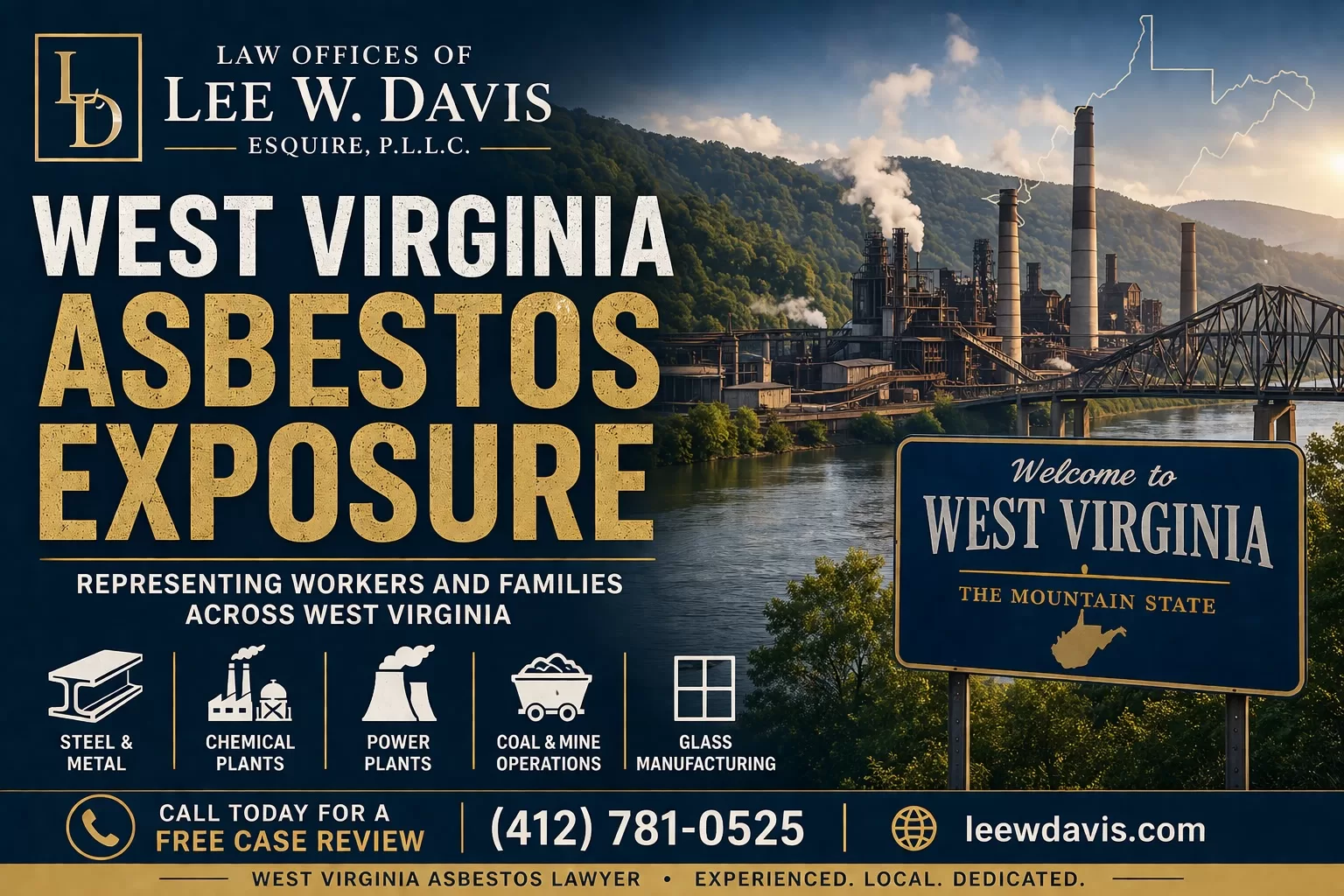
West Virginia asbestos claims help injured workers and their families recover money after an asbestos illness. You may have a claim even if the exposure happened decades ago. You may also have one even if the company that exposed you has closed. So this guide covers who can file, what evidence you need, who pays, and how the process works.
I am Lee Davis. For more than 25 years, I have represented West Virginia families against the companies that put asbestos in their workplaces. Below, I answer the questions people ask me first.
Who can file West Virginia asbestos claims
You can usually file if asbestos exposure in West Virginia later caused a serious disease. However, the group of eligible people is broader than most expect.
Workers form the largest group. In addition, family members exposed at home can file, too. For example, a spouse who washed dusty work clothes may develop the same disease. And when a worker has died, surviving family members can often file on their behalf.
Also, a few things do not end a claim. The exposure being old does not. The employer being closed does not. Even a smoking history does not automatically bar a lung cancer claim.
Diseases that support a claim
The diagnosis shapes the case. Therefore, it helps to know the main asbestos diseases.
First, mesothelioma is a cancer of the lining of the lungs or abdomen. Because asbestos causes almost every case, courts treat these claims seriously. If this is your diagnosis, start with my West Virginia mesothelioma lawyer page.
Second, asbestos also causes lung cancer. Smoking raises the risk sharply, but it does not erase your claim. To learn more, see my WV asbestos lung cancer lawyer page.
Third, asbestosis and pleural disease scar the lungs. These conditions are not cancer, yet they can still disable you. You can also read about asbestos-related diseases at the National Cancer Institute.
Where asbestos exposure happened in West Virginia
Asbestos ran through nearly all of the state’s heavy industry. Moreover, the illnesses often appear 20 to 40 years later. As a result, workers from the 1970s and 1980s are being diagnosed today.
Steel drove exposure in the Northern Panhandle. Meanwhile, the Kanawha Valley “Chemical Valley” exposed plant operators and maintenance crews. In addition, aluminum smelting, river power plants, and glassworks added more risk.
The exact plant usually matters to your case. So find yours in the West Virginia asbestos job sites directory.
Types of West Virginia asbestos claims
“An asbestos claim” is really several claims at once. Understanding them explains why recovery is still possible.
- Personal-injury claims — brought by the living, diagnosed person.
- Wrongful-death and survival claims — brought by the family after a death.
- Lawsuits against solvent defendants — companies still in business.
- Bankruptcy-trust claims — against funds left by defunct companies.
- Take-home exposure claims — for family members exposed at home.
- Workers’ compensation considerations — which may apply in some jobs.
Most West Virginia asbestos claims combine several of these. For instance, a lawsuit and several trust claims often move forward together.
Who may be responsible
Many people assume the employer is the only target. In truth, responsibility usually reaches much further.
- Asbestos-product manufacturers
- Insulation and equipment suppliers
- Premises owners where you worked
- Contractors and distributors
- Successor companies
- Bankruptcy trusts
Because so many parties can share fault, finding all of them is a big part of the work.
Evidence that strengthens your claim
These cases turn on documents, not just memory. Therefore, the stronger your record, the stronger your claim.
- Pathology and diagnostic records
- Employment and Social Security records
- Union records
- Coworker testimony
- Employer and facility history
- Asbestos-product identification
- Invoices, maintenance, and contractor records
- Evidence of take-home exposure
- Death certificates and estate documents
Also, this proof is easier to gather early. So please do not wait to ask.
The claim process step by step
Most of the work happens before any courtroom. In fact, many claims settle without a trial. Here is the usual path.
- Review the diagnosis and medical records.
- Investigate where and when the exposure happened.
- Identify every responsible party and trust.
- Preserve and collect the evidence.
- File trust claims and, if needed, a lawsuit.
- Move through discovery and depositions.
- Evaluate settlement offers or prepare for trial.
Step two usually decides the case. For that reason, talking to a lawyer early matters most.
Asbestos trust fund claims
Courts forced many bankrupt asbestos companies to set aside money for victims. As a result, these trusts still pay today.
Still, two points matter. A closed company does not automatically have a trust you can use. Instead, eligibility depends on your disease, your exposure history, the approved job sites and products, and each trust’s own rules. Where a trust does apply, the bankruptcy usually created it to pay eligible current and future claimants.
Wrongful-death and family claims
When someone dies of an asbestos disease, the claim does not always die too. Instead, surviving family members can often bring a wrongful-death claim. A survival claim may also cover what the person suffered first.
Because these claims are time-sensitive, please ask about your options soon.
West Virginia asbestos claims by region
Where you worked shapes your claim. Below are the communities I serve most, each with local history and help.
- Weirton asbestos lawyer — steel, Northern Panhandle
- Wheeling asbestos lawyer — Ohio County steel
- Fairmont mesothelioma lawyer — Marion County
- Parkersburg asbestos lawyer — chemical and glass
- Charleston asbestos lawyer — Kanawha Valley
- Huntington asbestos lawyer — railroads and river industry
When to talk to a lawyer
Not every question needs a lawyer. However, a few situations call for a fast, careful review.
These include a mesothelioma or lung cancer diagnosis, the death of a family member, or an exposure tied to a closed company. In addition, cases with many defendants or a nearing deadline need early action. So if any of these fit, please reach out through my West Virginia asbestos lawyer page or call the office. The first talk is free, and I work on contingency.
Check If Your Family Was Exposed
Get your free guide instantly + a confidential case review.
🔒 100% Confidential. No obligations.
Frequently asked questions
How long do I have to file West Virginia asbestos claims?
Deadlines depend on several things. For example, they can turn on the diagnosis date, when you learned the cause, whether the person has died, and the claim type. Because a missed deadline can end a valid claim, please ask early.
The company that exposed me has closed. Is it too late?
Not necessarily. A closed company may still be tied to a bankruptcy trust. However, eligibility depends on your diagnosis, exposure history, approved sites and products, and the trust’s rules.
I have lung cancer, not mesothelioma. Do I still have a case?
Possibly, yes. Asbestos causes lung cancer, and a smoking history does not automatically bar a claim. To learn more, see my WV asbestos lung cancer lawyer page.
My family member died. Can we still file?
Often, yes. Surviving family members can usually bring a wrongful-death or survival claim. Still, these claims are time-sensitive, so please ask soon.
What does it cost to talk to you?
Nothing up front. The first talk is free, and you pay no attorney’s fees unless we recover money for you.
This guide is general information, not legal advice, and does not create an attorney-client relationship. Every case differs, so please discuss your specific situation with a lawyer.