
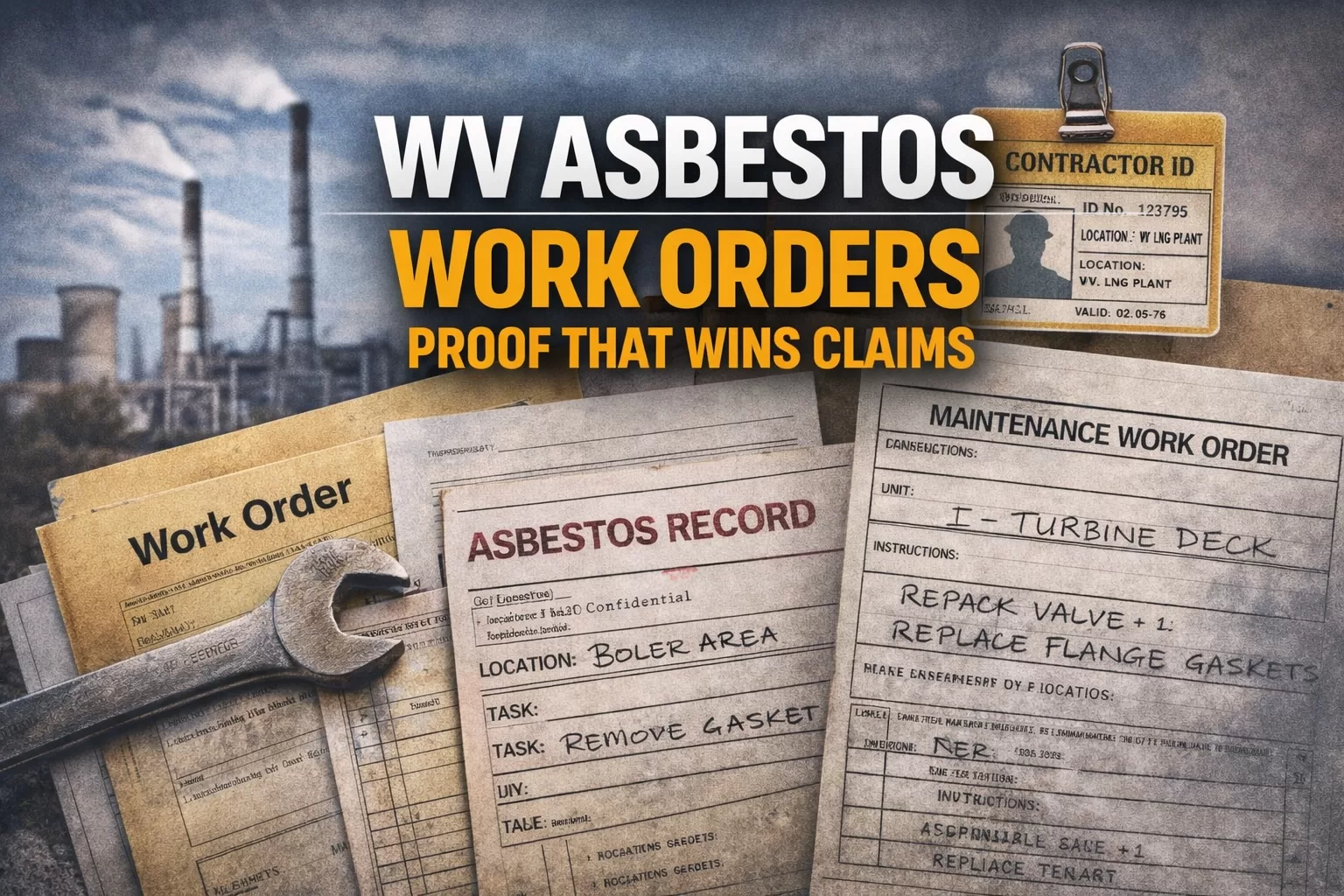
If you’re trying to build a West Virginia asbestos case, WV Asbestos Work Orders can be the difference between a claim that stalls and a claim that moves. People think the “proof” is a product name on a box. In the real world, the strongest cases are often built from the paper trail: maintenance work orders, shutdown sheets, job tickets, piping lists, equipment IDs, and contractor records that show where you were, what you touched, and when—even if nobody remembers the brand of insulation from 1978.
Work orders are especially powerful for power plants, chemical facilities, refineries, mines, steel operations, and industrial maintenance work across West Virginia, because they capture the repetitive reality of asbestos exposure: outages, rebuilds, tear-outs, gasket changes, valve packing, boiler work, refractory repair, pump rebuilds, and insulation disturbance.
Call (412) 781-0525 if you want a straightforward review of whether your work records are enough to support a viable claim.
What Work Orders Actually Prove in an Asbestos Case
Most asbestos cases come down to three things:
- Exposure (did you work around asbestos-containing materials?)
- Causation (is that exposure a substantial factor in disease?)
- Identification (what site, what equipment/material, what time period?)
WV Asbestos Work Orders help prove all three—especially the first and third—by creating a documented map of your work history inside a facility.
Work orders help show:
- You were assigned to a specific unit/area (Boiler 2, Turbine Deck, Pipe Alley, Refractory Line, etc.)
- You performed tasks known to disturb asbestos (tear-out, scraping, grinding, cutting, replacement)
- The frequency and duration of the work (weekly PMs vs. one-time job)
- The equipment involved (pumps, compressors, turbines, boilers, heat exchangers, valves, pipe systems)
- The time period (which matters because asbestos use changed over time but didn’t disappear overnight)
Why Work Orders Matter When Product Names Are Missing
A defense lawyer loves the sentence: “He can’t name the product.”
That’s because they know many workers were never told what they were handling. But a missing brand name does not end a case if you can prove the work, the location, and the disturbance of asbestos-containing components.
Work orders are often better than memory because they’re:
- Created contemporaneously (at the time of the work)
- Routinely kept by facilities or contractors
- Tied to specific equipment and areas
- Corroborated by other records (timecards, logs, outage schedules)
If you can’t name the product, you build the case by proving the job and the conditions—and then connecting that to what was typically used on that equipment during that era.
The Work Orders That Matter Most
Not all work orders are equal. The best ones show disturbance of asbestos materials.
The most useful categories include:
- Outage / turnaround work orders (highest exposure periods)
- Boiler and turbine maintenance tickets
- Valve repack / gasket replacement orders
- Pump rebuild and compressor service records
- Refractory repair and tear-out orders
- Insulation removal or “lagging” references
- Pipefitting and mechanical maintenance orders
- Electrical and instrumentation work in insulated areas
- Demolition, retrofit, or “abatement” references (even if they didn’t call it that then)
Words and phrases that are asbestos “tells”
Even if the record never says “asbestos,” these terms often point right to it:
- lagging / insulation / wrap / blanket
- refractory / firebrick / ceramic / lining
- packing / repack / stem packing
- gasket / flange / cut gasket / scrape gasket
- boiler / economizer / superheater
- steam line / hot line / high-temp
- tear-out / demo / remove / chip-out / grind
- outage / shutdown / turnaround
Mesothelioma/Asbestos Legal Help – WV, MI & PA
Speak directly with attorney Lee W. Davis. No call centers. Free, confidential review.
Where to Get WV Asbestos Work Orders
People assume the plant “doesn’t have anything.” Sometimes that’s true. Often, it’s not.
Common sources:
- Your union (dispatch records, job assignments, benefit documentation)
- Contractor employers (old job books, foreman logs, job tickets)
- Facility maintenance departments (CMMS systems, legacy archives)
- Payroll/timecard records (to anchor dates and locations)
- OSHA or state safety records (if incidents or abatement occurred)
- Co-worker records (someone else kept the binder)
- Old notebooks (shutdown books, tool lists, crew sheets)
Even partial sets can be enough if they establish repeated work in asbestos-heavy areas.
How Work Orders Tie Into Medical Causation
Work orders don’t diagnose disease—but they help the medical causation proof by documenting:
- The intensity and frequency of exposures
- The high-risk tasks (tear-outs, gasket scraping, insulation disturbance)
- The years of exposure (latency matters in asbestos cancers)
For mesothelioma and many asbestos-related cancers, causation is strengthened when the work history clearly shows repeated, documented industrial exposure over time.
The Defense Attacks You Need to Expect (And Beat)
If you’re building a claim around WV Asbestos Work Orders, expect a defense strategy like this:
Attack 1: “This only shows he worked there—not that he disturbed asbestos.”
How you beat it: target the work orders tied to gasket/packing/insulation/refractory tasks, outages, and hot systems.
Attack 2: “No product identification.”
How you beat it: prove the equipment and the era; then connect to the types of asbestos components typically used on that equipment during that time period, plus co-worker corroboration.
Attack 3: “He was only there briefly.”
How you beat it: show frequency: repeated tickets, multiple outages, recurring PM work, multiple units/areas.
Attack 4: “He wore PPE / safety programs existed.”
How you beat it: older records often show the opposite; and even later-era “PPE” policies were inconsistently followed and rarely prevented fiber exposure during tear-outs and scraping. The work history still matters.
What You Should Gather Before You Talk to a Lawyer
If you want the fastest evaluation of whether your records support a claim, gather:
- Any work orders you personally kept
- Employer names and years
- Facility names and units/areas you worked
- Trades/tasks performed (pipefitter, millwright, electrician, insulator, mechanic, laborer)
- Names of two coworkers who can confirm job duties
- A basic medical timeline (diagnosis date, treating facility)
You don’t need everything. You need enough to build a credible work history that can be proven.
West Virginia Asbestos Claims Can Be Won Without a Perfect Product List
A lot of valid cases don’t start with a product name. They start with work.
WV Asbestos Work Orders are one of the cleanest ways to prove what happened inside a facility—because they show the assignments, the equipment, the areas, and the tasks that created exposure.
If you have work orders (or can identify where they are), you may be closer to a viable case than you think.
Call (412) 781-0525 to discuss your work history and whether your documentation supports a West Virginia asbestos claim.
Check If Your Family Was Exposed
Get your free guide instantly + a confidential case review.
🔒 100% Confidential. No obligations.
FAQs
1) What if I don’t have my own copies of work orders?
That’s common. Many cases are built by locating records through former employers, unions, contractors, or facility archives. Even partial records can be enough if they establish repeated asbestos-heavy tasks.
2) Do work orders need to say “asbestos” to be useful?
No. Most older work orders don’t. The value is in the task, equipment, and location—gasket scraping, valve repacks, insulation tear-outs, refractory work, boiler/turbine systems—these tasks speak for themselves.
3) I was a contractor, not a plant employee. Do work orders still help?
Yes. Contractor tickets, shutdown books, badge logs, timecards, and job assignments can be extremely persuasive because they show where you were sent and what you were assigned to do.
4) How far back do work orders exist?
It varies. Some facilities kept paper records for decades; others migrated to computerized systems. The key is anchoring your work history with whatever exists—work orders, payroll records, union dispatch logs, or coworker statements.
5) Will work orders prove causation by themselves?
They’re a major part of exposure proof, which supports causation. Medical records establish diagnosis; work orders help establish the occupational exposure history that ties the disease to asbestos.
Mesothelioma/Asbestos Legal Help – WV, MI & PA
Speak directly with attorney Lee W. Davis. No call centers. Free, confidential review.