
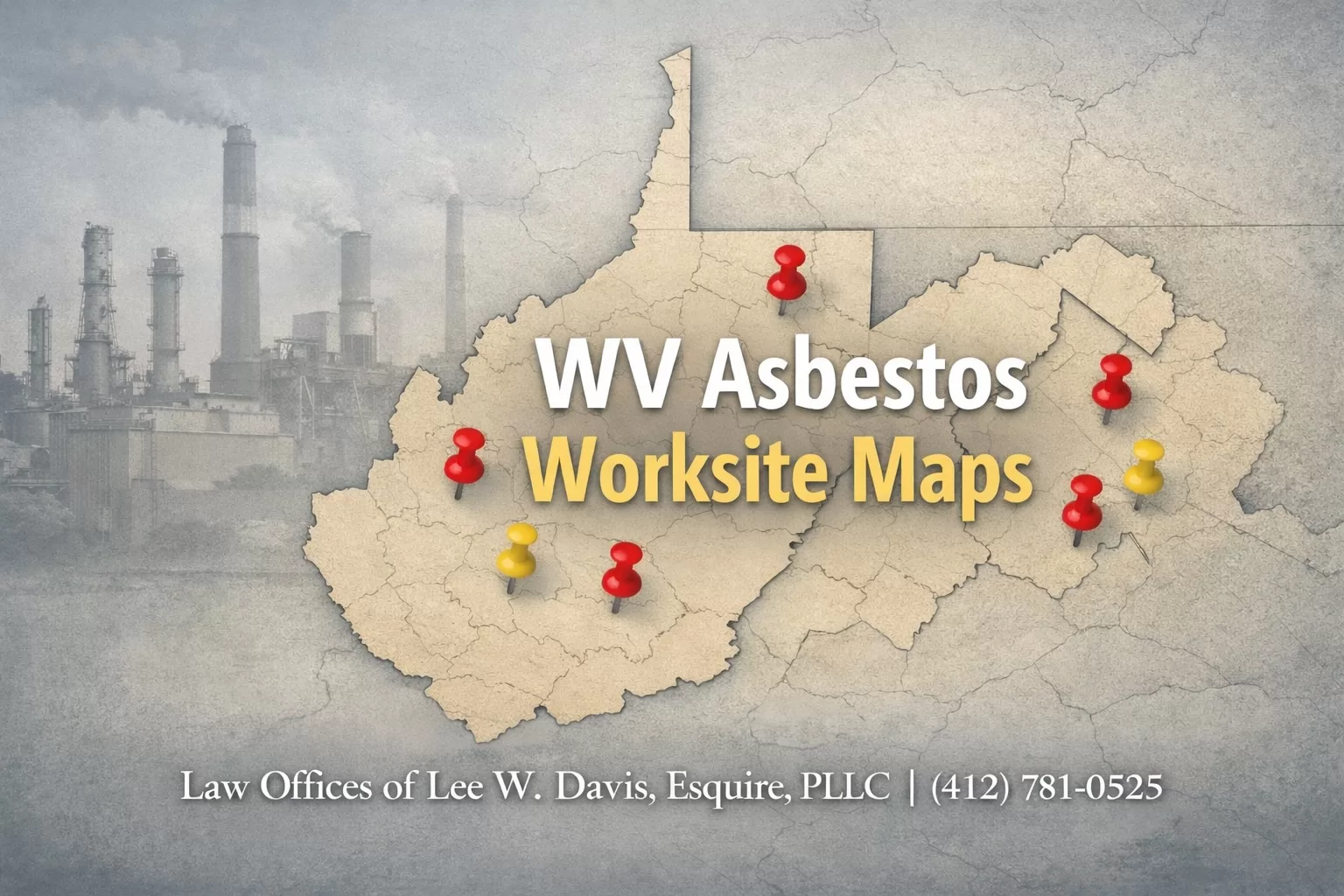
WV Asbestos Worksite Maps can be the difference between “I think it was there” and “here’s exactly where it happened.” In West Virginia, asbestos exposure often traces back to specific industrial corridors—steel, chemicals, power generation, rail, and heavy maintenance—where the same insulation, gaskets, refractory, and pipe covering appeared year after year across different contractors and trades.
Mesothelioma/Asbestos Legal Help – WV, MI & PA
Speak directly with attorney Lee W. Davis. No call centers. Free, confidential review.
If you (or your family) are trying to connect a diagnosis to a real exposure history, mapping the worksites is a practical way to organize evidence and build a clean, credible narrative—especially when memories fade, records disappear, or the work was done decades ago.
Read More: West Virginia mesothelioma lawyer
Why mapping matters in West Virginia asbestos cases
A strong claim usually needs more than a diagnosis. It needs context: where the exposure occurred, when it occurred, what the worker did there, and how asbestos fibers were released. Worksite maps help by:
- Pinpointing exposure locations (plants, shops, yards, power stations, mills)
- Matching job duties to known asbestos materials (insulation removal, gasket work, boiler repair, demolition, maintenance)
- Connecting multiple jobsites into a single timeline (common for union trades and traveling crews)
- Identifying witnesses and records (foremen, coworkers, dispatch logs, job tickets)
What a “WV asbestos worksite map” actually includes
A useful worksite map isn’t just a pin on Google. It’s a case tool that ties together:
- Jobsite name + address/city/county (when known)
- Years on-site (even approximate ranges)
- Trade/work area (boiler room, pipe rack, turbine deck, maintenance bay)
- Likely asbestos products encountered (refractory, pipe insulation, cement, packing)
- Supporting sources (employment records, union records, SS statements, old resumes, affidavits)
This is especially important across major WV hubs like Charleston, Huntington, Parkersburg, Wheeling, Morgantown, Beckley, and Weirton, where industrial work overlapped across generations and contractors.
👉Search Asbestos Job Sites in West Virginina
How maps help families in wrongful death and legacy exposure claims
Many families are building the story after a diagnosis or death—without the worker available to fill gaps. A worksite map helps survivors collect and organize:
- Old work photos and badge IDs
- Union membership history and dispatch lists
- Coworker names and job sequences
- Medical timeline vs. employment timeline
It creates a clear, persuasive “work-and-exposure footprint” that supports settlement discussions and (when needed) litigation.
What to do if you don’t remember every jobsite
You don’t need perfection to start. We often begin with three anchors:
- employer name(s), 2) trade/job title, 3) a few cities or counties in WV. From there, a map can expand as records come in.
Talk to a WV asbestos lawyer about worksite mapping
If you want your claim presented with maximum clarity, worksite mapping is one of the most practical starting points. If you’re unsure whether your history fits, you can still get answers quickly—without guessing and without wasting months chasing the wrong records.
Call (412) 781-0525 or message the Law Offices of Lee W. Davis, Esquire, P.L.L.C. to discuss your WV exposure timeline and whether a mapped work history can support a claim.
Check If Your Family Was Exposed
Get your free guide instantly + a confidential case review.
🔒 100% Confidential. No obligations.
Comments are closed.