
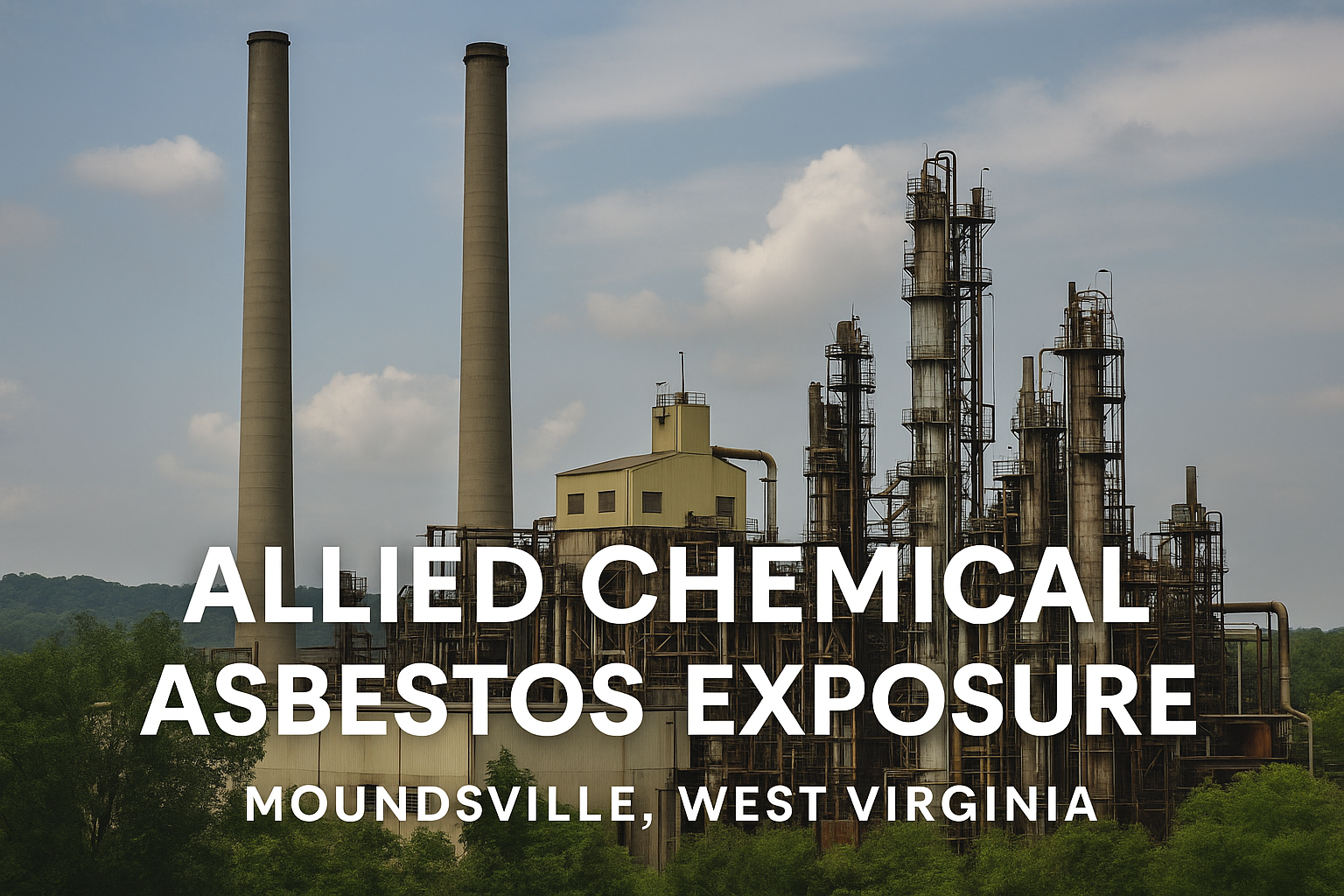
Allied Chemical asbestos exposure at the Moundsville, West Virginia plant along the Ohio River created a documented legacy of mesothelioma and lung cancer for workers and their families throughout Marshall County and the surrounding Ohio Valley communities. For nearly three decades — from the early 1950s through 1980 — Allied Chemical and its successor Allied Signal operated one of the most significant chemical manufacturing facilities on the West Virginia side of the Ohio River, using asbestos-containing insulation, refractory, gaskets, and process equipment materials throughout the plant in concentrations that exposed workers across every trade and role at the facility.
Mesothelioma/Asbestos Legal Help – WV, MI & PA
Speak directly with attorney Lee W. Davis. No call centers. Free, confidential review.
If you worked at the Allied Chemical or Allied Signal Moundsville plant, or if you worked there under the LCP Chemicals or Hanlin Chemicals name after the plant was sold in 1980, and you have been diagnosed with mesothelioma or lung cancer, the corporate succession history of the facility — from Allied Chemical through Allied Signal to Honeywell International — connects your work history to a well-documented asbestos liability chain that has supported successful claims for Ohio Valley workers for decades.
The Allied Chemical Moundsville Plant — History and Operations
Allied Chemical Corporation traced its origins to Allied Chemical & Dye Corporation, formed in 1920 as a consolidation of five American chemical companies. By 1958 the company had taken the Allied Chemical Corporation name, and by the early 1950s had established its Moundsville, West Virginia chemical manufacturing operation along the Ohio River approximately three miles south of Moundsville in the Round Bottom alluvial area.
The Moundsville facility was a chlorine and chemical processing plant — one of the operations that drew OSHA’s very first citation on May 28, 1971, when the agency cited Allied Chemical for allowing toxic mercury to pool on floors and working surfaces at the plant. The chemical processing operations at Moundsville required the full range of high-temperature industrial infrastructure — boiler systems for steam generation and process heat, miles of insulated process piping carrying chemical process fluids at elevated temperatures and pressures, heat exchangers, pumps, valves, and the mechanical systems throughout the facility — all of which required asbestos-containing materials throughout the pre-1980 period.
Allied Signal operated the Moundsville site from 1953 until 1980. When Allied divested the facility, it sold the southern portion — known as the South Plant — to LCP Chemicals-West Virginia, which underwent a name change to Hanlin Chemicals-West Virginia in 1990. The northeast portion was sold to Olin Corporation. Allied Signal retained the northwest portion of the site, designated Allied Park. The corporate chain continued when Allied Signal merged with Signal Companies in 1985, acquired Honeywell in 1999, and took on the Honeywell International name — creating the current corporate successor to Allied Chemical’s Moundsville operations.
How Allied Chemical Created Asbestos Exposure at the Moundsville Plant
Chemical manufacturing facilities of Allied Chemical’s scale and era used asbestos-containing materials throughout every aspect of their industrial infrastructure — not as an unusual feature of the Moundsville plant specifically, but as the standard practice of chemical plant construction and maintenance throughout the period of the plant’s operation.
Process piping insulation — The miles of process piping carrying chemical process fluids at elevated temperatures throughout the Allied Chemical Moundsville plant were insulated with asbestos-containing pipe covering throughout the facility’s operational life. Workers who maintained, repaired, and replaced that insulation — and workers who worked in the confined pipe chases, mechanical rooms, and process areas where that insulation was present — accumulated asbestos exposure from the full extent of the process piping system throughout the plant.
Boiler and steam system insulation — The boiler systems generating steam for process heat and utility functions at Allied Chemical Moundsville were insulated with asbestos-containing block insulation on the boiler shells and asbestos pipe covering on the steam distribution systems running throughout the facility. Boiler maintenance and overhaul work at Allied Chemical required stripping and replacing that insulation — some of the most fiber-intensive maintenance work at the facility.
Gaskets and valve packing throughout the process system — The flanged connections throughout the Allied Chemical Moundsville process piping system used asbestos-containing gaskets, and the valves throughout the system used asbestos-containing packing materials. Workers who broke open flanged connections to access process piping — during routine maintenance, emergency repairs, and planned turnarounds — disturbed those aged asbestos gaskets with every repair. A pipefitter career at Allied Chemical Moundsville involved replacing asbestos-containing gaskets at thousands of flanged connections throughout the process system across their time at the facility.
Refractory materials in furnaces and process equipment — Chemical processing operations at Allied Chemical Moundsville used furnaces, kilns, and heat-intensive process equipment lined with asbestos-containing refractory materials throughout their construction. Maintenance and rebuild of that refractory — performed during planned shutdowns and turnaround periods at the facility — involved direct contact with asbestos-containing materials in some of the most fiber-releasing conditions of any routine plant maintenance work.
Pump and equipment packing — The pumps, compressors, and rotating equipment throughout the Allied Chemical Moundsville process systems used asbestos-containing packing materials in their seals and stuffing boxes. Mechanics who maintained and rebuilt that equipment throughout the facility accumulated direct asbestos exposure from the packing materials throughout every equipment service job performed at the plant.
Turnaround and shutdown work — Allied Chemical Moundsville conducted planned turnarounds and facility shutdowns during which every maintenance task accumulated throughout the operational period was performed simultaneously. Those turnaround periods concentrated asbestos fiber release throughout the facility — as insulation was stripped, gaskets were broken loose throughout the process system, and refractory was torn out and rebuilt — into the most intensive asbestos exposure windows of any phase of plant operation. Outside contractors and maintenance workers brought in specifically for Allied Chemical turnarounds accumulated their highest single-event asbestos exposure during those shutdown periods.
Mesothelioma/Asbestos Legal Help – WV, MI & PA
Speak directly with attorney Lee W. Davis. No call centers. Free, confidential review.
The Corporate Succession Chain — From Allied Chemical to Honeywell
The corporate successor to Allied Chemical’s Moundsville operation matters directly to the legal claim. Understanding the chain is essential to identifying the correct defendants and trust fund claim pathways.
Allied Chemical & Dye Corporation (1920) → Allied Chemical Corporation (1958) — the corporate entity operating the Moundsville plant from the early 1950s through the late 1970s.
Allied (1983) → Allied Signal (1985) — formed through the merger of Allied Chemical and Signal Companies. Allied Signal operated the Moundsville site until selling portions of it in 1980-81 and retaining Allied Park.
Honeywell International (1999) — Allied Signal’s acquisition of Honeywell created the current corporate successor to Allied Chemical’s asbestos liability. Honeywell has been a defendant in Allied Chemical and Allied Signal asbestos litigation and continues to face claims from workers at facilities the company operated under its predecessor names.
Bendix Corporation and NARCO — Allied Signal’s acquisition of the Bendix Corporation brought in asbestos product liability from Bendix’s brake lining and friction products. Allied Signal also owned North American Refractories Company (NARCO) from 1979 to 1986 — a major refractory manufacturer whose asbestos-containing products were used at facilities throughout the region including chemical plants and steel operations in West Virginia. The NARCO Asbestos Disease Trust remains active and continues to pay claims from workers exposed to NARCO refractory products at Allied Chemical and other facilities throughout West Virginia.
LCP Chemicals and Hanlin Chemicals — Workers who continued at the Moundsville plant after the 1980 sale to LCP Chemicals (later Hanlin Chemicals) may have additional claim pathways based on the continuation of asbestos-containing materials at the facility after the ownership transition.
Workers Most Commonly Involved in Allied Chemical Moundsville Asbestos Claims
Pipefitters and steamfitters — The trade most directly associated with the asbestos-containing process piping, gaskets, and valve packing throughout the Allied Chemical Moundsville plant. A pipefitting career at Allied Chemical represented sustained, direct contact with asbestos-containing materials throughout the process piping system across the full plant.
Maintenance mechanics — Plant mechanics who maintained the pumps, compressors, rotating equipment, and process machinery throughout Allied Chemical Moundsville accumulated asbestos exposure from the asbestos-containing packing and sealing materials in that equipment throughout every maintenance job.
Boilermakers — Workers who built, maintained, and overhauled the boiler systems at Allied Chemical Moundsville performed the most fiber-intensive maintenance work at the facility — stripping asbestos-containing boiler insulation during overhauls and working inside confined boiler environments where ambient fiber concentrations were highest.
Insulators — The insulators who applied and removed the asbestos-containing insulation on the process piping and boiler systems at Allied Chemical Moundsville had the most direct and concentrated asbestos exposure of any trade at the facility.
Chemical operators and process workers — Operators who worked throughout the Allied Chemical Moundsville process units — managing process systems, responding to equipment issues, working around ongoing maintenance — accumulated ambient asbestos exposure from the continuous presence of asbestos-containing materials and maintenance work throughout the plant environment.
Outside contractors and turnaround workers — Workers dispatched to Allied Chemical Moundsville for planned turnarounds and shutdown maintenance by contractors serving the chemical plant industry in the Ohio Valley region accumulated turnaround-period asbestos exposure — often the most concentrated single-event exposure of any phase of plant maintenance work.
Plant engineers and supervisors — Engineering and supervisory personnel whose inspection and management roles took them throughout the Allied Chemical Moundsville facility accumulated ambient asbestos exposure from every process department, mechanical room, and utility area they visited throughout their careers at the plant.
Take-Home Asbestos Exposure — Allied Chemical Moundsville Families
Workers at the Allied Chemical Moundsville plant carried asbestos fibers home on their work clothing throughout the exposure era — on their work jackets, their pants, their boots and gloves. Spouses who laundered that clothing and family members who lived in the same household as Allied Chemical workers accumulated secondary asbestos exposure that has produced mesothelioma and lung cancer diagnoses in family members who never entered the plant. See take-home asbestos cases for more on secondary exposure claims from Allied Chemical Moundsville families.
What Evidence Supports an Allied Chemical Moundsville Asbestos Claim
- Diagnosis records confirming mesothelioma or lung cancer
- Work history at Allied Chemical, Allied Signal, LCP Chemicals, or Hanlin Chemicals at the Moundsville facility — job titles, departments, years worked, specific maintenance tasks or process work performed
- Memory of the specific areas of the plant, the maintenance work, and the turnaround periods during which asbestos-containing materials were disturbed
- Names of coworkers, supervisors, or contractors you worked with at the Moundsville facility
- Union records from West Virginia Pipefitters, Boilermakers, Insulators, or Laborers locals confirming employment and dispatch history at the plant
- Social Security earnings records confirming Allied Chemical, Allied Signal, LCP Chemicals, or Hanlin Chemicals as employers
For a broader overview of West Virginia asbestos claims see West Virginia mesothelioma lawyer. For the Kanawha Valley chemical plant exposure profile see chemical plant asbestos WV. For the Union Carbide WV exposure profile see Union Carbide asbestos WV. For the WV shutdown and turnaround work profile see WV asbestos exposure shutdown work. For the WV pipe leak and gasket repair profile see WV asbestos pipe leaks. For lung cancer claims from WV chemical plant exposure see West Virginia lung cancer. You can search the full list of asbestos job sites in West Virginia for additional documentation of the Allied Chemical Moundsville site and surrounding Marshall County facilities.
Knowledge of Allied Chemical and WV Chemical Plant Asbestos Cases Since 1989
I began researching West Virginia asbestos cases in 1989, working as a paralegal on the original West Virginia asbestos mass trials — cases that included chemical plant workers throughout the Ohio Valley and Kanawha Valley whose mesothelioma and lung cancer traced to asbestos exposure at facilities including the major chemical operations along the Ohio River corridor. I was licensed in West Virginia in 2002 and have represented West Virginia mesothelioma and asbestos lung cancer claimants since my return to Pittsburgh in 1999.
Allied Chemical Moundsville claims require knowledge of the corporate succession from Allied Chemical through Allied Signal to Honeywell International, the NARCO refractory trust fund pathway, the Bendix friction products liability chain, and the facility-specific product identification documentation from decades of Ohio Valley chemical plant asbestos litigation. That knowledge comes from working West Virginia chemical plant cases specifically.
When you call, you speak directly with me. No call centers. No case managers.
West Virginia’s statute of limitations runs from the date of diagnosis, not from the date of your exposure at Allied Chemical or any successor operation at the Moundsville facility.
Call (412) 781-0525 or start your confidential case review online now.
Check If Your Family Was Exposed
Get your free guide instantly + a confidential case review.
🔒 100% Confidential. No obligations.
Frequently Asked Questions
Q: I worked at the Moundsville plant when it was LCP Chemicals and later Hanlin Chemicals in the 1980s and 1990s. Does that post-Allied period still support a mesothelioma claim?
A: Yes, potentially. When Allied Signal sold the South Plant portion of the Moundsville facility to LCP Chemicals in 1980, the asbestos-containing materials already in place throughout the process piping, boiler systems, and equipment at the facility did not leave with the previous owner. Workers who continued at the Moundsville plant under LCP Chemicals and Hanlin Chemicals worked in a facility where the legacy asbestos-containing materials from the Allied Chemical operational period remained present and continued to deteriorate, shed fibers, and create exposure during maintenance and repair work throughout the post-1980 period. The product defendants for post-1980 exposure claims include both the manufacturers of the materials originally installed during the Allied Chemical period and any new asbestos-containing materials introduced after the 1980 ownership transition.
Q: I worked as an outside pipefitter contractor at Allied Chemical Moundsville during several turnarounds in the 1970s. My career took me to many other WV chemical plants as well. Does a multi-facility turnaround career history support a mesothelioma claim?
A: Yes — and a multi-facility turnaround career throughout WV chemical plants is typically a strong claim profile. Each facility in your turnaround career represents a distinct set of asbestos-containing product manufacturers and potentially a distinct set of trust fund claims and civil litigation defendants. Allied Chemical Moundsville turnaround work — stripping process piping insulation, breaking open gasketted flanges throughout the process system, working in confined spaces during peak fiber release conditions — was among the most asbestos-intensive work at the facility, and the same turnaround exposure pattern at each additional WV chemical plant in your career adds to the cumulative claim. Call to discuss your specific turnaround work history and diagnosis.
Q: How does the Honeywell connection affect my Allied Chemical Moundsville asbestos claim?
A: Honeywell International is the current corporate successor to Allied Signal, which was itself the successor to Allied Chemical. That corporate succession means Honeywell carries the asbestos liability for Allied Chemical’s Moundsville operations as a going-concern civil litigation defendant. In addition, Honeywell’s former NARCO subsidiary — North American Refractories Company — established a bankruptcy trust that remains active and continues to pay claims from workers exposed to NARCO’s asbestos-containing refractory products at Allied Chemical and other facilities throughout West Virginia. An experienced West Virginia asbestos attorney evaluates both the Honeywell civil litigation pathway and the NARCO trust fund pathway for Allied Chemical Moundsville claimants based on the specific work history and the products documented at the facility during the relevant time period.
🡒 Read about asbestos at Kammer Power Plant
Mesothelioma/Asbestos Legal Help – WV, MI & PA
Speak directly with attorney Lee W. Davis. No call centers. Free, confidential review.
Comments are closed.