Michigan Chemical Engineer Asbestos Exposure

Michigan Chemical Engineer Asbestos

Michigan Chemical Engineer Asbestos exposure occurred inside the process systems that powered the state’s chemical industry. Engineers working in these facilities were responsible for keeping operations running—but that meant being physically present in environments where asbestos was used in piping, reactors, insulation, and high-temperature equipment.

You didn’t need to work directly with asbestos materials to be exposed.

You just had to be there when those systems were opened, repaired, or breaking down.


Mesothelioma/Asbestos Legal Help – WV, MI & PA

Speak directly with attorney Lee W. Davis. No call centers. Free, confidential review.


Where Chemical Engineers Encountered Asbestos

Chemical plants across Michigan were built around systems that relied on asbestos for heat resistance and durability. That included:

  • Process piping and chemical lines
  • Reactors and pressure vessels
  • Heat exchangers and thermal systems
  • Gaskets, packing, and sealing materials
  • Insulated equipment operating at extreme temperatures

These were not isolated materials—they were part of the system itself.

When those systems were disturbed, asbestos fibers were released into the surrounding air.


Exposure During Failures and System Work

The most significant exposure didn’t happen during normal operation.

It happened when something went wrong.

Chemical engineers were present during:

  • Process upsets and system failures
  • Leak investigations
  • Emergency shutdowns
  • Equipment modifications and upgrades

Those situations required engineers to be inside active work areas while insulation was removed and equipment was opened.

These were high-risk conditions—often without warning and without protection.


Michigan Chemical Facilities and Exposure Risk

Chemical engineers across Michigan worked in facilities where asbestos use was widespread, including:

  • Dow Chemical operations in Midland
  • Other large-scale chemical processing plants
  • Industrial facilities connected to automotive manufacturing
  • Power and utility systems supporting plant operations

These environments were built for heat, pressure, and chemical resistance—exactly where asbestos was used most heavily.

👉 Search Asbestos Job Sites in Michigan


You Were in the System, Not Outside It

This is what separates engineer exposure from what most people expect.

You weren’t observing from a distance.

You were:

  • Walking process units
  • Evaluating system performance
  • Responding to operational issues
  • Coordinating repairs in real time

That meant being in the same airspace where asbestos fibers were released.

That exposure is real—and it’s documented.


Why Chemical Engineer Cases Are Strong

These cases often show:

  • Long-term exposure across multiple systems
  • Direct presence during high-risk events
  • Detailed work histories tied to specific plants
  • Repeated exposure over years of operation

You didn’t need to install insulation or remove materials.

Being there during those events is enough to establish exposure.


What a Michigan Asbestos Claim Looks Like

These claims are not against your employer.

They are filed against the manufacturers and suppliers of asbestos-containing materials used in these facilities.

Many of those companies have established trust funds that still compensate people today.


Time Limits for Michigan Claims

Michigan law generally measures the statute of limitations from diagnosis—not exposure.

That means even if your work occurred decades ago, your claim may still be valid.


Experience With Michigan Industrial Exposure Cases

I handled thousands of asbestos cases involving Michigan industrial workers, including approximately 3,200 GM Saginaw Foundry cases.

These cases are built on how exposure actually occurred inside real industrial systems—not job titles alone.

When you call, you speak directly with me.

📞 (412) 781-0525

🌐 https://leewdavis.com

Check If Your Family Was Exposed

Get your free guide instantly + a confidential case review.

🔒 100% Confidential. No obligations.


Frequently Asked Questions

Q: Can chemical engineers in Michigan develop mesothelioma from asbestos exposure?

Yes. Engineers were exposed while working around piping, reactors, and systems containing asbestos materials.


Q: Do I need to have handled asbestos directly?

No. Being present during system work where asbestos was disturbed is enough to support a claim.


Q: Which Michigan plants had asbestos exposure risks?

Chemical facilities, including large operations like Dow in Midland, and related industrial plants used asbestos extensively.

Mesothelioma/Asbestos Legal Help – WV, MI & PA

Speak directly with attorney Lee W. Davis. No call centers. Free, confidential review.

Michigan Plant Engineer Asbestos

Michigan Plant Engineer Asbestos Exposure

Michigan Plant Engineer Asbestos exposure occurred inside some of the most complex industrial systems in the country. Engineers working in automotive plants, foundries, and manufacturing facilities were responsible for keeping operations running—but that often meant working in environments where asbestos was present in insulation, equipment, and high-heat systems.

You didn’t have to install insulation or remove materials to be exposed. You just had to be there when those systems were opened, repaired, or failing.


Mesothelioma/Asbestos Legal Help – WV, MI & PA

Speak directly with attorney Lee W. Davis. No call centers. Free, confidential review.

How Engineers Were Exposed in Michigan Plants

Plant engineers in Michigan worked directly around systems that relied on asbestos for decades. That exposure occurred in:

  • Steam and process piping
  • Boilers and high-temperature systems
  • Foundry operations and heat treatment areas
  • Gaskets, packing, and mechanical components
  • Electrical and control system insulation

When these systems were disturbed—especially during maintenance—airborne asbestos fibers were released into the surrounding environment.

Engineers were often standing in the middle of those conditions.


Exposure During Maintenance, Repairs, and Failures

The most significant exposure events typically happened during:

  • Equipment breakdowns
  • Emergency repairs
  • Scheduled plant shutdowns
  • System upgrades and retrofits

Engineers were required to evaluate problems, coordinate repairs, and bring systems back online. That meant being present while insulation was removed, components were replaced, and contaminated materials were handled.

These were not controlled environments.

They were active work zones with multiple crews operating at the same time.


Michigan Industrial Facilities and Exposure Risk

Plant engineers across Michigan worked in facilities where asbestos use was widespread, including:

  • Automotive manufacturing plants
  • GM, Ford, and Chrysler facilities
  • Saginaw foundries (grey iron, nodular iron, malleable iron)
  • Powerhouses within manufacturing complexes
  • Heavy industrial and machining facilities

These environments were built around heat, pressure, and durability—conditions where asbestos was heavily used.

👉 Search Asbestos Job Sites in MIchigan


Why Engineer Exposure Cases Are Strong

Cases involving plant engineers often show:

  • Long-term exposure across multiple systems
  • Direct presence during high-risk maintenance work
  • Detailed work histories tied to specific facilities
  • Repeated exposure events over years

You didn’t have to be assigned to insulation work.

Being present in those environments is enough to establish exposure.


You Were There When It Happened

This is what matters most.

If you were:

  • Walking plant floors
  • Inspecting systems
  • Overseeing repairs
  • Responding to equipment issues

You were in the same airspace where asbestos fibers were released.

That exposure is not hypothetical—it’s documented across decades of industrial operation.


What a Michigan Asbestos Claim Looks Like

These cases are not about suing your employer.

They are brought against the manufacturers and suppliers of asbestos-containing materials used throughout these facilities.

Many of those companies have established trust funds that still pay claims today.


Time Limits for Michigan Claims

In Michigan, the statute of limitations typically begins at diagnosis—not exposure.

Even if your work occurred decades ago, you may still have the ability to pursue a claim.


Experience With Michigan Industrial Cases

I handled thousands of asbestos cases involving Michigan industrial workers, including approximately 3,200 GM Saginaw Foundry cases.

These cases are built on how exposure actually occurred in real-world environments—not job titles alone.

When you call, you speak directly with me.

📞 (412) 781-0525

🌐 https://leewdavis.com

Check If Your Family Was Exposed

Get your free guide instantly + a confidential case review.

🔒 100% Confidential. No obligations.


Frequently Asked Questions

Q: Can plant engineers in Michigan develop mesothelioma from asbestos exposure?

Yes. Engineers were exposed while working around systems containing asbestos during maintenance and repairs.


Q: Do I need to have worked directly with asbestos materials?

No. Being present in areas where asbestos was disturbed is enough to support a claim.


Q: What industries in Michigan had the highest asbestos exposure risk?

Automotive plants, foundries, and heavy manufacturing facilities had widespread asbestos use.

Mesothelioma/Asbestos Legal Help – WV, MI & PA

Speak directly with attorney Lee W. Davis. No call centers. Free, confidential review.

Michigan Asbestos Exposure Diary

Michigan Asbestos Exposure Diary Guide

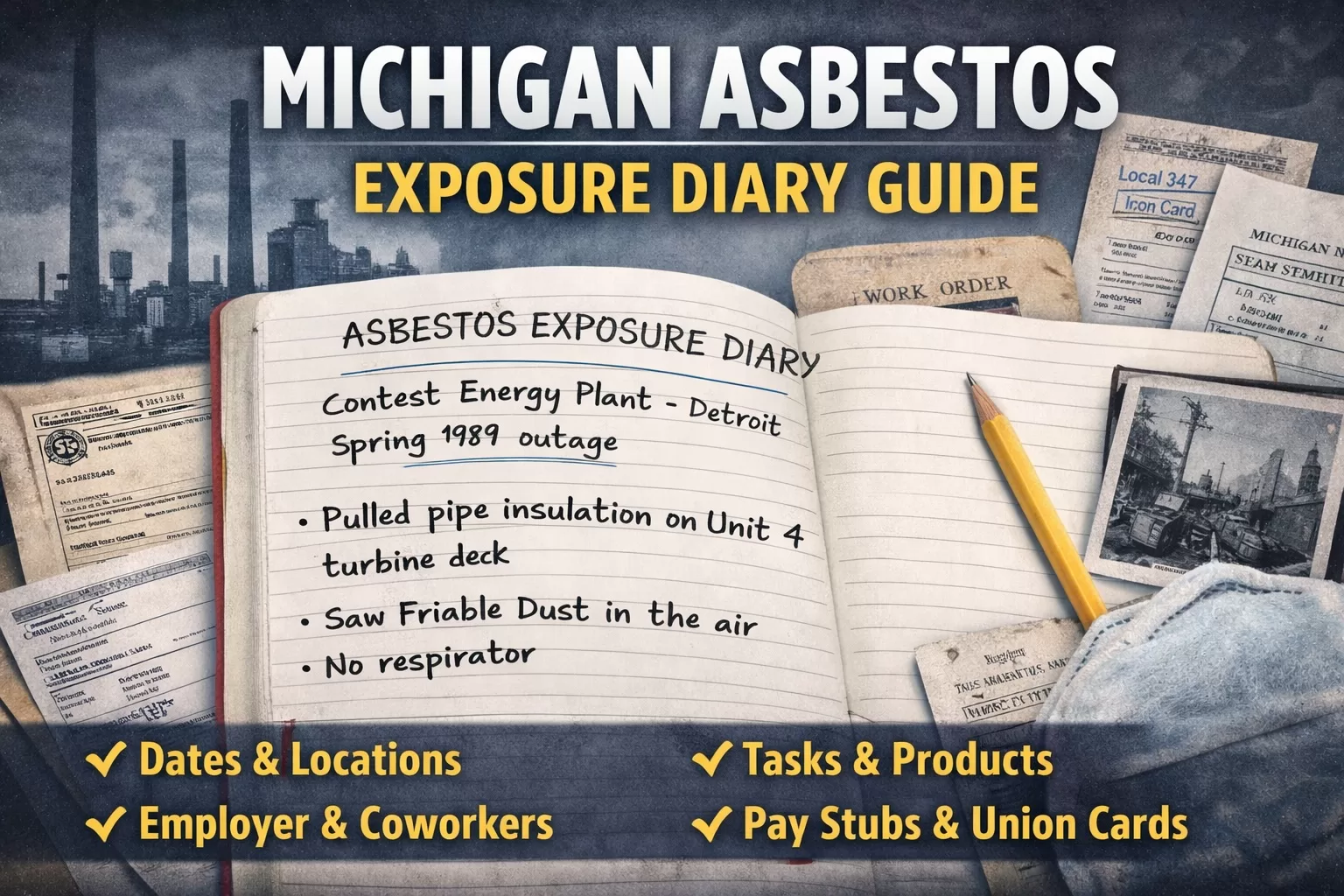
A Michigan Asbestos Exposure Diary is one of the simplest ways to turn a vague work history into usable proof. People remember the trade, the plant, and the kind of work—but decades later, the details that matter most in an asbestos claim (locations, tasks, dates, products, and witnesses) can blur. A diary creates a clean timeline you can match to records, jobsite documents, and medical proof.

Mesothelioma/Asbestos Legal Help – WV, MI & PA

Speak directly with attorney Lee W. Davis. No call centers. Free, confidential review.

If you worked around insulation, pipe covering, boilers, turbines, pumps, gaskets, valve packing, refractory, or demolition dust in Michigan, a diary helps you capture what you do remember now—before it fades further.

What a strong diary entry looks like

You do not need perfect dates. You need consistent, specific details. A good entry answers these questions:

  • Where: facility name, city, building/area (boiler room, turbine deck, unit number, maintenance shop)
  • When: year range, season, or shutdown/outage periods (“spring outage 1992,” “winter 1987 rebuild”)
  • Who: employer + any contractor names, foreman, crew members, union local if known
  • What you did: tear-out, re-pack valves, scrape gaskets, remove pipe insulation, mix refractory, sweep dust
  • What you saw: pipe covering, block insulation, mudded fittings, cloth wrap, cement-like materials, bags/boxes
  • Dust conditions: dry removal, sawing, grinding, compressed air clean-up, sweeping
  • PPE and controls: no respirator, paper mask, wet methods, negative air, containment (or none)
  • Witnesses: coworkers who can confirm tasks/areas (even if you don’t have contact info yet)

The diary isn’t “feelings.” It’s facts you can later support with documents.

The six “memory anchors” that make diaries valuable

Most asbestos cases get stronger when your diary gives you hooks to chase records. Use these anchors:

  1. Outages and shutdowns (utilities, plants, foundries)
  2. Major projects (new line install, boiler rebuild, turbine overhaul, demolition)
  3. Equipment IDs (pump numbers, unit numbers, building names)
  4. Contractor overlap (outside trades on site during dusty work)
  5. Work order language (“remove insulation,” “replace packing,” “refractory repair”)
  6. Product identifiers (even partial—color, bag markings, “mud,” “block,” “cloth wrap”)

If you can write entries around those six things, you’ve created a map for evidence.

What to attach to your diary (simple evidence list)

When you can, staple or scan attachments behind the diary:

  • Pay stubs / W-2s / pension statements showing employer and years
  • Union records (dispatch logs, membership cards, benefit statements)
  • Badge photos, jobsite IDs, apprenticeship paperwork
  • Old resumes, calendars, notebooks, tool logs
  • Any training cards or safety paperwork
  • Photos of the facility or the area you worked (even public photos help with location accuracy)

A diary + a few records often does more than a “perfect story” with nothing to back it up.


Common mistake: writing too broad

“Worked around asbestos” is not a diary entry. Make it task-based.

Better:

  • “Cut and scraped old gaskets on flanges in the maintenance shop; dust on clothes; no respirator.”
  • “Pulled pipe insulation during outage work on Unit 2; swept debris at end of shift.”

That level of detail is what later connects to product types and responsible companies.

When a diary is most helpful

A Michigan Asbestos Exposure Diary is especially useful if:

  • You worked at multiple sites over many years
  • You were a contractor and moved from job to job
  • You can describe the work but not the product brand
  • Your coworkers are retired, moved, or hard to locate
  • The jobsite has changed ownership and records are scattered

Talk to a lawyer before you “clean up” your story

Don’t rewrite your history to sound “legal.” Start with the truth and keep it consistent. An experienced asbestos lawyer can help you match your diary to records and identify where the exposure proof will actually come from.

Learn More about help from a Michigan Mesothelioma Lawyer

If you have questions about what to document for a Michigan asbestos claim, call (412) 781-0525. The right paper trail can turn “I think it was asbestos” into a case that can actually move.

Check If Your Family Was Exposed

Get your free guide instantly + a confidential case review.

🔒 100% Confidential. No obligations.


FAQs

What if I don’t remember exact dates?

That’s normal. Use ranges (1988–1991), seasons, or outage periods. Consistency and detail matter more than precision.

Should I include the names of coworkers?

Yes—write them down even if you don’t have contact information. Names can later help locate witnesses or confirm crews and contractors.

Can a diary replace jobsite records?

No. But it can lead you to the records that matter and keep your exposure timeline consistent while those records are gathered.

Mesothelioma/Asbestos Legal Help – WV, MI & PA

Speak directly with attorney Lee W. Davis. No call centers. Free, confidential review.

Michigan Asbestos Pay Stubs

Michigan Asbestos Pay Stubs Proof

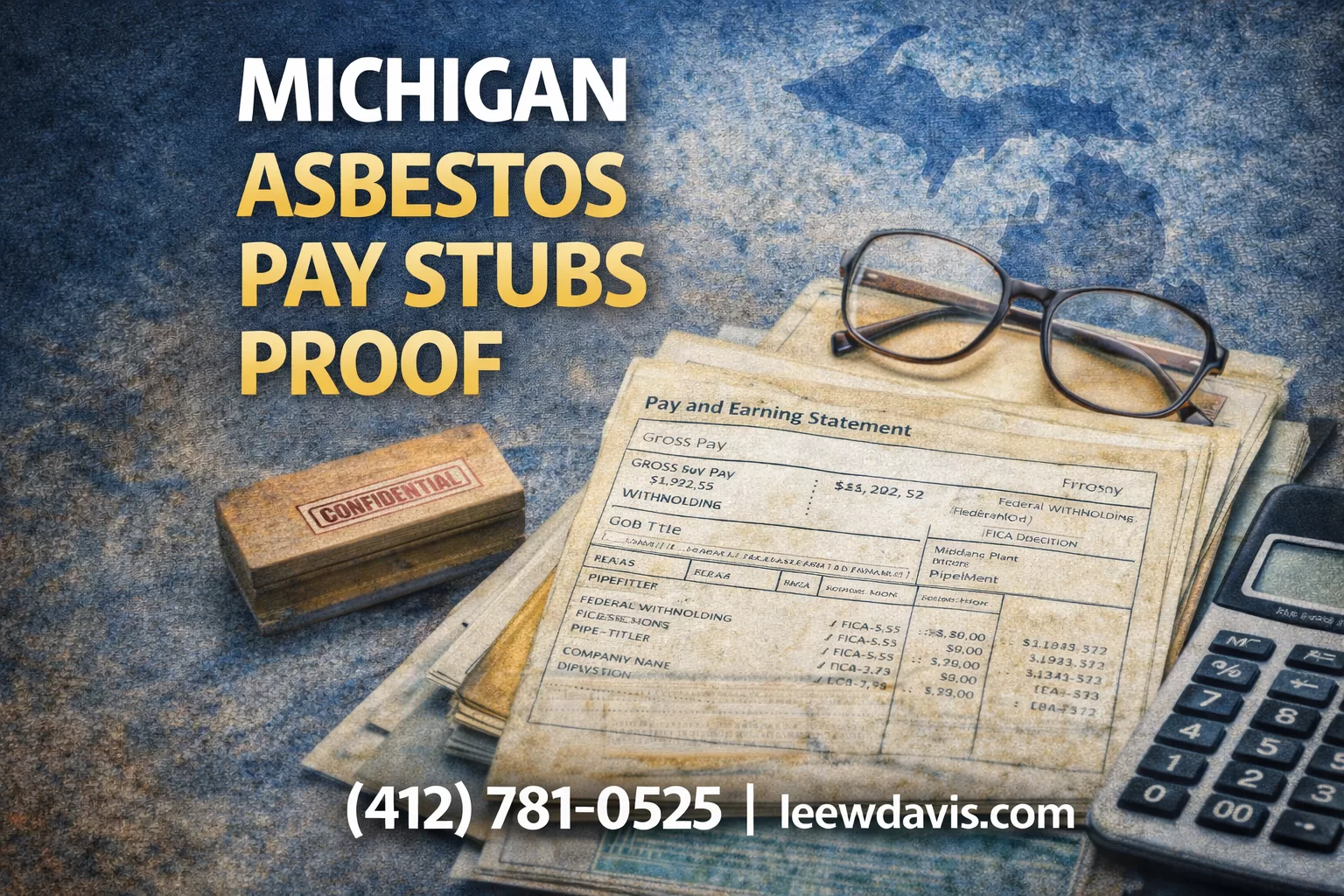
If you’re building an asbestos case, Michigan Asbestos Pay Stubs are often the fastest way to prove where you worked and when—especially when the jobsite is gone, the contractor is dissolved, or the company “can’t locate” old personnel files.

Pay stubs matter because they can show:

  • Employer name (and sometimes the parent company)
  • Plant, department, or union deductions that tie you to a specific facility
  • Dates of employment during high-exposure periods (outages, rebuilds, shutdowns)
  • Job classifications (maintenance, pipefitter, electrician, millwright, insulator)
  • Wage codes and shift differentials that match heavy industrial work

👉 Search Asbestos Job Sites in Michigan

Mesothelioma/Asbestos Legal Help – WV, MI & PA

Speak directly with attorney Lee W. Davis. No call centers. Free, confidential review.

Where to look for old pay stubs in Michigan

  • Old tax folders (W-2s and pay stubs often stored together)
  • Union benefit statements and dues history
  • Pension paperwork and retirement plan archives
  • Bank records showing direct-deposit employer names
  • SSA earnings history (great for confirming employers and years)

Learn More: Michigan asbestos exposure records

Why pay stubs can beat “work history”

Work history gets messy because people worked for:

  • Multiple contractors on the same jobsite
  • Labor pools during outages
  • Temporary maintenance assignments across plants

Pay stubs help lock the timeline down. Once the timeline is pinned, you can match it to the high-risk work: pipe insulation, refractory tear-outs, boiler work, valve packing, gasket scraping, pump rebuilds, and equipment maintenance.

What to request next

Once you’ve identified the employer and years, the best follow-up records usually are:

  • Union dispatch logs / referral slips
  • Job tickets and foreman time sheets
  • Plant maintenance logs and outage records
  • Safety training rosters and respirator/fit-test records
  • Abatement or air-monitoring records (when they exist)

Learn More: Michigan asbestos exposure deadline

Talk to someone who knows how to prove the case

If you have even a handful of pay stubs, that can be enough to start building the proof chain. To discuss what you have and what to request next, call (412) 781-0525.

Check If Your Family Was Exposed

Get your free guide instantly + a confidential case review.

🔒 100% Confidential. No obligations.


FAQs

Do I need every pay stub to bring a case?

No. A small set showing the right employer and years is often enough to anchor the timeline.

What if I was paid by a contractor, not the plant?

That can still work. The contractor name on pay stubs can lead to dispatch records, job tickets, and jobsite assignments.

What if I can’t find pay stubs anymore?

We can often reconstruct the work timeline using SSA earnings history, tax records, union benefit histories, and banking records.

Mesothelioma/Asbestos Legal Help – WV, MI & PA

Speak directly with attorney Lee W. Davis. No call centers. Free, confidential review.

Michigan Asbestos Exposure Deadline

Michigan Asbestos Exposure Deadline Guide

If you’re dealing with an asbestos-related diagnosis or learning that your exposure happened years ago, Michigan Asbestos Exposure Deadline issues can decide whether you have a case—or whether the defense tries to run out the clock before you even file. Most people assume the deadline is a simple “X years from exposure.” In real asbestos litigation, it rarely works that way.

Mesothelioma/Asbestos Legal Help – WV, MI & PA

Speak directly with attorney Lee W. Davis. No call centers. Free, confidential review.

The practical problem in Michigan cases is timing and proof. Exposure often occurred decades ago. A diagnosis may be recent, but the defense will still push hard on when you “should have known,” what your doctors told you, and when symptoms first appeared. That’s why the deadline question isn’t just legal—it’s strategic.

The deadline question isn’t only “when were you exposed?”

Asbestos claims usually revolve around when the injury was discovered (or reasonably should have been discovered), not the first day you worked around insulation, gaskets, pipe covering, or industrial equipment. That distinction matters because many Michigan workers were exposed in the 1960s–1990s, but didn’t learn the truth until a biopsy, CT scan, or specialist consult years later.

If your diagnosis is recent, the defense may still try to argue:

  • You had symptoms earlier and waited
  • You were told “asbestos” years ago but didn’t act
  • You had prior imaging that hinted at lung disease
  • You discussed work history with a doctor long before diagnosis

The clock fight is one of the first things defendants push because it can end a case early.

What actually starts the clock in real cases

In real-world practice, the timeline often turns on a few dates that are easy to document if you gather them early:

  • first abnormal imaging (CT/X-ray)
  • first referral to pulmonology or oncology
  • first time “asbestos exposure” appears in a medical note
  • biopsy date or pathology confirmation
  • date of a formal mesothelioma diagnosis
  • date the family learned cause of death (wrongful death claims)

You don’t need to have every detail memorized. You need the date anchors and the ability to prove them cleanly.

Learn More: Michigan Mesothelioma Lawyer


Why waiting creates risk even if you “still have time”

Even when a claim is timely, delay creates two problems:

1) Evidence disappears.

Worksites change, contractors dissolve, union locals merge, vendors disappear, and coworkers pass away. The longer you wait, the more you’re forced into “memory” proof instead of records.

2) The defense controls the narrative.

When a case is filed late in a timeline, defendants frame it as “speculation,” “no product ID,” “no proof,” or “alternative causes.” Filing with a clean record trail flips that dynamic.

👉 Search Asbestos Job Sites in Michigan

A fast “deadline-safe” checklist for Michigan families

If you want the case protected while records are still available, do these steps now:

  1. Write down every Michigan jobsite you can remember (even approximate years).
  2. List trades and tasks (pipefitting, millwright work, maintenance, boiler work, refractory work, electrical, etc.).
  3. Gather diagnosis documents: imaging, pathology, oncology notes, and discharge summaries.
  4. Pull Social Security work history (it anchors employers and years).
  5. Save union info (local number, benefit statements, dues history).
  6. Don’t rely on “I’ll remember later”—you won’t need to if it’s documented now.

Wrongful death timing is different

If the claim involves a death, the timeline is handled differently than a living-injury claim. Families are often dealing with grief and paperwork, and it’s common for deadlines to get overlooked. If you’re handling a Michigan asbestos death, you want the case evaluated quickly so the defense can’t run a clock argument before the facts are even assembled.

What to do next

If you’re trying to protect a Michigan asbestos claim—or you’re worried about a deadline—get a clear timeline review before you assume you’re safe. A short review can tell you what matters, what doesn’t, and what needs to be gathered now.

Call (412) 781-0525 to talk with Law Offices of Lee W. Davis, Esquire, P.L.L.C. about Michigan asbestos exposure claims and how timing affects your options.

Check If Your Family Was Exposed

Get your free guide instantly + a confidential case review.

🔒 100% Confidential. No obligations.


FAQs

What if I was exposed decades ago?

That’s common. Many Michigan cases involve exposure long before diagnosis. The key is usually when the disease was discovered or should have been discovered—not the first day of exposure.

What if I don’t know the product name?

You can still have a case. Worksites, job duties, and records often establish exposure even when specific brand names aren’t remembered.

Should I wait until I have all the records?

No. You can start with the key dates and work history first. Waiting to “perfect” the file can create deadline and evidence problems.

Michigan Asbestos Training Records

Michigan Asbestos Training Records | Claim Proof

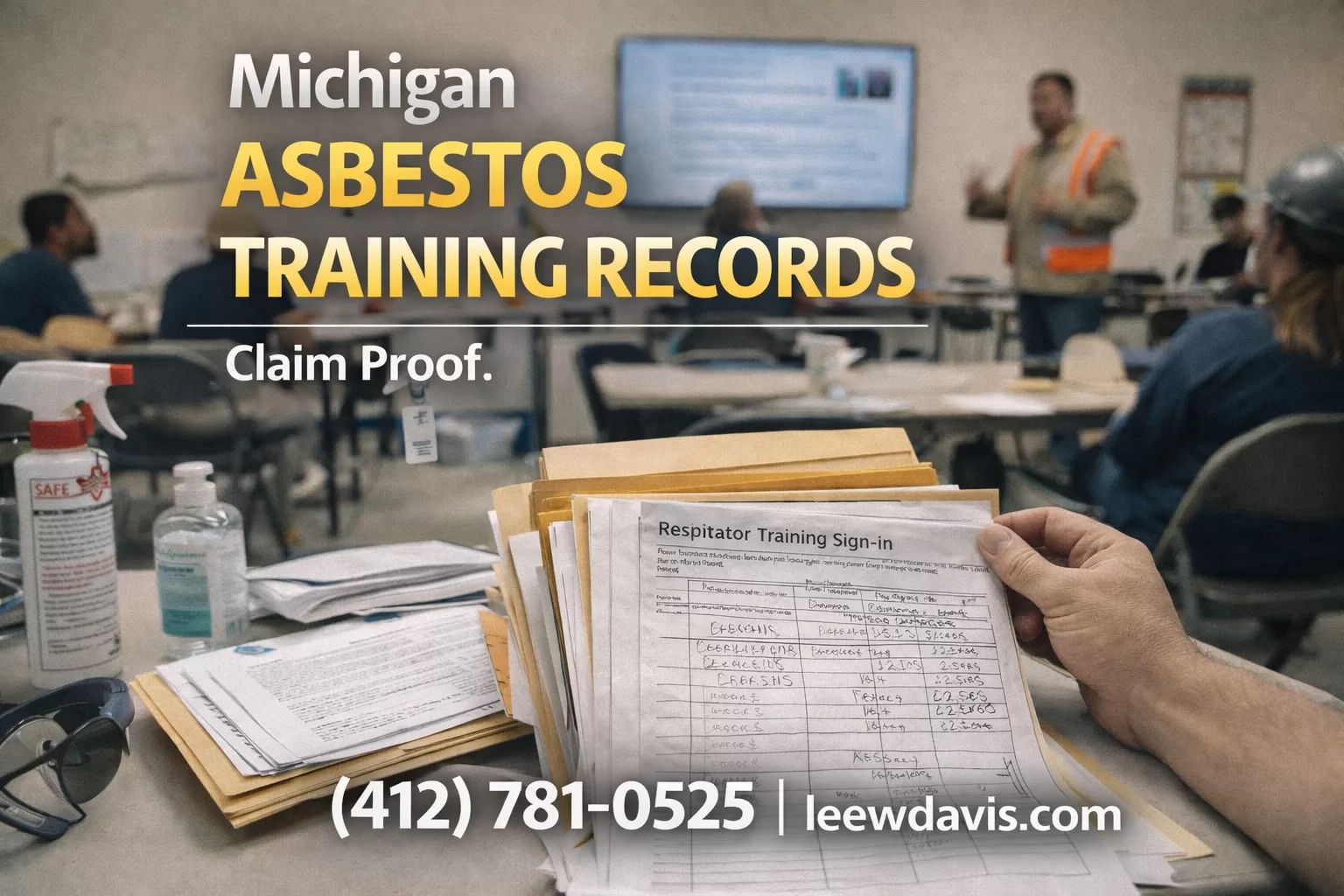
If you’re building a Michigan asbestos case, Michigan Asbestos Training Records can be a quiet piece of evidence that helps your work history “snap into place.” People assume the only proof that matters is a brand name on insulation or a box label from decades ago. In real cases, what matters is whether we can show where you worked, what tasks you performed, and what safety hazards were known and addressed at the time.

Training records can do that.

They often identify the employer or contractor, the job classification, the site or project, the dates, and the type of training provided (hazard communication, respiratory protection, asbestos awareness, abatement procedures, or confined-space work where asbestos disturbance was common). That matters because asbestos exposure cases are usually built around repetitive maintenance work—pipe insulation disturbance, gasket and packing changes, boiler work, refractory repair, pump rebuilds, and tear-outs during shutdowns—especially in older facilities across Michigan.

Mesothelioma/Asbestos Legal Help – WV, MI & PA

Speak directly with attorney Lee W. Davis. No call centers. Free, confidential review.

What counts as a “training record” in Michigan?

Depending on the workplace and era, training documentation can include:

  • asbestos awareness or hazard communication sign-in sheets
  • respirator fit test records and medical clearance logs
  • safety meeting minutes referencing insulation, refractory, or demolition work
  • abatement or remediation training certifications
  • union training center course completions
  • contractor safety orientation packets tied to specific jobsites

Even when the training doesn’t say “you were exposed,” it can corroborate the story: you were assigned to industrial work where asbestos was a known hazard, and the employer treated it as a hazard requiring training.

👉 Search Asbestos Job Sites in Michigan

Why these records help your case

Michigan asbestos cases often turn on the same problem: time. The work was years ago. The site may be renamed or sold. Supervisors are gone. Product identification is incomplete.

Read More: Michigan Asbestos exposure records

Training records can help fill the gap by:

  • confirming your presence in an industry/trade where asbestos use was routine
  • confirming dates and employers/contractors when payroll records are missing
  • linking you to projects and sites that also appear in other records (work orders, abatement logs, jobsite blueprints, material lists)
  • showing safety knowledge and warnings that support negligence and duty issues

How to get Michigan asbestos training records

Where we look depends on the trade and the era:

  • employer HR/safety departments (even if the site closed, records may have been retained)
  • union locals and apprenticeship programs (training center archives)
  • third-party safety vendors that ran orientations or fit testing
  • project owners/GCs who required training before site access
  • abatement contractors and consultants tied to plant maintenance or demolition

If you don’t know where to start, start with your trade and your approximate years. The point is to build a record trail.

What to do next

If you have a diagnosis or you’re building a claim and your work history is complicated, don’t wait until records disappear. Getting the paper trail now can make the difference between a claim that crawls and a claim that moves.

Learn More: Michigan Mesothelioma Lawyer

Call (412) 781-0525 or use the contact form below or at leewdavis.com to discuss what records matter most for your Michigan work history and how to obtain them.

Check If Your Family Was Exposed

Get your free guide instantly + a confidential case review.

🔒 100% Confidential. No obligations.


FAQs

What if I never received “asbestos training” specifically?

That’s common. Hazard communication, safety orientation, respirator training, and demolition/maintenance briefings can still help show the type of work and conditions you were placed in.

Do training records prove asbestos exposure by themselves?

Usually they support the timeline and job conditions. They’re strongest when paired with jobsite documentation like work orders, abatement logs, or material lists.

What if the company is out of business?

We often track records through successor entities, archived project files, union training sources, or vendors that handled safety programs.

Mesothelioma/Asbestos Legal Help – WV, MI & PA

Speak directly with attorney Lee W. Davis. No call centers. Free, confidential review.

Michigan Asbestos Union Records

Michigan Asbestos Union Records | Proof for Claims

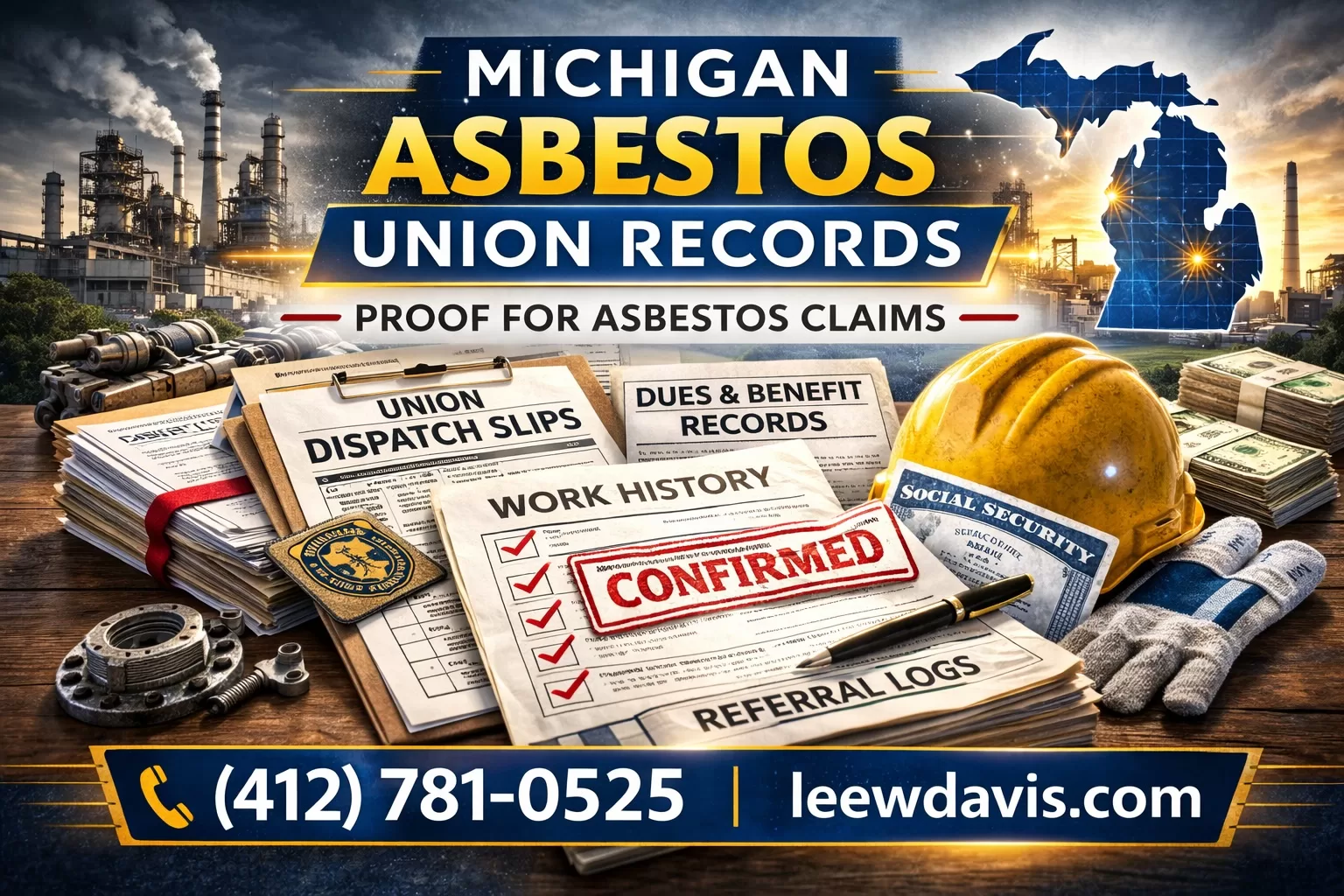
Michigan Asbestos Union Records are one of the most underused ways to prove exposure when a jobsite is old, a contractor is gone, or the product brand is forgotten. If you worked industrial trades in Michigan—pipefitting, insulation, millwright work, electricians, boilermakers, laborers, carpenters, ironworkers—your union paper trail can establish the timeline and locations that make a case real.

Mesothelioma/Asbestos Legal Help – WV, MI & PA

Speak directly with attorney Lee W. Davis. No call centers. Free, confidential review.

People think “proof” means finding a dusty box with a product label from 1975. In practice, the strongest cases often start with work history verification: dispatch slips, referral logs, dues records, benefit contribution histories, and apprenticeship records that show where you were sent, which contractor you worked under, and the periods you were on-site. That’s the backbone that lets you connect the dots to known asbestos-containing work at Michigan plants, foundries, refineries, power generation, and heavy industrial facilities.

What union records can show (and why it matters)

Union records can help establish:

  • Dates of employment and dispatch (critical for statutes and exposure windows)
  • Contractor names you worked for (even when payroll records are missing)
  • Jobsite locations or project identifiers
  • Trade classification (pipefitter vs. laborer vs. insulator—exposure narratives differ)
  • Benefit contribution histories that corroborate work periods
  • Apprenticeship and upgrade records showing progression into higher-exposure tasks

This matters because asbestos cases are won on credible, document-backed work history. Once the work history is anchored, it becomes much easier to identify likely exposure sources: pipe insulation, block insulation, boiler work, refractory repair, gaskets, valve packing, cement, electrical components, and industrial maintenance materials that historically contained asbestos.

👉 Search Michigan asbestos job sites

What to request (practical checklist)

When requesting records, ask for:

  • Dispatch/referral history (dates, contractors, jobsite/project if listed)
  • Membership start/end dates and local/branch information
  • Benefit contribution history (pension/health/welfare)
  • Apprenticeship records and training dates
  • Any available “out-of-work list,” assignment cards, or work log summaries

If the union can’t provide jobsite names, contractor names and date ranges still help you reconstruct the path using other sources (old W-2s, Social Security earnings, coworker statements, job photos, and facility maintenance records).

Learn More: Michigan Asbestos Exposure Records

If you worked non-union

Non-union workers can still build similar proof using Social Security earnings records, payroll stubs, contractor HR files, union benefit participation through a spouse, or project documentation. The strategy is the same: prove where you worked and what the job required.

If you need help building a Michigan asbestos work history file, call (412) 781-0525. The sooner you start collecting records, the easier it is to lock down the details while they’re still available.

Check If Your Family Was Exposed

Get your free guide instantly + a confidential case review.

🔒 100% Confidential. No obligations.


FAQs

1) What if my union says records are too old?

Older records may be archived or held by a benefit fund administrator. Ask where legacy dispatch/benefit records were transferred.

2) Do union records show the exact asbestos product?

Usually no, and that’s okay. They prove jobsite + dates + trade work. That foundation supports the exposure narrative.

3) What if I worked for multiple contractors?

That’s common. Dispatch histories and contribution records help map your timeline across contractors and sites.

Learn More: Michigan Medical Proof

Mesothelioma/Asbestos Legal Help – WV, MI & PA

Speak directly with attorney Lee W. Davis. No call centers. Free, confidential review.

Michigan Asbestos Bankruptcy Claims Guide

Michigan Asbestos Bankruptcy Claims guide: how trust claims work, what proof matters, and how payouts are calculated. Call (412) 781-0525.

If you’re researching Michigan Asbestos Bankruptcy Claims, you’re usually trying to answer one question: who actually pays when the asbestos company is gone? For many Michigan workers, part of the recovery comes through bankruptcy trusts created after manufacturers reorganized. Those claims are separate from (and sometimes in addition to) lawsuits against solvent defendants.

Mesothelioma/Asbestos Legal Help – WV, MI & PA

Speak directly with attorney Lee W. Davis. No call centers. Free, confidential review.

A trust claim is not “easy money,” and it’s not a one-size-fits-all form. The value of a claim depends on how well the exposure is documented and how the diagnosis is supported. The most common reason claims stall is missing proof—especially when the work happened decades ago across multiple sites.

What makes a Michigan bankruptcy trust claim move

Trusts generally look for two categories of proof:

1) Medical proof

You typically need diagnosis support and records showing the disease and the timing. Different trusts can have different medical criteria and documentation expectations.

Read More: Michigan Mesothelioma Lawyer

2) Exposure proof tied to a specific product/company

This is where Michigan cases can succeed or fail. It’s not enough to say “I worked around asbestos.” The claim has to connect your work history to the bankrupt company’s asbestos-containing product. This is often through jobsite history, trade duties, coworker information, invoices/material records, or other documentation.

Why Michigan work histories can be trust-friendly

Michigan has long industrial corridors—auto plants, foundries, chemical facilities, utilities, schools, hospitals, and large commercial builds—where insulation, gaskets, packing, refractory, and industrial components were widely used. In many claims, the strongest leverage isn’t a perfect memory of brand names. It’s a consistent work history that matches the industrial reality of the site and the trade.

Timing matters more than people realize

There are two “timing” issues that come up constantly:

  • Preserving the right to pursue all available paths (trust claims and lawsuits where appropriate)
  • Avoiding delay once records and medical support are in hand

When a case is prepared correctly at the front end, it tends to move faster and with less back-and-forth.

👉 Search Asbestos Job Sites in Michigan

The bottom line

Michigan asbestos cases are won with structure: a clean medical story, a clean work history, and exposure proof that can be mapped to responsible companies—even when those companies reorganized years ago.

If you or a family member is dealing with an asbestos disease diagnosis and you want to understand whether Michigan Asbestos Bankruptcy Claims are part of your recovery options, call (412) 781-0525.

Check If Your Family Was Exposed

Get your free guide instantly + a confidential case review.

🔒 100% Confidential. No obligations.

Michigan Asbestos Exposure Map Guide

Michigan Asbestos Exposure Map Guide

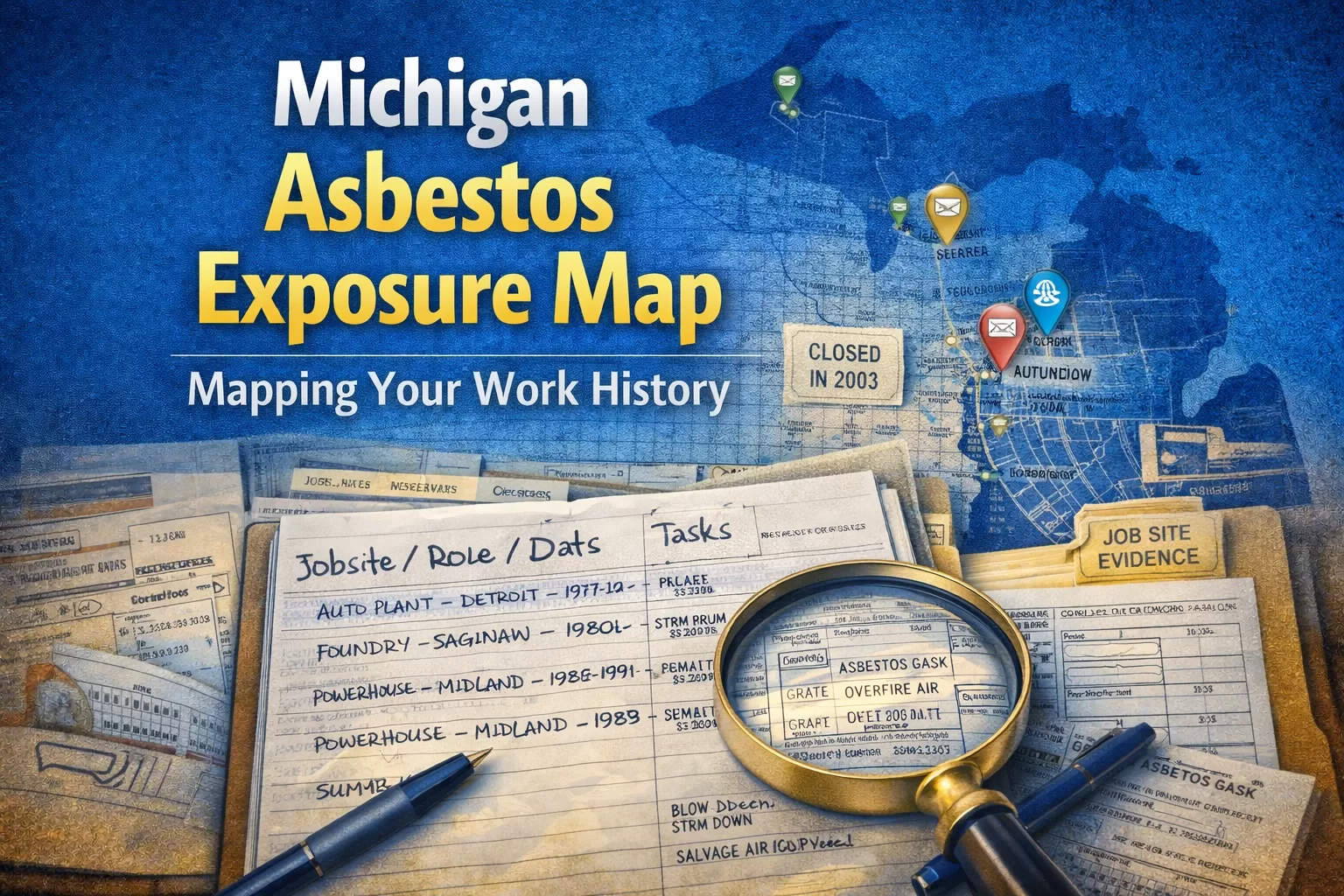
If you’re building a Michigan asbestos claim, one of the fastest ways to turn “I worked there” into real proof is to create a Michigan Asbestos Exposure Map—a simple, written map of your job sites, time periods, and work tasks that points directly to the records that matter.

Mesothelioma/Asbestos Legal Help – WV, MI & PA

Speak directly with attorney Lee W. Davis. No call centers. Free, confidential review.

Most people think an asbestos case starts with remembering a brand name. In real life, many strong cases begin with something more reliable: where you worked, when you were there, and what you did. Once those three pieces are organized, the supporting documents are easier to locate—union dispatch logs, contractor rosters, shutdown schedules, maintenance files, vendor lists, purchase orders, equipment manuals, and jobsite drawings.

What a Michigan Asbestos Exposure Map is

A Michigan Asbestos Exposure Map is not a literal Google map. It’s a structured list that links:

  • Facility name + city (plant, foundry, refinery, power station, mill, school, shipyard, hospital, etc.)
  • Date range (years and approximate months if possible)
  • Your role/trade (pipefitter, electrician, millwright, mechanic, insulator, laborer, maintenance, contractor)
  • Task-based exposure (tear-outs, rebuilds, gasket changes, packing removal, boiler work, refractory repair, valve/pump work, insulation disturbance, demolition, retrofit work)

This “map” becomes the backbone of your proof.

Why the map matters in Michigan claims

Michigan cases often come down to credibility and documentation. A strong exposure map helps you:

  1. Avoid gaps that let defendants claim your exposure is “speculative.”
  2. Tie your work to specific equipment and systems (steam lines, boilers, turbines, pumps, compressors, heat exchangers).
  3. Identify the right records custodians—the contractor, the facility owner, the maintenance department, or the supplier.
  4. Focus the investigation so you’re not chasing everything at once.

How to build your exposure map in 30 minutes

Start with a simple table or bullet list:

Jobsite / City – Years – Trade – Tasks – Any remembered details

Examples of “details” that help later:

  • Unit names (Boiler 3, Turbine Hall, Pipe Rack, Powerhouse)
  • Department names (Maintenance, Utilities, Mill Services)
  • Contractor names (who you worked for)
  • Outage seasons (spring/fall shutdowns)
  • Equipment identifiers (pump model, valve type, compressor line)

You don’t need perfection. You need structure.

👉 Search Asbestos Job Sites in Michigan

What records your map helps uncover

Once your map is drafted, it points to the most useful evidence sources, including:

  • Union dispatch records / work history reports
  • Contractor payroll rosters and job assignments
  • Shutdown schedules / outage planning documents
  • Maintenance logs / job tickets
  • Equipment manuals and parts lists
  • Supplier and vendor records (who supplied insulation, gaskets, packing, refractory, cement)
  • Blueprints and P&IDs that show where asbestos-containing components were used

The goal is simple: convert “I was there” into “here’s the paper trail that proves what I worked around.”

Talk to a lawyer who builds cases from records

If you worked at Michigan industrial facilities and you’re trying to document asbestos exposure, I can help you organize the map and identify what records to pursue next.

Call (412) 781-0525 or visit leewdavis.com to discuss your work history and options.

Check If Your Family Was Exposed

Get your free guide instantly + a confidential case review.

🔒 100% Confidential. No obligations.


FAQs

What if I can’t remember product names?

That’s common. Your work sites, dates, and tasks often lead to better proof than brand memories.

Do I need every job I ever worked?

No. Start with your highest-exposure sites (maintenance, outages, tear-outs, boiler/steam systems, heavy equipment).

Can an exposure map help even if the plant is closed?

Yes. Records can still exist with successor companies, contractors, unions, archives, prior litigation, or public sources.

Is this the same as a “jobsite list” page?

No. A jobsite list is general. Your exposure map is personal—your timeline, your tasks, your proof trail.

Mesothelioma/Asbestos Legal Help – WV, MI & PA

Speak directly with attorney Lee W. Davis. No call centers. Free, confidential review.

Michigan Asbestos Supplier Records

Michigan Asbestos Supplier Records

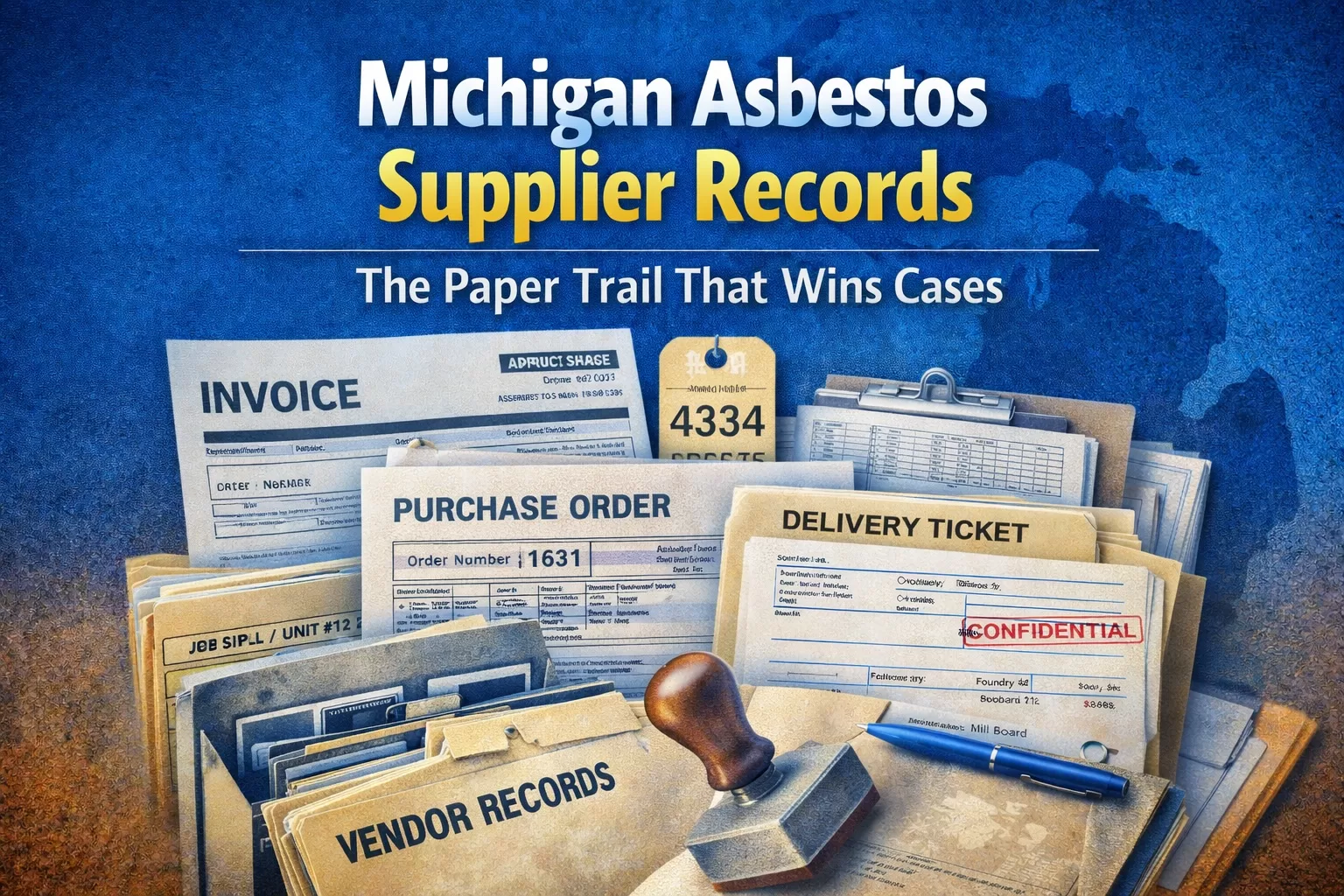
If you’re building a Michigan asbestos case, Michigan Asbestos Supplier Records can be the missing link between “I worked there” and proof that asbestos-containing materials were actually ordered, delivered, and used on your job. When a plant is gone, a contractor is dissolved, or coworkers can’t remember brand names from decades ago, supplier paperwork often survives—and it speaks with dates, quantities, job numbers, and delivery locations.

Mesothelioma/Asbestos Legal Help – WV, MI & PA

Speak directly with attorney Lee W. Davis. No call centers. Free, confidential review.

What supplier records usually show (and why it matters)

Supplier files can confirm which asbestos products were provided, when, and to whom. That matters because defendants love to argue: “No product identification, no case.” A good supplier trail helps you answer the questions that decide liability:

  • Invoices (dates, quantities, product descriptions, pricing)
  • Purchase orders (who ordered it, job number, department or maintenance unit)
  • Delivery tickets / bills of lading (where it went, receiving signature, dock/location)
  • Vendor account statements (pattern of recurring orders over time)
  • Credit memos / returns (proof of ongoing supply and job activity)
  • Catalog codes / SKU descriptions (often identify insulation, cement, packing, gaskets)

Even if an invoice doesn’t say “asbestos” in plain English, product descriptors, part numbers, and legacy catalog codes can still pin down what the material was—especially for older insulation, refractory products, packing, gasket sheet, and high-heat cements.

The Michigan worksites where supplier records are most valuable

Supplier records are especially strong evidence for Michigan industrial settings where maintenance and shutdown work was continuous:

  • Auto plants and stamping operations
  • Foundries and machine shops
  • Powerhouses and utility operations
  • Chemical facilities and refineries
  • Steel-related facilities and heavy manufacturing
  • Large institutional boiler rooms (universities, hospitals, municipal buildings)

These are the places where gasket work, valve work, pipe insulation disturbance, refractory tear-outs, boiler maintenance, and equipment rebuilds created repeated exposure—often over years.

👉 Search Asbestos Job Sites in Michigan

Who to request records from (practical targets)

People think “the employer” is the only source. In real cases, the supplier ecosystem is broader:

  1. Supply houses and industrial distributors (local branches matter)
  2. Union contractors and mechanical contractors who bought materials for jobs
  3. OEM equipment vendors who supplied “kits” (packing, gaskets, insulation components)
  4. Third-party maintenance companies (shutdown/turnaround contractors)
  5. Purchasing departments or accounts payable archives (when they exist)

If you already know one vendor name—an industrial supply store, a local distributor, a refractory supplier—that’s often enough to start building the paper trail.

What to ask for (request language that works)

When you request supplier records, vague requests get vague results. A tight request is better:

  • Vendor account records under the facility name and common variants
  • Invoices, purchase orders, delivery tickets, and statements for a defined time range
  • Any job-number references, maintenance department references, or contractor billing references
  • Product codes, SKU descriptions, catalog entries, and historical product sheets (if retained)

If the supplier says “we don’t have it,” sometimes the parent company, a successor entity, or a records vendor does. It’s also common for suppliers to keep financial statements longer than the underlying documents—those can still identify account numbers, branch locations, and purchase patterns.

How supplier records fit into exposure proof

Supplier records rarely stand alone. They work best when tied to:

  • Your work history and job duties
  • Facility shutdown periods and maintenance cycles
  • Coworker testimony (“we used that gasket sheet / insulation cement”)
  • Facility drawings, equipment lists, or maintenance logs
  • Medical records confirming asbestos-related disease

In other words: supplier records help you move from possibility to probability—and that’s where claims get real leverage.

Read More: Michigan Mesothelioma Lawyer

If you’re missing the “brand name,” don’t stall

It’s normal for people to remember the work but not the label. Many strong cases are built from records that nobody knew existed until the right request was made. Michigan asbestos claims are often won on documentation and persistence—especially where jobsite conditions are older and the corporate story has changed hands.

If you want help identifying the best supplier targets for your Michigan work history, we can map the likely vendors and records sources based on your jobsite, trade, and years of work.

Talk directly with attorney Lee W. Davis about a Michigan asbestos claim. Call (412) 781-0525 or use the contact below or at leewdavis.com.

Check If Your Family Was Exposed

Get your free guide instantly + a confidential case review.

🔒 100% Confidential. No obligations.


FAQs (add to the bottom)

What are Michigan Asbestos Supplier Records?

They’re vendor documents—like invoices, purchase orders, and delivery tickets—that show asbestos-containing materials were ordered and delivered to a Michigan jobsite or contractor.

What if the invoice doesn’t say “asbestos”?

Many older records use product codes, legacy names, or generic descriptions. Part numbers, catalog codes, and product families can still identify asbestos materials.

How far back do suppliers keep these records?

It varies. Some keep detailed invoices for limited periods, but account statements, ledgers, tax archives, or records held by successors may go back much farther.

Mesothelioma/Asbestos Legal Help – WV, MI & PA

Speak directly with attorney Lee W. Davis. No call centers. Free, confidential review.