PA Asbestos Pension Records

PA Asbestos Pension Records

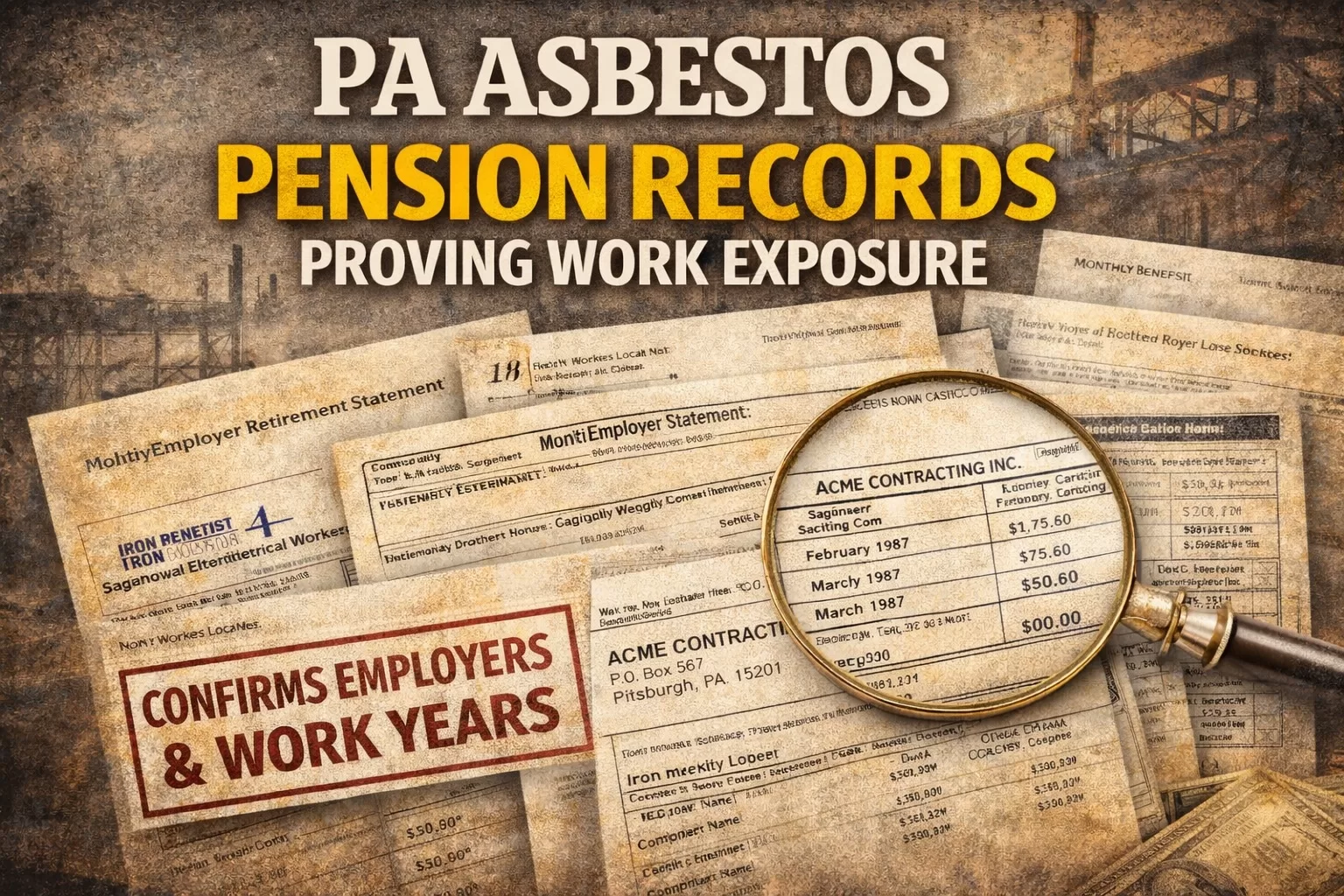
PA Asbestos Pension Records can be the cleanest “proof document” you’ll ever find in an asbestos case—especially when the company is gone, the payroll department is gone, and the jobsite is now a parking lot. Pension files don’t argue. They show who paid into the plan, when they paid, and often what classification you worked under. In Pennsylvania asbestos claims, that’s the difference between “I remember” and “here’s the record.”

If you worked in mills, power plants, refineries, shipyards, rail, commercial construction, or industrial maintenance, there’s a good chance a pension plan has better records than your former employer ever did.

For broader guidance on Pennsylvania asbestos investigations, visit Pennsylvania asbestos lawyer support here:

/pennsylvania-asbestos-lawyer/


Why pension records matter in Pennsylvania asbestos cases

Pension records matter because they can establish three things that drive an asbestos claim:

  • Employment confirmation: the employer name(s) tied to you
  • Work dates: start/stop periods, contribution months/years
  • Trade/classification: in many plans, your category or bargaining unit

That combination supports your exposure story without relying on memory alone. When trusts, defendants, or insurers challenge where you worked and when, pension contributions can pin it down.


What counts as “pension records”?

“Pension records” can mean more than a single annual statement. Useful records may include:

  • Benefit statements (annual or periodic)
  • Plan participation letters (eligibility and vesting info)
  • Employer contribution histories (who paid in and when)
  • Service credit summaries (credited quarters/years)
  • Classification or unit codes (trade/category identifiers)
  • Multi-employer plan entries (common in unionized trades)

Even a basic benefit statement can be enough to confirm work history when other evidence is missing.


Multi-employer plans and union pension files

A lot of Pennsylvania industrial work ran through multi-employer pension arrangements—where contributions followed the worker across employers. That structure can be valuable in asbestos claims because it can show:

  • Multiple employers you worked for over time
  • Continuous industry service even when companies dissolved
  • Work periods that line up with known asbestos-heavy eras

That’s particularly useful when someone worked in maintenance, shutdowns/turnarounds, or traveled between facilities and contractors.


How pension records fit into a proof package

Pension records are not the whole case, but they’re a powerful “spine” for your proof. They work best alongside:

Pension proof helps establish the “where and when.” Other documents and testimony establish the “what you were around.”

Common problems and how pension records solve them

1) The employer is out of business

Pension contributions can still show the employer name and dates—even if the company no longer exists.

2) The work was decades ago

Older work history is exactly where pension documentation can outperform memory.

3) The worker changed contractors frequently

Multi-employer contributions can show continuity and confirm the list of employers.

4) You don’t remember the exact dates

Pension credit summaries often narrow the timeframe to months or quarters.

What if you don’t have the records?

If you don’t have your pension paperwork, you can still request it. Many people can obtain records from:
• The pension plan administrator or benefits office
• A union benefits office (if union-related)
• A retirement plan servicing company (depending on the plan)

If you’re not sure where to start, that’s normal—most people aren’t. The point is: these records exist more often than people think, and they can be obtained.

FAQs

What pension records help prove asbestos exposure in Pennsylvania?

The most useful are benefit statements, employer contribution histories, and service credit summaries because they confirm employer names and work periods that support your exposure history.

Can multi-employer pension files show job history and dates?

Yes. Multi-employer plans commonly track contributions by employer and time period, which can establish a timeline even when individual employers can’t be located.

What if the pension fund says they have no records?

Sometimes records are under a different name, a successor plan, or a third-party administrator. A targeted request—using the correct identifying information—often finds what a generic inquiry misses.

Call Lee Now

If your case depends on proving where you worked and when, PA Asbestos Pension Records are often one of the strongest documents you can put in the file.

This is the kind of evidence I’ve focused on for decades—starting in 1988 as a paralegal building work histories and product identification proof, through the Saginaw foundry cases, and into the Pennsylvania cases I handle today. Real asbestos cases are won with credible records, not vague stories.

If you want help identifying the right pension source and building a serious proof package for a Pennsylvania claim, call (412) 781-0525 or contact me through leewdavis.com.

Check If Your Family Was Exposed

Get your free guide instantly + a confidential case review.

🔒 100% Confidential. No obligations.
PA Asbestos W2 Records

PA Asbestos W2 Records

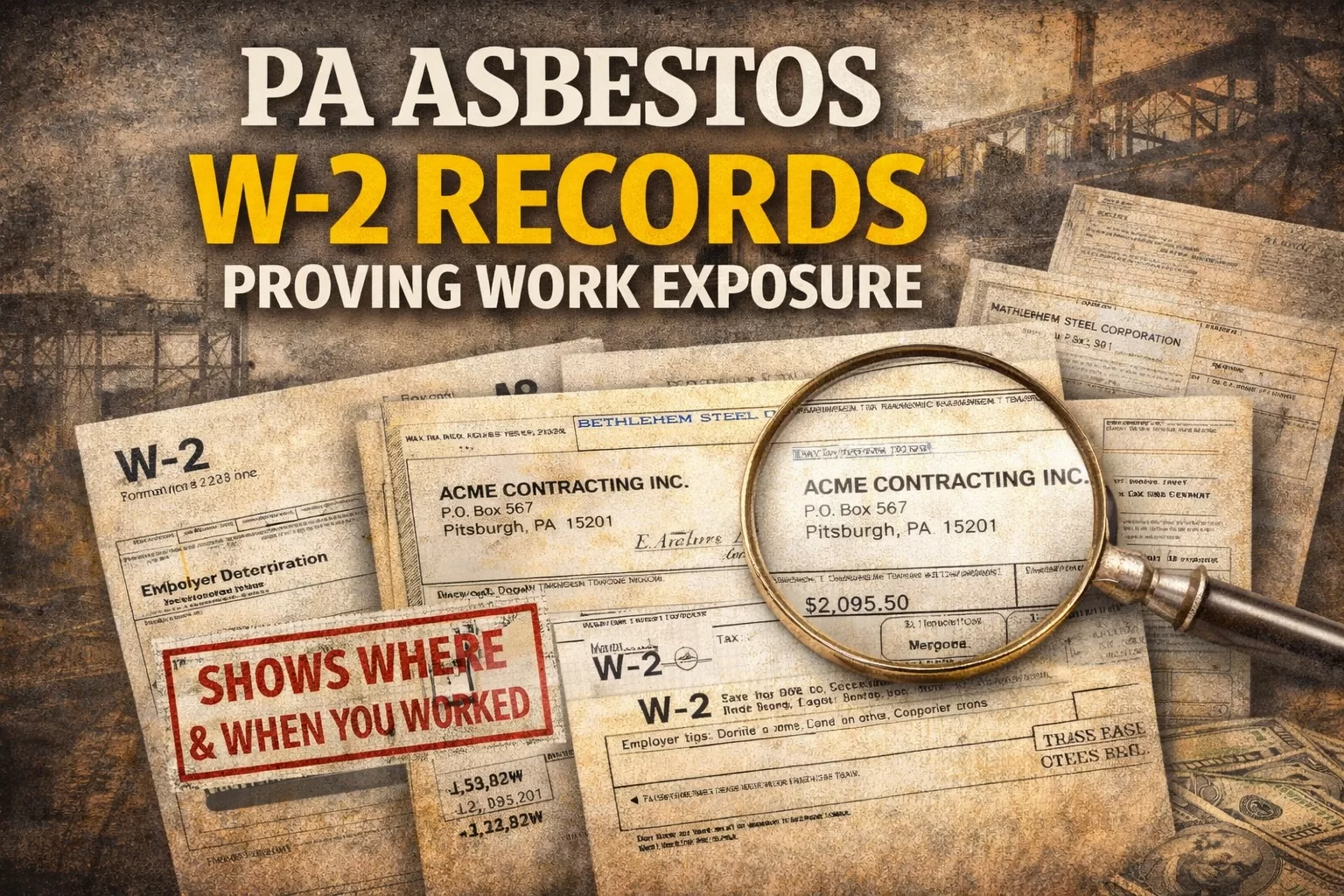
PA Asbestos W2 Records are some of the cleanest “paper proof” you can use to show who employed you and when—especially when a company is gone, a jobsite changed names, or the only proof left is your memory. In asbestos cases, dates and employer identity matter because they anchor everything else: the jobsite, the trade, the products used, and the time window that matches disease latency.

Read about: Pittsburgh Asbestos Lawyer

Mesothelioma/Asbestos Legal Help – WV, MI & PA

Speak directly with attorney Lee W. Davis. No call centers. Free, confidential review.

What W-2 records prove (and why it matters)

A W-2 typically confirms:

  • Employer name and address (often the exact legal entity you need)
  • Tax year (your timeline without argument)
  • Wages reported (a reliable marker that you were truly on the payroll)

That matters because asbestos cases are won and lost on credible exposure history. If you can’t show where you worked during the years asbestos products were being installed, removed, or disturbed, defendants and trusts will exploit the gap.

The practical problem: people don’t have old W-2s

Most clients don’t keep W-2s from 20–40 years ago. That’s normal. The goal is not perfection—it’s building a document trail that confirms your employment history clearly enough to support product identification and causation.

Where to get W-2 and wage proof when you don’t have it

Here are the fastest sources I use in real cases:

1) IRS “Wage & Income Transcript” (high value)

The IRS can provide transcripts that reflect W-2 information reported to them. It’s often the best substitute when the paper W-2 is long gone.

2) Social Security Earnings Record (supports the years)

SSA records are excellent for confirming years and total earnings, and they help when employer names changed. (It’s not always as specific as a W-2 transcript, but it strengthens the foundation.)

3) Old tax returns or a prior tax preparer

Many preparers keep copies longer than you’d think—especially if the file was digitized later.

4) Union benefit records / pension plan administrators

If your work ran through a hall, the benefit side often preserved employer contributions that track your work history.

5) Payroll processors / successor companies

Sometimes the employer is “gone,” but payroll records were handled by a third party or a successor entity that still has archives.


How W-2 proof gets used in a Pennsylvania asbestos claim

W-2 proof does one job extremely well: it locks in the employment frame so the rest of the exposure case can be built without guessing.

Once the employer-years are confirmed, we use that to:

  • Match you to specific plants, departments, and crafts
  • Identify likely asbestos-containing products used during those years
  • Confirm co-worker witness windows (who worked with you when it matters)
  • Support filings with trusts and/or against solvent defendants with consistent, defensible work history

If a defense lawyer wants to argue “he wasn’t even there,” W-2 proof is how you end that argument.

Read about Pennsylvania Asbestos Product Identification


FAQs

Do I need the original W-2 forms?

No. Transcripts and wage records that reliably confirm employer and year can do the job, especially when paired with other work history proof.

What if the company name on my W-2 isn’t the name everyone used at the plant?

That’s common. Many facilities operated under trade names while payroll ran through a parent or affiliate. The W-2 name often helps us trace the correct entity.

What if I was a contractor and worked for multiple employers?

That’s exactly where W-2 proof helps. It breaks your work into real, dated segments so we can pinpoint which employers match which jobsites and tasks.

Will W-2 proof help if I’m filing a trust claim?

Yes. Many trusts demand a credible work history package. Wage records reduce “deficiency” issues and delays.


Call to talk through your records

Product identification and work-history proof has been my lane since 1988, when I started building exposure evidence as a paralegal—through the Saginaw foundry casework and then years of West Virginia mesothelioma and lung cancer cases, working directly with clients to develop credible, legitimate exposure proof that holds up under scrutiny.

Read about Pennsylvania Asbestos Exposure Timeline

If you’re sitting on partial records—or none at all—I’ll tell you what matters, what doesn’t, and what we can still prove.

Call (412) 781-0525 or reach me through leewdavis.com for a confidential case review.

Check If Your Family Was Exposed

Get your free guide instantly + a confidential case review.

🔒 100% Confidential. No obligations.
PA Asbestos Social Security Records

PA Asbestos Social Security Records

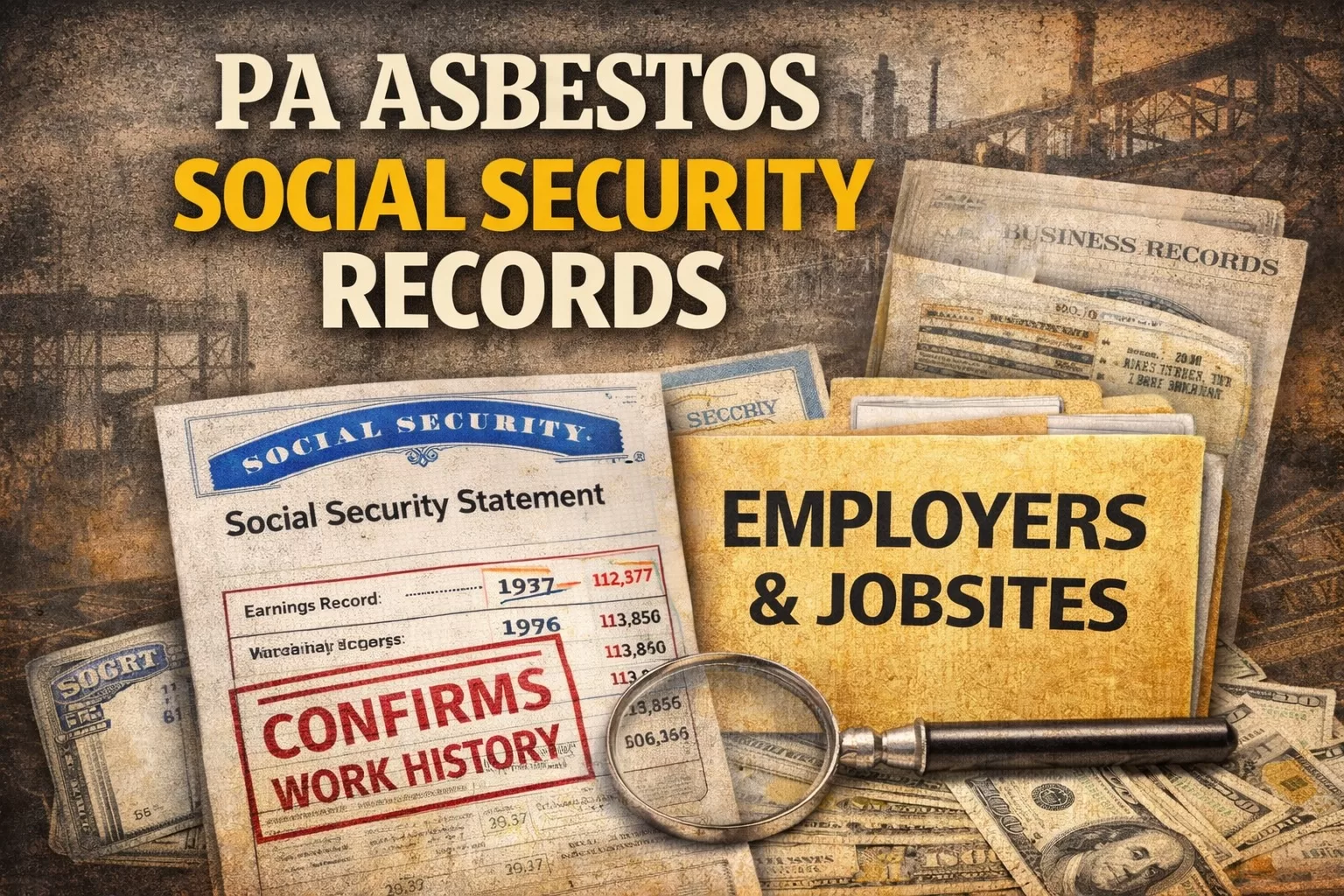
If you’re building an asbestos claim in Pennsylvania, PA Asbestos Social Security records can quietly do a lot of heavy lifting. When an employer is gone, payroll records are missing, or the jobsite is “too old” for anyone to conveniently verify, Social Security earnings history can still show where you worked, when you worked, and who paid you. That’s often enough to stabilize the foundation of a case and move the proof forward.

Mesothelioma/Asbestos Legal Help – WV, MI & PA

Speak directly with attorney Lee W. Davis. No call centers. Free, confidential review.

I use Social Security documentation the same way I’ve used work records since I started doing this in 1988: not as “extra paper,” but as credible, independent confirmation that backs up a work history and makes an exposure story harder to attack.

Read More: Pennsylvania Asbestos Work History


What PA Asbestos Social Security records actually show

Social Security records typically confirm:

  • Employer names tied to your earnings
  • Years and quarters worked
  • Wage totals reported for each year
  • Sometimes employer addresses or identifying details (varies)

That matters because asbestos cases are built on work history + product exposure + medical proof. Social Security records help lock in the first part—work history—when memories fade and companies vanish.

Read More: Pennsylvania Asbestos Exposure Timeline


When Social Security records help the most

You should seriously consider requesting these records if:

  • You worked decades ago and don’t have pay stubs or W-2s
  • The company changed names, merged, shut down, or “doesn’t exist”
  • You were a union tradesman with many short-term job assignments
  • You did maintenance, shutdown, or turnaround work across multiple sites
  • You’re helping a family member reconstruct a deceased worker’s history

In other words: if the defense will argue “we don’t even know where he worked,” Social Security records are one of the cleanest ways to answer that.


What to request from Social Security

For asbestos claims, you’re generally looking for an earnings history that identifies employers over time. There are different request paths depending on whether the worker is living or deceased and who is requesting (the worker, spouse, estate representative, etc.).

Practical tip: Social Security documents won’t usually identify “the jobsite,” but they can identify the employer or contractor, which lets you reconstruct jobsites through:

  • union records
  • personnel files
  • jobsite rosters
  • coworker statements
  • deposition testimony
  • product identification built from the employer’s typical materials and trades

This is how you convert a paper record into something usable in a real claim.

Read about Pennsylvania Asbestos Product Identification


Common issues you need to watch for

Social Security records are valuable, but they aren’t perfect:

  • Union halls may show up differently than the contractors
  • Some workers have entries that are abbreviated, confusing, or outdated
  • Certain jobs may be missing if pay wasn’t properly reported
  • Records don’t explain what you did (insulator vs. pipefitter vs. mechanic)

That’s normal. The point is not to treat these records as the entire case. The point is to use them to anchor the timeline and employers so the rest of the proof has something solid to attach to.


How these records fit into a Pennsylvania asbestos claim

In a Pennsylvania asbestos case, once you can reliably show employer/timeframe, you can usually move faster on:

  • identifying likely asbestos-containing products used by that employer
  • matching trades to typical exposure sources (insulation, gaskets, refractory, cement, packing, valves, boilers)
  • narrowing which defendants belong in the case
  • building a work narrative that makes sense to a jury and survives motions

That’s the difference between an “old story someone remembers” and a claim supported by documentation.


Get the work history right before you chase the rest

PA Asbestos Social Security records can confirm your work history even when companies are gone and paperwork is missing. That’s exactly the kind of proof-building I’ve done since I started this work in 1988—through major industrial case inventories and into Pennsylvania asbestos and lung cancer cases where the real issue is always the same: credible exposure evidence.

Read About Pennsylvania Asbestos Trust Claims Help

If you want help identifying what records to request and how to use them to support a legitimate asbestos claim, call (412) 781-0525 or contact me through leewdavis.com for a free case review.

Check If Your Family Was Exposed

Get your free guide instantly + a confidential case review.

🔒 100% Confidential. No obligations.
Pennsylvania Asbestos Trust Claims Help

Pennsylvania Asbestos Trust Claims Help

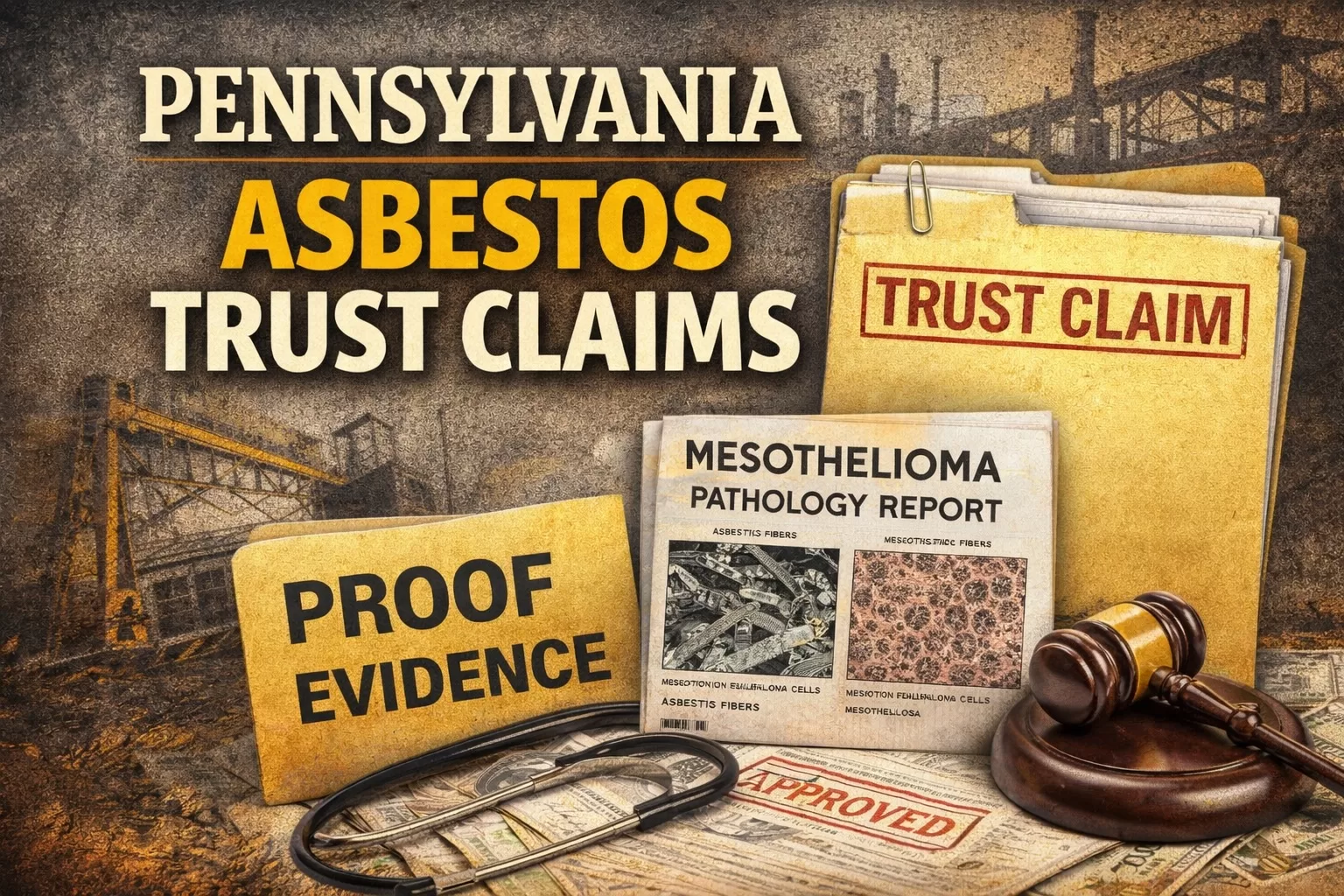
Pennsylvania Asbestos Trust Claims exist because many asbestos manufacturers went bankrupt—after decades of selling insulation, gaskets, refractory, cement, and industrial products that exposed workers and families across the Commonwealth. If you’ve been diagnosed with mesothelioma, lung cancer, asbestosis, or another asbestos-related disease, a trust claim may be one of the fastest paths to compensation—but only if the case is built correctly and the evidence is presented in the right form.

This is where most people (and too many lawyers) lose time: they treat trust claims like a simple form. They aren’t. A trust claim is an evidence-driven case file. The trust will pay when you prove exposure to its products (or approved jobsite pathways), prove the medical criteria, and present a work history that fits the trust’s rules.

Mesothelioma/Asbestos Legal Help – WV, MI & PA

Speak directly with attorney Lee W. Davis. No call centers. Free, confidential review.

If you need broader Pennsylvania guidance on investigations and deadlines, start here: Pennsylvania asbestos lawyer (Pittsburgh-based case review).


What counts as a “trust claim” in Pennsylvania?

An asbestos bankruptcy trust is a compensation program created in bankruptcy court to pay present and future victims. Each trust has its own Trust Distribution Procedures (TDPs) and its own proof requirements, including:

  • Qualifying medical diagnoses (often with specific pathology and imaging support)
  • Exposure evidence showing you were around the company’s asbestos-containing product or an approved jobsite/occupation pathway
  • Timeframes and work history details that match the trust’s criteria
  • Claim forms completed consistently (dates, sites, job titles, and products must line up)

Some trusts are efficient and predictable. Others are slow, inconsistent, or overly technical. Either way, your claim file has to be strong enough that it survives scrutiny without becoming a “delay target.”


Who is eligible for Pennsylvania Asbestos Trust Claims?

Most qualifying claimants fall into one of these categories:

  • Industrial and trade workers exposed on jobsites (steel mills, power plants, chemical plants, refineries, foundries, construction sites)
  • Skilled trades who handled or worked near asbestos-containing equipment (pipefitters, insulators, electricians, millwrights, boilermakers, mechanics, crane operators, maintenance workers)
  • Family members with secondary exposure (typically from contaminated work clothes)
  • Estates / families bringing wrongful death claims when the victim has passed

The key is not just “you worked somewhere.” The question is: can we prove exposure to a specific trust’s product or approved exposure pathway in a way that the trust will accept?


What proof actually matters to a trust

Trusts aren’t moved by a “story.” They pay on documentation. The strongest claim files usually include:

1) Work and jobsite proof

  • Social Security earnings records
  • Employer HR records, job classifications, union records
  • Personnel files, job badges, plant access records
  • Deposition transcripts from prior cases (where available)
  • Co-worker statements that are specific and credible

2) Product identification

Trust claims often rise or fall on this point. “Asbestos was everywhere” doesn’t get paid. A trust wants a link between the worker and a product line it funded.

That’s why product ID is its own discipline: the product names, the tasks, the locations, the time period, and the trade all have to match. If you need the Pennsylvania version of that approach, use this:

Read More: https://leewdavis.com/pennsylvania-asbestos-product-identification/

3) Medical proof

Depending on diagnosis type, trusts commonly require:

  • Pathology report / diagnostic confirmation
  • Imaging support (CT scans, radiology narratives)
  • Physician statements or B-reader support in some categories
  • Clear causation linkage to asbestos disease criteria

You don’t need a “perfect” file. But you do need a coherent, consistent, supported file. If the documents contradict each other, trusts delay—sometimes for months.


Why trust claims get delayed or underpaid

In practice, most problems come from a small number of avoidable issues:

  • Jobsite history that’s too vague (“multiple plants,” no dates, no trade detail)
  • Product identification that’s generic or inconsistent with the job role
  • Medical documentation that doesn’t clearly match the trust’s disease level
  • Claim form errors (wrong dates, mismatched work history, missing exposure detail)
  • Not using the best exposure route available (product ID vs. approved site list vs. occupation pathway)

Trusts are not courts. There’s no judge supervising day-to-day fairness. Your leverage is the strength of the record you submit.


Mesothelioma/Asbestos Legal Help – WV, MI & PA

Speak directly with attorney Lee W. Davis. No call centers. Free, confidential review.


How Pennsylvania jobsite lists fit into trust claims

For Pennsylvania claimants, jobsite documentation can do real work—especially when a plant or site has a long history of known asbestos products and contractors rotating through.

If your exposure involved industrial facilities or major employers, cross-check here:

Read More: https://leewdavis.com/asbestos-job-sites-in-pennsylvania/

Even when a trust doesn’t accept “jobsite only” proof, jobsite evidence often strengthens the credibility of product ID and co-worker proof.


What “claims help” looks like in the real world

When you hire me for trust claims, the goal is simple: build a claim file that pays—and do it in a way that is credible, consistent, and defensible.

That typically means:

  • Reconstructing a clean employment timeline
  • Identifying likely asbestos product categories by trade and site
  • Pinning down product names and manufacturers with proof
  • Collecting and organizing medical documentation in the format trusts accept
  • Submitting claims in a sequence that avoids contradictions across trusts
  • Protecting the case for any related lawsuit where appropriate

FAQs

Do I need a lawsuit to file a trust claim?

No. Many people file trust claims without filing a lawsuit. Whether you should do one, the other, or both depends on the exposure evidence and the defendants.

How long do Pennsylvania asbestos trust claims take?

It varies widely by trust and by how complete the file is. A strong submission can move quickly; a weak file can sit in “deficiency” status for months.

Can my family file if my loved one passed away?

Yes. Estates and families can pursue trust compensation in many situations. If the diagnosis and exposure evidence are solid, wrongful death trust claims are often viable.

Call Lee Directly

If you’re looking for Pennsylvania Asbestos Trust Claims help, don’t waste months submitting a weak file that gets “deficiency” letters and delays. I’ve been doing exposure proof and product identification work since I started as a paralegal in 1988, carried that discipline through major industrial case inventories, and I still build these cases the same way today: credible work history, credible product ID, credible medical proof—organized to get paid.

Start here: Pennsylvania asbestos trust claims — free case review.

Call (412) 781-0525 or use leewdavis.com to reach me.

Check If Your Family Was Exposed

Get your free guide instantly + a confidential case review.

🔒 100% Confidential. No obligations.
Pennsylvania Asbestos Exposure Affidavit

Pennsylvania Asbestos Exposure Affidavit

A Pennsylvania Asbestos Exposure Affidavit is a sworn statement—signed under oath—that lays out the facts of your asbestos exposure in a clear, usable way. It is not “fluff,” and it is not a generic narrative. It is a proof document. When done right, it helps lock down who, what, where, and when—so your claim is supported by evidence that can be verified.

If you are dealing with mesothelioma, asbestos lung cancer, or another asbestos-related diagnosis, you will eventually run into one basic problem: you can’t win a case with a diagnosis alone. You also need credible exposure proof. An affidavit is one of the cleanest ways to organize that proof.

Mesothelioma/Asbestos Legal Help – WV, MI & PA

Speak directly with attorney Lee W. Davis. No call centers. Free, confidential review.

What an exposure affidavit is (and what it isn’t)

An exposure affidavit is:

  • A sworn statement of facts (not opinions)
  • Based on personal knowledge (what you did, saw, handled, breathed, cleaned, repaired)
  • Structured so it can be cross-checked against records and witnesses

An exposure affidavit is not:

  • A “life story”
  • A rant about how companies behaved
  • A list of every job you ever had with no detail
  • A medical report (that’s separate)

Why affidavits matter in Pennsylvania asbestos cases

Pennsylvania asbestos cases rise or fall on product identification and work practice exposure. Courts and defendants look for specifics. The stronger your affidavit, the harder it is for the defense to pretend the exposure is “speculative” or “too vague.”

A good affidavit also helps your lawyer:

  • Identify defendants and product lines faster
  • Target the right jobsite records and union records
  • Locate coworkers who can corroborate details
  • Avoid internal inconsistencies later (when memories fade)


What to include in a Pennsylvania asbestos exposure affidavit

1) Your identifying information

  • Full legal name
  • Date of birth
  • Current address (or county/state)
  • Confirmation you are competent to testify
  • Statement that it is made under oath/penalty of perjury

2) A clean work history (high-level, then detailed)

Start with a list of employers and years. Then add detail only for the jobs that mattered.

For each relevant job:

  • Employer name and location (city/state)
  • Dates (even approximate)
  • Job title and main duties
  • Areas of the plant/site where you worked
  • Names of foremen/supervisors if remembered

Read about: Pennsylvania Asbestos Work History

3) The actual exposure facts

This is the core. For each exposure setting, describe:

  • Tasks: cutting insulation, replacing gaskets, grinding packing, mixing refractory, pulling cable, brake work, boiler work, pipe covering, tearing out old material, etc.
  • Frequency: daily/weekly/seasonal, shutdown work, turnarounds
  • Conditions: enclosed rooms, poor ventilation, visible dust, sweeping, compressed air
  • Proximity: whether you handled it directly or worked next to crews who did
  • Protective equipment: what you had (usually none), what you were told (usually nothing)

4) Product identification (what you actually remember)

Do not guess. But do not be timid either.

Include what you can honestly identify:

  • Brand names (if known)
  • Packaging description (color, labeling, “asbestos” warnings, logos)
  • Where it was stored on site
  • Who supplied it (if known)
  • Who else worked with it

If you don’t know a brand name, describe the category and the task precisely. Many products can be identified later through records, coworker proof, and jobsite evidence—but only if the tasks are described clearly.

5) Coworkers and corroboration

List coworkers who can confirm:

  • You were there
  • The work occurred
  • The dust conditions were real
  • The products or materials used were what you describe

Even partial names matter. “Mike (pipe crew),” “Big John, insulators,” etc.—your lawyer can often track these down with the right starting point.

6) Non-occupational exposure (only if real)

If it applies, keep it factual:

  • Take-home exposure from a household member
  • Home renovation or demolition work
  • Military service exposures

But don’t dilute the affidavit—Pennsylvania cases usually need the occupational story tight and credible.

Read about: Pennsylvania Asbestos Exposure Timeline

Format that works (simple and usable)

A strong affidavit typically uses numbered paragraphs and headings like:

  1. Background
  2. Work History Overview
  3. Employer #1 – Job Duties and Exposure
  4. Employer #2 – Job Duties and Exposure
  5. Specific Products / Materials Recalled
  6. Coworkers / Witnesses
  7. Oath and signature

It should read like proof—because that’s what it is.


Call Lee Directly Now

If you’re looking at a diagnosis and wondering how you’re supposed to prove exposure from 20, 30, or 40 years ago, that’s exactly the work I’ve done my entire career.

I started doing asbestos product identification as a paralegal in 1988, before anyone had databases or neat “jobsite lists.” Later, I worked on the Saginaw foundry cases where exposure proof had to be real, consistent, and defensible. And I’ve continued that same hands-on evidence development through individual West Virginia mesothelioma and lung cancer cases—working directly with clients to build legitimate, credible exposure packages that hold up under scrutiny.

Read about: Pittsburgh Asbestos Lawyer

If you need help building a Pennsylvania asbestos exposure affidavit the right way—focused, accurate, and usable—call me.

Law Offices of Lee W. Davis, Esquire, PLLC

(412) 781-0525 — Free, confidential case review

leewdavis.com

Check If Your Family Was Exposed

Get your free guide instantly + a confidential case review.

🔒 100% Confidential. No obligations.
FAQs

Do I need an affidavit if I already have medical records?

Yes. Medical records prove the diagnosis. The affidavit helps prove the exposure history that caused it.

What if I can’t remember product names?

That’s common. The affidavit can still be strong by focusing on tasks, locations, equipment, and coworkers—then product identification can be built from those anchors.

Can a coworker affidavit help even if I worked there decades ago?

Yes. Consistent coworker proof often strengthens older exposure cases because it confirms the same materials and conditions during the same time period.

Pennsylvania Asbestos Exposure Timeline

Pennsylvania Asbestos Exposure Timeline


Pennsylvania Asbestos Exposure Timeline evidence can make or break an asbestos claim. The timeline shows when you were exposed, where it happened, and how long it took for symptoms and diagnosis to appear—exactly the sequence insurers and defendants argue about. If you’re building a claim for mesothelioma, lung cancer, or another asbestos disease, start by laying out your work history, the products/materials you handled, and the first medical red flags in a clear, dated order.

Mesothelioma/Asbestos Legal Help – WV, MI & PA

Speak directly with attorney Lee W. Davis. No call centers. Free, confidential review.

If you were exposed in Western PA mills, power plants, refineries, shipyards, boiler rooms, schools, or industrial maintenance work, your timeline usually includes long gaps: years where you felt fine, then small symptoms, then a cascade of imaging and pathology. Insurance adjusters and defense lawyers exploit those gaps. The right approach is simple: build a clean, accurate exposure timeline that matches the medicine and matches the work.

What “timeline” means in a real asbestos case

A Pennsylvania asbestos exposure timeline is a dated sequence that answers four questions:

  1. When and where did exposure happen? (jobsite + dates + trade/tasks)
  2. What asbestos-containing products were you around? (product names + materials + insulation/gaskets/refractory, etc.)
  3. When did symptoms and testing begin? (first complaints, first imaging, pulmonary visits)
  4. When did diagnosis occur? (pathology date, staging, and treating facility)

A solid timeline doesn’t require perfection. It requires honesty, internal consistency, and enough detail that a claim can be proven without guesswork.

Why the timeline matters in Pennsylvania

Pennsylvania workers often moved between employers—union halls, contractors, seasonal shutdowns, mill maintenance, power plant outages. That creates “broken” work records and overlapping exposure periods. A well-built timeline:

  • Explains latency (the long delay between exposure and disease) without sounding like a theory.
  • Separates exposure windows so a claim can be targeted to the right defendants/products.
  • Protects against defense narratives like “it could have been anywhere” or “it was too remote.”
  • Supports damages and causation by showing progression from symptoms → imaging → diagnosis.


What to put in your timeline

Start with a one-page chronology. You can expand later. Use these categories:

1) Work and jobsite blocks (the exposure windows)

For each job or jobsite, list:

  • Employer/contractor name (even if it’s partial)
  • Location/jobsite name and city
  • Approximate dates (month/year is fine to start)
  • Trade and tasks (boiler work, pipefitting, millwright, electrician, insulator, maintenance, laborer)
  • Where you physically worked (boiler room, turbine deck, pump house, electrical shop, coke batteries, rolling mill, foundry)

If you’re not sure on dates, estimate honestly and mark it as approximate. Consistency beats fake precision.

2) Product/contact clues (the “what”)

This is where many claims get stronger fast. List what you remember touching, removing, cutting, grinding, or being near:

  • Pipe insulation, block insulation, cement, mud, wrap
  • Gaskets, packing, expansion joints, valves, pumps
  • Refractory, firebrick, hot tops, ladles, furnaces, ovens
  • Electrical panels, wire insulation, arc chutes, cloth tape (job dependent)

If you know brand names, write them down. If you don’t, write down what the material looked like and how it was used.

For deeper proof-building, use this page: Pennsylvania asbestos product identification (internal link).

3) Symptom and testing milestones (the medical spine)

Add dates for:

  • First shortness of breath, chest pain, cough, unexplained weight loss, fatigue
  • First abnormal chest X-ray or CT report
  • First pulmonology appointment
  • Biopsy/pathology date and diagnosis date
  • Treatments: surgery/chemo/radiation (if applicable)

You don’t need every record to start—just the key “turning points.”

4) Life events that explain gaps (important and legitimate)

Defense teams love gaps. You can neutralize them by noting real-life reasons:

  • Layoffs, plant closures, job changes
  • Periods without insurance
  • Retirements and return-to-work periods
  • Moves or treating with different hospitals

This isn’t storytelling. It’s documentation.

Common timeline mistakes that weaken otherwise good cases

  • Too vague to verify: “worked at plants in the 70s.” (Which plant? What job? What months/years?)
  • Work history without tasks: job title alone rarely proves exposure.
  • Medical dates that don’t match records: inconsistent “first diagnosis” dates cause credibility problems.
  • Mixing different exposures into one blob: you want exposure windows, not a fog bank.

A clean timeline structure you can copy

You can build this in a simple notes app:

1969–1974: Employer / Jobsite / City — Trade — tasks — exposure materials

1975–1982: Employer / Jobsite / City — Trade — tasks — exposure materials

1983–1990: Employer / Jobsite / City — Trade — tasks — exposure materials

2024: first symptoms (month)

2025: first CT abnormality (month)

2025: biopsy/pathology (month) + diagnosis (month)

2025–present: treatment course

Then we tighten it with records and witnesses.

Where this fits with your other proof pages

If you’re building a real claim file, the timeline sits in the middle of the package:

  • Work history = where you worked, doing what
  • Timeline = when the exposure and disease progression occurred
  • Product identification = what materials/brands were involved
  • Union records = membership, dispatches, contractors, and job lists
  • Pathology and imaging = the medical proof of the disease

If you haven’t already, start with Pittsburgh asbestos lawyer for the broader Western PA investigation framework and deadlines.


Call for a real review

If you’ve been diagnosed with mesothelioma, asbestos lung cancer, or another asbestos disease, don’t let your claim get reduced to a handful of vague dates and assumptions. I’ve been building asbestos exposure proof the right way since 1988, including industrial cases in Michigan and decades of West Virginia and Pennsylvania asbestos casework—working directly with clients to document credible jobsite exposure, product identification, and the medical timeline that holds up when it matters.

Call (412) 781-0525 or visit leewdavis.com to request a confidential case review.

Check If Your Family Was Exposed

Get your free guide instantly + a confidential case review.

🔒 100% Confidential. No obligations.
Pennsylvania Asbestos Union Records

Pennsylvania Asbestos Union Records Help

If you worked a trade in Pennsylvania, your Pennsylvania asbestos union records may be one of the cleanest ways to prove where you worked, when you worked, and what type of work you were dispatched to do—especially when an employer is gone, payroll records are missing, or the jobsite name has changed over the decades. In real asbestos cases, these records often do more than “confirm employment.” They can lock down the time period, job locations, and craft duties that put you around insulation, gaskets, packing, refractory materials, pipe covering, cement, boiler work, turbines, pumps, valves, and other high-heat equipment that historically used asbestos.

Mesothelioma/Asbestos Legal Help – WV, MI & PA

Speak directly with attorney Lee W. Davis. No call centers. Free, confidential review.

If you’re building an exposure claim, union documentation can be the backbone that makes everything else credible.

What counts as “union records” in an asbestos case

When people hear “union records,” they usually think of a membership card. In practice, the most useful records are the ones that show work assignments and time on the job. Depending on the trade and the era, that can include:

  • Dispatch / referral logs (where the hall sent you and when)
  • Out-of-work lists and referral histories
  • Benefit fund contribution histories (pension, health & welfare, annuity)
  • Dues history and membership status
  • Apprenticeship or training records (showing craft and time period)
  • Grievance records or jobsite-related correspondence
  • Work reports or steward records (more common on some projects)
  • Craft classification and local affiliation (helps identify the kind of tasks you performed)

These records don’t need to “say asbestos” to be valuable. They prove the building blocks: location + timeframe + trade duties—the exact elements courts, defendants, and trusts look for when evaluating exposure.

Why union records matter for Pennsylvania asbestos claims

Pennsylvania industrial and commercial work created repeat exposure patterns: power houses, steel mills, coke plants, chemical facilities, refineries, glass plants, shipyard-related work, and large institutional buildings. The products were often the same across many sites, and the trade tasks were predictable.

Union records help you prove the part defendants fight about most: you were actually there.

They can also solve common problems that slow cases down:

  • The employer went out of business
  • Payroll records are gone
  • The company name changed or merged
  • The jobsite has multiple names over time
  • You worked through multiple contractors
  • You were dispatched to short-duration shutdowns, turnarounds, or rebuilds

A solid union history can turn “I think it was 1977–1979” into “I was dispatched to that site during the outage in March 1978,” which is the difference between a vague narrative and a provable exposure timeline.


What union records can prove (without you guessing)

A strong file can support:

  • Work years and continuity (helpful for latency and duration arguments)
  • Specific job locations and repeats to the same facility
  • Trade classification (pipefitter, electrician, boilermaker, millwright, laborer, insulator, sheet metal, etc.)
  • Project cadence (shutdown work, maintenance windows, rebuild cycles)
  • Which contractors you ran with (and sometimes who supervised)
  • Benefit contributions tied to specific periods (supports time on the job even when employer records are missing)

Once that’s established, the next step is to identify the products typical to that craft and site during that time period.

Union records aren’t the whole case—just the backbone

Union documentation is powerful because it’s objective. But it doesn’t replace product proof. The goal is to use your union history to support a clean, credible product identification package.

If you haven’t already, these pages connect directly to the next step:

And if your case is Pittsburgh-centered, start with the main hub:

https://leewdavis.com/pittsburgh-asbestos-lawyer/

How to request Pennsylvania union records (the practical path)

Most unions and benefit funds will not hand over a complete file based on a phone call. The clean way is a written request that identifies:

  • Full name (including prior names)
  • Date of birth (or last four of SSN if needed)
  • Local number and trade
  • Approximate membership years
  • Current mailing address
  • A signed authorization (and sometimes notarization)

If the worker is deceased, the request typically needs estate authority or next-of-kin documentation depending on the plan’s rules. The point is to get the right records the first time—dispatch/referral history and benefit contribution history—not just a membership confirmation letter.

Don’t let time erase your proof

In asbestos cases, delays cost evidence. Old locals merge, record systems change, funds switch administrators, and paper files disappear. If you have a diagnosis—mesothelioma, asbestos lung cancer, or other asbestos-related disease—this is not the moment to “wait and see.”

Talk to a Pennsylvania asbestos lawyer who builds proof for a living

Product identification and exposure proof has been my lane since I started doing asbestos work in 1988. I’ve done it in high-volume foundry litigation, including the Saginaw foundry cases, and I’ve carried that same discipline into individual Pennsylvania cases—tracking down the records, matching the job history to the trade work, and developing evidence that holds up when it’s challenged.

If you need help obtaining and using Pennsylvania asbestos union records, call me. We’ll take your work history seriously, build it correctly, and push the case forward.

Law Offices of Lee W. Davis, Esquire, PLLC

(412) 781-0525 — Free case review

Start here: https://leewdavis.com/pittsburgh-asbestos-lawyer/

Check If Your Family Was Exposed

Get your free guide instantly + a confidential case review.

🔒 100% Confidential. No obligations.
Pennsylvania Asbestos Pathology Report

Pennsylvania Asbestos Pathology Report Guide

A Pennsylvania asbestos pathology report is one of the most important documents in any real asbestos case. It is not “marketing,” and it is not theory. It is the hard medical proof—what a pathologist actually found in tissue, fluid, or biopsies—when doctors suspected mesothelioma or another asbestos-related cancer.

Mesothelioma/Asbestos Legal Help – WV, MI & PA

Speak directly with attorney Lee W. Davis. No call centers. Free, confidential review.

If you’ve been told you have mesothelioma, lung cancer, pleural disease, or an asbestos-related diagnosis, the pathology report is often the document that insurers and defendants treat as the starting gun. It confirms what type of cancer is present, where it appears, and what the medical evidence supports.

What a pathology report is (in plain English)

A pathology report is the written result of lab testing on a specimen—most often a biopsy from the pleura (lining of the lung), lung tissue, lymph node tissue, or fluid collections. The report is typically prepared after surgery or a biopsy procedure and includes:

  • Specimen source (where the tissue came from)
  • Gross description (what it looked like)
  • Microscopic description (what it looked like under the microscope)
  • Final diagnosis
  • Immunohistochemistry (IHC) results (marker testing used to confirm cancer type)

For mesothelioma cases, those IHC markers matter because they help distinguish mesothelioma from metastatic adenocarcinoma and other cancers.


Why pathology matters in Pennsylvania asbestos claims

In a real claim, the question is not “Did you have exposure?” first. The question becomes: What does the medical evidence prove—right now?

A pathology report often anchors:

  • The confirmed diagnosis (mesothelioma vs. lung cancer vs. something else)
  • The disease type and location (pleural vs. peritoneal, etc.)
  • Severity and staging context (often in related medical records)
  • The basis for damages (treatment plan, prognosis, disability impact)

For Pennsylvania cases, it’s also a key document in establishing the timeline of diagnosis for claim and lawsuit deadlines.

What you should expect to see in a mesothelioma pathology report

Most mesothelioma pathology reports include:

  • A clear statement identifying malignant mesothelioma (if confirmed)
  • A description of the histologic type (often epithelioid, sarcomatoid, or biphasic)
  • A panel of IHC markers supporting the diagnosis (the specific markers vary by lab and case)
  • Identification of the tissue source (pleural biopsy, lung wedge, lymph node, etc.)

You don’t need to memorize marker names to protect your case. You do need the report, and you need it preserved.

Pathology is not the same thing as “asbestos exposure proof”

A pathology report proves disease. It does not, by itself, prove which jobsite, which product, which contractor, or which manufacturer caused the exposure. Those are separate proof tracks.

That’s why a real Pennsylvania asbestos case is built like a file—not a story:

  • Diagnosis proof (pathology + imaging + treating physician records)
  • Work and jobsite proof (where you worked and when)
  • Exposure proof (what materials you handled and what was in the area)
  • Product identification (brands, suppliers, contractors, equipment, insulation systems)

What to do if you’ve been diagnosed in Pennsylvania

If you’ve received a pathology-confirmed diagnosis, do not rely on general internet checklists. You need an attorney who understands what these reports mean in real litigation and who knows how asbestos cases are actually proven.

I’ve been focused on asbestos evidence—medical proof and jobsite proof—since I started in this field as a paralegal in 1988. That work carried through major industrial cases including Michigan foundry cases and then West Virginia mesothelioma and lung cancer cases, working directly with clients to develop credible, legitimate evidence of occupational exposure.

Start here

For guidance on Pennsylvania asbestos claims and case evaluation, start with my main page here: Pennsylvania asbestos lawyer: https://leewdavis.com/pennsylvania-asbestos-lawyer/

If you have a pathology-confirmed diagnosis and you want a straightforward review of whether you have a real asbestos claim, contact my office for a free case review.


FAQs

What is a pathology report in an asbestos case?

A pathology report is the lab document that states what disease is present based on tissue or fluid testing, including the final diagnosis and supporting findings.

Does a pathology report prove asbestos exposure?

No. A pathology report proves disease. Exposure proof and product identification are separate parts of the case.

If I have mesothelioma, do I always have a claim?

Not always. A valid claim depends on provable exposure history, defendants/products involved, and legal deadlines—along with the medical proof.

Can a lung cancer pathology report support an asbestos case?

Yes, in the right circumstances. The pathology report can support diagnosis proof, while occupational and product evidence establishes asbestos exposure and causation.

Free Case Review — (412) 781-0525

If you have a pathology-confirmed mesothelioma or asbestos-related cancer diagnosis in Pennsylvania, call (412) 781-0525. I’ve been building real asbestos proof packages since 1988—from early mass trial work, through the Saginaw foundry cases, and into decades of individual mesothelioma and lung cancer cases. You’ll speak with an attorney who knows how these cases are actually proven. Call now or visit leewdavis.com to get started.

Mesothelioma/Asbestos Legal Help – WV, MI & PA

Speak directly with attorney Lee W. Davis. No call centers. Free, confidential review.

Check If Your Family Was Exposed

Get your free guide instantly + a confidential case review.

🔒 100% Confidential. No obligations.
Pennsylvania Asbestos Product Identification

Pennsylvania Asbestos Product Identification help: prove exposure with product names, job records, coworker proof, and medical evidence. Free consult

Pennsylvania Asbestos Product Identification is the difference between a claim that gets taken seriously and a claim that gets stalled or denied. In real cases, the fight is rarely “did you work there?”—it’s “what asbestos products were you around, who made them, and can we prove it with credible evidence?”

If you or a family member has mesothelioma, asbestos lung cancer, or another asbestos disease, the goal is simple: identify the products, the manufacturers, the tasks, and the time period in a way that stands up to scrutiny.

Mesothelioma/Asbestos Legal Help – WV, MI & PA

Speak directly with attorney Lee W. Davis. No call centers. Free, confidential review.

What “product identification” actually means in Pennsylvania cases

Product identification is proof that links your exposure to a specific asbestos-containing product (or family of products) and a responsible manufacturer or supplier. It can come from:

  • Job and union records showing where you worked and what you did
  • Co-worker statements confirming the products used on the job
  • Worksite documents (maintenance logs, purchase orders, specs, MSDS sheets)
  • Deposition testimony from knowledgeable witnesses
  • Medical records proving diagnosis and causation opinions

Common asbestos products that show up in PA work histories

In Pennsylvania litigation, product identification often centers on high-use industrial materials, including:

  • Pipe insulation and block insulation
  • Boilers, furnaces, and refractory materials
  • Gaskets, packing, valves, and pumps
  • Cement products, sheet goods, and fireproofing
  • Electrical components and panel materials
  • Brake and clutch products in mechanical work

The key is not listing everything under the sun—it’s identifying the products that match your actual tasks, your jobsite, and the era you worked.


Evidence that helps most in Pennsylvania asbestos claims

If you want the fastest path to a provable claim, these tend to move the needle:

1) Work and earnings records

Social Security earnings, employer records, union cards, pension records, and jobsite rosters establish timeline and location.

2) Credible co-worker proof

A co-worker who can place you on specific jobs and identify the products used is often the most valuable witness in the whole case.

3) Jobsite-specific context

Facilities in Western PA often used predictable systems and suppliers. Pairing your work history with jobsite patterns helps narrow down likely products and defendants.

For jobsite research, start here: Asbestos job sites in Pennsylvania.

The most common mistake: proving “asbestos exposure” but not the product

Many people can prove they were around asbestos generally—but defendants and insurers attack the claim unless the product link is clear. “There was asbestos everywhere” isn’t enough. We build the proof around:

  • Your trade and tasks (what you physically worked on)
  • The specific materials encountered
  • The manufacturers tied to those materials
  • Witness and document support that confirms the story

Deadlines still matter

Even strong product identification can’t fix an expired statute of limitations. Pennsylvania deadlines are often triggered by diagnosis and vary based on the claim type.

Review this before you wait another month: Pennsylvania asbestos claim deadlines.


FAQs

1) What is Pennsylvania Asbestos Product Identification?

Pennsylvania Asbestos Product Identification is the process of proving which asbestos-containing products you worked around, who made them, and how that exposure happened.

2) What if I don’t remember the product names?

That’s common. We use work history, jobsite patterns, co-worker proof, and documents to reconstruct the most likely products and responsible manufacturers.

3) Do I need co-workers to prove my case?

Not always, but co-worker proof is often the strongest evidence in disputed exposure cases—especially when companies deny their products were present.


Call to talk it through

Product identification has been the core of my asbestos work since I started as a paralegal in 1988—through the Saginaw foundry casework and into Pennsylvania and West Virginia mesothelioma and lung cancer cases where the outcome turns on credible proof, not guesswork.

Call (412) 781-0525 or use this form:

Check If Your Family Was Exposed

Get your free guide instantly + a confidential case review.

🔒 100% Confidential. No obligations.
If you’re trying to figure out what products matter, which defendants actually fit your work history, and what evidence will hold up, start here:

Pittsburgh asbestos lawyer — free case review.

PA Asbestos Defendant Identification

PA Asbestos Defendant Identification

PA Asbestos Defendant Identification is the step that turns an asbestos history into an actual case. You can have a clear diagnosis, a credible work history, and obvious exposure—but if the wrong companies are named (or the right companies are missed), the case gets delayed, undervalued, or thrown into a fight you didn’t need.


This post explains how asbestos defendants are identified in Pennsylvania, why it’s harder than people expect, and what information helps the most.

Why PA Asbestos Defendant Identification is complicated

Asbestos cases are rarely “one employer, one product.” Exposure often comes from layers:

  • The jobsite owner (plant, mill, school, refinery, hospital)
  • Maintenance contractors and outage/shutdown vendors
  • Product manufacturers (insulation, gaskets, packing, cement, refractory, fireproofing)
  • Distributors/suppliers that stocked or delivered materials
  • Corporate successors (companies sold, merged, renamed, dissolved)
  • Premises and contractor relationships that shift responsibility

A worker might remember “we changed gaskets” or “we tore out insulation,” but the real target is: who made it, who supplied it, and who controlled the work area.

👉 Search Asbestos Job Sites in Pennsylvania

The four “buckets” of defendants in Pennsylvania asbestos cases

1) Product manufacturers

These are the classic defendants—companies tied to asbestos-containing products used at the site. Identification usually comes from:

  • coworker testimony
  • old purchase records (when available)
  • jobsite patterns (what was commonly used in that era)
  • packaging/brand recollections (even partial)

2) Premises owners

In some situations, the entity that owned/controlled the premises is relevant—especially where it controlled safety, specified materials, or directed maintenance practices.

3) Contractors and specialty trades

Outage contractors, insulation contractors, refractory crews, demolition teams, and maintenance vendors can matter—sometimes for identification, sometimes for causation context, and sometimes for responsibility depending on the facts.

4) Successor corporations and affiliates

This is where many cases get won or lost. A company can be liable even if it no longer exists in its old form. Successor research often involves:

  • corporate family trees (mergers/acquisitions)
  • product line continuity
  • name changes and dissolutions
  • historic brand ownership

What information helps your lawyer identify the right defendants

You do not need perfect memory. But details help:

  • Jobsite names and locations (even “north end boiler house” helps)
  • Years and projects (outages, shutdowns, rebuilds)
  • Trades you worked with and what they were doing
  • The materials you handled (insulation, refractory, cement, gaskets, packing)
  • Any vendor/supplier or storeroom habits you recall
  • Names of supervisors/foremen or crews

If you have old documents—union cards, pay stubs, W-2s, apprenticeship records—those can establish time windows and employers that lead to product identification.

Why speed matters

Defendant identification isn’t just paperwork. It impacts:

  • how quickly a case can be filed
  • which defendants can still be sued (deadlines vary)
  • whether you end up stuck in “prove it” fights that waste time
  • the value of the case and the leverage in settlement talks

Starting early also allows preservation of coworker testimony and documents before they disappear.

Talk to a Pennsylvania asbestos lawyer

If you or a loved one has an asbestos-related diagnosis, the first step is building a clear exposure timeline and then doing PA Asbestos Defendant Identification correctly—before mistakes get locked into pleadings.

Free consultation: 412-781-0525

Check If Your Family Was Exposed

Get your free guide instantly + a confidential case review.

🔒 100% Confidential. No obligations.

FAQs

What if I don’t remember the brand names of asbestos products?

That’s common. Defendant identification can still be built through jobsite records, coworker testimony, contractor history, and successor research.

Can I have more than one defendant in a Pennsylvania asbestos case?

Yes. Many cases involve multiple defendants because exposure often came from several products, contractors, and work areas over time.

Do jobsite owners always get sued?

Not always. It depends on control, role, and the facts. Many cases focus on product manufacturers and successor entities, but premises liability can matter in certain scenarios.

How long does PA Asbestos Defendant Identification take?

It varies. Some cases are clear in weeks; others require deeper investigation, witness location, and corporate-successor tracing.