Greene County Boiler Asbestos

Greene County Boiler Asbestos Exposure
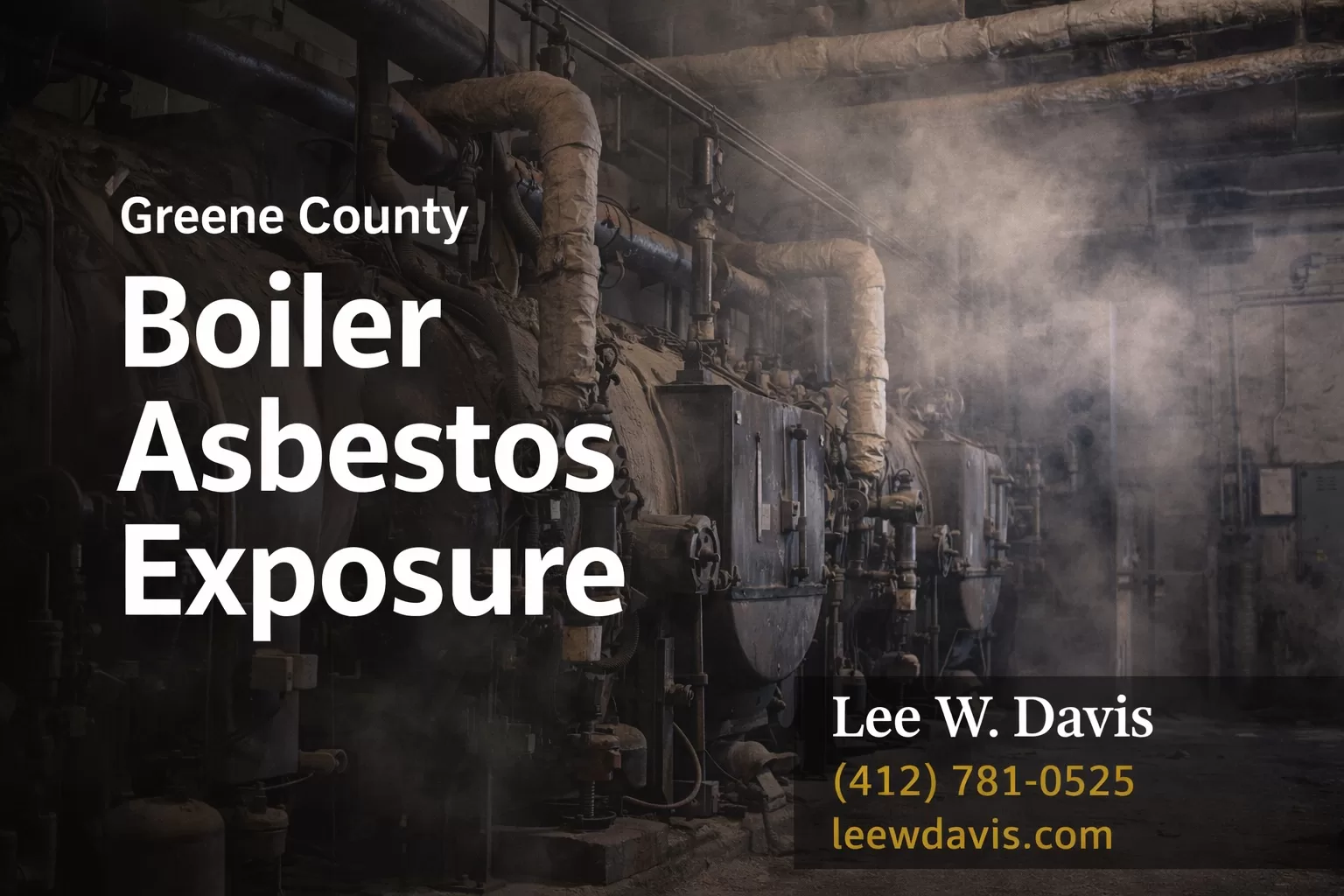
If you worked on boiler systems at a Greene County industrial facility and you’ve been diagnosed with mesothelioma or lung cancer, Greene County boiler asbestos exposure is a well-documented occupational history that has supported successful claims for workers and their families throughout this southwestern Pennsylvania county. Greene County’s industrial economy — dominated by coal mining and preparation, coke production, natural gas operations, and the power generating station that served the region — relied on boiler and steam systems throughout its industrial infrastructure, and those systems were insulated with asbestos-containing materials that exposed workers across every trade involved in their construction, maintenance, and repair.

Mesothelioma/Asbestos Legal Help – WV, MI & PA

Speak directly with attorney Lee W. Davis. No call centers. Free, confidential review.

Greene County’s Industrial Character and Its Boiler Asbestos History

Greene County sits at the southwestern corner of Pennsylvania, sharing the Mon Valley industrial corridor with Washington and Fayette counties while developing its own distinct industrial identity rooted in coal. Coal mining, coal preparation, coke production, and the natural gas extraction and distribution that supported southwestern Pennsylvania’s energy needs defined Greene County’s working economy for most of the twentieth century. Each of those industrial sectors operated boiler and steam systems requiring asbestos-containing insulation — and each produced its own category of boiler asbestos exposure for the workers who maintained those systems.

The county’s most significant boiler asbestos exposure environment was not a steel mill or chemical plant but a power generating station — Hatfield Ferry Power Station on the Monongahela River at Masontown. A coal-fired generating station of Hatfield Ferry’s scale is essentially an industrial facility built entirely around boiler and steam systems. The turbine hall, the boiler room, the feedwater systems, and the miles of high-pressure steam distribution piping throughout the plant all required the heavy asbestos insulation that characterized industrial power generation through the late 1970s. Workers who maintained and rebuilt those systems at Hatfield Ferry accumulated boiler asbestos exposure across careers at one of Greene County’s most significant industrial employers.

Greene County Facilities Where Boiler Asbestos Exposure Was Most Significant

Hatfield Ferry Power Station, Masontown — The Hatfield Ferry generating station on the Monongahela River was Allegheny Power’s major southwestern Pennsylvania generating facility. Like all coal-fired power plants of its era, Hatfield Ferry was built around high-pressure boiler systems that required the most demanding thermal insulation available — which through the 1970s meant asbestos-containing materials throughout the boiler shell, the steam drum, the feedwater and condensate systems, and the miles of steam distribution piping throughout the plant. Workers who built, maintained, and rebuilt those systems — boilermakers, pipefitters, insulators, and millwrights — accumulated sustained asbestos exposure throughout their careers at the facility. Plant engineers and shift engineers who oversaw those systems walked and inspected those environments continuously throughout their engineering careers at Hatfield Ferry.

Coal preparation facilities throughout Greene County — Coal preparation plants process mined coal through washing, sizing, and treatment systems that require steam and hot water for processing operations. Those utility systems included boiler systems insulated with asbestos-containing materials throughout the pre-1980 period. Workers maintaining coal preparation plant boiler and utility systems at Greene County facilities accumulated boiler asbestos exposure as a feature of their coal industry employment.

Mine utility systems — Underground coal mines and their surface facilities operated compressed air systems, ventilation equipment, and utility steam systems with boiler components requiring asbestos-containing insulation. Workers maintaining mine surface plant mechanical systems, including boiler and utility system maintenance at Greene County mine operations, accumulated exposure from those systems throughout their mining industry careers.

Coke production operations — The coke production facilities connected to Greene County’s coal industry operated by-products recovery systems and utility steam infrastructure requiring asbestos-containing insulation throughout their operational lives. Workers maintaining those systems — particularly in the by-products recovery departments where steam was used in the chemical processing of coke oven gas — accumulated boiler system asbestos exposure throughout their coke industry careers.

Industrial construction throughout Greene County — Boilermakers, pipefitters, and insulators who worked industrial construction and outage work throughout Greene County and the bordering southwestern PA counties accumulated boiler system asbestos exposure across multiple facilities over careers that spanned the county’s full industrial geography and extended into neighboring Washington and Fayette counties.


The Specific Boiler Work That Created Asbestos Exposure in Greene County

Boiler insulation installation at Hatfield Ferry and mine facilities — Applying asbestos-containing block insulation to boiler shells, fitting pipe covering to steam distribution lines, and applying insulating and finishing cement throughout completed boiler systems at Greene County facilities released asbestos fibers throughout every phase of the installation process.

Boiler insulation removal during overhauls — Stripping old asbestos-containing boiler insulation during major overhauls at Greene County industrial facilities — the baked, crumbled, fiber-releasing material that accumulated over years of high-temperature boiler operation — generated concentrated fiber release directly into the breathing zone of the workers performing the work.

Steam line maintenance at power plant and mine facilities — Replacing gaskets at flanged connections, changing valve packing, repairing damaged insulation sections, and servicing steam trap components throughout Greene County industrial steam systems disturbed asbestos-containing materials in the immediate work area of every maintenance task.

Power plant boiler confined space work — Boilermakers and plant engineers who entered Hatfield Ferry boiler drums, examined tube sheets, and conducted assessments of boiler internals worked in confined environments where ambient fiber concentrations from aging asbestos insulation were at their highest throughout the generating station’s operational life.

Outage and shutdown work — Major maintenance outages at Hatfield Ferry and other Greene County facilities concentrated boiler maintenance work — and boiler asbestos exposure — into intensive periods when multiple systems were being simultaneously worked throughout the facility.

Trades Most Commonly Involved in Greene County Boiler Asbestos Claims

  • Boilermakers — the trade most directly associated with boiler construction, maintenance, and repair at Greene County facilities including Hatfield Ferry Power Station
  • Pipefitters and steamfitters — workers who installed and maintained the steam distribution systems connected to Greene County’s industrial boilers, working in direct contact with asbestos-containing pipe insulation, gaskets, and valve packing throughout their careers
  • Insulators — the workers who applied and removed the asbestos-containing insulation on Greene County boiler systems and steam lines, with the most severe direct exposure profile of any trade involved in boiler system work
  • Millwrights — plant millwrights maintaining the mechanical systems associated with boiler operation throughout Greene County industrial facilities
  • Plant engineers and shift engineers — engineering and supervisory roles that placed workers continuously in Greene County boiler environments including the Hatfield Ferry turbine hall and boiler room throughout their careers

What Evidence Supports a Greene County Boiler Asbestos Claim

  • Diagnosis records confirming mesothelioma or lung cancer
  • Work history at Greene County facilities with boiler systems — job titles, years worked, specific boiler-related tasks performed, facilities including Hatfield Ferry or coal preparation plants
  • Memory of the specific boiler rooms, steam systems, and work areas where you spent your career
  • Names of coworkers, contractors, foremen, or supervisors you worked alongside during boiler maintenance and outage work at Greene County facilities
  • Union records confirming employment and dispatch history at specific Greene County facilities
  • Social Security earnings records confirming employers and time periods

For a broader overview of Greene County asbestos claims see the Greene County asbestos lawsuit resource. For the broader Pittsburgh area boiler asbestos resource see Pittsburgh boiler asbestos exposure. For related county boiler pages see Washington County boiler asbestos and Fayette County plant engineer asbestos. For workers with lung cancer diagnoses see Pittsburgh asbestos lung cancer. For a broader overview of how Pennsylvania mesothelioma claims work see our Pennsylvania resource. You can search the full list of asbestos job sites in Pennsylvania to review all documented Greene County exposure sites.

Knowledge of Greene County and Southwestern PA Asbestos Cases Since 1989

I first began researching southwestern Pennsylvania asbestos cases in 1989, working on asbestos mass trials across Pennsylvania and West Virginia. I returned to Pittsburgh in 1999 after supervising 3,200 Saginaw, Michigan Foundry cases to handle mesothelioma and lung cancer cases individually across western Pennsylvania, applying decades of product identification work — tracking the specific boiler insulation manufacturers, gasket suppliers, and steam system component companies whose materials were used at Greene County facilities — directly to every case evaluation.

When you call, you speak directly with me. No call centers. No case managers.

If you or a family member worked on boiler systems at Greene County industrial facilities and has been diagnosed with mesothelioma or lung cancer, time matters. Pennsylvania’s statute of limitations runs from the date of diagnosis, not from the date of your exposure decades ago.

Call (412) 781-0525 or start your confidential case review online now.

Check If Your Family Was Exposed

Get your free guide instantly + a confidential case review.

🔒 100% Confidential. No obligations.


Frequently Asked Questions

Q: I worked as a boilermaker at Hatfield Ferry Power Station doing boiler overhauls and maintenance for many years. Does that support a mesothelioma claim?

A: Yes, potentially. A boilermaker career at Hatfield Ferry Power Station performing boiler overhauls and maintenance is a significant asbestos exposure profile. Power plant boiler overhauls involve stripping old asbestos-containing boiler insulation — one of the highest fiber-release activities in any industrial setting — working inside boiler drums and confined boiler spaces where fiber concentrations were most intense, and replacing gaskets and packing throughout the boiler and associated steam systems. That work, performed repeatedly at a major coal-fired generating station, represents a substantial cumulative exposure history that warrants careful legal evaluation.

Q: I worked as a pipefitter at coal preparation plants throughout Greene County maintaining steam systems and utility equipment. Does that multi-site, coal industry career support a mesothelioma claim?

A: Yes, potentially. A pipefitter career spanning multiple Greene County coal preparation facilities accumulates asbestos exposure from distinct steam systems at each location. Coal preparation plant utility systems — the steam, compressed air, and hot water systems that supported coal washing and processing operations — historically used asbestos-containing pipe insulation, gaskets, and valve packing throughout their operational lives. Maintaining those systems across a career at multiple Greene County coal facilities represents cumulative exposure that warrants legal evaluation.

Q: How long do I have to file a mesothelioma claim in Pennsylvania connected to Greene County boiler asbestos exposure?

A: Pennsylvania’s statute of limitations runs from the date of diagnosis, not the date of your exposure. Wrongful death claims carry different and sometimes shorter deadlines running from the date of death. Do not assume it is too late — call as soon as a diagnosis is confirmed so we can evaluate your boiler work history at Greene County facilities and identify all responsible parties.

Mesothelioma/Asbestos Legal Help – WV, MI & PA

Speak directly with attorney Lee W. Davis. No call centers. Free, confidential review.

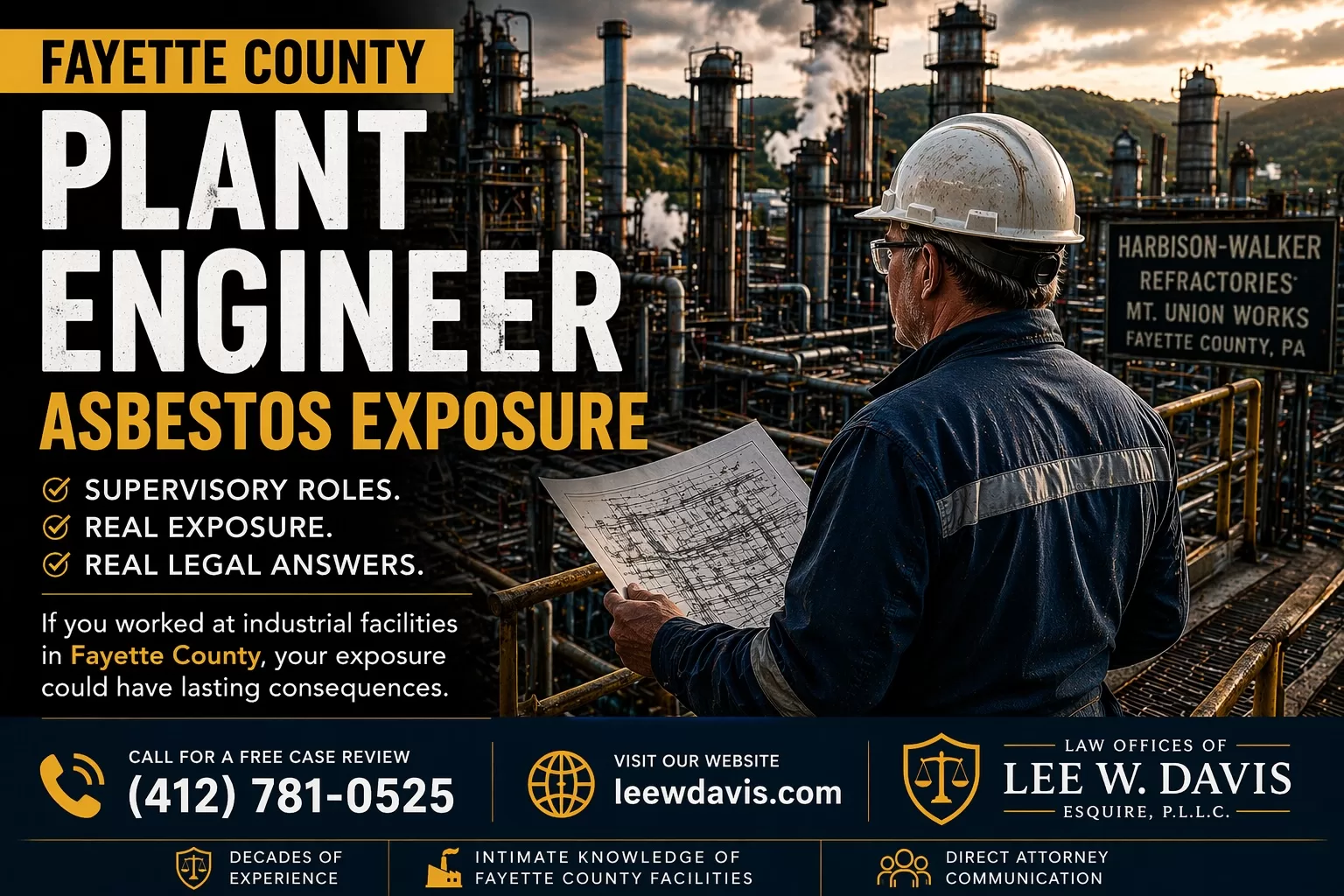
Fayette County Plant Engineer

Fayette County Plant Engineer Asbestos

If you worked as a plant engineer at a Fayette County industrial facility and you’ve been diagnosed with mesothelioma or lung cancer, Fayette County plant engineer asbestos exposure is an occupational history that warrants careful legal evaluation. Fayette County’s industrial geography — its glass manufacturing plants, refractory manufacturers, coal and coke operations, and supporting industrial facilities throughout Connellsville, Uniontown, Mt. Pleasant, and the surrounding communities — employed plant engineers whose careers took them continuously through environments saturated with asbestos-containing materials across decades of industrial employment.

Mesothelioma/Asbestos Legal Help – WV, MI & PA

Speak directly with attorney Lee W. Davis. No call centers. Free, confidential review.

Engineering and supervisory roles are among the most consistently overlooked in asbestos litigation throughout western Pennsylvania, and Fayette County is no exception. Plant engineers at Fayette County’s industrial facilities spent their careers walking plant floors, supervising maintenance and outage work, overseeing the trades workers who disturbed asbestos-containing refractory, insulation, and gasket materials throughout those facilities, and conducting engineering inspections in the mechanical spaces where fiber concentrations were highest. That sustained supervisory presence throughout asbestos-saturated industrial environments across a full career is a legitimate and frequently viable asbestos exposure history.

Fayette County’s Distinct Industrial Character and Its Asbestos Implications

Fayette County’s industrial profile differs importantly from the steel mill-dominated counties to its north. While the Mon Valley steel corridor reached into Fayette County through coal and coke supply operations, the county’s primary industrial identity was shaped by glass manufacturing, refractory production, and the coal mining and coke processing that supplied the Pittsburgh steel industry. Each of those industrial sectors created its own distinct asbestos exposure environment — and each placed plant engineers in that environment continuously.

Refractory manufacturing is the most distinctive Fayette County exposure category. Facilities like Harbison-Walker Refractories at Mt. Union manufactured the refractory products — the blocks, boards, cements, and specialty materials used to line furnaces throughout the Pittsburgh steel and manufacturing region — that themselves contained asbestos in significant concentrations. A plant engineer overseeing refractory manufacturing at a Harbison-Walker or similar Fayette County facility was not merely working near asbestos-containing materials in the utility systems surrounding production — they were engineering the production of asbestos-containing products themselves. That is a qualitatively different and potentially more severe exposure pathway than plant engineering at a consuming facility.

Glass manufacturing at facilities including Bryce Brothers Glass Factory in Mt. Pleasant and Lenox Crystal required extreme furnace temperatures and the sustained refractory and insulation systems that created asbestos exposure throughout plant operations. Plant engineers overseeing glass production continuously supervised work in environments where asbestos-containing furnace insulation, refractory, and utility system insulation were present throughout every production department.

Coal and coke operations throughout Fayette County supplied the Pittsburgh steel industry and operated their own boiler systems, mechanical infrastructure, and processing equipment requiring asbestos-containing insulation and refractory throughout. Plant engineers at Fayette County coal preparation and coke processing operations supervised maintenance and mechanical work in those environments across careers at individual operations throughout the county.


Fayette County Facilities Where Plant Engineer Asbestos Exposure Was Most Significant

Harbison-Walker Refractories Mt. Union — One of the most significant refractory manufacturers in American industrial history, Harbison-Walker produced asbestos-containing refractory products at its Mt. Union and other western PA operations throughout the peak asbestos era. Plant engineers overseeing refractory manufacturing at Harbison-Walker were in direct proximity to asbestos-containing raw materials and finished products throughout every phase of the manufacturing process — an exposure environment more intensive than most plant engineering roles because the product being manufactured itself contained asbestos.

Bryce Brothers Glass Factory Mt. Pleasant — Glass manufacturing requires sustained extreme heat and the refractory and insulation systems that manage it. Plant engineers at Bryce Brothers oversaw furnace operations, annealing systems, and the mechanical infrastructure throughout the facility in environments where asbestos-containing materials were present on virtually every furnace, utility system, and piece of process equipment in the plant.

Lenox Crystal Mt. Pleasant — Crystal and specialty glass manufacturing at Lenox Crystal required the same extreme heat management as conventional glass production, with the refractory and insulation systems that created asbestos exposure throughout the facility’s operational life. Plant engineers overseeing Lenox Crystal operations supervised work throughout those environments continuously.

Permali Corporation Mt. Pleasant — Manufacturing operations at Permali and similar Fayette County industrial facilities operated boiler and steam systems, mechanical equipment, and process systems with the asbestos-containing insulation and refractory that characterized industrial manufacturing of that era throughout the county.

Connellsville coke operations — The Connellsville coke producing region was historically one of the most significant in the country, supplying the Pittsburgh steel industry for generations. Coke battery operations used asbestos-containing refractory and insulation extensively, and plant engineers overseeing coke production supervised work in some of the most refractory-intensive environments in western Pennsylvania.

The Plant Engineer’s Exposure Pathways in Fayette County Facilities

Manufacturing and production oversight — At refractory manufacturing facilities like Harbison-Walker, plant engineers oversaw manufacturing operations where asbestos-containing raw materials were processed and asbestos-containing products were fabricated and tested. Engineering oversight of that production placed engineers in continuous proximity to asbestos content throughout every phase of their working careers.

Supervision of maintenance and outage work — Plant engineers at Fayette County glass, refractory, and industrial manufacturing facilities directed maintenance and outage work involving direct disturbance of asbestos-containing refractory and insulation materials. Supervising that work — standing in the work area during tear-out and rebuild of asbestos-containing furnace refractory, overseeing insulation replacement on process piping — placed engineers in the same high-exposure environment as the trades workers doing the hands-on work.

Plant-wide inspection rounds — Engineering inspection roles at Fayette County industrial facilities required regular walks through every production department, mechanical room, and utility area — spaces where asbestos-containing insulation and refractory were present throughout and where accumulated dust created continuous ambient fiber exposure during every inspection.

Furnace and kiln inspection — At glass manufacturing and refractory production facilities, plant engineers who inspected furnace conditions, assessed refractory wear, and directed refractory maintenance worked in the immediate vicinity of the most asbestos-intensive environments in those facilities — the furnace shells and kiln linings where asbestos-containing refractory materials aged, deteriorated, and released fibers throughout the operational life of the equipment.

Outage engineering oversight — Major outages at Fayette County industrial facilities — particularly at glass plants where furnace rebuilds required complete refractory replacement — concentrated asbestos exposure into intensive periods when plant engineers were present throughout, overseeing the tear-out of old asbestos-containing refractory and the installation of new materials.

What Evidence Supports a Fayette County Plant Engineer Asbestos Claim

  • Diagnosis records — pathology reports, imaging, treatment summaries confirming mesothelioma or lung cancer
  • Employment history at Fayette County facilities — job titles, engineering responsibilities, departments supervised, years worked
  • Memory of specific manufacturing operations, maintenance work, outage periods, and plant areas you oversaw throughout your career
  • Names of trades workers, production supervisors, maintenance contractors, and colleagues you worked with at specific Fayette County facilities
  • Personnel records, engineering documentation, or pension records confirming employment timeline
  • Social Security earnings records confirming employers and time periods

For a broader overview of Fayette County asbestos claims see the Fayette County asbestos lawsuit resource. For the broader western PA plant engineer resources see Pennsylvania plant engineer asbestos and Pittsburgh plant engineer asbestos. For related county plant engineer pages see Westmoreland County plant engineer asbestos and Beaver County plant engineer asbestos. For workers with lung cancer diagnoses see Pittsburgh asbestos lung cancer. For a broader overview of how Pennsylvania mesothelioma claims work see our Pennsylvania resource. You can search the full list of asbestos job sites in Pennsylvania to review all documented Fayette County exposure sites.

Knowledge of Fayette County and Western PA Asbestos Cases Since 1989

I first began researching western Pennsylvania asbestos cases in 1989, working on asbestos mass trials across Pennsylvania and West Virginia. I returned to Pittsburgh in 1999 to handle mesothelioma and lung cancer cases individually across western Pennsylvania, applying decades of product identification and facility knowledge — including knowledge of the refractory manufacturing sector that is central to Fayette County’s industrial asbestos history — directly to every case evaluation.

Refractory manufacturing cases require specific knowledge of the products made, the raw materials used, and the manufacturing processes involved that most asbestos attorneys do not have. This practice has handled refractory-related asbestos cases and has the background to evaluate a Fayette County refractory plant engineer claim with the specificity it requires.

When you call, you speak directly with me. No call centers. No case managers.

If you worked as a plant engineer at a Fayette County industrial facility and have been diagnosed with mesothelioma or lung cancer, Pennsylvania’s statute of limitations runs from the date of diagnosis.

Call (412) 781-0525 or start your confidential case review online now.

Check If Your Family Was Exposed

Get your free guide instantly + a confidential case review.

🔒 100% Confidential. No obligations.


Frequently Asked Questions

Q: I was a plant engineer at a refractory manufacturing facility in Fayette County for many years, overseeing the production of furnace lining products. The products we made contained asbestos. Do I have a mesothelioma claim?

A: Possibly yes — and your exposure profile is distinct from most plant engineer claims in an important way. Engineering oversight of refractory manufacturing places you not just near asbestos-containing utility systems but in direct proximity to asbestos-containing raw materials and finished products throughout every phase of the production process. The manufacturing environment for asbestos-containing refractory products is one of the most fiber-intensive settings in any industrial operation. A plant engineering career spent overseeing that production warrants careful legal evaluation regardless of whether you personally handled raw asbestos materials or finished asbestos-containing products.

Q: I was a plant engineer at Bryce Brothers Glass Factory and supervised the furnace rebuild outages where the old refractory lining was torn out and replaced. Is that enough to support a mesothelioma claim?

A: Yes, potentially. Supervising furnace rebuild outages at a glass manufacturing facility is one of the most significant asbestos exposure events in industrial glass production. Furnace refractory tear-out — breaking out the old asbestos-containing lining of a glass furnace — generates concentrated fiber release in an enclosed furnace environment. A plant engineer who supervised those outages — present throughout the tear-out and rebuild process, conducting engineering oversight of the work, approving progress — was in the high-exposure environment created by that work throughout every outage period across their career. Call to discuss your specific career history and diagnosis.

Q: How long do I have to file a mesothelioma claim in Pennsylvania connected to Fayette County plant engineering work?

A: Pennsylvania’s statute of limitations runs from the date of diagnosis, not the date of your exposure. Wrongful death claims carry different and sometimes shorter deadlines running from the date of death. Do not assume it is too late — call as soon as a diagnosis is confirmed so we can evaluate your engineering career history at Fayette County facilities and identify all responsible parties.

Mesothelioma/Asbestos Legal Help – WV, MI & PA

Speak directly with attorney Lee W. Davis. No call centers. Free, confidential review.

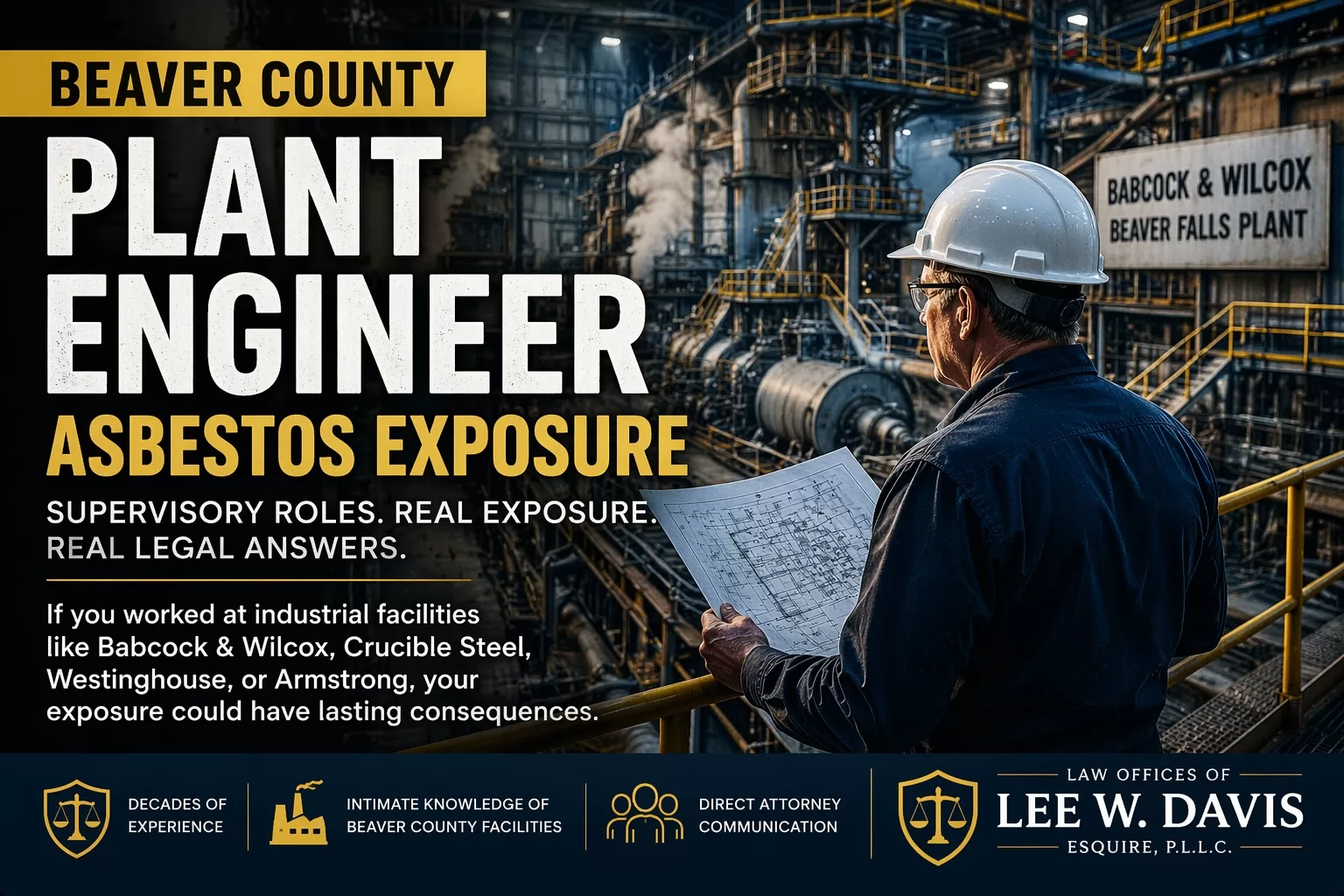
Beaver County Plant Engineer Asbestos Exposure

Beaver County Plant Engineer Asbestos Exposure

If you worked as a plant engineer at a Beaver County industrial facility and you’ve been diagnosed with mesothelioma or lung cancer, Beaver County plant engineer asbestos exposure is a well-documented occupational history that warrants careful legal evaluation. Beaver County’s industrial base — Babcock & Wilcox in Beaver Falls, the Ohio River steel and manufacturing corridor through Aliquippa, Ambridge, and Monaca, the Crucible Steel Midland operations, Westinghouse Beaver, and the Armstrong Beaver Falls facility — employed generations of plant engineers whose roles took them into every corner of facilities saturated with asbestos-containing materials across decades of industrial employment.

Mesothelioma/Asbestos Legal Help – WV, MI & PA

Speak directly with attorney Lee W. Davis. No call centers. Free, confidential review.

When I returned to Pittsburgh in 1999, Beaver County asbestos cases were among the first I handled — an abundance of claims from workers and families throughout the county’s industrial communities. That caseload represents firsthand knowledge of Beaver County facilities, Beaver County products, and the specific exposure histories of the workers who built and maintained this region’s industrial infrastructure. No national call center can replicate that.

Why Beaver County Plant Engineers Are Among the Most Overlooked Claimants

Beaver County’s industrial workforce is well represented in asbestos litigation — its boilermakers, pipefitters, steelworkers, and insulators have pursued successful claims for decades. But plant engineers and shift engineers at those same facilities rarely appear in that litigation, not because their exposure was less real, but because the engineering and supervisory role is the one claimant population that most consistently underestimates its own asbestos exposure history.

A plant engineer at Babcock & Wilcox Beaver Falls didn’t build the boilers — but they oversaw every aspect of that manufacturing operation, walked every department on regular inspection rounds, supervised the maintenance and fabrication crews working directly with asbestos-containing materials, and were present throughout every major outage and shutdown at the facility. That sustained supervisory presence throughout an asbestos-saturated manufacturing environment across a career spanning decades is a significant occupational exposure history regardless of whether the engineer ever held a piece of insulation in their hands.


Beaver County Facilities Where Plant Engineer Asbestos Exposure Was Most Significant

Babcock & Wilcox Beaver Falls — East Works and Main Plant — Babcock & Wilcox was one of the most important boiler and pressure vessel manufacturers in American industrial history, and its Beaver Falls operations were among the most significant in the company. Plant engineers at Babcock & Wilcox Beaver Falls oversaw the fabrication and assembly of boilers, pressure vessels, and heat exchangers — equipment that incorporated asbestos-containing materials in its construction. The manufacturing environment at the East Works and Main Plant included asbestos-containing insulation, refractory, and gasket materials throughout, and the testing and quality assurance functions that plant engineers performed placed them in direct proximity to those materials across their entire careers at the facility.

Crucible Steel Midland Works — Plant engineers at the Crucible Steel Midland facility oversaw specialty steel production operations with the extensive refractory, insulation, and steam system infrastructure that characterized specialty steel manufacturing. Engineering inspection and maintenance oversight at Crucible Steel meant continuous plant presence throughout facilities where asbestos-containing materials were present in every furnace, every pipe system, and every mechanical installation throughout the operational life of the facility.

Westinghouse Beaver — Westinghouse’s Beaver County manufacturing operations employed plant engineers who oversaw manufacturing processes in environments where asbestos-containing insulation was present on steam systems, process equipment, and mechanical infrastructure throughout the facility. Engineering oversight of those operations meant continuous presence throughout asbestos-containing manufacturing environments across careers spanning decades.

Armstrong Beaver Falls — The Armstrong Cork and later Armstrong Ceiling Tile facility in Beaver Falls manufactured products that contained asbestos as a core component for most of the facility’s operational history. Plant engineers overseeing that manufacturing operation supervised work involving direct asbestos content in the products being made, as well as the utility systems — boilers, steam lines, and mechanical equipment — throughout the plant.

Ohio River industrial corridor — The steel and manufacturing operations through Aliquippa, Ambridge, and Monaca employed plant engineers who oversaw steelmaking, fabrication, and manufacturing operations in the same Ohio River industrial environment that exposed generations of trades workers to asbestos throughout their careers.

The Plant Engineer’s Specific Exposure Pathways in Beaver County Facilities

Supervision of maintenance and outage work — Plant engineers at Beaver County facilities directed and supervised the insulation, pipefitting, millwright, and boilermaker work that involved the most intensive disturbance of asbestos-containing materials. Supervising that work meant standing in the work area while insulation was being cut, stripped, and replaced — breathing the same air as the workers doing the hands-on work throughout every maintenance and outage period across an entire career.

Manufacturing and production oversight — At facilities like Babcock & Wilcox and Armstrong, plant engineers oversaw manufacturing operations where asbestos-containing materials were incorporated directly into the products being built. Engineering oversight of product fabrication, testing, and quality assurance placed engineers in continuous proximity to asbestos-containing materials as a feature of the manufacturing process itself — not just the utility systems surrounding it.

Plant-wide inspection rounds — Engineering inspection roles required walking every department at Beaver County industrial facilities on a regular basis — through mechanical rooms, pipe chases, fabrication areas, and production departments where asbestos-containing insulation was present on every pipe and piece of equipment. The accumulated dust in those spaces created continuous background fiber exposure throughout every working day.

Boiler and mechanical space inspection — Inspecting the boiler systems, steam equipment, and mechanical infrastructure at Beaver County industrial facilities — entering confined spaces, examining tube sheets, assessing mechanical systems — placed plant engineers in environments where ambient fiber concentrations from aging asbestos insulation were at their highest.

Outage engineering oversight — Major maintenance outages at Beaver County facilities represented the most intensive asbestos exposure periods of any phase of plant operation. Plant engineers were present throughout those outage periods — overseeing the work, approving progress, and conducting engineering acceptance inspections of completed maintenance — all requiring continuous plant presence during maximum asbestos fiber disturbance.

Mesothelioma/Asbestos Legal Help – WV, MI & PA

Speak directly with attorney Lee W. Davis. No call centers. Free, confidential review.

What Evidence Supports a Beaver County Plant Engineer Asbestos Claim

Plant engineer claims require a different evidentiary approach than skilled trades claims — one that this practice has developed specifically for Beaver County facilities based on decades of handling claims from this county.

  • Diagnosis records — pathology reports, imaging, treatment summaries confirming mesothelioma or lung cancer
  • Employment history at Beaver County facilities — job titles, engineering responsibilities, departments supervised, years worked
  • Memory of specific maintenance work, outage periods, manufacturing operations, and plant areas you oversaw throughout your career
  • Names of trades workers, maintenance contractors, and supervisors you worked with at specific Beaver County facilities
  • Personnel records, engineering documentation, or pension records confirming employment timeline
  • Social Security earnings records confirming employers and time periods

Related Beaver County and Western PA Resources

For Beaver County trade-specific pages see Beaver County boilermakers, Beaver County pipefitters, and Beaver County steelworker asbestos claims. For boiler system specific exposure see Beaver County boiler asbestos. For the Crucible Steel Midland facility see Crucible Steel Midland Works. For the broader western PA plant engineer resources see Pennsylvania plant engineer asbestos and Pittsburgh plant engineer asbestos. For workers with lung cancer diagnoses see Pittsburgh asbestos lung cancer. For a broader overview of how Pennsylvania mesothelioma claims work see our Pennsylvania resource. You can search the full list of asbestos job sites in Pennsylvania to review all documented Beaver County exposure sites.

Knowledge of Beaver County Asbestos Cases Since 1989 — Including Direct Case History

I first began researching western Pennsylvania asbestos cases in 1989 as a paralegal. When I returned to Pittsburgh in 1999, Beaver County asbestos cases were among the first and most abundant cases I handled — representing workers and families from Babcock & Wilcox, the Ohio River corridor facilities, and the broader Beaver County industrial community throughout the years immediately following my return. That direct case history in Beaver County — the product identification work, the facility documentation, the exposure narratives built from actual Beaver County workers’ careers — is applied directly to every Beaver County claim I evaluate today.

When you call, you speak directly with me. No call centers. No case managers.

If you worked as a plant engineer at a Beaver County industrial facility and have been diagnosed with mesothelioma or lung cancer, your supervisory role does not disqualify your claim. Pennsylvania’s statute of limitations runs from the date of diagnosis.

Call (412) 781-0525 or start your confidential case review online now.

Check If Your Family Was Exposed

Get your free guide instantly + a confidential case review.

🔒 100% Confidential. No obligations.


Frequently Asked Questions

Q: I was a plant engineer at Babcock & Wilcox Beaver Falls for over twenty years overseeing boiler fabrication and quality assurance. I supervised the trades workers but didn’t work directly with insulation or gaskets myself. Do I have a mesothelioma claim?

A: Possibly yes. Direct physical contact with asbestos-containing materials is not a legal requirement for a mesothelioma or lung cancer claim. A twenty-year engineering career at Babcock & Wilcox Beaver Falls overseeing boiler fabrication and quality assurance placed you continuously in a manufacturing environment where asbestos-containing materials were incorporated into the products being built and present throughout the utility systems supporting production. Supervising the trades workers doing the hands-on work meant being in those spaces throughout every working day. That sustained engineering presence in an asbestos-intensive manufacturing environment warrants careful legal evaluation.

Q: I was a shift engineer at one of the Ohio River steel facilities in Beaver County and spent every shift walking the plant floor overseeing maintenance. Is that enough to support a mesothelioma claim?

A: Possibly yes. Shift engineers who spend careers walking the plant floor at Beaver County steel facilities — overseeing maintenance work, conducting equipment inspections, supervising the mechanical systems throughout the facility — accumulate asbestos exposure through sustained presence in environments where asbestos-containing insulation is present on every pipe, piece of equipment, and mechanical system in the space. The exposure pathway differs from a boilermaker or pipefitter, but the cumulative fiber dose over a full career in those environments can be significant. Beaver County is a county I know intimately from decades of actual case history — call to discuss your specific facility and career.

Q: How long do I have to file a mesothelioma claim in Pennsylvania connected to Beaver County plant engineering work?

A: Pennsylvania’s statute of limitations runs from the date of diagnosis, not the date of your exposure. Wrongful death claims carry different and sometimes shorter deadlines running from the date of death. Do not assume it is too late — call as soon as a diagnosis is confirmed so we can evaluate your engineering career history at Beaver County facilities and identify all responsible parties.

Mesothelioma/Asbestos Legal Help – WV, MI & PA

Speak directly with attorney Lee W. Davis. No call centers. Free, confidential review.

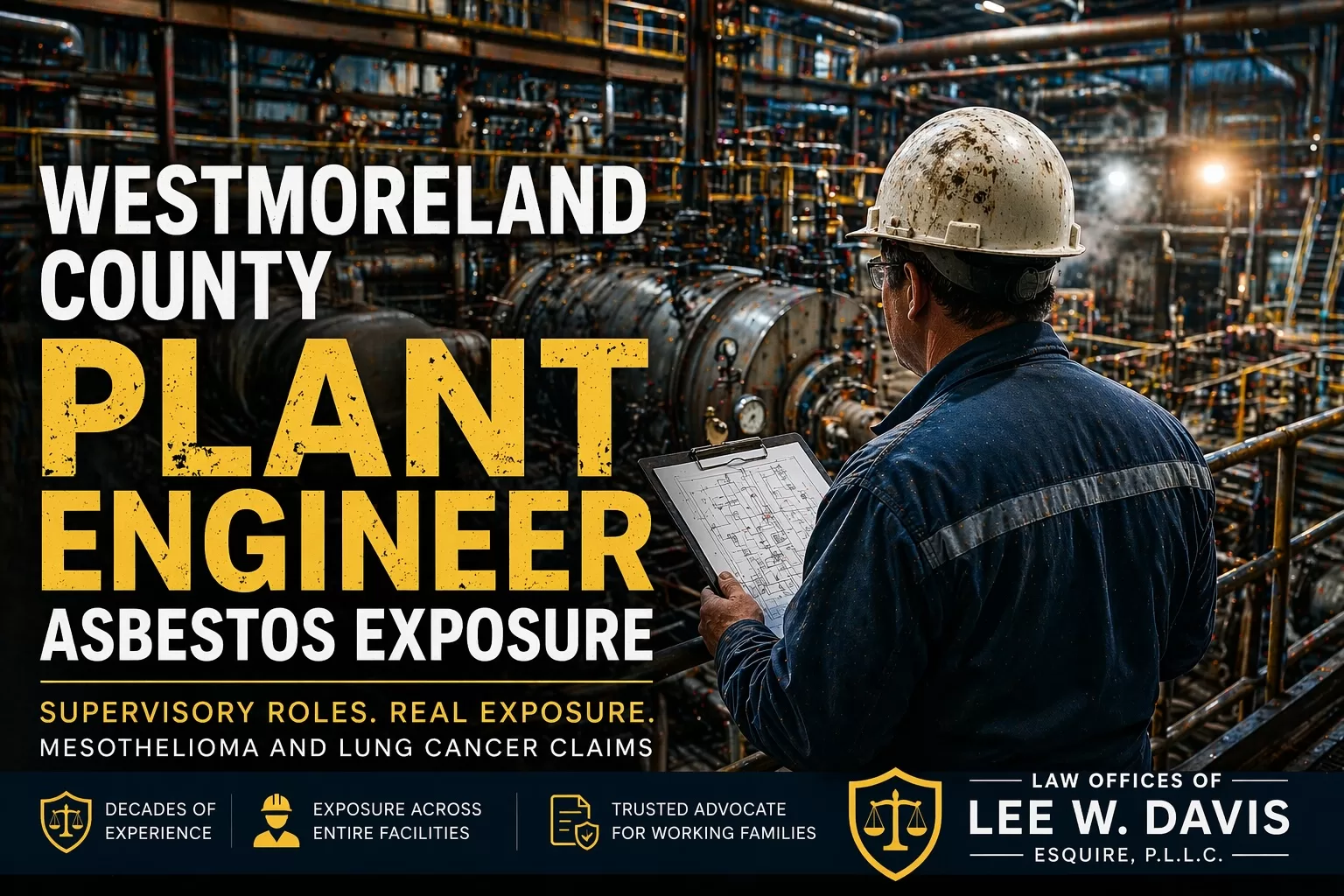
Westmoreland County Plant Engineer Asbestos

Westmoreland County Plant Engineer Asbestos

If you worked as a plant engineer at a Westmoreland County industrial facility and you’ve been diagnosed with mesothelioma or lung cancer, Westmoreland County plant engineer asbestos exposure is an occupational history that warrants careful legal evaluation — even though engineering and supervisory roles are among the most frequently overlooked in asbestos litigation. Plant engineers at Westmoreland County’s steel operations, manufacturing plants, power generating stations, and glass facilities spent their careers walking the plant floor, supervising maintenance and outage work, and inspecting the mechanical systems throughout their facilities — accumulating asbestos exposure through continuous presence in environments saturated with asbestos-containing materials across decades of industrial employment.

Mesothelioma/Asbestos Legal Help – WV, MI & PA

Speak directly with attorney Lee W. Davis. No call centers. Free, confidential review.

Why Plant Engineers in Westmoreland County Are Overlooked — and Why That Matters

The workers most commonly associated with asbestos mesothelioma claims from Westmoreland County are the skilled trades — pipefitters, boilermakers, millwrights, insulators. Their direct contact with asbestos-containing materials is easy to describe and document. Plant engineers and shift engineers don’t fit that pattern, and as a result they and their families frequently assume that a supervisory or engineering role doesn’t support an asbestos claim.

That assumption is wrong. It has caused legitimate Westmoreland County claims to go unfiled every year.

Plant engineers at Westmoreland County industrial facilities were not office workers who happened to be near a plant. They were the people responsible for the plant’s mechanical and process systems — which meant they were in those systems continuously. They walked every department on regular inspection routes. They supervised the skilled trades workers who were disturbing asbestos-containing insulation and refractory materials throughout the facility. They were present during every major maintenance outage — the period when asbestos fiber concentrations throughout the plant were at their highest. They entered confined mechanical spaces to conduct engineering assessments of boiler systems, steam equipment, and mechanical infrastructure.

A plant engineer who spent twenty or thirty years at a Westmoreland County industrial facility doing that work accumulated significant cumulative asbestos exposure — through a different pathway than a pipefitter or boilermaker, but real, sustained, and legally significant.


Westmoreland County Facilities Where Plant Engineer Asbestos Exposure Was Most Significant

Hempfield Power Station — The Hempfield generating station in Greensburg was one of Westmoreland County’s most significant industrial facilities from an asbestos exposure standpoint. A power generating station is built around boiler and steam systems — the turbine hall, the boiler room, the feedwater and condensate systems, and the steam distribution infrastructure throughout the plant all required heavy asbestos insulation. Plant engineers responsible for the Hempfield generating systems conducted regular inspections throughout those environments and oversaw the maintenance and outage work that involved the most intensive asbestos disturbance at the facility. A career spent engineering those systems at Hempfield represents sustained exposure to asbestos fiber throughout every phase of the plant’s operation.

Westinghouse Greensburg operations — Westinghouse operated manufacturing facilities in the Greensburg area throughout the mid-twentieth century. Plant engineers overseeing those manufacturing operations supervised work in environments where asbestos-containing insulation was present on steam systems, process equipment, and mechanical infrastructure throughout the facility. Engineering oversight of Westinghouse Greensburg manufacturing meant continuous presence throughout those asbestos-containing environments across careers spanning decades.

Elliott Turbomachinery Jeannette — Elliott’s turbomachinery manufacturing and testing operations in Jeannette involved plant engineers who oversaw the fabrication, assembly, and testing of turbines, compressors, and related equipment. The manufacturing environment at Elliott and the test facilities where turbines and compressors were run under operating conditions included asbestos-containing materials in the equipment being built and in the insulation throughout the manufacturing and test areas.

Steel-related and manufacturing operations throughout Westmoreland County — The steel support operations, metal fabrication facilities, and manufacturing plants distributed throughout Westmoreland County operated boiler and steam systems, heat treatment equipment, and process systems requiring sustained asbestos insulation. Plant engineers overseeing those operations spent their careers in environments where asbestos-containing materials were present throughout every department they supervised.

The Plant Engineer’s Specific Exposure Pathways at Westmoreland County Facilities

Supervision of maintenance and outage work — Plant engineers at Westmoreland County facilities directed and supervised the insulation, pipefitting, millwright, and boilermaker work that involved the most intensive disturbance of asbestos-containing materials. Standing in the work area while insulation was being cut, stripped, and replaced — breathing the same air as the workers doing the hands-on work — placed the engineering supervisor in direct proximity to active asbestos fiber release throughout a career at a Westmoreland County industrial facility.

Plant-wide inspection rounds — The engineering inspection role required walking every department on a regular basis at Westmoreland County industrial facilities. In those facilities of the 1950s through the 1980s that meant walking through spaces where asbestos-containing insulation lined every pipe, covered every piece of equipment, and shed fibers continuously into the ambient air. The accumulated dust in mechanical rooms, pipe chases, and boiler areas created continuous low-level background exposure throughout every working day.

Outage oversight — Major maintenance outages at Westmoreland County facilities — at Hempfield Power Station, at Westinghouse, at Elliott, and throughout the county’s manufacturing base — represented the most intensive asbestos exposure periods of any phase of plant operation. Plant engineers were present throughout those outage periods, overseeing the work, approving progress, and conducting engineering acceptance inspections of completed maintenance — all requiring continuous plant presence during the period of maximum asbestos fiber disturbance.

Boiler and mechanical space inspection — Inspecting boiler systems at Westmoreland County industrial facilities — entering boiler drums, examining tube sheets, reviewing feedwater systems, and assessing mechanical spaces — placed plant engineers in confined environments where ambient fiber concentrations from aging asbestos insulation were at their highest throughout the facility’s operational life.

What Evidence Supports a Westmoreland County Plant Engineer Asbestos Claim

Plant engineer asbestos claims require a different evidentiary approach than skilled trades claims. Salaried plant engineers typically have more complete individual employment records than union trades workers — personnel files, engineering department records, pension documentation — but lack union dispatch records. The exposure narrative is built differently — from the engineer’s detailed account of their supervisory responsibilities, the Westmoreland County facilities and departments they managed, the maintenance and outage work they oversaw, and the specific conditions they worked in throughout their career.

The evidence that matters most includes:

  • Diagnosis records — pathology reports, imaging, treatment summaries confirming mesothelioma or lung cancer
  • Employment history at Westmoreland County facilities — job titles, engineering responsibilities, departments supervised, years worked
  • Memory of specific maintenance work, outage periods, and plant areas you oversaw throughout your career at Westmoreland County facilities
  • Names of trades workers, maintenance contractors, and supervisors you worked with at specific facilities
  • Personnel records, engineering documentation, or pension records confirming employment timeline
  • Social Security earnings records confirming employers and time periods

Related Westmoreland County and Western PA Resources

For a broader overview of Westmoreland County asbestos claims see the Westmoreland County asbestos lawsuit resource. For Westmoreland County trade-specific pages see Westmoreland County boilermakers, Westmoreland County pipefitters, and Westmoreland County millwrights. For boiler system specific exposure see Westmoreland County boiler asbestos. For the broader western PA plant engineer resource see Pennsylvania plant engineer asbestos and Pittsburgh plant engineer asbestos. For workers with lung cancer diagnoses see Pittsburgh asbestos lung cancer. For a broader overview of how Pennsylvania mesothelioma claims work see our Pennsylvania resource. You can search the full list of asbestos job sites in Pennsylvania to review all documented Westmoreland County exposure sites.

Knowledge of Westmoreland County Asbestos Cases Since 1989

I first began researching western Pennsylvania asbestos cases in 1989, working on asbestos mass trials across Pennsylvania and West Virginia. I returned to Pittsburgh in 1999 to handle mesothelioma and lung cancer cases individually across western Pennsylvania, applying decades of product identification and facility knowledge directly to every case evaluation. Plant engineer and supervisory role claims require a different investigative approach than skilled trades claims, but the underlying exposure at Westmoreland County industrial facilities in the 1950s through the 1980s was real, sustained, and legally significant regardless of whether the engineer ever touched a piece of insulation directly.

When you call, you speak directly with me. No call centers. No case managers.

If you worked as a plant engineer at a Westmoreland County industrial facility and have been diagnosed with mesothelioma or lung cancer, your supervisory role does not disqualify your claim. Pennsylvania’s statute of limitations runs from the date of diagnosis.

Call (412) 781-0525 or start your confidential case review online now.

Check If Your Family Was Exposed

Get your free guide instantly + a confidential case review.

🔒 100% Confidential. No obligations.


Frequently Asked Questions

Q: I was a plant engineer at Hempfield Power Station for over twenty-five years, responsible for the boiler and turbine systems. I supervised maintenance work throughout the plant but never touched insulation myself. Do I have a mesothelioma claim?

A: Possibly yes. Direct physical contact with asbestos-containing materials is not a legal requirement for a mesothelioma claim. A twenty-five year engineering career at Hempfield Power Station responsible for boiler and turbine systems placed you continuously in the most asbestos-intensive environments at the facility — supervising maintenance and outage work when insulation was actively being disturbed, conducting boiler inspections in confined spaces where ambient fiber concentrations were highest, and walking the turbine hall and mechanical areas on regular inspection routes throughout your career. That sustained engineering presence at a major power generating station is a significant cumulative exposure history that warrants careful legal evaluation.

Q: I was a shift engineer at a Westmoreland County manufacturing facility and spent every shift walking the plant floor supervising the maintenance crew. Is that enough exposure to support a mesothelioma claim?

A: Possibly yes. Shift engineers who spend careers walking the plant floor at Westmoreland County industrial facilities — supervising maintenance work, conducting equipment inspections, overseeing the mechanical systems throughout the facility — accumulate asbestos exposure through sustained presence in environments where asbestos-containing insulation is present on virtually every pipe, piece of equipment, and mechanical system in the space. The exposure pathway is different from a boilermaker or pipefitter doing hands-on work, but the cumulative fiber dose over a full career in those environments can be significant. Call to discuss your specific facility history and diagnosis.

Q: How long do I have to file a mesothelioma claim in Pennsylvania connected to Westmoreland County plant engineering work?

A: Pennsylvania’s statute of limitations runs from the date of diagnosis, not the date of your exposure. Wrongful death claims carry different and sometimes shorter deadlines running from the date of death. Do not assume it is too late — call as soon as a diagnosis is confirmed so we can evaluate your engineering career history at Westmoreland County facilities and identify all responsible parties.

Mesothelioma/Asbestos Legal Help – WV, MI & PA

Speak directly with attorney Lee W. Davis. No call centers. Free, confidential review.

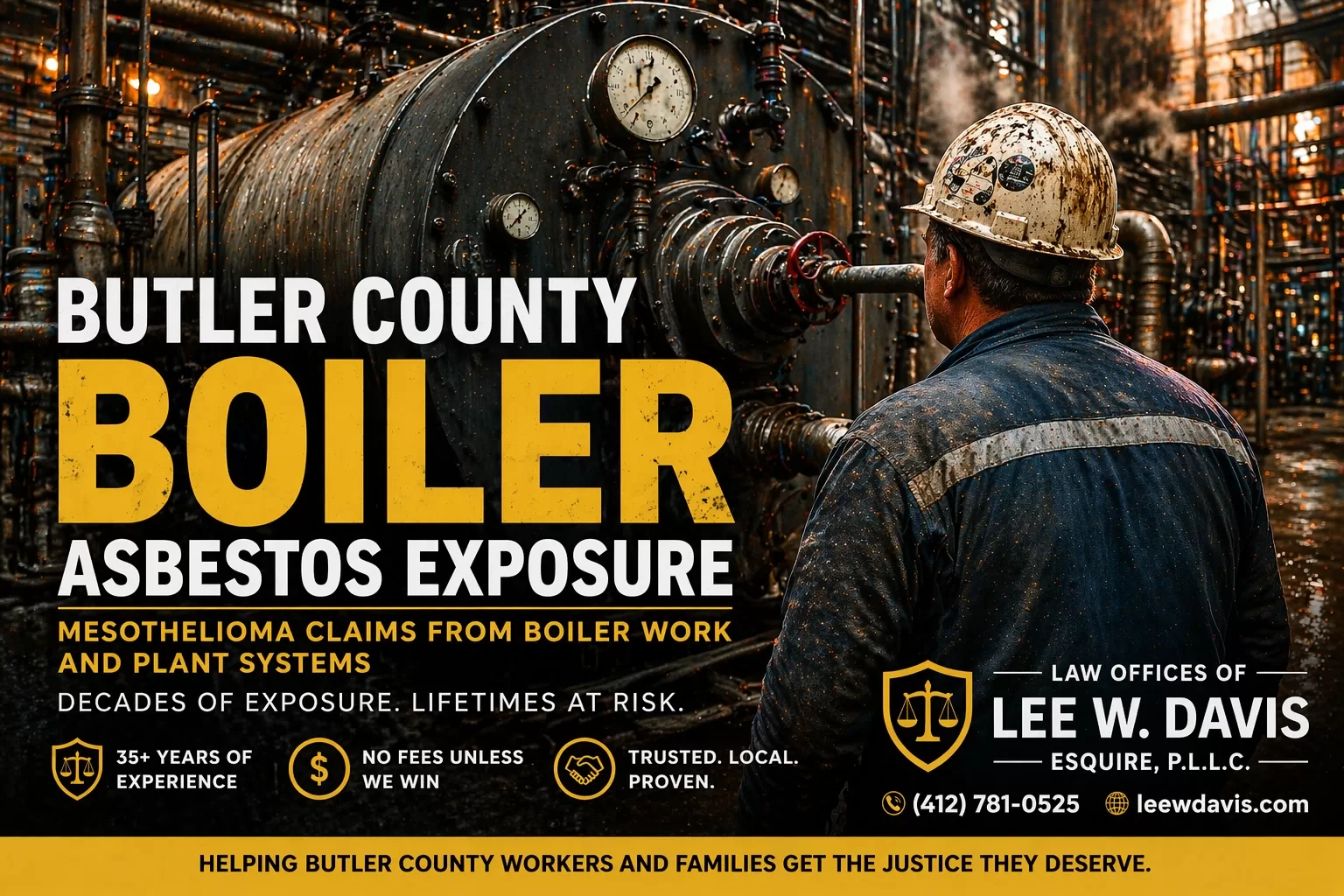
Butler County Boiler Asbestos Exposure

Butler County Boiler Asbestos Exposure

If you worked on boiler systems at a Butler County industrial facility and you’ve been diagnosed with mesothelioma or lung cancer, Butler County boiler asbestos exposure is an occupational history that has supported successful claims for workers and their families throughout this region of western Pennsylvania. Butler County’s industrial base — anchored by the Armco Steel Butler Works, the Connoquenessing Valley manufacturing corridor, and the supporting industrial infrastructure throughout Butler, Saxonburg, Zelienople, and the surrounding communities — relied on boiler and steam systems throughout its operational history, and those systems were insulated with asbestos-containing materials that exposed workers across every trade involved in their construction, operation, maintenance, and repair.

Mesothelioma/Asbestos Legal Help – WV, MI & PA

Speak directly with attorney Lee W. Davis. No call centers. Free, confidential review.

Boiler Systems and Asbestos in Butler County’s Industrial Facilities

Every major industrial facility in Butler County required steam — for process heat in steel and specialty manufacturing, for building heat and utility services, and for the mechanical processes that drove Butler County’s industrial economy through most of the twentieth century. Generating and distributing that steam required boiler systems, and those boiler systems required insulation. Before the late 1970s, the insulation applied to industrial boilers and steam systems throughout Butler County was almost universally asbestos-containing — block insulation on boiler shells, pipe covering on steam distribution lines, insulating cement on fittings and irregular surfaces, and finishing cement over the completed system, each layer containing asbestos in concentrations that could reach 80 percent in products used through the post-war industrial era.

Workers who built, operated, maintained, and rebuilt those systems breathed asbestos fibers throughout their working lives in Butler County’s industrial facilities. The latency period between asbestos exposure and mesothelioma — commonly twenty to fifty years — means that workers exposed at Butler County facilities in the 1960s, 1970s, and 1980s are receiving diagnoses today that trace directly to that occupational exposure.

Butler County Facilities Where Boiler Asbestos Exposure Was Most Significant

Armco Steel Butler Works — The Armco Steel Butler Works was Butler County’s most significant industrial facility, and its boiler and steam systems were among the most extensive in the county. Steel production required sustained high-temperature heat and continuous steam for process and utility functions throughout the plant. The boiler systems supporting those operations were insulated with asbestos-containing materials throughout their operational life, and the workers who built, maintained, and rebuilt them accumulated sustained asbestos exposure across careers at the facility. Armco’s corporate evolution through AK Steel to Cleveland-Cliffs does not eliminate the liability of the product manufacturers whose asbestos-containing materials were used in the Butler Works boiler systems throughout the operational years of highest exposure.

Butler County manufacturing facilities — The manufacturing operations distributed throughout Butler County — metal fabrication, light industrial, and processing facilities throughout the Connoquenessing Valley and surrounding communities — operated boiler and steam systems for process heat and utility services. Workers across those facilities maintained those systems in environments where asbestos-containing insulation was present on every pipe and piece of boiler equipment in the space.

Industrial powerhouses serving Butler County — The electrical generating and utility powerhouses serving Butler County’s communities and industries operated boiler systems of the kind that created the most intensive boiler asbestos exposure environments. Turbine steam systems, boiler shells, feedwater systems, and steam distribution piping throughout a generating or utility facility all required the heavy asbestos insulation that characterized industrial power generation from the post-war era through the late 1970s.

Industrial construction throughout Butler County — Boilermakers, pipefitters, and insulators who worked industrial construction and outage work throughout Butler County accumulated boiler system asbestos exposure across multiple facilities over careers that extended beyond the county into the broader western PA industrial region.


The Specific Boiler Work That Created Asbestos Exposure in Butler County

Boiler insulation installation — Applying asbestos-containing block insulation to boiler shells at Butler County facilities, fitting pipe covering to steam distribution lines, and applying insulating and finishing cement throughout completed boiler systems released asbestos fibers throughout every phase of the installation process.

Boiler insulation removal during overhauls — Stripping old asbestos-containing boiler insulation during major overhauls at Butler County industrial facilities — the baked, crumbled, fiber-releasing material that accumulated over years of high-temperature operation — generated concentrated fiber release directly into the breathing zone of the workers performing the tear-out.

Steam line maintenance — Replacing gaskets at flanged connections, changing valve packing, repairing damaged insulation sections, and servicing steam trap components throughout Butler County industrial steam systems disturbed asbestos-containing materials in the immediate work area of every maintenance task performed.

Boiler confined space work — Plant engineers, shift engineers, and inspection personnel who entered Butler County industrial boiler drums, examined tube sheets, and conducted assessments of boiler internals worked in confined environments where ambient fiber concentrations from aging asbestos insulation were at their highest.

Outage and shutdown work — Major maintenance outages at Butler County facilities concentrated boiler maintenance work — and boiler asbestos exposure — into intensive periods when multiple systems were being simultaneously worked throughout the facility.

Mesothelioma/Asbestos Legal Help – WV, MI & PA

Speak directly with attorney Lee W. Davis. No call centers. Free, confidential review.

Trades Most Commonly Involved in Butler County Boiler Asbestos Claims

  • Boilermakers — the trade most directly associated with boiler construction, maintenance, and repair at Butler County facilities, including the Armco Steel Butler Works operations
  • Pipefitters and steamfitters — workers who installed and maintained the steam distribution systems connected to Butler County’s industrial boilers, working in direct contact with asbestos-containing pipe insulation, gaskets, and valve packing throughout their careers
  • Insulators — the workers who applied and removed the asbestos-containing insulation on Butler County boiler systems and steam lines, with the most severe direct exposure profile of any trade involved in boiler system work
  • Millwrights — plant millwrights maintaining the mechanical systems associated with boiler operation in the same spaces where boiler insulation created constant ambient fiber exposure throughout the work environment
  • Plant engineers and shift engineers — supervisory and inspection roles that placed workers continuously in Butler County boiler environments throughout their careers

What Evidence Supports a Butler County Boiler Asbestos Claim

  • Diagnosis records confirming mesothelioma or lung cancer
  • Work history at Butler County facilities with boiler systems — job titles, years worked, specific boiler-related tasks performed
  • Memory of the specific boiler rooms, steam systems, and work areas where you spent your career
  • Names of coworkers, contractors, foremen, or supervisors you worked alongside during boiler maintenance and overhaul work
  • Union records confirming employment and dispatch history at specific Butler County facilities
  • Social Security earnings records confirming employers and time periods

For a broader overview of Butler County asbestos exposure see Armco Steel Butler Works asbestos. For the broader Pittsburgh area boiler asbestos resource see Pittsburgh boiler asbestos exposure. For the Westmoreland County equivalent see Westmoreland County boiler asbestos. For the Washington County equivalent see Washington County boiler asbestos. For workers with lung cancer diagnoses see Pittsburgh asbestos lung cancer. For a broader overview of how Pennsylvania mesothelioma claims work see our Pennsylvania resource. You can search the full list of asbestos job sites in Pennsylvania to review all documented Butler County exposure sites.

Knowledge of Butler County Boiler Asbestos Cases Since 1989

I first began researching western Pennsylvania asbestos cases in 1989 as a paralegal, working on asbestos mass trials across Pennsylvania and West Virginia. I returned to Pittsburgh in 1999 from representing more than 3,200 GM Foundry Workers in Saginaw, MI to handle mesothelioma and lung cancer cases individually across western Pennsylvania, applying decades of product identification work — tracking the specific boiler insulation manufacturers, gasket suppliers, and steam system component companies whose materials were used at Butler County facilities including the Armco Steel Butler Works — directly to every case evaluation.

When you call, you speak directly with me. No call centers. No case managers.

If you or a family member worked on boiler systems at Butler County industrial facilities and has been diagnosed with mesothelioma or lung cancer, time matters. Pennsylvania’s statute of limitations runs from the date of diagnosis, not from the date of your exposure decades ago.

Call (412) 781-0525 or start your confidential case review online now.

Check If Your Family Was Exposed

Get your free guide instantly + a confidential case review.

🔒 100% Confidential. No obligations.


Frequently Asked Questions

Q: I worked as a boilermaker at Armco Steel in Butler doing boiler maintenance and outage work for many years. Does that support a mesothelioma claim?

A: Yes, potentially. A boilermaker career at the Armco Steel Butler Works performing boiler maintenance and outage work represents a significant asbestos exposure history. Boiler maintenance and outage work at a major steel facility involved working directly on asbestos-insulated boiler systems — stripping old insulation during overhauls, working inside boiler drums and confined boiler spaces where fiber concentrations were highest, and replacing gaskets and packing throughout the boiler and connected steam systems. That work, performed repeatedly across a career at the Butler Works, warrants careful legal evaluation for anyone who has received a mesothelioma or lung cancer diagnosis.

Q: I worked pipefitter jobs at multiple Butler County facilities over my career maintaining steam systems. Does that multi-facility history help my claim?

A: Yes. A pipefitter career spanning multiple Butler County industrial facilities accumulates asbestos exposure from distinct steam systems and distinct sets of asbestos-containing product manufacturers at each location. Each facility and each product line encountered there represents a separate thread in your exposure narrative and potentially a separate defendant in your claim. Multi-facility pipefitter careers maintaining steam systems throughout Butler County typically produce strong claim profiles because the total exposure is cumulative and the number of potentially responsible product defendants is larger.

Q: How long do I have to file a mesothelioma claim in Pennsylvania connected to Butler County boiler asbestos exposure?

A: Pennsylvania’s statute of limitations runs from the date of diagnosis, not the date of your exposure. Wrongful death claims carry different and sometimes shorter deadlines running from the date of death. Do not assume it is too late — call as soon as a diagnosis is confirmed so we can evaluate your boiler work history at Butler County facilities and identify all responsible parties before records and witnesses become harder to locate.

Mesothelioma/Asbestos Legal Help – WV, MI & PA

Speak directly with attorney Lee W. Davis. No call centers. Free, confidential review.

Washington County Boiler Asbestos Exposure

Washington County Boiler Asbestos Exposure

If you worked on boiler systems at a Washington County industrial facility and you’ve been diagnosed with mesothelioma or lung cancer, Washington County boiler asbestos exposure is a well-documented occupational history that has supported successful claims for workers and their families throughout this region of western Pennsylvania. Washington County’s steel facilities, manufacturing plants, coal operations, and the powerhouses and industrial steam systems that served them all relied on boiler systems insulated with asbestos-containing materials throughout their operational lives — and the workers who built, operated, maintained, and rebuilt those systems accumulated asbestos exposure that continues to produce mesothelioma and lung cancer diagnoses today.

Mesothelioma/Asbestos Legal Help – WV, MI & PA

Speak directly with attorney Lee W. Davis. No call centers. Free, confidential review.

Boiler Systems in Washington County’s Industrial Facilities

Washington County sits at the southwestern edge of the Pittsburgh industrial region, sharing the industrial character of the Mon Valley corridor while extending south and west through communities with their own significant industrial employment base. The county’s steel facilities, coal operations, manufacturing plants, and electrical generating stations all required steam — and generating, distributing, and maintaining that steam required boiler systems insulated from the moment they were built with materials that historically contained asbestos in high concentrations.

The specific boiler environments that created asbestos exposure in Washington County included the utility boilers at industrial manufacturing facilities throughout the county, the process steam systems at Washington County steel and metal operations, the boiler and steam infrastructure at powerhouses serving major industrial sites, and the generating station boiler systems that provided electrical power to the county’s communities and industries. Workers across every trade involved with those systems — from the boilermakers who built and maintained them to the pipefitters who ran the connected steam distribution systems, the insulators who applied and removed the asbestos-containing insulation, and the plant engineers and shift engineers who oversaw them — accumulated occupational asbestos exposure throughout their careers in Washington County.

Washington County Facilities Where Boiler Asbestos Exposure Was Most Significant

Washington Steel — Washington Steel Corporation operated one of Washington County’s most significant industrial facilities, with the boiler and steam systems that supported steel production requiring heavy asbestos insulation throughout their operational life. Workers maintaining those systems — boilermakers, pipefitters, insulators, and millwrights — worked in direct contact with asbestos-containing materials as a routine feature of their employment at the facility.

Canonsburg Steel — The steel operations in Canonsburg included boiler and steam systems supporting the manufacturing process. Workers at Canonsburg Steel who maintained boiler and steam infrastructure accumulated exposure from the asbestos-containing insulation throughout those systems.

McGraw Edison — McGraw Edison’s Washington County manufacturing operations used steam systems for manufacturing processes. Workers maintaining those systems encountered asbestos-containing insulation throughout the facility.

Bethlehem Mines and coal operations — While primarily a coal operation, Bethlehem Mines and the broader coal industry in Washington County operated facilities with boiler and compressed air systems requiring asbestos-containing insulation throughout their mechanical infrastructure.

Washington County powerhouses and generating facilities — The electrical generating stations and industrial powerhouses serving Washington County’s communities and industries operated boiler systems of the kind that created the most intensive boiler asbestos exposure environments — turbine steam systems, boiler shells, feedwater systems, and miles of high-pressure steam distribution piping all requiring heavy asbestos insulation throughout their operational lives.

Industrial construction throughout Washington County — Boilermakers, pipefitters, and insulators who worked industrial construction and outage work throughout Washington County accumulated boiler system asbestos exposure across multiple facilities over careers that spanned the county’s full industrial geography and extended into the neighboring Mon Valley corridor.


The Specific Boiler Work That Created Asbestos Exposure in Washington County

Boiler insulation installation — Applying asbestos-containing block insulation to boiler shells, fitting pipe covering to steam lines, and applying insulating and finishing cement throughout boiler systems released asbestos fibers throughout every phase of the installation process at Washington County facilities.

Boiler insulation removal during overhauls — Stripping old asbestos-containing boiler insulation during major overhauls at Washington County industrial facilities — particularly the baked, crumbled, fiber-releasing material that accumulated over years of high-temperature operation — generated concentrated fiber release directly into the breathing zone of the workers performing the work.

Steam line maintenance — Replacing gaskets at flanged connections, changing valve packing, repairing damaged insulation sections, and servicing steam system components throughout Washington County industrial facilities disturbed asbestos-containing materials in the immediate work area of every maintenance task.

Boiler inspection in confined spaces — Plant engineers, shift engineers, and inspection personnel who entered Washington County industrial boiler drums, examined tube sheets, and conducted assessments of boiler internals worked in confined environments where ambient fiber concentrations from aging asbestos insulation were at their highest.

Outage work — Major maintenance outages at Washington County facilities concentrated boiler maintenance activity — and boiler asbestos exposure — into intensive periods when multiple systems were being simultaneously worked by crews that included boilermakers, pipefitters, insulators, and laborers throughout the facility.

Trades Most Commonly Involved in Washington County Boiler Asbestos Claims

  • Washington County boilermakers — the trade most directly associated with boiler construction, maintenance, and repair at Washington County facilities
  • Pipefitters and steamfitters — workers who installed and maintained the steam distribution systems connected to Washington County’s industrial boilers, working in direct contact with asbestos-containing pipe insulation, gaskets, and packing throughout their careers
  • Insulators — the workers who applied and removed the asbestos-containing insulation on Washington County boiler systems and steam lines, with the most severe direct exposure profile of any trade involved in boiler system work
  • Millwrights — plant millwrights maintaining the mechanical systems associated with boiler operation in the same spaces where boiler insulation created constant ambient fiber exposure
  • Plant engineers and shift engineers — supervisory and inspection roles that placed workers continuously in Washington County boiler environments throughout their careers

What Evidence Supports a Washington County Boiler Asbestos Claim

  • Diagnosis records confirming mesothelioma or lung cancer
  • Work history at Washington County facilities with boiler systems — job titles, years worked, specific boiler-related tasks performed
  • Memory of the specific boiler rooms, steam systems, and work areas where you spent your career
  • Names of coworkers, contractors, foremen, or supervisors you worked alongside during boiler maintenance and overhaul work
  • Union records confirming employment and dispatch history at specific Washington County facilities
  • Social Security earnings records confirming employers and time periods

For a broader overview of Washington County asbestos claims see the Washington County asbestos lawyer resource. For the broader Pittsburgh area boiler asbestos resource see Pittsburgh boiler asbestos exposure. For the Westmoreland County equivalent see Westmoreland County boiler asbestos. For workers with lung cancer diagnoses see Pittsburgh asbestos lung cancer. For a broader overview of how Pennsylvania mesothelioma claims work see our Pennsylvania resource. You can search the full list of asbestos job sites in Pennsylvania to review all documented Washington County exposure sites.

Knowledge of Washington County Boiler Asbestos Cases Since 1989

I first began researching western Pennsylvania asbestos cases in 1989, working on asbestos mass trials across Pennsylvania and West Virginia. I returned to Pittsburgh in 1999 to handle mesothelioma and lung cancer cases individually across western Pennsylvania, applying decades of product identification work — tracking the specific boiler insulation manufacturers, gasket suppliers, and steam system component companies whose materials were used at Washington County facilities — directly to every case evaluation.

When you call, you speak directly with me. No call centers. No case managers.

If you or a family member worked on boiler systems at Washington County industrial facilities and has been diagnosed with mesothelioma or lung cancer, time matters. Pennsylvania’s statute of limitations runs from the date of diagnosis, not from the date of your exposure decades ago.

Call (412) 781-0525 or start your confidential case review online now.

Check If Your Family Was Exposed

Get your free guide instantly + a confidential case review.

🔒 100% Confidential. No obligations.


Frequently Asked Questions

Q: I worked as a pipefitter maintaining steam lines connected to boilers at Washington Steel for over twenty years. Does that support a mesothelioma claim?

A: Yes, potentially. A twenty-year pipefitter career maintaining steam lines connected to industrial boilers at Washington Steel represents sustained asbestos exposure from the pipe insulation, gaskets, and valve packing throughout those systems. Pipefitters who maintained steam distribution systems at Washington County steel facilities worked in direct contact with asbestos-containing materials on a daily basis across careers spanning decades. That occupational history — combined with a mesothelioma or lung cancer diagnosis — warrants careful legal evaluation.

Q: I worked boilermaker construction throughout Washington County and neighboring counties over my career. Does that multi-county, multi-facility history help my claim?

A: Yes. A boilermaker construction career spanning Washington County and the broader western PA region accumulates asbestos exposure from distinct boiler systems and distinct sets of asbestos-containing product manufacturers at each facility. Each job site and each product line encountered there represents a separate thread in your exposure narrative and potentially a separate defendant in your claim. Multi-county boilermaker construction careers typically produce strong claim profiles because the total exposure is cumulative across every facility and every boiler system where you worked.

Q: How long do I have to file a mesothelioma claim in Pennsylvania connected to Washington County boiler asbestos exposure?

A: Pennsylvania’s statute of limitations runs from the date of diagnosis, not the date of your exposure. Wrongful death claims carry different and sometimes shorter deadlines running from the date of death. Do not assume it is too late — call as soon as a diagnosis is confirmed so we can evaluate your boiler work history at Washington County facilities and identify all responsible parties before records and witnesses become harder to locate.

Mesothelioma/Asbestos Legal Help – WV, MI & PA

Speak directly with attorney Lee W. Davis. No call centers. Free, confidential review.

Beaver County Boiler Asbestos Exposure

Beaver County Boiler Asbestos Exposure

Beaver County boiler asbestos exposure was a common and dangerous part of industrial work across the region. From steel operations and power plants to chemical facilities and manufacturing sites, boiler systems were essential—and heavily insulated with asbestos-containing materials.

If you worked around boiler systems in Beaver County and have been diagnosed with mesothelioma or lung cancer, your exposure likely came from those environments.

📞 (412) 781-0525 — Speak directly with an attorney.


Boiler Systems Were Built With Asbestos

Boilers operated under extreme heat and pressure, requiring insulation to function safely and efficiently.

That insulation often contained asbestos, including:

  • Block insulation covering boiler units
  • Pipe insulation connected to steam systems
  • Gaskets and packing in valves and connections
  • Refractory materials inside high-heat equipment

These materials were part of the system—not optional components.


Exposure Occurred During Maintenance and Repairs

The highest asbestos exposure did not happen during normal operation.

It happened when boilers were opened.

Workers were exposed during:

  • Boiler cleanouts
  • Insulation removal and replacement
  • Valve and gasket repairs
  • Shutdowns and plant outages
  • Emergency repair work

When insulation was disturbed, asbestos fibers were released into the air.

You didn’t have to handle asbestos directly.

You just had to be nearby.


Who Was Exposed in Beaver County

Boiler-related asbestos exposure affected workers across many roles, including:

  • Boilermakers
  • Pipefitters
  • Maintenance workers
  • Engineers
  • Laborers and contractors

Exposure was not limited to one trade.


Beaver County Facilities With Boiler Exposure

Workers in Beaver County were exposed across industrial environments including:

  • Steel and metal processing facilities
  • Power generation plants
  • Chemical and manufacturing operations
  • Industrial construction and maintenance sites

These facilities relied on boiler systems daily—creating repeated exposure over years or decades.

👉 Search Asbestos Job Sites in Pennsylvania


Take-Home Asbestos Exposure

In many cases, exposure didn’t stop at work.

Asbestos fibers settled on clothing and were carried home.

That exposed:

  • Spouses
  • Children
  • Other family members

We’ve seen cases where family members developed mesothelioma without ever working in an industrial setting.


Check If Your Family Was Exposed

Get your free guide instantly + a confidential case review.

🔒 100% Confidential. No obligations.

Why Boiler Exposure Claims Are Strong

These cases often involve:

  • Heavy asbestos use in confined systems
  • Repeated exposure during maintenance
  • Work across multiple facilities
  • Long-term industrial employment

This creates strong claims against multiple manufacturers.


Filing a Beaver County Asbestos Claim

These claims are not filed against your employer.

They are brought against the manufacturers of asbestos-containing materials used in boiler systems.

Many of those companies have established trust funds.


Mesothelioma/Asbestos Legal Help – WV, MI & PA

Speak directly with attorney Lee W. Davis. No call centers. Free, confidential review.

Time Limits for Pennsylvania Claims

Pennsylvania law generally measures the statute of limitations from the date of diagnosis—not exposure.

Even if your work occurred decades ago, your claim may still be valid.


Experience With Beaver County Asbestos Cases

I’ve worked on asbestos cases tied to western Pennsylvania industrial facilities since 1989, including boiler-related exposure cases.

These cases are built on real exposure history—how work actually happened inside these systems.

When you call, you speak directly with me.

📞 (412) 781-0525

🌐 https://leewdavis.com

Check If Your Family Was Exposed

Get your free guide instantly + a confidential case review.

🔒 100% Confidential. No obligations.


Frequently Asked Questions

Q: Are boilers a major source of asbestos exposure in Beaver County?

Yes. Boilers were heavily insulated with asbestos materials and created significant exposure during maintenance and repairs.


Q: Do I need to work directly on boilers to have a claim?

No. Being present during boiler work where asbestos was disturbed can be enough.


Q: Can family members be affected by asbestos exposure?

Yes. Take-home exposure can affect others in the household.

Mesothelioma/Asbestos Legal Help – WV, MI & PA

Speak directly with attorney Lee W. Davis. No call centers. Free, confidential review.

Westmoreland County Boiler Asbestos Exposure

Westmoreland County Boiler Asbestos Exposure

If you worked on boiler systems at a Westmoreland County industrial facility and you’ve been diagnosed with mesothelioma or lung cancer, Westmoreland County boiler asbestos exposure is a well-documented occupational history that has supported successful claims for workers and their families throughout the region. Westmoreland County’s industrial base — its steel-related operations, manufacturing plants, power generating stations, and the supporting industrial infrastructure throughout Greensburg, New Kensington, Latrobe, Jeannette, and the surrounding communities — relied on boiler and steam systems throughout their operational lives, and those systems were insulated with asbestos-containing materials that exposed workers across every trade involved in their installation, operation, maintenance, and repair.

Mesothelioma/Asbestos Legal Help – WV, MI & PA

Speak directly with attorney Lee W. Davis. No call centers. Free, confidential review.

Boiler Systems and Asbestos in Westmoreland County’s Industrial Facilities

Boilers and steam systems were the circulatory system of Westmoreland County’s industrial facilities — generating the heat and pressure that drove manufacturing processes, powered generating equipment, and provided utility services throughout every major plant in the county. Those systems were insulated from the time they were built with materials that historically contained asbestos in high concentrations, and they remained insulated with those materials throughout decades of continuous operation.

The workers who built, operated, maintained, and repaired Westmoreland County’s industrial boiler systems — boilermakers, pipefitters, insulators, millwrights, and the plant engineers and shift engineers who oversaw those systems — accumulated asbestos exposure that continues to produce mesothelioma and lung cancer diagnoses today. The latency period between asbestos exposure and mesothelioma diagnosis — commonly twenty to fifty years — means that workers exposed at Westmoreland County facilities in the 1960s, 1970s, and 1980s are receiving diagnoses right now.

Westmoreland County Facilities Where Boiler Asbestos Exposure Was Most Significant

Hempfield Power Station — The Hempfield generating station in Greensburg was one of the most significant power plant boiler environments in Westmoreland County. Power generating stations are built around boiler and steam systems — turbines, boiler shells, feedwater systems, and the miles of high-pressure steam distribution piping throughout the plant all required heavy asbestos insulation throughout their operational lives. Workers at Hempfield who maintained, repaired, and rebuilt those systems accumulated sustained boiler asbestos exposure across their careers.

Westinghouse Greensburg operations — Westinghouse operated manufacturing facilities in the Greensburg area that relied on boiler and steam systems for manufacturing processes. Workers maintaining those systems worked in environments with asbestos-containing insulation throughout.

Elliott Turbomachinery Jeannette — Elliott’s turbomachinery manufacturing operations in Jeannette involved fabrication and testing of turbines, compressors, and related equipment that used asbestos-containing materials in their construction and testing environments. Workers building and testing equipment that would be insulated with asbestos-containing materials in its installed condition accumulated exposure from those materials throughout the manufacturing and testing process.

Steel-related and manufacturing operations throughout the county — The steel support operations, metal fabrication facilities, and manufacturing plants distributed throughout Westmoreland County operated boiler and steam systems for process heat and utility services. Workers across those facilities maintained those systems in environments where asbestos-containing insulation was present throughout.

Industrial construction throughout Westmoreland County — Boilermakers, pipefitters, and insulators who worked industrial construction and outage work throughout Westmoreland County accumulated exposure across multiple facilities over careers that spanned the county’s full industrial geography.


The Specific Boiler Work That Created Asbestos Exposure in Westmoreland County

Boiler insulation installation and application — Applying asbestos-containing block insulation to boiler shells, fitting pipe covering to steam distribution lines, and applying insulating and finishing cement to the completed system released asbestos fibers throughout every phase of the installation process. This was the foundational work of boiler insulation in Westmoreland County facilities from the post-war era through the late 1970s.

Boiler insulation removal during overhauls — When Westmoreland County industrial boilers required major overhaul or repair, the first step was removing the existing insulation — dried, crumbled, and saturated with decades of heat cycling. Stripping old asbestos-containing boiler insulation released fibers in concentrated form directly into the breathing zone of the workers performing the work.

Steam line maintenance — The steam distribution systems connected to Westmoreland County industrial boilers required regular maintenance — replacing gaskets at flanged connections, changing valve packing, repairing damaged insulation sections, and servicing steam traps throughout the distribution network. Each task disturbed asbestos-containing materials in the immediate work area.

Boiler inspection and assessment — Plant engineers and shift engineers who conducted regular inspections of Westmoreland County boiler systems — entering boiler drums, examining tube sheets, conducting confined-space assessments — worked in environments where ambient fiber concentrations from aging asbestos insulation created continuous background exposure.

Outage and shutdown work — Major maintenance outages at Westmoreland County facilities concentrated boiler maintenance work — and boiler asbestos exposure — into intensive periods when multiple systems were being worked simultaneously throughout the facility.

Trades Most Commonly Involved in Westmoreland County Boiler Asbestos Claims

  • Westmoreland County boilermakers — the trade most directly associated with boiler construction, maintenance, and repair throughout the county’s industrial facilities
  • Westmoreland County pipefitters — workers who installed and maintained the steam distribution systems connected to Westmoreland County’s industrial boilers
  • Westmoreland County millwrights — plant millwrights maintaining mechanical systems associated with boiler operation throughout Westmoreland County facilities
  • Insulators — direct handlers of the asbestos-containing insulation applied to and removed from Westmoreland County boiler systems
  • Plant engineers and shift engineers — supervisory and inspection roles that placed workers continuously in Westmoreland County boiler environments throughout their careers

What Evidence Supports a Westmoreland County Boiler Asbestos Claim

  • Diagnosis records confirming mesothelioma or lung cancer
  • Work history at Westmoreland County facilities with boiler systems — job titles, years worked, specific boiler-related tasks performed
  • Memory of the specific boiler rooms, steam systems, and work areas where you spent your career in the county
  • Names of coworkers, contractors, foremen, or supervisors you worked alongside during boiler maintenance and overhaul work
  • Union records confirming employment and dispatch history at specific Westmoreland County facilities
  • Social Security earnings records confirming employers and time periods

For a broader overview of Westmoreland County asbestos claims see the Westmoreland County asbestos lawsuit resource. For the broader Pittsburgh area boiler asbestos resource see Pittsburgh boiler asbestos exposure. For workers with lung cancer diagnoses see Pittsburgh asbestos lung cancer. For a broader overview of how Pennsylvania mesothelioma claims work see our Pennsylvania resource. You can search the full list of asbestos job sites in Pennsylvania to review all documented Westmoreland County exposure sites.

Knowledge of Westmoreland County Boiler Asbestos Cases Since 1989

I first began researching western Pennsylvania asbestos cases in 1989 as a paralegal, working on asbestos mass trials across Pennsylvania and West Virginia. I returned to Pittsburgh after supervising 3,200 GM Foundry cases in Michigan in 1999 to handle mesothelioma and lung cancer cases individually across western Pennsylvania, applying decades of product identification work — tracking the specific boiler insulation manufacturers, refractory suppliers, and steam system component companies whose materials were used at Westmoreland County facilities — directly to every case evaluation.

When you call, you speak directly with me. No call centers. No case managers.

If you or a family member worked on boiler systems at Westmoreland County industrial facilities and has been diagnosed with mesothelioma or lung cancer, time matters. Pennsylvania’s statute of limitations runs from the date of diagnosis, not from the date of your exposure decades ago.

Call (412) 781-0525 or start your confidential case review online now.

Check If Your Family Was Exposed

Get your free guide instantly + a confidential case review.

🔒 100% Confidential. No obligations.


Frequently Asked Questions

Q: I worked as a boilermaker at Hempfield Power Station doing boiler overhauls for over twenty years. Is that enough to support a mesothelioma claim?

A: A twenty-year boilermaker career at Hempfield Power Station performing boiler overhauls is a very strong asbestos exposure profile. Major boiler overhauls at a power plant involved stripping old asbestos-containing boiler insulation — one of the highest fiber-release activities in any industrial setting — working inside boiler drums and confined spaces where fiber concentrations were most intense, and replacing gaskets and packing throughout the boiler and steam systems. That work, performed repeatedly over twenty years, represents a substantial cumulative exposure history that warrants careful legal evaluation.

Q: I worked pipefitter jobs throughout Westmoreland County maintaining steam lines connected to industrial boilers at multiple facilities. Does that multi-facility history help my mesothelioma claim?

A: Yes. A pipefitter career spanning multiple Westmoreland County facilities accumulates asbestos exposure from distinct steam systems and distinct sets of asbestos-containing product manufacturers at each location. Each facility and each product line encountered there represents a separate thread in your exposure narrative and potentially a separate defendant in your claim. Multi-facility pipefitter careers maintaining steam systems throughout Westmoreland County typically produce strong claim profiles because the total exposure is cumulative across every facility where you worked.

Q: How long do I have to file a mesothelioma claim in Pennsylvania connected to Westmoreland County boiler asbestos exposure?

A: Pennsylvania’s statute of limitations runs from the date of diagnosis, not the date of your exposure. Wrongful death claims carry different and sometimes shorter deadlines running from the date of death. Do not assume it is too late — call as soon as a diagnosis is confirmed so we can evaluate your boiler work history at Westmoreland County facilities and identify all responsible parties.

Mesothelioma/Asbestos Legal Help – WV, MI & PA

Speak directly with attorney Lee W. Davis. No call centers. Free, confidential review.

Allegheny County Asbestos Exposure

Allegheny County Asbestos Exposure | Mesothelioma Lawyer

If you worked in Allegheny County and you’ve been diagnosed with mesothelioma or lung cancer, Allegheny County asbestos exposure is among the most extensively documented occupational exposure histories in the United States. Allegheny County was the industrial center of western Pennsylvania for most of the twentieth century — home to the Mon Valley steel corridor, the Ohio River chemical and manufacturing operations, the Allegheny Valley specialty steel and power generation facilities, and the glass works, coke plants, and heavy manufacturing operations that employed generations of workers in environments saturated with asbestos-containing materials.

The asbestos-related disease burden that industrial work in Allegheny County created continues to produce mesothelioma and lung cancer diagnoses today — decades after the exposure occurred, decades after many of the facilities have closed, and decades after asbestos was phased out of industrial use. Pennsylvania’s statute of limitations runs from the date of diagnosis rather than the date of exposure, which means workers exposed in Allegheny County’s industrial facilities in the 1950s, 1960s, 1970s, and 1980s are receiving diagnoses and filing viable claims right now.

The Scale of Allegheny County’s Asbestos Exposure History

No county in Pennsylvania — and few in the country — has a more extensive asbestos exposure history than Allegheny County. The county’s industrial geography included three major river corridors — the Mon Valley, the Ohio River corridor, and the Allegheny Valley — each lined with major industrial facilities that used asbestos-containing materials throughout their operations for decades.

Along the Mon Valley: US Steel’s massive Homestead, Duquesne, Irvin, and Edgar Thomson works, the Clairton Coke Works — the largest coke facility in the western hemisphere — and the Koppers operations that ran alongside them. Along the Ohio River: the Neville Island industrial complex, the chemical and manufacturing operations that defined the river corridor from Pittsburgh to Aliquippa. Along the Allegheny Valley: Allegheny Ludlum’s specialty steel operations at Brackenridge, the PPG Tarentum chemical plant, Cheswick Power Station, and the broader network of industrial employers from Pittsburgh through Natrona Heights and beyond.

Every one of those facilities relied on asbestos-containing materials throughout its operations — in the insulation on steam and process piping, in the refractory materials lining furnaces and coke ovens, in the gaskets and packing throughout mechanical systems, and in the construction and maintenance materials used across decades of continuous production. Workers throughout Allegheny County breathed asbestos fibers as a routine feature of their industrial employment, and the mesothelioma and lung cancer diagnoses resulting from that exposure are the foundation of the claims we evaluate and pursue.

Allegheny County Facility-Specific Asbestos Resources

Our practice has developed detailed exposure resources for the major Allegheny County industrial facilities most commonly associated with mesothelioma and lung cancer claims:

Steel and Coke Facilities

  • US Steel Homestead Works — one of the largest integrated steel facilities in American history, with asbestos throughout every production and mechanical department along the Mon Valley
  • Clairton Coke Works — the largest coke plant in the western hemisphere at its peak, with asbestos across battery operations, by-products recovery, and mechanical systems throughout the facility
  • Koppers Clairton — coke and chemical operations on the same industrial corridor
  • Neville Island Coke and Chemical — Ohio River coke and chemical facility within Allegheny County

Specialty Steel and Chemical Facilities

Power Generating Stations

  • Cheswick Power Station — Springdale generating station with heavy asbestos insulation throughout mechanical and steam systems

Allegheny Valley Geographic Resources

Allegheny County Trade-Specific Asbestos Resources

Asbestos exposure in Allegheny County’s industrial facilities affected every major trade. Our practice has developed detailed exposure resources for the trades most commonly represented in Allegheny County mesothelioma and lung cancer claims:

Engineering and Supervisory Role Asbestos Resources

Plant engineers, shift engineers, and maintenance supervisors at Allegheny County industrial facilities accumulated significant asbestos exposure through continuous presence throughout the facilities they managed — often across careers spanning thirty or more years at major industrial sites:

Allegheny County Asbestos Claims — The Legal Framework

Allegheny County asbestos claims are typically pursued on multiple tracks simultaneously. Product liability claims in Pennsylvania courts target the manufacturers of the asbestos-containing insulation, refractory, gasket, and packing materials used at the specific Allegheny County facilities where exposure occurred. Asbestos bankruptcy trust claims are filed with the trusts established by manufacturers who have gone through bankruptcy proceedings. Both pathways are often available and are pursued in parallel to maximize total recovery.

Allegheny County and its surrounding courts have been active venues for asbestos litigation for decades. That institutional familiarity with asbestos cases — among judges, defense counsel, and expert witnesses — means that the quality of the case built at the outset matters significantly. An experienced asbestos attorney who knows the Allegheny County facilities, the products used at those facilities, and the specific exposure histories of the trades that worked there builds a stronger case from day one than a national firm learning the job sites from scratch.

For a broader overview of how Pennsylvania mesothelioma claims work see our Pennsylvania resource. For workers in neighboring counties see Armstrong County asbestos lawyer and Washington County asbestos lawyer. You can search the full list of asbestos job sites in Pennsylvania to review all documented Allegheny County exposure sites.

Take-Home Exposure in Allegheny County

The density of Allegheny County’s industrial workforce meant that take-home asbestos exposure — fibers carried home on work clothing, hair, and vehicles — was a significant source of secondary exposure for families throughout the communities surrounding Allegheny County’s industrial facilities. Workers who brought asbestos dust home from the Homestead Works, Clairton, Cheswick, Allegheny Ludlum, and other major Allegheny County facilities exposed family members who never set foot inside those plants. Take-home asbestos cases arising from Allegheny County industrial employment have supported successful mesothelioma claims for decades.

Knowledge of Allegheny County Asbestos Cases Since 1989

I first began researching Allegheny County and western Pennsylvania asbestos cases in 1989, working on asbestos mass trials across Pennsylvania and West Virginia. I returned to Pittsburgh in 1999 to handle mesothelioma and lung cancer cases individually, personally programming the original western Pennsylvania product identification database — tracking which manufacturers supplied asbestos-containing materials to specific Allegheny County facilities during specific periods — and applying that knowledge directly to every case evaluation since.

When you call, you speak directly with me. No call centers. No case managers.

If you or a family member worked in Allegheny County’s industrial facilities and has been diagnosed with mesothelioma or lung cancer, Pennsylvania’s statute of limitations runs from the date of diagnosis. Do not wait.

Call (412) 781-0525 or start your confidential case review online now.


Frequently Asked Questions

Q: I worked at multiple Allegheny County facilities over my career — the Homestead Works, then Cheswick, then as a contractor at Clairton. Does that multi-facility history help my mesothelioma claim?

A: Yes significantly. A career spanning multiple Allegheny County industrial facilities accumulates exposure from distinct environments with distinct sets of asbestos-containing product manufacturers. Each facility and each product line encountered there represents a separate thread in your exposure narrative and potentially a separate defendant in your claim. Workers with multi-facility careers throughout Allegheny County’s industrial corridor often have the strongest mesothelioma and lung cancer claim profiles because the total exposure is greatest and the number of potentially responsible defendants is largest.

Q: The facility where I worked in Allegheny County closed decades ago. Can I still file a mesothelioma claim?

A: Yes. Pennsylvania’s statute of limitations runs from the date of diagnosis — not the date of your exposure or the date the facility closed. The primary defendants in Allegheny County asbestos claims are the manufacturers of the asbestos-containing products used at those facilities — many of whom established bankruptcy trusts that continue to pay claims today regardless of when the facilities themselves closed. A diagnosis received now from exposure that occurred at the Homestead Works in 1970 is a viable claim today.

Q: How long do I have to file a mesothelioma claim in Pennsylvania connected to Allegheny County asbestos exposure?

A: Pennsylvania’s statute of limitations runs from the date of diagnosis, not the date of your exposure. Wrongful death claims carry different and sometimes shorter deadlines running from the date of death. Do not assume it is too late — call as soon as a diagnosis is confirmed so we can evaluate your full Allegheny County work history and identify all responsible parties before records and witnesses become harder to locate.

Allegheny County Engineer Asbestos Exposure

Allegheny County Engineer Asbestos

Allegheny County Engineer Asbestos exposure happened inside the industrial systems that defined Pittsburgh and the surrounding region for decades. Engineers working in steel mills, power plants, chemical facilities, and manufacturing operations across Allegheny County were not removed from asbestos—they were inside the environments where it was used every day.

If you worked as an engineer in Allegheny County and have been diagnosed with mesothelioma or lung cancer, your exposure may be tied directly to those working conditions.

📞 (412) 781-0525 — Speak directly with an attorney.


Engineers Worked Inside Asbestos-Heavy Systems

Allegheny County’s industrial base relied on asbestos throughout its infrastructure. Engineers worked around:

  • Steam and process piping systems
  • Boilers, turbines, and heat exchangers
  • Electrical and control equipment
  • Gaskets, packing, and sealing materials
  • Insulated mechanical systems operating under extreme heat

These were not isolated exposure points.

They were the systems engineers were responsible for maintaining, inspecting, and overseeing.


Exposure Happened During Real Work Conditions

The most dangerous exposure didn’t occur during normal operation.

It happened when systems were disturbed.

Engineers were present during:

  • Maintenance and repair work
  • Equipment failures
  • Emergency shutdowns
  • Scheduled plant outages
  • System upgrades and modifications

During those events, insulation was removed, piping was opened, and asbestos fibers were released into the air.

You didn’t have to touch asbestos.

You just had to be there.


Allegheny County Facilities Where Exposure Occurred

Engineers across Allegheny County worked in facilities where asbestos use was widespread, including:

  • Steel mills throughout the Pittsburgh region
  • Coke plants and chemical processing facilities
  • Power generation stations
  • Industrial manufacturing plants

These environments were consistent over decades—creating repeated exposure over time.

👉 Search Asbestos Job Sites in Pennsylvania


Take-Home Exposure Affected Families

In many cases, exposure didn’t stop at work.

Asbestos fibers settled on clothing and were carried home—day after day.

That exposed:

  • Spouses doing laundry
  • Children in the home

We’ve seen cases where family members developed mesothelioma without ever stepping foot inside a plant.

That’s take-home exposure—and it matters.


Why Engineer Asbestos Cases Are Strong

These cases often show:

  • Long-term exposure across multiple facilities
  • Presence during high-risk maintenance work
  • Detailed employment histories
  • Repeated exposure over years or decades

You didn’t need to be a trades worker handling insulation.

Being present in those environments is enough.

Mesothelioma/Asbestos Legal Help – WV, MI & PA

Speak directly with attorney Lee W. Davis. No call centers. Free, confidential review.


What an Allegheny County Asbestos Claim Looks Like

These cases are not filed against your employer.

They are brought against the manufacturers and suppliers of asbestos-containing materials used in those facilities.

Many of those companies have established trust funds that still compensate victims today.


Time Limits for Filing a Claim

Pennsylvania law generally measures the statute of limitations from the date of diagnosis—not exposure.

Even if your work occurred decades ago, your claim may still be valid.


Experience With Allegheny County Asbestos Cases

I’ve handled asbestos cases tied to Allegheny County facilities since 1989 as a paralegal, including work involving engineers and supervisory roles.

These cases are built on how exposure actually occurred inside real industrial environments.

When you call, you speak directly with me.

📞 (412) 781-0525

🌐 https://leewdavis.com

Check If Your Family Was Exposed

Get your free guide instantly + a confidential case review.

🔒 100% Confidential. No obligations.


Frequently Asked Questions

Q: Can engineers in Allegheny County develop mesothelioma from asbestos exposure?

Yes. Engineers were exposed while working around asbestos-containing systems during maintenance and operations.


Q: Do I need direct contact with asbestos to file a claim?

No. Being present in areas where asbestos was disturbed is sufficient to support a claim.


Q: Can family members be affected by asbestos exposure?

Yes. Take-home exposure can affect spouses and others in the household.

Mesothelioma/Asbestos Legal Help – WV, MI & PA

Speak directly with attorney Lee W. Davis. No call centers. Free, confidential review.