WV Asbestos Jobsite Witnesses: Finding Coworker Proof

WV Asbestos Jobsite Witnesses

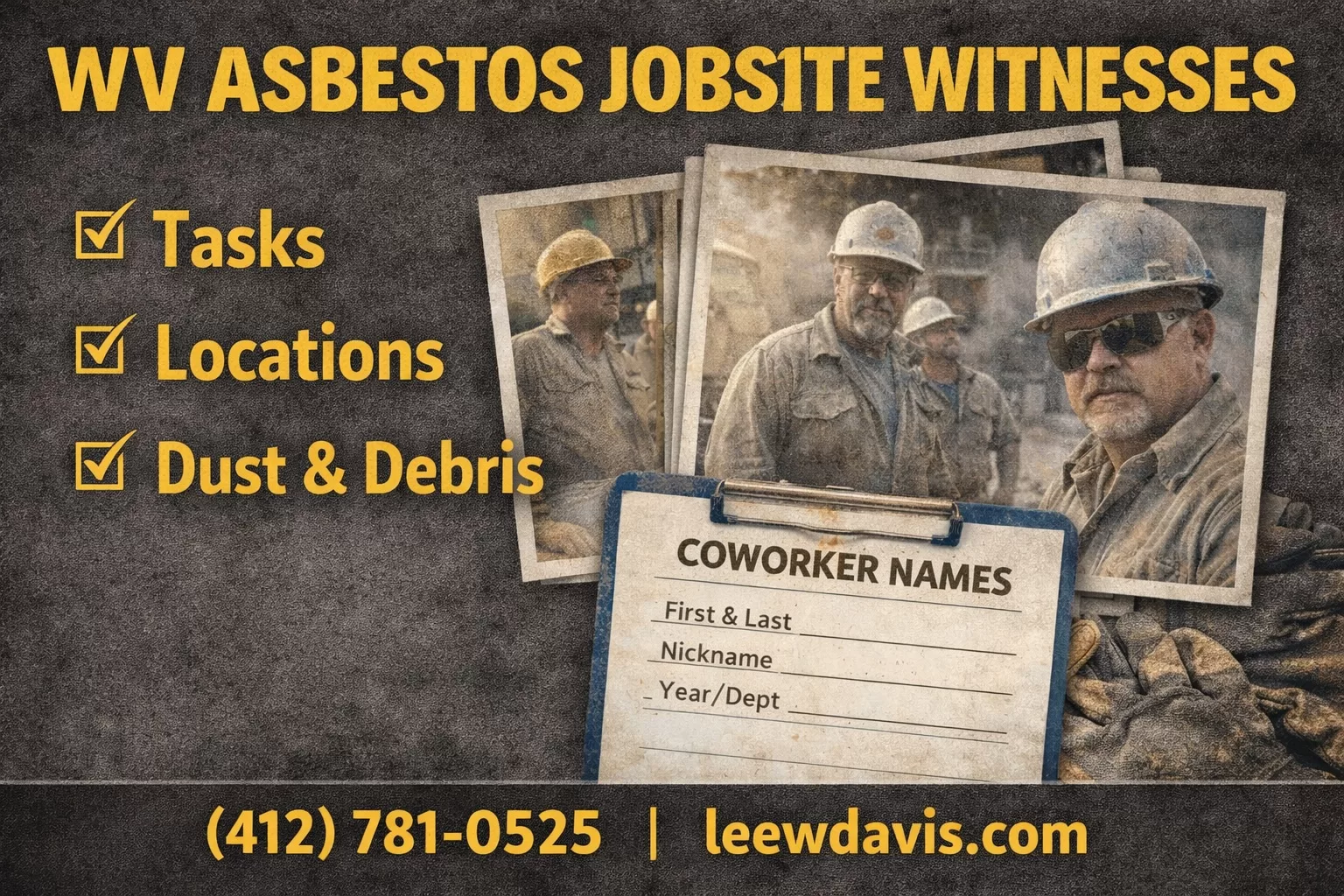
If you’re building an asbestos case, WV Asbestos Jobsite Witnesses can be the difference between a claim that “sounds right” and a claim that proves exposure. Records often show where you worked and when—but witnesses help show what you did, what products were present, and how dusty the work really was. In West Virginia asbestos litigation, credible coworker testimony can help connect the jobsite to specific exposure sources.

Why jobsite witnesses matter in WV asbestos claims

A strong witness can help confirm:

  • The jobsite layout (boiler rooms, pipe chases, turbine decks, maintenance shops, refractory areas)
  • The tasks performed (cutting gaskets, mixing insulation/cement, removing lagging, grinding packing)
  • The products used (brand names, packaging, colors, common nicknames on the crew)
  • Who supplied or installed materials (contractors, maintenance teams, outside vendors)
  • When the dusty work happened (shutdowns/turnarounds, outages, demolition, retrofits)

👉 Search Asbestos Job Sites in West Virginia

Even when someone can’t remember a brand name, a witness can often describe the routine: “We replaced pipe covering during outages,” “we pulled old insulation off valves,” or “we swept debris after the insulators finished.” Those details can matter.

Who counts as a “witness”?

Jobsite witnesses aren’t limited to a person who worked your exact job. Useful witnesses include:

  • Coworkers on the same crew
  • Workers in nearby trades (pipefitters, boilermakers, electricians, millwrights, laborers)
  • Supervisors or foremen who tracked job assignments
  • Union hall contacts who can help locate members
  • Family members who observed dusty work clothes and routines (in some cases)

The best witnesses are typically the ones who can place you at the site and describe specific tasks, locations, and time periods.

How to find WV Asbestos Jobsite Witnesses

Start with the simplest list-building first—then work outward.

1) Build your “who list” (names you already know)

  • Full names (even partials help)
  • Nicknames used on the job
  • Crew names or supervisors
  • Contractors you worked alongside

2) Build your “where list” (sites and areas)

  • Facility name and city
  • Unit numbers, departments, or buildings
  • Shutdown/outage periods
  • Maintenance shops or warehouses you reported to

3) Use union and trade networks

If you were in a union trade, the hall may not hand over personal info—but it can sometimes help pass along a message to a member or retiree group. Retiree breakfasts and trade Facebook groups can also surface leads.

4) Use old paperwork as a map

Even “boring” documents can be a witness-finder:

  • Pay stubs / W-2s / tax returns (employer confirmation)
  • Job badges or safety cards
  • Work orders, toolbox sheets, outage rosters
  • Benefit statements or pension records

5) Think in “nearby trades”

If you were a mechanic, the insulators and pipefitters were probably nearby. If you were a laborer, you were likely cleaning up behind multiple trades. Often, the best witness is the person who did the dusty task—even if you didn’t.

What you should ask a witness (the practical checklist)

When you reach someone, keep it simple and specific. You want statements about:

  • Timeframe: years/months, outages, shutdowns, major projects
  • Location: which building, unit, floor, room, department
  • Task: what work was performed and how often
  • Dust: visible dust, cleanup methods, ventilation, sweeping, compressed air
  • Products: any remembered names, packaging, or descriptions
  • Your role: what they saw you doing and where you worked

A good witness doesn’t need perfect memory—they need credible, consistent detail.

Common witness problems (and how to handle them)

  • “I don’t remember brands.” That’s common. Task/area/timeframe still helps.
  • “I don’t want to get involved.” Many people fear hassle. Keep the request narrow and respectful.
  • “We were there decades ago.” True—and that’s why you document what you can now, while people are still reachable.

Quick next step

If you’re not sure who to contact first, start with one jobsite and one time window—then build outward. The goal is to assemble a clean, believable exposure narrative supported by records and real-world jobsite testimony.

Talk to Lee about your witness plan. Call (412) 781-0525 to discuss how to locate and use WV Asbestos Jobsite Witnesses to support your claim.

Check If Your Family Was Exposed

Get your free guide instantly + a confidential case review.

🔒 100% Confidential. No obligations.

FAQs

1) Who are the best WV Asbestos Jobsite Witnesses to use?

The strongest witnesses are usually coworkers who worked near you during the same time period and can describe the tasks, locations, and dusty conditions—even if they can’t recall product brand names.

2) What if I can’t remember anyone’s full name?

Start with partial names, nicknames, job titles, supervisors, and the contractor/company names. Old pay stubs, W-2s, union records, and badge photos can help rebuild a witness list.

3) Do witnesses have to be in West Virginia to help a WV claim?

No. A witness can live anywhere. What matters is whether they can credibly confirm exposure facts tied to a West Virginia jobsite, time window, and work duties.

4) What if a witness is worried about getting involved?

That’s common. Keep it narrow: they may only need to confirm basic facts (jobsite, timeframe, work areas, and typical tasks). A lawyer can handle the process and limit the burden on the witness.

5) Can family members be witnesses?

Sometimes. Family members can often describe dusty work clothes, laundering routines, and symptoms timeline. In many cases, coworker/jobsite witnesses are still the most valuable for proving workplace exposure.

Mesothelioma/Asbestos Legal Help – WV, MI & PA

Speak directly with attorney Lee W. Davis. No call centers. Free, confidential review.

WV Asbestos Defendant Identification

WV Asbestos Defendant Identification

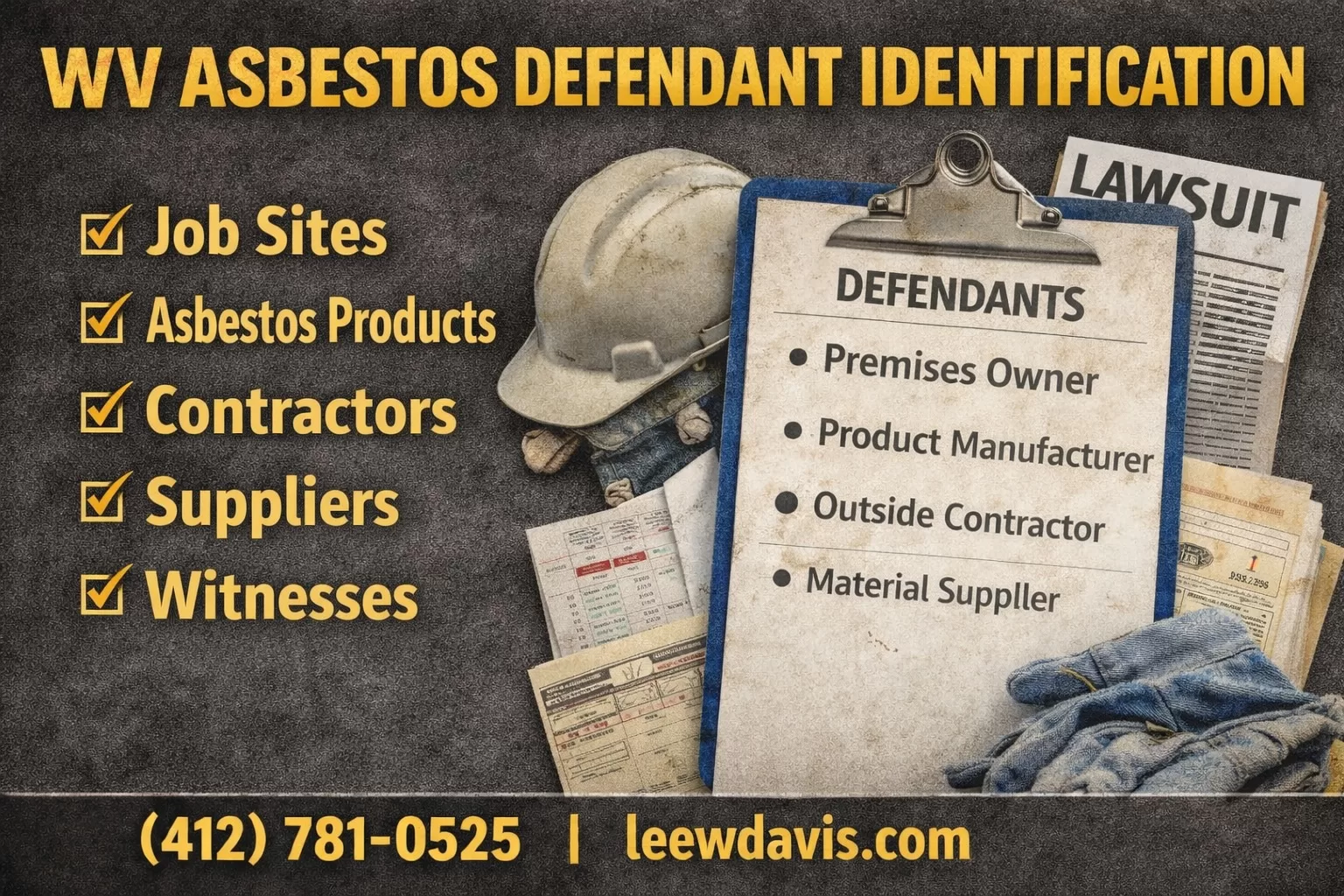
WV Asbestos Defendant Identification is the step that turns a general exposure story into a case you can actually file. In West Virginia asbestos litigation, the question is rarely “Was there asbestos?”—it’s usually which companies are legally responsible for the asbestos you breathed and the disease that followed.

Mesothelioma/Asbestos Legal Help – WV, MI & PA

Speak directly with attorney Lee W. Davis. No call centers. Free, confidential review.

This checklist is designed to help you identify potential defendants based on products, job sites, contractors, and supply chains, even if the work happened decades ago.

1) Start with your jobsite list (not your diagnosis)

Defendant ID begins with where you worked and what you did, not just what you were diagnosed with.

Create a simple timeline:

  • Employer and location (plant, mine, refinery, mill, shipyard, power station)
  • Your trade and tasks (pipefitter, electrician, insulator, boilermaker, mechanic, laborer)
  • Years on-site (even rough ranges help)
  • Departments/units (boiler room, turbine deck, maintenance shop, coke ovens, machine room)

A strong timeline helps connect you to the specific materials historically used in those areas.

👉 Search Asbestos Job Sites in West Virginia

2) Identify asbestos-containing product categories you likely encountered

You don’t always need a brand name on Day 1. You need product type + task + location.

Common product categories that generate defendants include:

  • Pipe insulation and block insulation
  • Boiler/turbine insulation and refractory
  • Gaskets, packing, and seals
  • Cement, mud, and joint compounds
  • Fireproofing and spray-on insulation
  • Asbestos cloth, rope, tape, and gloves
  • Brake/clutch components (heavy equipment, locomotives, industrial vehicles)

Write down what you remember seeing (color, texture, packaging, nicknames on site). Small details become big later.

3) Separate “premises” from “product” defendants

West Virginia cases often involve multiple defendant types.

Typical defendant buckets:

  • Premises owners/operators (who controlled the site and safety policies)
  • Product manufacturers (made the asbestos-containing materials)
  • Distributors/suppliers (sold or delivered the materials)
  • Contractors (installed/removed insulation, performed maintenance shutdowns, demolition, abatement)

Your claim may involve one bucket—or several—depending on the jobsite and time period.

4) Use contractor shutdown history as a roadmap

Many exposures happen during:

  • Turnarounds/shutdowns
  • Boiler rebuilds
  • Turbine outages
  • Refractory tear-outs
  • Demolition and retrofits

If you remember a shutdown, recall:

  • Which outside contractors were there
  • What they were removing/repairing
  • Whether dust controls were used (often not)
  • Whether your crew worked alongside them

Contractors can matter because they identify who installed what, and sometimes they controlled the work zone.

5) Don’t ignore the supply chain

Even if a product was manufactured by Company A, you may have claims tied to:

  • The supplier that sold it to the facility
  • The distributor that repeatedly stocked it
  • The maintenance contractor that specified it

This is why purchase records, maintenance logs, and vendor lists (when available) can be valuable.

6) Witnesses and coworkers are often the missing link

If you’re unsure about brands, defendants, or even exact time frames, start building a witness list:

  • Coworkers (same crew, adjacent crews, shutdown crews)
  • Supervisors/foremen
  • Safety officers or maintenance planners
  • Union hall contacts (who can confirm contractors and assignments)

A credible witness can confirm product presence and work conditions—two keys for defendant identification.

7) “I don’t remember brands” is normal—and workable

Most clients don’t remember the name on a box from 1978. That’s why this process relies on:

  • Work history + location
  • Task-based exposure logic
  • Jobsite knowledge and historical product use
  • Witness support and records where available

The point is to build enough structure that the defendant list becomes clear.


Quick intake checklist

  • Primary job sites (name + city/state)
  • Years at each job site
  • Trade and typical tasks
  • Where you worked (boiler room, maintenance shop, etc.)
  • Materials you cut/sanded/removed
  • Outside contractors you remember
  • Names of 3–5 coworkers who can confirm conditions

Call Now

If you want help narrowing down the right defendants, call (412) 781-0525. The sooner we map your work history and product exposure, the sooner we can identify responsible companies and move your West Virginia asbestos claim forward.

Check If Your Family Was Exposed

Get your free guide instantly + a confidential case review.

🔒 100% Confidential. No obligations.

WV Asbestos Exposure Timeline

WV Asbestos Exposure Timeline

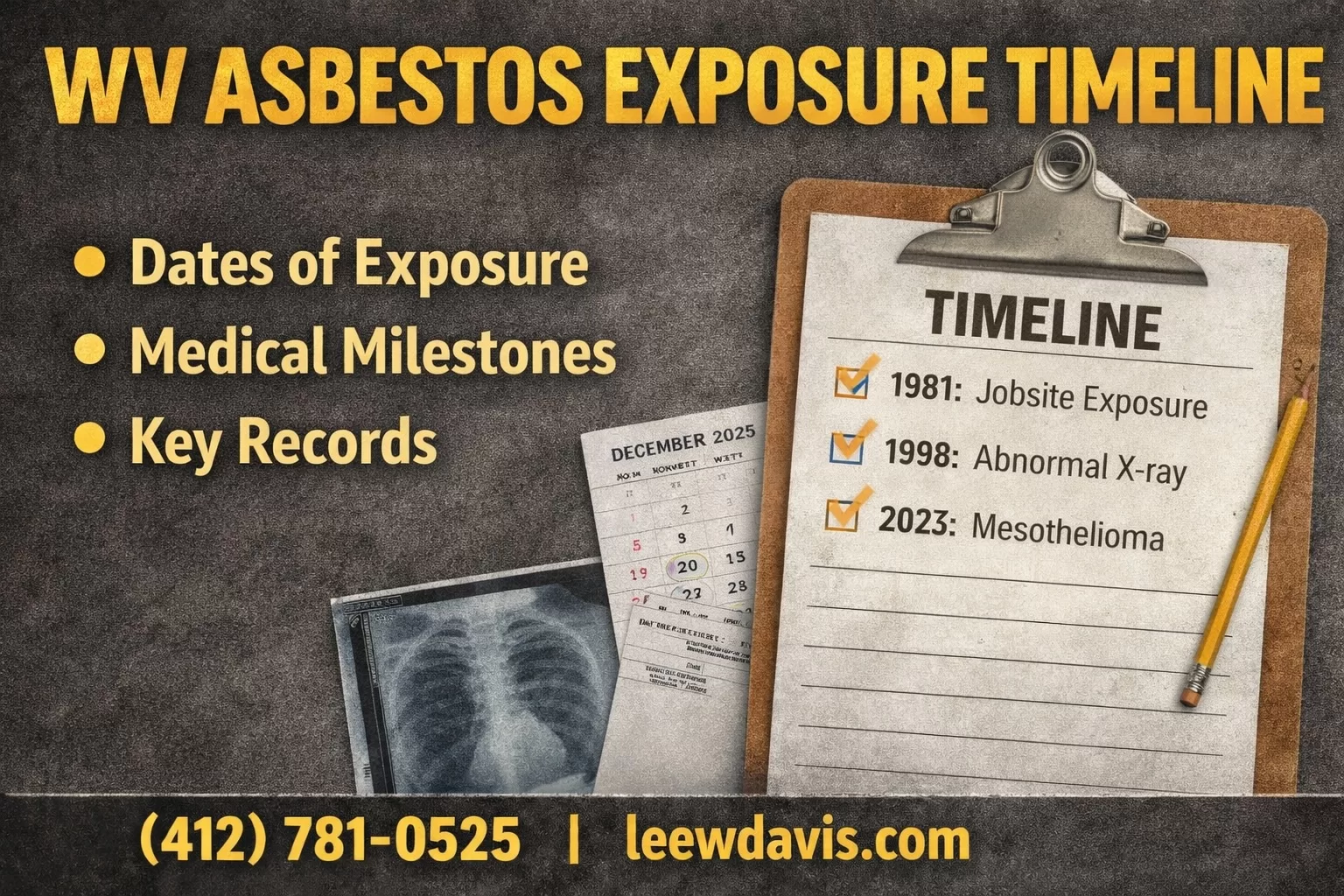
When a client calls about asbestos exposure, one of the first things I do is build a clear WV Asbestos Exposure Timeline. The timeline often determines what evidence we need, which companies may be responsible, and whether filing deadlines are still open.

Here’s the practical way to think about it: asbestos cases are not like a car crash where the injury happens the same day. Most asbestos diseases develop over time—so the “timeline” is really about exposure history, medical milestones, and key documentation dates.

Mesothelioma/Asbestos Legal Help – WV, MI & PA

Speak directly with attorney Lee W. Davis. No call centers. Free, confidential review.

What an asbestos timeline usually includes

A good WV Asbestos Exposure Timeline isn’t complicated, but it must be complete. I typically look for:

  • First exposure date (or best estimate)
  • Last exposure date (or best estimate)
  • Work sites and job titles tied to each time period
  • Products used or worked near (insulation, gaskets, packing, cement, refractory, etc.)
  • Co-workers or witnesses who can confirm conditions
  • Any secondary documentation (union records, Social Security earnings, apprenticeship history)

Even if you can’t remember every date, we can often build the timeline using employment records and other sources.

Medical dates that matter

Your medical history becomes the backbone of the timeline. Key dates often include:

  • First symptoms (shortness of breath, chest pain, fatigue, cough)
  • First abnormal imaging (X-ray/CT)
  • Specialist referrals (pulmonology/oncology)
  • Diagnosis date (mesothelioma or another asbestos-related disease)
  • Biopsy/pathology date (if applicable)
  • Treatment start dates (surgery, chemo, radiation, immunotherapy)

These records help establish both causation and the seriousness of the disease, and they help defend the case if an insurer tries to claim “it’s something else.”

Why the timeline affects deadlines

In West Virginia asbestos litigation, the ability to bring a claim often depends on when the injury was discovered and when you knew or should have known it was related to asbestos exposure. That’s why the WV Asbestos Exposure Timeline matters: it connects exposure history to diagnosis and supports a legally defensible filing window.

If a family is pursuing a wrongful death claim, the timeline also expands to include the date of death and key probate/estate dates.


Common timeline mistakes that hurt claims

These are issues I see over and over:

  • Waiting too long to request medical and employment records
  • Relying only on memory and not documenting sites/products
  • Leaving out short jobs or “in-between” work that involved exposure
  • Not preserving witness names early
  • Not writing down dates of diagnosis and major medical events

A timeline doesn’t need to be perfect on day one—but it should be started immediately.

What to do right now

If you suspect asbestos exposure, start your WV Asbestos Exposure Timeline today:

  1. Write down every jobsite you can remember (even brief ones).
  2. List your job titles and what you did day-to-day.
  3. Make a list of co-workers who saw the same conditions.
  4. Gather your medical records (imaging, pathology, oncology notes).
  5. Save any old photos, badges, pay stubs, or union paperwork.

👉 Search Asbestos Job Sites in West Virginia

Talk to a West Virginia asbestos lawyer

If you or a loved one has been diagnosed with mesothelioma or another asbestos-related disease, I can help you put the WV Asbestos Exposure Timeline together and identify what evidence matters most.

Call (412) 781-0525 or visit leewdavis.com to discuss your situation and next steps.

Check If Your Family Was Exposed

Get your free guide instantly + a confidential case review.

🔒 100% Confidential. No obligations.


FAQs

1) What if I can’t remember exact dates?

That’s common. We can often reconstruct your WV Asbestos Exposure Timeline using Social Security earnings, union records, personnel files, and witness statements.

2) Does one jobsite matter more than others?

Sometimes. A single heavy-exposure jobsite can be key, but multiple sites can strengthen causation and broaden liability.

3) Should I wait until I have all records before calling?

No. Call first. We can help you identify what to request and what dates matter so you don’t lose time

Mesothelioma/Asbestos Legal Help – WV, MI & PA

Speak directly with attorney Lee W. Davis. No call centers. Free, confidential review.

WV Asbestos Medical Records

WV Asbestos Medical Records

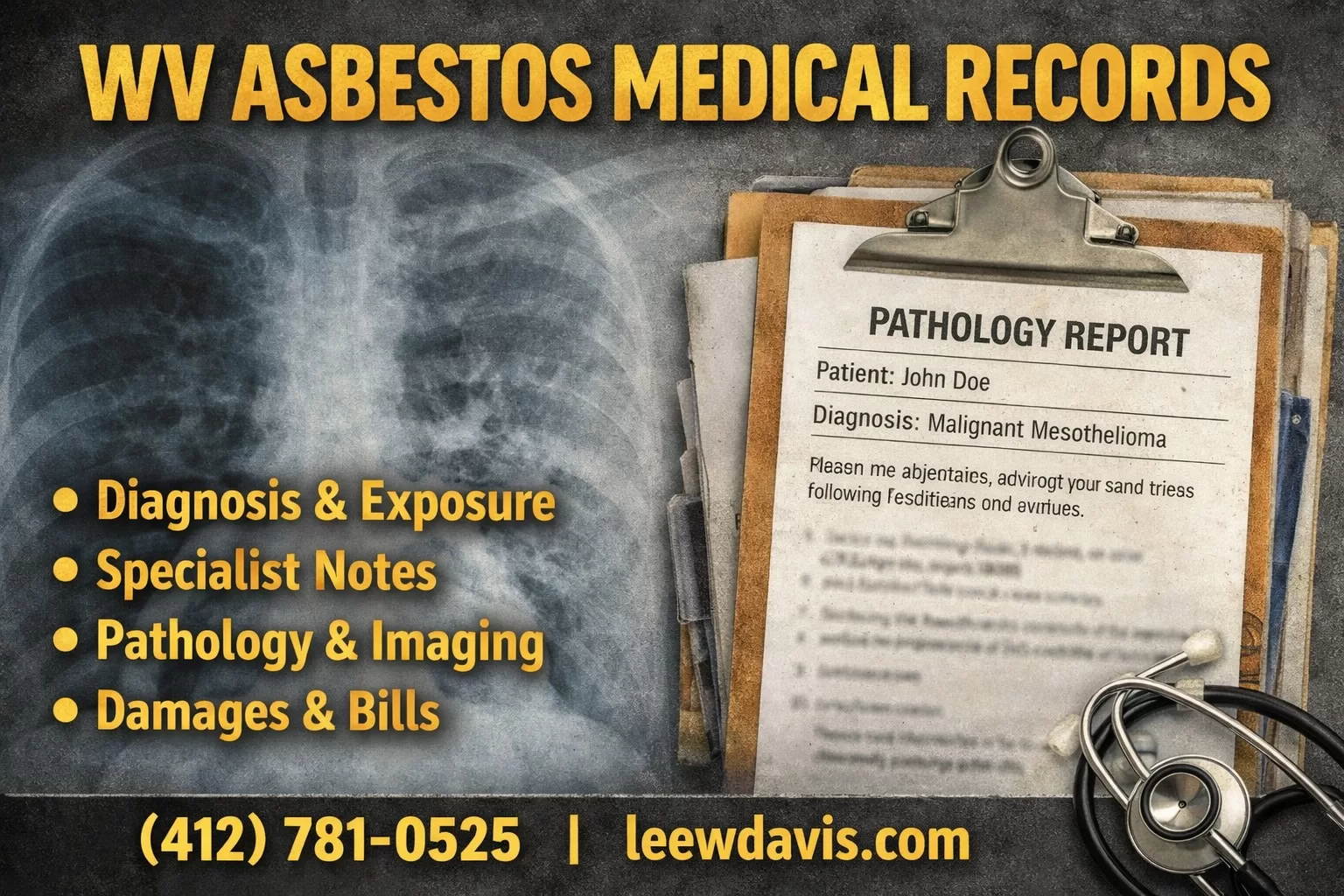
WV Asbestos Medical Records can make or break a claim because they help prove three things: diagnosis, causation, and damages. If you (or a family member) have mesothelioma, asbestos lung cancer, or another asbestos-related disease, the right medical documentation is often what connects the dots between exposure, the condition, and the real-world impact on work and life.

Mesothelioma/Asbestos Legal Help – WV, MI & PA

Speak directly with attorney Lee W. Davis. No call centers. Free, confidential review.

Below is a practical checklist of what to gather, why it matters, and how we help clients organize it quickly.

Why WV Asbestos Medical Records matter

Insurance adjusters, defendants, and trust administrators don’t “take your word for it.” They look for records that establish:

  • A clear diagnosis (what you have, when you were diagnosed, and how it was confirmed)
  • A medically supported link to asbestos (occupational/environmental history and physician notes)
  • The scope of harm (treatment, complications, limitations, and prognosis)

If your records are incomplete, inconsistent, or scattered across multiple facilities, the case can stall—or the value can drop.

WV Asbestos Medical Records checklist

Here are the records we typically want to see early:

1) Diagnostic proof

  • Pathology reports (biopsy results are often the “gold standard”)
  • Cytology reports (pleural fluid/peritoneal fluid findings, if applicable)
  • Imaging: CT scans, PET scans, X-rays (plus radiology reports)
  • Pulmonary function tests (PFTs), if lung impairment is part of the case

2) Treating physician and hospital records

  • Oncology, pulmonology, thoracic surgery, GI, and primary care notes
  • Hospital admissions/discharge summaries
  • Operative reports (if surgery occurred)
  • Treatment timeline: chemo/immunotherapy/radiation protocols and outcomes

3) Exposure and history documentation inside the chart

This is where a lot of cases quietly win or lose.

  • “History of present illness” notes referencing asbestos exposure
  • Occupational history captured by physicians
  • Smoking history (if any), documented accurately and consistently

4) Proof of damages

  • Work restrictions/disability notes
  • Home oxygen records (if applicable)
  • Pain management records
  • Bills, EOBs, and out-of-pocket documentation (we’ll tell you what actually matters)


How to request WV Asbestos Medical Records fast

Most providers can produce records if you submit a written request and HIPAA authorization. Common tips:

  • Request the full chart, not just a “summary.”
  • Ask for pathology slides/blocks if needed (separate process from ordinary records).
  • Pull records from every facility involved—diagnosis site, treating hospital, specialists, and imaging centers.

If you’re overwhelmed, that’s normal. Our office can help coordinate requests and identify gaps.

What if the patient has passed away?

You can still obtain key WV Asbestos Medical Records through the proper estate representative or authorization. In wrongful death cases, we also look for:

  • Terminal hospitalization records
  • Hospice records
  • Death certificate and related medical documentation

(If helpful, you can also review: West Virginia asbestos claims and asbestos lawsuits in West Virginia pages for the bigger picture and filing steps.)

Call for help organizing your records

If you want, we’ll review what you already have, tell you what’s missing, and map out the fastest way to complete the file without wasting time.

Call (412) 781-0525 to discuss your situation with Law Offices of Lee W. Davis, Esquire, P.L.L.C. You can also start with a short intake and we’ll take it from there.

Check If Your Family Was Exposed

Get your free guide instantly + a confidential case review.

🔒 100% Confidential. No obligations.


FAQs

What WV Asbestos Medical Records are most important?

Pathology (biopsy) reports, imaging reports (CT/PET), and specialist notes documenting diagnosis and exposure history are usually the most important.

Do I need records from decades ago?

Not always. We focus on the records that prove diagnosis and link the disease to asbestos exposure, plus the documents that show damages. Older records can help in some situations, but we’ll prioritize what moves the case forward.

Can my family gather WV Asbestos Medical Records for me?

Often yes, with proper written authorization. If the patient is deceased, the estate representative can typically obtain records with the appropriate documentation.

What if my records don’t mention asbestos exposure?

That’s common. We can still build the exposure case using work history, jobsite evidence, co-worker statements, and other documentation—while ensuring the medical file supports diagnosis and damages.

Mesothelioma/Asbestos Legal Help – WV, MI & PA

Speak directly with attorney Lee W. Davis. No call centers. Free, confidential review.

WV Asbestos Work History

WV Asbestos Work History

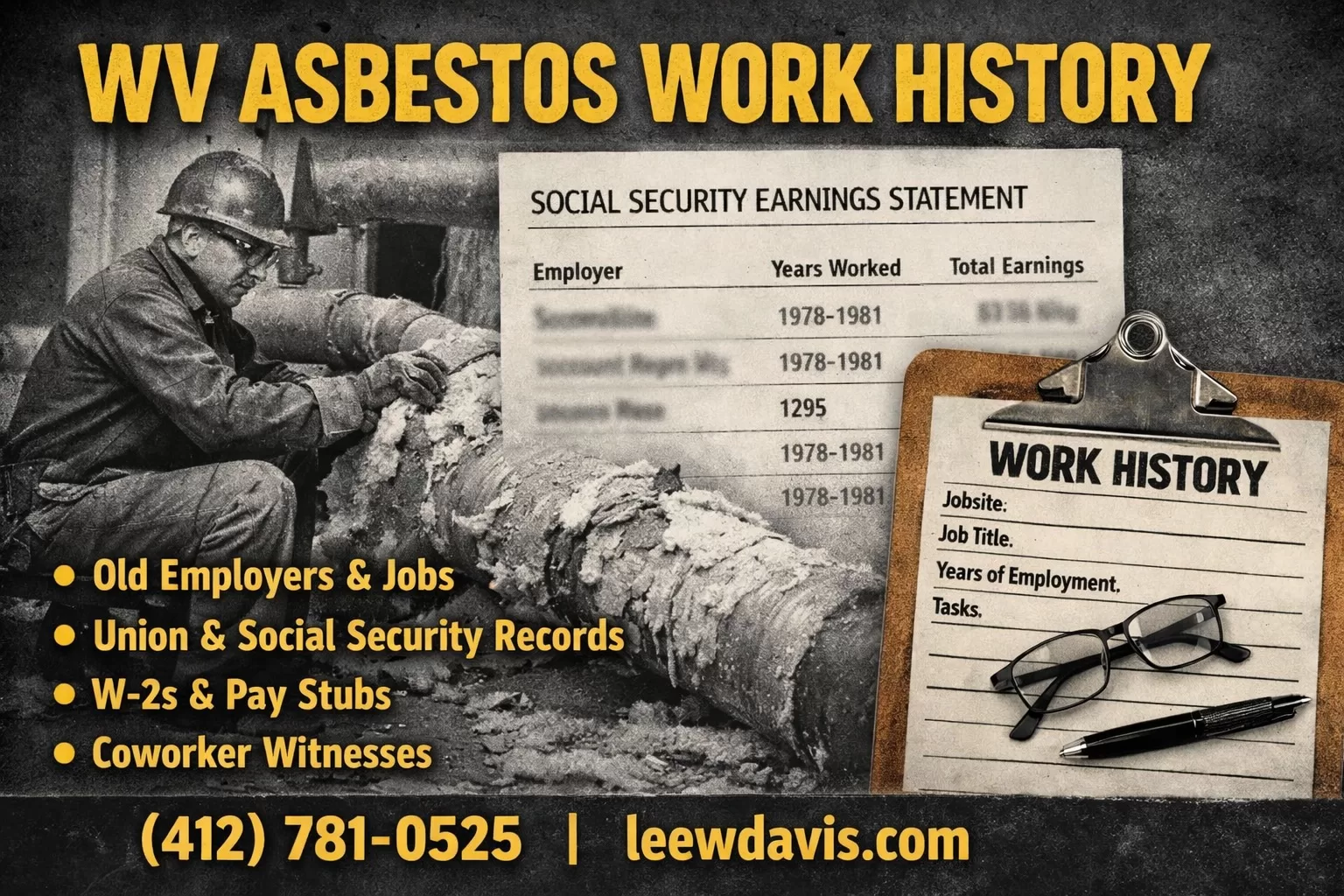
If you’re building a West Virginia asbestos claim, WV Asbestos Work History is often the backbone of the case. The diagnosis matters, but the legal question is usually practical: where did the exposure happen, what work were you doing, and who supplied the asbestos products at that jobsite? A strong work history does not have to be perfect on day one. It just has to be organized, truthful, and detailed enough to identify the most likely exposure sources.

Mesothelioma/Asbestos Legal Help – WV, MI & PA

Speak directly with attorney Lee W. Davis. No call centers. Free, confidential review.

What “work history” means in an asbestos case

In an asbestos case, your work history is more than a résumé. It’s a timeline that connects:

  • Employer(s) and job locations
  • Job titles and tasks (what you physically did)
  • Trades and crews you worked around (pipefitters, insulators, electricians, boilermakers, laborers, maintenance)
  • Products and equipment you handled or were near (insulation, gaskets, packing, cement, refractory, boilers, turbines, valves, pumps)
  • Dates (even approximate ranges help)

A “good enough” work history usually includes the who, where, what, and when—and then we build the “what products” and “which defendants” from there.

👉 Search Asbestos Job Sites in West Virginia

Start with your best timeline (even if it’s incomplete)

Most people don’t remember everything at once—especially if the exposure was decades ago. Here’s how to build it fast:

1) List every employer and jobsite you can remember.

Write it in chronological order. If you’re unsure of dates, use approximate ranges (e.g., “1978–1981” or “early 1980s”).

2) Add your job title and tasks at each place.

Don’t just say “maintenance.” Say what that meant: changing gaskets, scraping flanges, replacing pipe insulation, cutting transite, sweeping debris, repairing boilers, working shutdowns/turnarounds.

3) Identify the “high-dust moments.”

Asbestos cases often turn on the messy, routine work: teardown, cleanup, grinding, wire-brushing, removing old insulation, pulling old gasket material, mixing dry powders.

4) Add coworker names.

Even one or two names per jobsite can matter. Coworkers help confirm work areas, products, and how the work was done.


Documents that help prove WV Asbestos Work History

You can prove work history in several ways. The goal is corroboration—multiple sources that line up.

  • Social Security Earnings Statement (often the quickest way to confirm employers/years)
  • Union records (hall dispatches, benefit records, pension records, membership history)
  • W-2s, pay stubs, tax returns (even a few years help)
  • Personnel files from the employer (if available)
  • Safety training records or job badges
  • Medical intake records that list prior employment
  • Worksite records (turnaround logs, contractor logs, purchase orders—often discovered later)

If you don’t have paperwork, that does not end the case. Many legitimate claims start with memory, then get supported through records and witness proof.

The most important details to write down right now

If you do nothing else today, make sure you capture these specifics while they’re fresh:

  • The exact plant name (or best description) and city/county
  • Your department/area (boiler room, powerhouse, mill floor, maintenance shop, coke works, pump house)
  • The type of work you did during shutdowns or repairs
  • Any brands you remember (even partial names)
  • Whether you worked around insulators or refractory crews
  • Whether the work created visible dust

Why work history wins cases

A clear, credible WV Asbestos Work History helps your lawyer:

  • Identify the right defendants (manufacturers, suppliers, contractors)
  • Match you to known jobsite asbestos exposures
  • Find and prepare coworker witnesses
  • Build the exposure narrative that explains how asbestos was encountered
  • Move faster toward settlement leverage by proving exposure sources early

Call to discuss your work history

If you have a diagnosis and even a rough job timeline, we can start organizing it into a claim-ready format.

Law Offices of Lee W. Davis, Esquire, P.L.L.C.

(412) 781-0525 | leewdavis.com

Consultations are confidential.

Check If Your Family Was Exposed

Get your free guide instantly + a confidential case review.

🔒 100% Confidential. No obligations.


FAQs

1) What if I can’t remember exact dates for each job?

That’s common. Approximate ranges are usually enough to start. Records (Social Security, union, tax) can tighten dates later.

2) What if the company is closed or the jobsite is gone?

You may still have a claim. Exposure proof often comes from jobsite history, product evidence, and coworker testimony—not just the employer’s current status.

3) Do I need proof that I personally handled asbestos?

Not always. Many cases involve working around asbestos work—insulation removal, gasket scraping, refractory tear-out, or dusty maintenance work in enclosed areas.

4) Should I write down product names even if I’m unsure?

Yes—note what you remember and mark it as “best recollection.” Partial details can still help identify the right product families and suppliers.

Mesothelioma/Asbestos Legal Help – WV, MI & PA

Speak directly with attorney Lee W. Davis. No call centers. Free, confidential review.

WV Asbestos Claim Settlement

WV Asbestos Claim Settlement

A WV Asbestos Claim Settlement is rarely “one-size-fits-all.” The value of an asbestos case is usually driven by what you can prove—diagnosis, exposure history, and the documents that connect the two—plus timing and where the claim must be filed. If you’re trying to understand whether a claim is strong, the right question is not “How much is it worth?” but “Do we have the proof that moves the number?”

If you want an experienced review of your work history and evidence, call (412) 781-0525 for a confidential consultation.

Mesothelioma/Asbestos Legal Help – WV, MI & PA

Speak directly with attorney Lee W. Davis. No call centers. Free, confidential review.

WV Asbestos Claim Settlement Factors That Matter Most

1) Diagnosis and medical proof

A settlement starts with clear medical documentation. Pathology reports, imaging, oncology notes, and treatment records tend to carry the most weight. In mesothelioma cases, the specific diagnosis (and documentation supporting it) is the cornerstone.

Practical tip: keep a single folder with the diagnosis date, the diagnosing provider, and the facility. That date often matters for deadlines.

2) Work history that “anchors” exposure

A WV Asbestos Claim Settlement gets stronger when the work history is specific: employer, job title, dates, locations, departments/units, and what you worked on. “I worked at a plant” is a start. “I worked maintenance in the boiler room from 1978–1986 and replaced gaskets/insulation weekly” is the kind of detail that supports liability and value.

3) Product identification and trade overlap

Many cases rise or fall on whether we can identify asbestos-containing products, insulation systems, or equipment associated with known asbestos components. Even when a person can’t name a product from memory, other evidence can help—co-worker statements, union/trade records, purchase records, and jobsite-specific patterns.

4) Corroboration: documents that are boring but decisive

Settlement value increases when “soft proof” becomes “hard proof.” Examples:

  • Social Security earnings histories
  • Union/benefit records
  • Personnel files
  • Work orders, maintenance logs, job cards
  • Old photos showing equipment labels or work areas
  • Credible witness statements from co-workers or supervisors

5) Timing and deadline compliance

Deadlines can be unforgiving. If a claim is filed late—or if the proof is assembled late—leverage drops. A well-supported claim that is prepared early typically negotiates better than a claim that’s rushed at the end.

If you’ve never looked at the bigger WV overview pages, these help frame the process:


How to Strengthen a WV Asbestos Claim Settlement

Build a clean “evidence stack”

Think of your proof in three layers:

  1. Medical proof (diagnosis + treatment)
  2. Exposure proof (work history + tasks + locations)
  3. Link proof (products/equipment/co-workers/documents tying exposure to asbestos sources)

When all three layers are present, settlement discussions become more concrete—and less speculative.

Don’t wait for “perfect” proof to start

People lose time chasing one missing detail. The best approach is to start with what you have, then build. Often, once a case is organized correctly, the missing links become obvious and obtainable.

When wrongful death changes the analysis

A WV Asbestos Claim Settlement looks different when the case involves a death. The evidence categories expand and the stakes rise, especially regarding medical records, timeline proof, and family documentation. If you’re dealing with a fatal exposure case, this related page may be helpful: https://leewdavis.com/mesothelioma-wrongful-death-claim/

Mesothelioma/Asbestos Legal Help – WV, MI & PA

Speak directly with attorney Lee W. Davis. No call centers. Free, confidential review.


FAQs

What evidence matters most for a WV Asbestos Claim Settlement?

The strongest cases usually have (1) clear medical diagnosis documentation, (2) specific work history (dates, sites, tasks), and (3) corroboration—union records, earnings history, co-worker proof, or documents showing asbestos-containing products at the jobsite.

Can I still have a case if I can’t name the exact asbestos product?

Yes. Many valid cases are built through jobsite evidence, trade patterns, co-worker statements, and historical documentation. Product identification helps, but it’s not always limited to personal memory.

How long does a WV asbestos case take to resolve?

It depends on diagnosis severity, complexity of exposure history, available documentation, and where the case must be filed. Cases with organized proof generally move faster than cases that require reconstruction from scratch.


Call for a confidential case review

If you want an experienced review focused on WV Asbestos Claim Settlement value drivers—diagnosis, exposure proof, and the evidence that actually moves negotiations—call Law Offices of Lee W. Davis, Esquire, P.L.L.C. at (412) 781-0525.

Check If Your Family Was Exposed

Get your free guide instantly + a confidential case review.

🔒 100% Confidential. No obligations.

WV Asbestos Claim Evidence: What Actually Proves Your Case

WV Asbestos Claim Evidence

If you’re pursuing a claim after an asbestos disease diagnosis, WV Asbestos Claim Evidence matters more than almost anything else. Claims rise and fall on whether the proof is organized, consistent, and tied to specific job sites, products, and time periods—especially when exposure happened decades ago.

The good news: most strong claims are built from practical evidence you can gather and preserve now, even if your former employer is gone or records are incomplete.

Mesothelioma/Asbestos Legal Help – WV, MI & PA

Speak directly with attorney Lee W. Davis. No call centers. Free, confidential review.

Start with the “core three” categories of proof

1) Work history and jobsite details

The most important evidence is a clean work history that answers: where, when, and what you did.

Helpful items include:

  • A timeline of employers, job titles, and dates (even approximate)
  • Job sites in West Virginia (plants, mills, power stations, chemical facilities, schools, shipyards)
  • Trades and tasks (pipefitting, insulation work, boilermaking, maintenance, tear-outs, gasket work)
  • Names of supervisors, foremen, or coworkers who remember the work

If you can write a solid timeline from memory, that’s often the foundation that allows everything else to snap into place.

👉 Search Asbestos Job Sites in West Virginia

2) Medical evidence (diagnosis + causation support)

A claim needs proof of the disease and treatment course. Key items include:

  • Pathology reports and diagnostic imaging reports
  • Oncology/pulmonology records
  • Treatment summaries (chemo, surgery, radiation)
  • Disability notes and prognosis details, when relevant

For wrongful death cases, you also want:

  • Death certificate and cause-of-death information
  • Hospital records near the end of life

3) Product and exposure evidence

This is where claims get won—linking the work to asbestos-containing materials and the circumstances of exposure.

Evidence can include:

  • Brand names remembered (insulation, refractory, gaskets, packing, cement, brake materials, etc.)
  • Maintenance logs, purchase orders, or old invoices (when available)
  • Photos from job sites, toolboxes, or old work areas
  • Safety manuals, training documents, or jobsite hazard policies

Even if you don’t have “perfect” product ID, you can often build it through coworkers, jobsite patterns, and standard materials used at that facility.


The “supporting” evidence that strengthens credibility fast

  • Coworker statements (who saw the dust, the tear-outs, the materials used)
  • Union records (locals, dispatch records, benefit records)
  • Social Security earnings history (helps confirm where you worked and when)
  • Personnel files (job titles, departments, transfer history)
  • Old resumes, calendars, notebooks, pay stubs, W-2s
  • Family testimony (especially for illness progression and damages, and for wrongful-death claims)

Avoid these common evidence mistakes

  • Waiting too long to write down names, job sites, and dates
  • Relying on a single document when the case needs a full story
  • Mixing up facilities or time periods (easy to do after 30–40 years)
  • Not preserving medical records early (providers purge or archive)
  • Assuming the other side will “find it”—they won’t

What to do today: a simple evidence checklist

  1. Write a one-page timeline: employers, job sites, dates, tasks
  2. List 5–10 coworkers or supervisors (names + any contact info)
  3. Gather medical records: diagnosis + pathology + treatment summary
  4. Pull SSA earnings history (or at least identify employers accurately)
  5. Collect any photos, union cards, old pay stubs, and job documents

Talk to a lawyer before you “organize away” something important

Evidence strategy is not just collecting paper—it’s deciding what matters, what must be proven, and how to present it consistently. If you’re in West Virginia and dealing with mesothelioma or another asbestos disease, getting the evidence plan right early can protect the value of your claim.

If you want help building your evidence package, contact the Law Offices of Lee W. Davis, Esquire, P.L.L.C. We can review your work history, identify missing proof, and map the fastest route to a credible claim.

Free Case Review: Get Your Evidence Organized Now

If you have questions about WV Asbestos Claim Evidence—or you’re not sure what records you need to prove exposure—let’s get it mapped out quickly and correctly.

Call the Law Offices of Lee W. Davis, Esquire, P.L.L.C. at (412) 781-0525 for a confidential case review.

You’ll speak directly with an attorney about your work history, job sites, medical diagnosis, and the fastest way to preserve the proof that matters.


FAQs

What is the most important WV Asbestos Claim Evidence?

Usually, it’s a clear work history tied to specific job sites and tasks—supported by medical proof of diagnosis and records that connect the work to asbestos-containing materials.

What if my employer is gone and I have no records?

Claims can still be proven through coworker statements, union history, Social Security earnings records, and jobsite patterns showing common asbestos materials used at the time.

Do I need the exact product brand name to file a claim?

Not always. Exact brand ID helps, but many cases are built through jobsite evidence, trade practices, witness testimony, and records showing typical asbestos materials used in that location and era.

Mesothelioma/Asbestos Legal Help – WV, MI & PA

Speak directly with attorney Lee W. Davis. No call centers. Free, confidential review.

WV Asbestos Wrongful Death: What Families Need To Know

WV Asbestos Wrongful Death

WV Asbestos Wrongful Death cases exist because mesothelioma and other asbestos diseases often take decades to show up—and by the time a diagnosis comes, families are already dealing with overwhelming medical decisions, fear, and financial pressure. If you lost a spouse, parent, or loved one to mesothelioma, you may have a valid claim even if the asbestos exposure happened long ago.

Mesothelioma/Asbestos Legal Help – WV, MI & PA

Speak directly with attorney Lee W. Davis. No call centers. Free, confidential review.

In West Virginia, wrongful death claims are not “about getting rich.” They are about accountability and making sure the family isn’t left carrying the cost of corporate decisions that exposed workers to asbestos without proper warnings or protection.

When a wrongful death claim makes sense

A WV asbestos wrongful death claim is commonly tied to occupational exposure, including:

  • Power plants, steel mills, chemical plants, and refineries
  • Pipefitting, boiler work, maintenance, insulation, or electrical trades
  • Manufacturing, foundries, and industrial facilities
  • Older construction sites and demolition work involving insulation and fireproofing

Often, the key is work history + product/jobsite identification + medical proof showing an asbestos-related disease.

👉 Search Asbestos Job Sites in West Virginia

What compensation can include

Every family’s loss is different, but these cases typically focus on real-world damages such as:

  • Medical expenses tied to the illness
  • Funeral and burial costs
  • Lost income and lost household services
  • Loss of companionship and guidance
  • Pain and suffering the person experienced before death (where legally available)

The value of a case depends heavily on the exposure evidence, the diagnosis, and the defendants involved—not just the name “mesothelioma.”

What evidence matters most

Even when exposure happened decades ago, you can still build a strong claim. The most helpful items are:

  • A clear employment timeline (employer, dates, job duties, unions/trades)
  • Known job sites and co-worker names (even partial lists help)
  • Medical records confirming an asbestos-related diagnosis
  • Any product identifiers (insulation brands, gaskets, cement, boilers, valves, etc.)

If you don’t have everything, that’s normal. A big part of the lawyer’s job is reconstructing exposure from records, prior testimony, and jobsite knowledge.

Deadlines can still control the case

Even though exposure may be old, the filing deadline is often triggered by the date of death or the date the disease was discovered/confirmed. Waiting can quietly damage a good claim. If you’re even considering a case, it’s worth getting the timeline reviewed now—before records disappear and witnesses become harder to locate.

Talk to a lawyer who handles these cases

If your family is facing a mesothelioma loss, you can start here:

Mesothelioma Wrongful Death Claim (WV guide): https://leewdavis.com/mesothelioma-wrongful-death-claim/

If you’d like to speak directly: (412) 781-0525 or contact us at leewdavis.com.

Check If Your Family Was Exposed

Get your free guide instantly + a confidential case review.

🔒 100% Confidential. No obligations.


FAQs (add these as your 3+ FAQ blocks)

What if my loved one worked around asbestos decades ago?

That’s common. Mesothelioma and other asbestos diseases often have long latency periods, and older exposure can still support a claim.

Do we need to know the exact asbestos product brand?

Not always at the start. Work history, job sites, and job duties can be enough to begin reconstructing exposure and identifying likely defendants.

Can a family file if the person never filed a lawsuit while alive?

Often yes. A wrongful death claim may still be possible even if the person did not pursue a case during their lifetime.

Mesothelioma/Asbestos Legal Help – WV, MI & PA

Speak directly with attorney Lee W. Davis. No call centers. Free, confidential review.

WV Asbestos Lawsuit Deadlines

WV Asbestos Lawsuit Deadlines

If you’re researching WV Asbestos Lawsuit Deadlines, the most important thing to know is this: West Virginia deadlines can depend on the type of claim and when the illness was discovered, not when asbestos exposure happened decades ago. If you want the bigger overview on filing and compensation, start here: Asbestos Lawsuits West Virginia – Filing, Deadlines & Compensation.

This page is general information—not legal advice. Deadlines can turn on specific facts (work history, diagnosis dates, prior claims, and more).

Why WV asbestos deadlines are different than other injury cases

Asbestos diseases (including mesothelioma and certain lung cancers) often appear 20–50 years after exposure. Because of that, West Virginia asbestos cases frequently turn on when you discovered (or reasonably should have discovered) the illness and its likely cause—not the first day you stepped into a plant, mill, or boiler room.

That “timing” question is exactly why WV Asbestos Lawsuit Deadlines should be treated like a checklist, not a guess.

WV Asbestos Lawsuit Deadlines depend on the claim type

Deadlines often vary based on what you’re filing:

Personal injury asbestos claim deadlines

A personal injury claim is typically filed by the person who is living with the diagnosis. In many asbestos cases, the practical trigger date is tied to diagnosis and causation discovery (when you learned it may be asbestos-related).

Key deadline question to document:

  • When was the diagnosis made?
  • When were you first told (or did you first suspect) it could be asbestos-related?

Wrongful death asbestos claim deadlines

A wrongful death claim is filed by the estate/family after a death. These claims usually focus on a different trigger date (commonly the date of death), and they can have different procedural requirements.

Key deadline question to document:

  • Date of death
  • Whether an estate is opened (and who will serve as personal representative)

The “discovery” issue in WV asbestos cases

In real-world asbestos litigation, the timeline often comes down to what you knew and when you knew it—and what records prove it.

Helpful proof can include:

  • Pathology and diagnosis records
  • Notes from oncologists/pulmonologists
  • Occupational medicine records
  • Any written reference to asbestos exposure as a suspected cause
  • Prior workers’ comp filings or benefits paperwork (if any)

If you want a structured overview of what gets filed and what compensation can include, link back to the main guide.

What to do right now if you’re worried about time limits

If someone is searching WV Asbestos Lawsuit Deadlines, it usually means one of two things: a new diagnosis, or the family is trying to act quickly after a death. Either way, here’s the practical sequence that preserves options:

  1. Write down the key dates (diagnosis date, first asbestos discussion, date of death if applicable).
  2. Gather worksite clues (job titles, unions/trades, facility names, contractors, refineries, power stations, steel mills).
  3. Pull medical records early (pathology reports matter).
  4. Avoid delay while “researching online.” A short legal review can prevent a deadline mistake.

For readers who want West Virginia jobsite context, you can also search our WV Asbestos jobsite index: https://leewdavis.com/asbestos-job-sites-in-west-virginia/.

Why deadlines matter even when “trust claims” exist

Some asbestos compensation routes are not traditional lawsuits (for example, certain bankruptcy trust claims). Those can have different requirements and timing rules, and they may still depend on diagnosis dates and proof packages.

That’s another reason to treat WV Asbestos Lawsuit Deadlines as a planning tool: the “right” path depends on exposure facts, medical proof, and who the viable defendants are.


FAQs

What are WV Asbestos Lawsuit Deadlines after a mesothelioma diagnosis?

In many cases, the practical trigger is tied to diagnosis and when you discovered the illness may be asbestos-related. The exact deadline depends on the facts.

Are WV Asbestos Lawsuit Deadlines different for wrongful death cases?

Yes. Wrongful death claims often use a different trigger date and require estate-related steps. The timeline can differ from a living personal injury claim.

If exposure was decades ago, is it too late to file in West Virginia?

Not necessarily. Many asbestos diseases have long latency periods, and the discovery issue can be central. What matters is documenting diagnosis and discovery timing.

What records help prove timing for WV asbestos claims?

Diagnosis/pathology records, physician notes about suspected asbestos causation, work history documents, and any earlier filings that mention asbestos exposure.


Call Lee Directly

If you’re trying to protect a claim and you’re unsure how WV Asbestos Lawsuit Deadlines apply to your situation, you can contact my office for a confidential review. When timing is close, a quick review of dates and records can make the difference.

Mesothelioma/Asbestos Legal Help – WV, MI & PA

Speak directly with attorney Lee W. Davis. No call centers. Free, confidential review.

Contact Lee Now!

Check If Your Family Was Exposed

Get your free guide instantly + a confidential case review.

🔒 100% Confidential. No obligations.

Nitro FMC Asbestos Exposure

Nitro FMC Asbestos Exposure


Nitro FMC Asbestos Exposure can occur when workers or contractors performed maintenance, repairs, or renovation work around industrial equipment where asbestos-containing materials were historically used. If you were later diagnosed with mesothelioma (or another asbestos-related disease) after work connected to the Nitro, West Virginia facility commonly identified as FMC/Great Lakes Chemical in trust jobsite lists, you may still have legal options—especially if records and witnesses are preserved early.

If you or a loved one worked in or around the Nitro plant—especially in maintenance, mechanical work, electrical work, insulation, pipe work, or shutdown projects—this page explains what usually matters most in an asbestos exposure claim and what you can do right now to protect your options.

Free case review

If you have a mesothelioma diagnosis (or another asbestos-related disease) and a work history connected to Nitro, West Virginia, you can request a free, confidential case review.

Call (412) 781-0525 or (855) 397-6640, or use the contact form on this website. You are not obligated to hire the firm to ask questions and get clarity.

Nitro FMC Asbestos Exposure and the jobs most often involved

Nitro FMC Asbestos Exposure cases most often involve jobs where workers were placed close to mechanical systems that historically used asbestos-containing materials—especially during maintenance, demolition, replacement, and rebuild work. This is not about a single “smoking gun” product. It’s about repeated contact with dust and disturbed materials over time.

Trades and roles that commonly show up in asbestos exposure histories include:

Even if you don’t remember a product name, your job duties, work locations, and time period can still support a claim.

What evidence matters in an asbestos claim tied to Nitro

Most people do not have a perfect file cabinet of proof. That’s normal. The goal is to build a reliable work-history picture and match it to medical proof.

Evidence that often helps in a Nitro-area asbestos case includes:

  • Pathology reports and diagnosis records (mesothelioma confirmation)
  • Treating physician records and imaging summaries
  • Employment history, job titles, and dates (including contractor work)
  • Union records, apprenticeship records, or benefit statements
  • Social Security earnings records (often a strong baseline document)
  • Coworker statements that confirm jobsite/work duties
  • Any documents showing the facility name used at the time (FMC / Great Lakes Chemical)

If a case becomes a wrongful death matter, families can often preserve and collect records that the worker never had the chance to gather.

Time limits and why acting quickly matters

Mesothelioma is a long-latency disease. Many people are shocked that exposure from decades ago can still be legally relevant. That is exactly why acting quickly after diagnosis is so important—deadlines may apply, and delay can make evidence harder to obtain.

A case review is not a lawsuit filing. It’s a practical first step to determine what the work history supports and whether a claim is worth pursuing.

Related West Virginia resources

For broader West Virginia asbestos information, you may also want to review:

Mesothelioma/Asbestos Legal Help – WV, MI & PA

Speak directly with attorney Lee W. Davis. No call centers. Free, confidential review.

FAQs

What kinds of jobs were higher risk at the Nitro FMC site?

Maintenance and outage trades—pipefitters, boilermakers, electricians, millwrights, insulators, laborers, and contractors working near hot systems, piping, and equipment—often faced higher risk where asbestos materials were present.

Do I need the exact asbestos product name to file a claim?

No. Work history, locations, job duties, and diagnosis records often matter more at the start. Product identification can be developed later through records, coworker testimony, and discovery.

What if the exposure was decades ago?

That’s common in mesothelioma cases. Deadlines often run from diagnosis (or death), so acting quickly after diagnosis can protect your rights and preserve evidence.

Conclusion: take the next step

If you believe your work history includes Nitro FMC Asbestos Exposure and you have been diagnosed with mesothelioma (or another asbestos-related disease), don’t wait for records to get harder to find.

Free, confidential case review: Call (412) 781-0525 or (855) 397-6640 or use the contact form on leewdavis.com to get a straightforward review of your work history and next steps.

Check If Your Family Was Exposed

Get your free guide instantly + a confidential case review.

🔒 100% Confidential. No obligations.