PA Asbestos Boiler Insulation

PA Asbestos Boiler Insulation

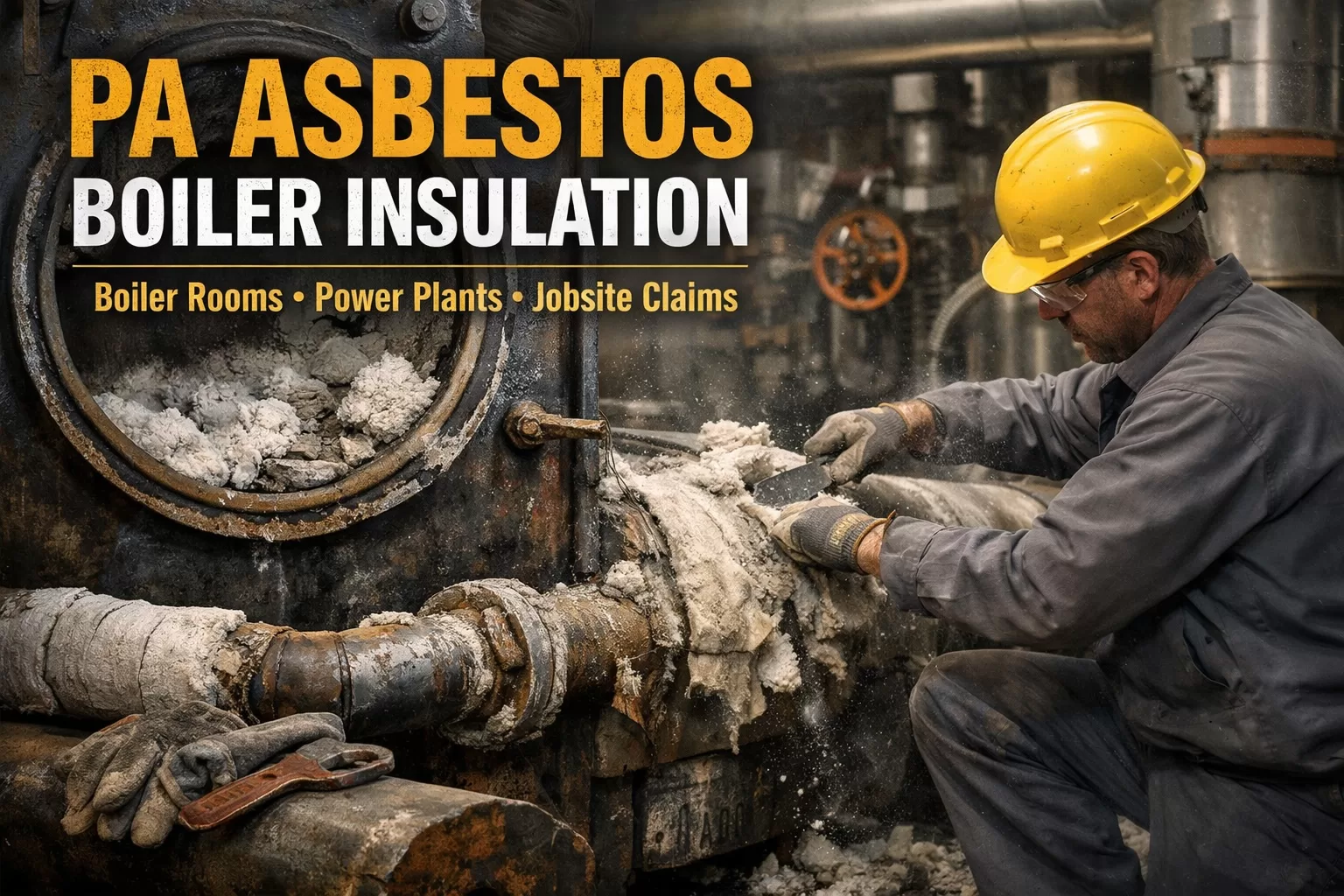
PA Asbestos Boiler Insulation exposure is one of the most commonโ€”and most overlookedโ€”sources of serious asbestos disease in Pennsylvania. Boilers were wrapped to hold heat. The insulation, block, cement, rope, and cloth used around boilers often contained asbestos. It performed well under high temperatures, which is exactly why it was used everywhere: power plants, steel mills, schools, hospitals, refineries, apartment buildings, universities, and older commercial buildings across Western Pennsylvania and the Commonwealth.

Mesothelioma/Asbestos Legal Help – WV, MI & PA

Speak directly with attorney Lee W. Davis. No call centers. Free, confidential review.

If you worked around boilersโ€”especially during maintenance, shutdowns, or repairsโ€”you may have breathed asbestos fibers without ever realizing it. Many workers werenโ€™t โ€œinsulators.โ€ They were mechanics, pipefitters, millwrights, stationary engineers, laborers, electricians, maintenance crews, and contractors who were simply assigned to tear out, patch, cut, or replace hot equipment.

Read about: Pennsylvania asbestos lawyer

Where PA boiler insulation exposure happens

Boiler-related exposure tends to occur in predictable locations:

  • Boiler rooms in schools, hospitals, and municipal buildings
  • Powerhouses and utility buildings in industrial complexes
  • Steel mill and foundry maintenance areas
  • Refinery and chemical plant utilities/steam generation
  • Apartment building and university mechanical rooms
  • Shutdown and turnaround projects where insulation gets disturbed fast

The highest-risk moments are not โ€œstanding near a boiler.โ€ The danger is when insulation is disturbedโ€”cutting, scraping, pulling, sweeping, vacuuming, or bagging it.


What โ€œboiler insulationโ€ usually includes

โ€œBoiler insulationโ€ is not one product. Itโ€™s a package of materials used together, often from multiple manufacturers:

  • Insulation block/lagging on boiler shells and housings
  • Insulating cement/mud used to patch, coat, and seal insulation
  • Rope packing and cloth/tape around doors, seams, and access points
  • Gaskets on cleanouts, manways, and inspection doors
  • Refractory and firebrick around burners and hot sections
  • Pipe insulation connected to boiler steam lines, elbows, and valves

A worker may only remember โ€œwhite chalky dust,โ€ โ€œmud,โ€ โ€œblanket wrap,โ€ or โ€œblock insulation.โ€ That can still be enough to start a credible exposure investigation.

Why boiler work creates heavy fiber release

Boiler insulation jobs produce dust because the materials are engineered to be cut, shaped, patched, and removed. Common scenarios:

  • Tear-outs during shutdowns (insulation comes off in chunks and powder)
  • Patch work using insulating cement that dries and crumbles
  • Door and access repairs where gaskets and rope are pulled and replaced
  • Cleanup after a jobโ€”sweeping, scraping floors, shaking work clothes
  • Confined spaces (boiler rooms trap dust, heat, and poor ventilation)

Even โ€œone big shutdownโ€ can be meaningful exposure. Asbestos disease is about fiber dose and duration, and some boiler-room work is among the worst.

Mesothelioma/Asbestos Legal Help – WV, MI & PA

Speak directly with attorney Lee W. Davis. No call centers. Free, confidential review.

Who typically gets exposed in Pennsylvania boiler rooms

You do not have to be the person โ€œinstallingโ€ insulation to be exposed. Boiler insulation exposure frequently shows up in:

  • Maintenance mechanics and utility crews
  • Pipefitters, plumbers, and steamfitters
  • Millwrights and industrial contractors
  • Stationary engineers and boiler operators
  • Electricians working near boiler housings and conduits
  • Laborers assigned to demo and cleanup
  • School district and hospital maintenance staff

If you were on the crew when insulation was disturbed, your exposure is real.

What evidence supports a PA asbestos boiler insulation claim

The proof usually comes from a combination of sourcesโ€”not one magic document:

  • Work history (employers, dates, job titles, locations)
  • Jobsite identification (the plant/school/hospital/building)
  • Task description (shutdown work, tear-outs, patching, cleanup)
  • Product identification (brand names when available, or the type of material)
  • Medical evidence (diagnosis, imaging, pathology, treatment records)
  • Witness support when available (coworkers who confirm materials and tasks)

You donโ€™t need to have every piece on day one. The job is building a credible package that can be proven and defended.

๐Ÿ‘‰ Search Asbestos Job Sites in Pennsylvania

How I handle boiler insulation identification

Iโ€™ve been building asbestos exposure proof packages since 1988, when I started as a paralegal. I learned product and jobsite identification the hard wayโ€”by matching trades, equipment, and work practices to the real-world asbestos materials people handled.

That work carried through the Saginaw foundry cases, and later through West Virginia and Pennsylvania asbestos litigation where the difference between a claim that survives and one that gets delayed is often simple: credible exposure proof tied to real products and real work.

Boiler insulation cases are not โ€œgeneric.โ€ The details matter, and they can be developed.

Read more Pittsburgh asbestos lawyer โ†’


FAQs

What is boiler insulation in asbestos cases?

Boiler insulation includes insulation block/lagging, insulating cement, cloth/tape, rope packing, gaskets, and related high-heat materials used on boilers and steam systems.

Do I have a claim if I only worked shutdowns or maintenance?

Often, yes. Shutdown work can involve heavy disturbance of insulation and concentrated dust exposure, especially during tear-outs and cleanup.

What diseases are linked to boiler insulation exposure?

Mesothelioma and asbestos-related lung cancer are most common. Asbestos exposure can also contribute to other asbestos-related conditions depending on medical findings.


Call Me

If you were exposed to PA Asbestos Boiler Insulationโ€”in a plant, school, hospital, boiler room, or shutdown jobโ€”and you now have mesothelioma, lung cancer, or another asbestos-related diagnosis, call my office. I focus on product identification and proof because that is what wins these cases.

Law Offices of Lee W. Davis, Esquire, PLLC

(412) 781-0525 โ€” Free case review

leewdavis.com

Check If Your Family Was Exposed

Get your free guide instantly + a confidential case review.

๐Ÿ”’ 100% Confidential. No obligations.

Read about: Mesothelioma wrongful death claim
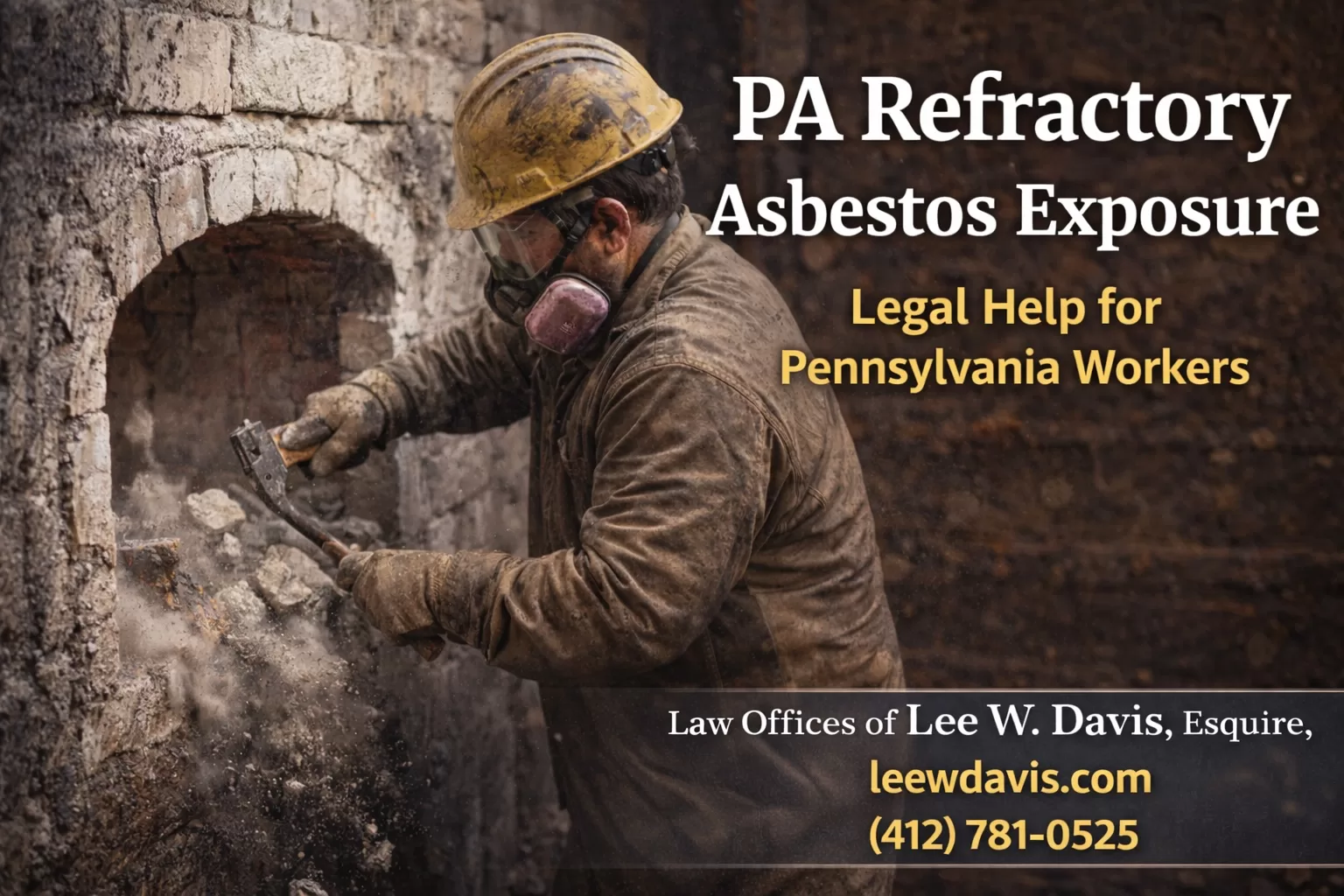
PA Refractory Asbestos Exposure

PA Refractory Asbestos Exposure | Legal Help

If youโ€™re searching PA Refractory Asbestos Exposure, youโ€™re usually not talking about one โ€œproduct.โ€ Youโ€™re talking about the hot-work trades and the high-heat areas where refractory materials were everywhereโ€”furnaces, boilers, ladles, soaking pits, reheat ovens, kilns, coke batteries, and industrial process units that had to stay hot without burning the place down. For decades, that protection often came at a cost: asbestos fibers released during installs, repairs, tear-outs, and shutdown rebuilds.

Mesothelioma/Asbestos Legal Help – WV, MI & PA

Speak directly with attorney Lee W. Davis. No call centers. Free, confidential review.

Refractory work is one of the most overlooked (and most provable) sources of asbestos exposure in Pennsylvania because it shows up across so many industriesโ€”steel, power generation, glass, chemical plants, paper mills, and heavy manufacturing.

Read more: Pennsylvania asbestos lawyer

Where refractory asbestos exposure happens in Pennsylvania

Refractory materials are used to line and protect equipment that runs at extreme temperatures. Exposure commonly occurred during:

  • Furnace and boiler rebuilds (tear-out, brick removal, patching, relining)
  • Foundry and steel mill maintenance (ladles, tundishes, soaking pits, reheat furnaces)
  • Kiln work in glass, brick, and cement operations (insulation boards, refractory brick, castables)
  • Outage/shutdown work where multiple trades are tearing down and rebuilding high-heat systems fast
  • Cleaning and demolitionโ€”sweeping debris, vacuuming dust, scraping old material, bagging rubble

Even if you werenโ€™t a โ€œrefractory worker,โ€ you may have inhaled fibers if you worked nearbyโ€”millwrights, pipefitters, boilermakers, electricians, laborers, insulators, welders, mechanics, and supervisors who were in the area during tear-out or rebuilds.

What โ€œrefractoryโ€ means in real terms

In asbestos litigation, the word โ€œrefractoryโ€ often includes:

  • Refractory brick
  • Castable refractory / refractory cement
  • Mortars and refractory mixes
  • Insulating firebrick
  • High-heat boards, papers, and wraps
  • Old insulation systems installed around high-temperature equipment

The key isnโ€™t memorizing the labels. The key is proving what you did, where you did it, and what materials were present when the dust was created.

What makes these claims strong

Refractory exposure cases tend to have a clear pattern: a worker spends repeated time around the same high-heat equipment, shutdowns create visible dust, and multiple trades are present. When you document that pattern correctly, it becomes credible evidence.

Strong proof often comes from:

  • Your work history (employer, years, departments, tasks)
  • Jobsite location details (furnace house, boiler room, melt shop, power block, kiln line) ๐Ÿ‘‰ Search Asbestos Job Sites in Pennsylvania
  • Shutdown/outage timing (when the rebuilds occurred)
  • Co-worker confirmation (even one credible witness can matter)
  • Medical diagnosis records tying the disease to asbestos exposure

Other Helpful links

For broader guidance and Pennsylvania claim strategy, start here: Pennsylvania asbestos lawyer.

To establish latency and sequence clearly, use: Pennsylvania asbestos exposure timeline.

If youโ€™re unsure what products were involved, this is the next step: Pennsylvania asbestos product identification.

If your case involves a family loss, read: Mesothelioma wrongful death claim.

Frequently asked questions

Was refractory material always asbestos?

Not always. But for decades, asbestos was widely used in many high-heat products and systems. The question is what was used at your jobsite during your years of work.

I wasnโ€™t the person installing refractoryโ€”does that matter?

No. Many exposures occur to trades working nearby during tear-out, rebuilds, and shutdown cleanup. Proximity counts when the work created airborne dust.

What if I canโ€™t remember brand names?

Thatโ€™s common. Most people remember the equipment and the workโ€”furnace relines, boiler rebuilds, brick tear-outs, โ€œrefractory cement,โ€ โ€œmud,โ€ โ€œfirebrick,โ€ shutdown work. With the right investigation, brand identification often follows.

How long do I have to file in Pennsylvania?

Usually the clock starts at diagnosis (or, for wrongful death, the date of death), not the year you worked. The details matterโ€”so treat timing as urgent.

Call Lee Directly

Refractory exposure cases donโ€™t win on buzzwordsโ€”they win on work detail, credible exposure history, and proof that holds up. Thatโ€™s what Iโ€™ve done for decades: identifying exposure sources, building legitimate work histories, and translating real jobsite facts into evidence that defendants and trusts canโ€™t dismiss.

If you have questions about PA Refractory Asbestos Exposureโ€”or youโ€™ve been diagnosed with mesothelioma, asbestos lung cancer, or pleural diseaseโ€”call me at (412) 781-0525 or reach out through leewdavis.com for a direct, no-nonsense case review.

Check If Your Family Was Exposed

Get your free guide instantly + a confidential case review.

๐Ÿ”’ 100% Confidential. No obligations.

PA Asbestos Gasket Removal

PA Asbestos Gasket Removal

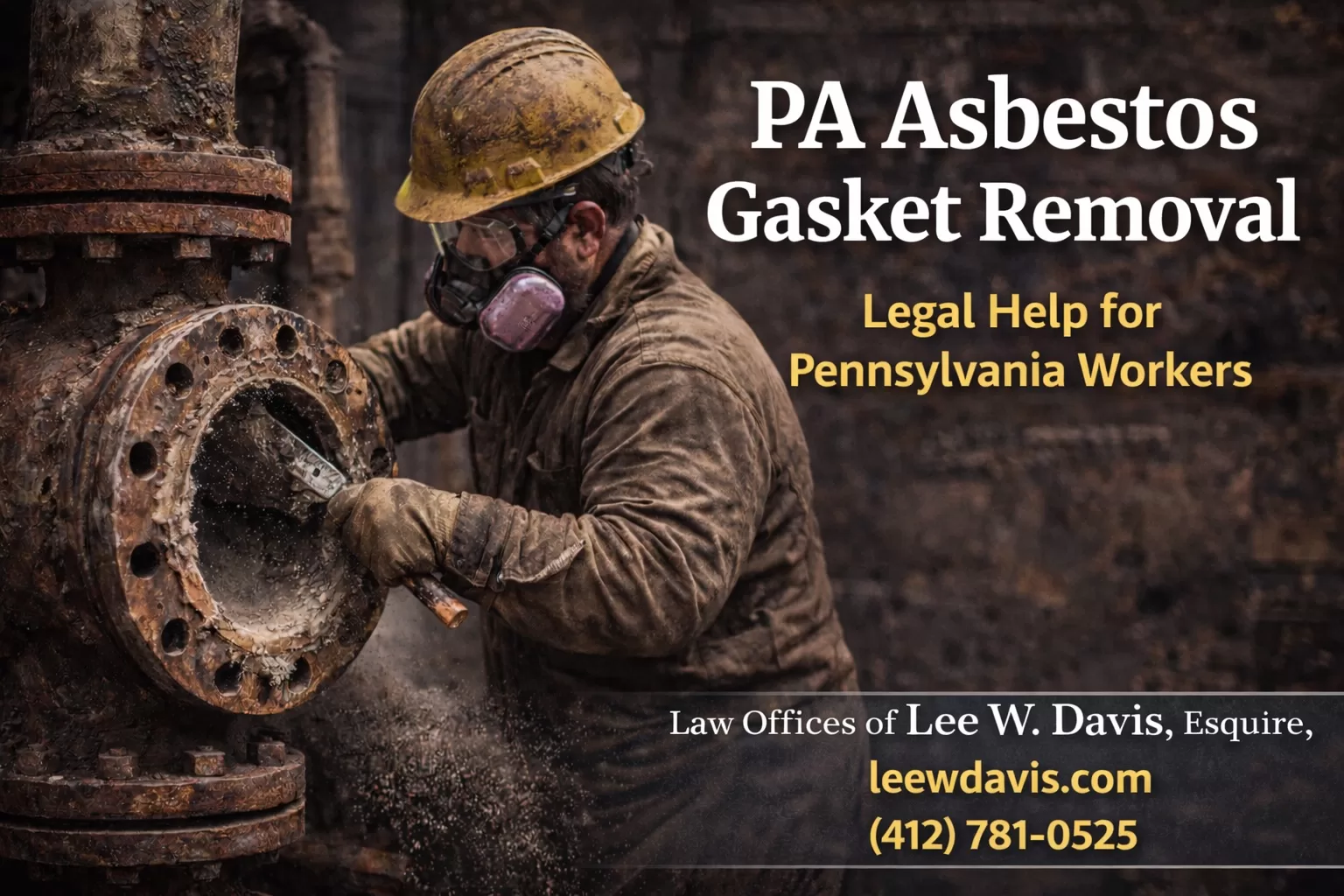
PA Asbestos Gasket Removal is one of the most common (and most provable) sources of occupational asbestos exposure in Pennsylvania industrial work. The risk isnโ€™t โ€œstanding near asbestos.โ€ The risk is the task: scraping, wire-brushing, cutting, grinding, or pulling old gaskets off flanges, valves, pumps, compressors, heat exchangers, and boiler doorsโ€”especially when the material is dry, brittle, and stuck like concrete. That is when the fibers release.

Mesothelioma/Asbestos Legal Help – WV, MI & PA

Speak directly with attorney Lee W. Davis. No call centers. Free, confidential review.

Iโ€™ve built cases around this exact exposure pattern for decadesโ€”because gasket work leaves a recognizable footprint in the work history, the jobsite, the equipment, and the product universe that was actually used.

Where gasket exposure happens in Pennsylvania

Gasket removal shows up across Pennsylvania in places that run hot, pressurized, or corrosive systems:

  • Powerhouses and boiler rooms (steam, feedwater, blowdown, condensate)
  • Steel mills, coke works, and fabrication shops
  • Chemical plants and refineries (process piping, exchangers, pumps, reactors)
  • Paper mills and food plants (maintenance shutdowns, washdowns, rebuilds)
  • Municipal and institutional plants (schools, hospitals, universities)

If you did โ€œmaintenance,โ€ โ€œshutdowns,โ€ โ€œturnarounds,โ€ โ€œoverhauls,โ€ or โ€œoutage work,โ€ gasket removal is usually part of itโ€”even if nobody called it that.

Who is most at risk

The highest-risk roles are the trades that are actually hands-on with flanges and equipment:

  • Pipefitters / steamfitters
  • Millwrights and industrial maintenance mechanics
  • Boiler operators and stationary engineers (when they help on outages)
  • Machinists and pump/valve rebuilders
  • Welders and riggers (when they prep or clean flanges)
  • Laborers assigned to tear-out and cleanup

And the risk isnโ€™t limited to one day. Gasket exposure is often repeated, routine, and spread across years, which matters when youโ€™re proving dose and causation.


What โ€œgasket removalโ€ really looks like (and why it matters)

In real life, itโ€™s not a neat โ€œremove gasketโ€ checkbox. Itโ€™s:

  • Breaking flanges and popping old gaskets loose
  • Scraping gasket faces with a razor scraper or gasket scraper
  • Wire brushing residue off flange faces
  • Using a grinder, Roloc disc, or emery cloth to clean the surface
  • Sweeping up dust after the fact (often dry sweeping)

That last partโ€”cleanupโ€”often generates as much exposure as removal.

How to prove a PA gasket case without guessing

A strong PA Asbestos Gasket Removal claim is built like a workmanlike proof package, not a story.

1) Lock down the work history (where and when).

You want job titles, employers, worksites, and date ranges. If you worked through halls, locals, contractors, or outages, you want that too. Start with your base timeline and then fill gaps job-by-job.

Read More: Pennsylvania asbestos exposure timeline

2) Identify the equipment and tasks (what you touched).

Pumps, valves, turbines, compressors, boilers, exchangers, and piping systems matter because they narrow the product universe. โ€œWorked in the powerhouseโ€ is vague. โ€œRebuilt pumps and changed flange gaskets during outagesโ€ is proof.

3) Product identification: narrow it to what was actually used.

This is where most cases are won or lost. Not every gasket was asbestosโ€”but plenty were, and many facilities used the same gasket sheet materials, packing, and brands for years. A credible case identifies the kinds of gasket materials used, the brands people actually saw, and the departments where it happened.

Read More: Pennsylvania asbestos product identification

4) Pick the right defendants and match them to the exposure.

Once you know the task + equipment + jobsite + time frame, you can identify likely manufacturers and suppliers tied to that work. This avoids โ€œkitchen sinkโ€ pleading and keeps the case credible.

Read More: Pittsburgh asbestos lawyer

5) Decide whether an asbestos trust claim is part of the strategy.

Some gasket/product exposures line up with trust pathways depending on jobsite, era, and product. Trust claims can also provide documentation leverage and additional recovery, depending on the overall case.

Read More: Pennsylvania asbestos trust claims

Mesothelioma/Asbestos Legal Help – WV, MI & PA

Speak directly with attorney Lee W. Davis. No call centers. Free, confidential review.

Common fact patterns that are strong

If you recognize any of these, thatโ€™s usually a solid starting point:

  • Outage work in a powerhouse, steel mill, or chemical plant with repeated flange breaks
  • Maintenance mechanic work involving pumps/valves and shutdown cleanup
  • โ€œGasket scrapingโ€ paired with packing removal on valves and pumps
  • Work in tight mechanical rooms with poor ventilation and dust control
  • Long-term trade work across multiple sites where the same tasks repeat

What to do next

If you were diagnosed with mesothelioma, lung cancer, or another asbestos-related disease and your history includes gasket removal work, donโ€™t wait around hoping the paperwork magically appears. The claim is built by reconstructing the real work, then matching it to the right product and defendant proof.

If the case involves a death in the family, the timeline is even more critical and the claim structure changes: mesothelioma wrongful death claim

Free Case Review

If your background includes PA Asbestos Gasket Removal workโ€”pipe, valves, pumps, boiler doors, shutdowns, scraping and cleanupโ€”call my office and weโ€™ll evaluate it directly and tell you what the claim needs and whether itโ€™s viable.

Law Offices of Lee W. Davis, Esquire, PLLC

(412) 781-0525

leewdavis.com

Check If Your Family Was Exposed

Get your free guide instantly + a confidential case review.

๐Ÿ”’ 100% Confidential. No obligations.

PA Insulation Asbestos Exposure

PA Insulation Asbestos Exposure Claims

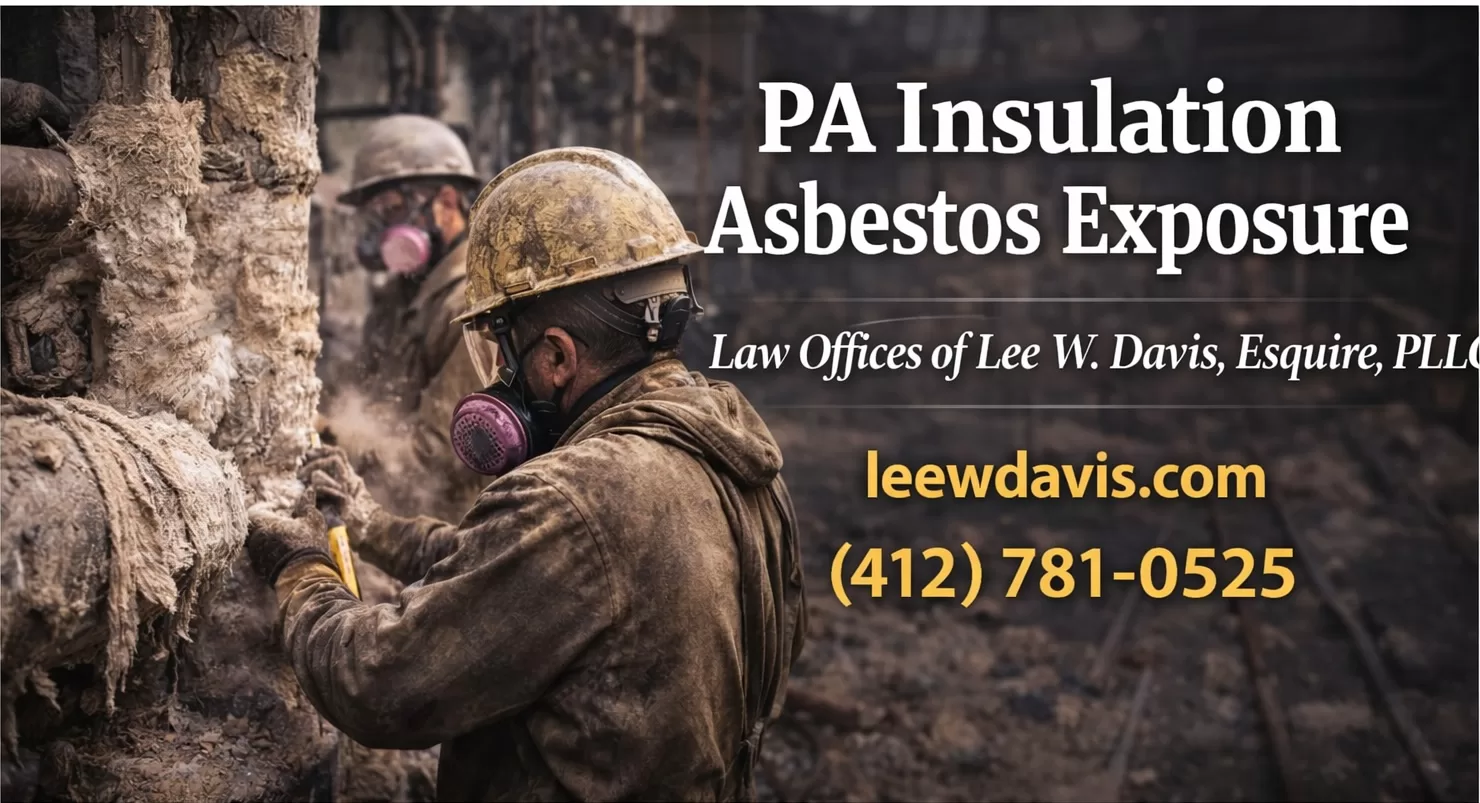
PA Insulation Asbestos Exposure is one of the most common pathways to mesothelioma and asbestos-related lung cancer in Pennsylvania industrial work. For decades, insulation was treated as โ€œstandard protectionโ€ in boilers, pipe runs, turbines, pumps, furnaces, heaters, and high-heat equipmentโ€”especially in steel, power generation, rail, chemical, and heavy manufacturing. The problem is simple: much of that insulation contained asbestos, and it was often cut, mixed, removed, scraped, or disturbed without warning and without adequate protection.

Read about Pittsburgh asbestos lawyer

If you worked maintenance, operations, millwright work, pipefitting, electrical, boiler work, or shutdown/turnaround crews, you may have been around asbestos insulation even if your job title never said โ€œinsulationโ€ and even if you didnโ€™t handle it every day. In real cases, exposure comes from routine tasksโ€”opening a valve, pulling a line, replacing a gasket, tearing out old lagging, or working beside another trade while insulation is disturbed and dust spreads into the air.

Where insulation exposure happens in Pennsylvania

Insulation-related exposure shows up again and again in the same environments:

  • Boiler rooms and mechanical rooms (schools, hospitals, factories, municipal buildings)
  • Steel mills and coke works (hot equipment, lines, and high-heat containment)
  • Power plants (turbines, boilers, piping systems, maintenance outages)
  • Refineries and chemical plants (process lines, heat tracing, high-temperature operations)
  • Shipyards, rail facilities, and industrial repair shops (equipment rebuilds and retrofits)
  • Shutdowns and turnarounds where old materials get disturbed quickly, often under pressure

Even โ€œminorโ€ insulation disturbance can matter. Cutting, sanding, pulling, or breaking aged insulation often releases fibers. And exposure is rarely a single eventโ€”most people with serious disease were exposed repeatedly over years.

What โ€œasbestos insulationโ€ can look like

In Pennsylvania cases, โ€œinsulationโ€ can mean several asbestos-containing materials, including:

  • Pipe insulation and block insulation (often white/gray, brittle when aged)
  • Lagging and wrap around lines, elbows, and fittings
  • Boiler and tank insulation used to hold heat and protect surfaces
  • Cement and insulating mud used at joints and fittings
  • Thermal blankets and high-heat barriers in industrial settings
  • Associated materials like gaskets and packing used in the same systems

If youโ€™re not sure what you saw, thatโ€™s normal. The question is not whether you can identify a brand name from memory today. The real question is whether your work put you around the kinds of systems and maintenance tasks where asbestos insulation was commonly used.

When an insulation case becomes a real claim

A legitimate PA insulation case is built around three basic pillars:

  1. Diagnosis (mesothelioma, asbestos-related lung cancer, or another asbestos disease)
  2. Work history showing credible exposure opportunities
  3. Product/company identification tied to the worksite and time period

Pennsylvania asbestos product identification

That last partโ€”identificationโ€”is where many firms get sloppy. I donโ€™t. Iโ€™ve been doing product identification work since I started in this field in 1988. That skill carried through large-scale foundry work (including the Saginaw GM foundry docket) and into years of Pennsylvania and West Virginia mesothelioma and lung cancer cases where the only way to win is to build credible proof that holds up.

What you should do if you suspect insulation exposure

If you or a family member has been diagnosed and the work history includes high-heat industrial environments, donโ€™t talk yourself out of it because you โ€œwerenโ€™t an insulator.โ€ Many of the strongest cases involve other trades who worked in and around insulation every week.

Start by pulling together:

  • A basic list of jobsites, dates, and job titles
  • The types of work you did (maintenance, outage work, boiler work, pipe work, equipment rebuilds)
  • Names of coworkers who remember how the work was done
  • Any documents you already have (union history, medical records, employment records)

You do not need a perfect file to call. You need a starting point.

๐Ÿ‘‰ Search Asbestos Job Sites in Pennsylvania


If you were exposed in a Pennsylvania plant, mill, power station, shop, or boiler room and youโ€™ve now been diagnosed with mesothelioma or asbestos-related lung cancer, you need a lawyer who knows how to prove exposureโ€”not someone who just โ€œcollects paperwork.โ€ Product identification has been my focus since 1988, through major industrial dockets and decades of hands-on casework. Call (412) 781-0525 or visit leewdavis.com to get a direct case review.

Pennsylvania Asbestos Plant Shutdowns

Pennsylvania Asbestos Plant Shutdowns | Claim Help

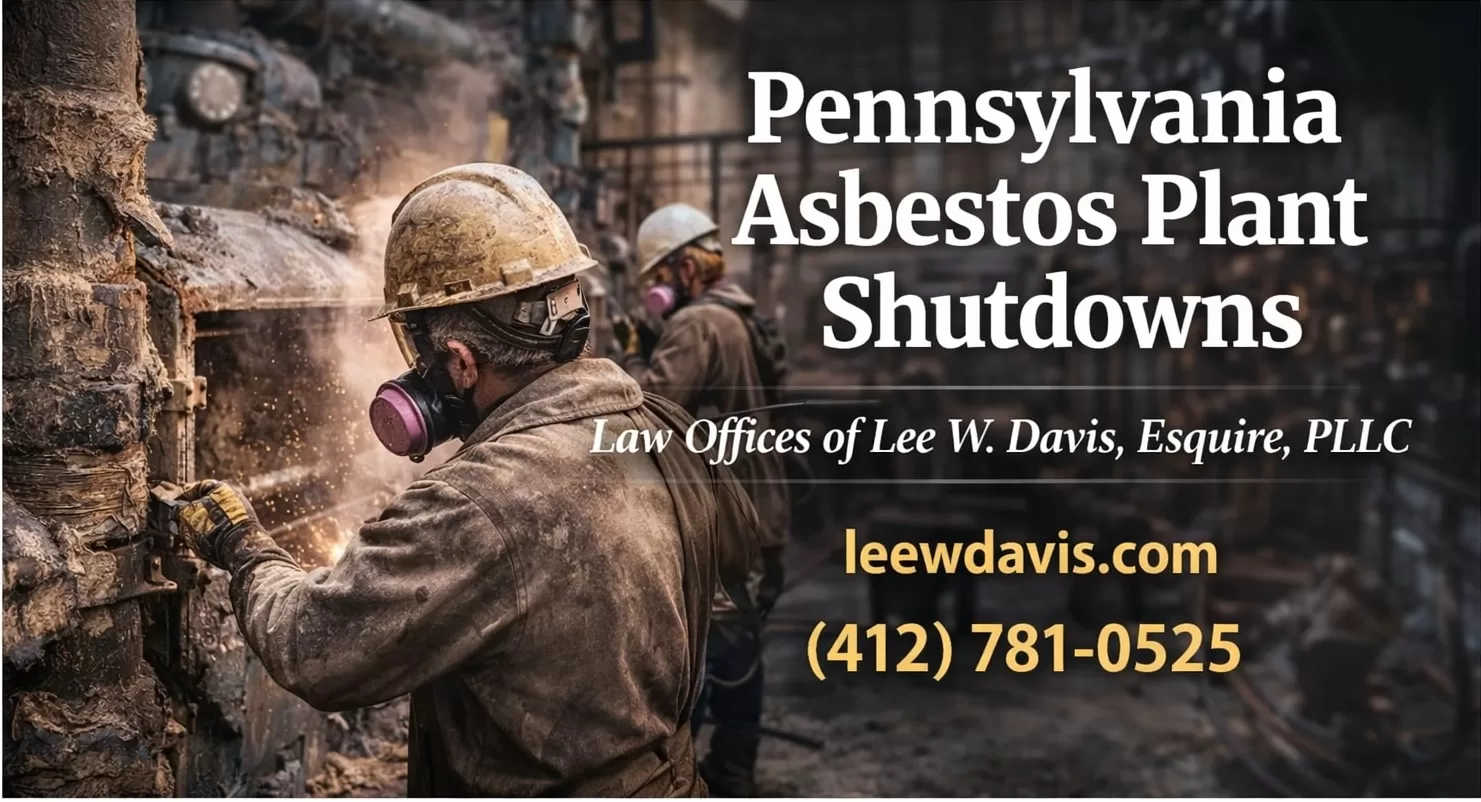
Pennsylvania asbestos plant shutdowns are one of the most common times workers get hit with the heaviest exposure. When a mill, refinery, power station, or manufacturing plant goes offline for a turnaround, everything thatโ€™s normally sealed up gets openedโ€”insulation comes off, gaskets get scraped, refractory gets chipped out, valves and pumps are rebuilt, and old equipment gets torn down fast. If asbestos was anywhere in that system, a shutdown can turn it into dust.

Mesothelioma/Asbestos Legal Help – WV, MI & PA

Speak directly with attorney Lee W. Davis. No call centers. Free, confidential review.

If you worked shutdowns in Western Pennsylvaniaโ€”or traveled job-to-job as a contractor, union trade, or maintenance workerโ€”and later developed mesothelioma, lung cancer, or another asbestos disease, you may have a valid claim.

For broader guidance and a case review, start here: Pittsburgh asbestos lawyer


Why shutdown work is a high-exposure moment

Shutdowns create the perfect storm:

  • High heat systems get opened up. Boilers, steam lines, turbines, exchangers, ovens, and process piping often had asbestos insulation or refractory nearby.
  • Old parts get disturbed. Gaskets, packing, rope, cloth, cement, board, and insulation are removed and replaced.
  • Multiple trades work in the same space. Even if you werenโ€™t the person cutting insulation, you can breathe what someone else disturbed.
  • Speed matters more than safety. Outages run on tight deadlines. Dust control and containment often come second.

The risk isnโ€™t theoretical. A shutdown job can concentrate exposure into a short periodโ€”days or weeksโ€”especially in enclosed areas like boiler rooms, pipe chases, mechanical rooms, or around process units.


What counts as a โ€œplant shutdownโ€ for claim purposes?

In plain English: if the facility went offline to do major work, it likely counts. That includes:

  • Turnarounds / outages
  • Maintenance shutdowns
  • Rebuilds / retrofits
  • Demolition and tear-out
  • Emergency repairs after failures

The label doesnโ€™t matter as much as what happened: materials were disturbed, and you were there.


How shutdown claims are proven

The key isnโ€™t just โ€œI worked there.โ€ Itโ€™s what you worked on and what products/materials were in play.

Strong evidence usually comes from a combination of:

  • Work history (where you worked, dates, job titles, trades, contractors)
  • Union records or dispatch logs
  • Coworker statements from people who remember the job and the materials
  • Plant/jobsite documentation (maintenance records, outage schedules, contractor rosters)
  • Product identification (brands and types of insulation, gaskets, packing, refractory, cement, etc.)
  • Medical proof (pathology, imaging, diagnosis records)

If you want to understand the โ€œproduct sideโ€ of the proof, see Pennsylvania Asbestos Product Identification. If youโ€™re gathering sworn statements, see Pennsylvania Asbestos Exposure Affidavit. If trust claims are part of your recovery path, see Pennsylvania Asbestos Trust Claims Help.


Common shutdown exposure scenarios I see in Pennsylvania

These patterns repeat across decades of industrial work:

  • Pipefitters and welders working around insulated piping and steam systems
  • Millwrights and mechanics rebuilding pumps, compressors, turbines, and rotating equipment
  • Electricians in dusty mechanical spaces with old insulation and panel components nearby
  • Boilermakers doing tear-out and rebuild work around boilers, refractory, and insulation
  • Laborers and cleanup crews sweeping, bagging, and hauling debris after tear-out

Often the person most exposed is the one doing the dirty โ€œsupport work,โ€ not the person whose name is on the work order.


Call if you worked shutdowns and were later diagnosed

I have focused on asbestos product identification and proof since I started in this field as a paralegal in 1988, through the Saginaw foundry cases, and then through years of West Virginia mesothelioma and lung cancer casesโ€”working directly with clients to build credible exposure evidence that holds up.

If you or a loved one has been diagnosed and shutdown work is part of the history, call my office. Weโ€™ll talk through where you worked, what you did, and what evidence still exists.

Law Offices of Lee W. Davis, Esquire, PLLC

Call (412) 781-0525 for a confidential case review.

Check If Your Family Was Exposed

Get your free guide instantly + a confidential case review.

๐Ÿ”’ 100% Confidential. No obligations.


FAQs

What if I only worked a few shutdowns years ago?

Short shutdown jobs can still matter. A concentrated exposure during a tear-out or rebuild can be enough to support a claim, especially when the work involved insulation, gaskets, packing, or refractory.

Do I need to remember exact product names?

Not always. Product identification can be developed through job records, union records, coworker proof, and known materials used in similar systems during the same era.

Can I file a claim if the plant is closed or the company is gone?

Yes. Many cases involve bankrupt manufacturers and asbestos trust claims, and others involve successor liability or remaining solvent defendants depending on the facts.

Mesothelioma/Asbestos Legal Help – WV, MI & PA

Speak directly with attorney Lee W. Davis. No call centers. Free, confidential review.

PA Boiler Room Asbestos

PA Boiler Room Asbestos Claims Help

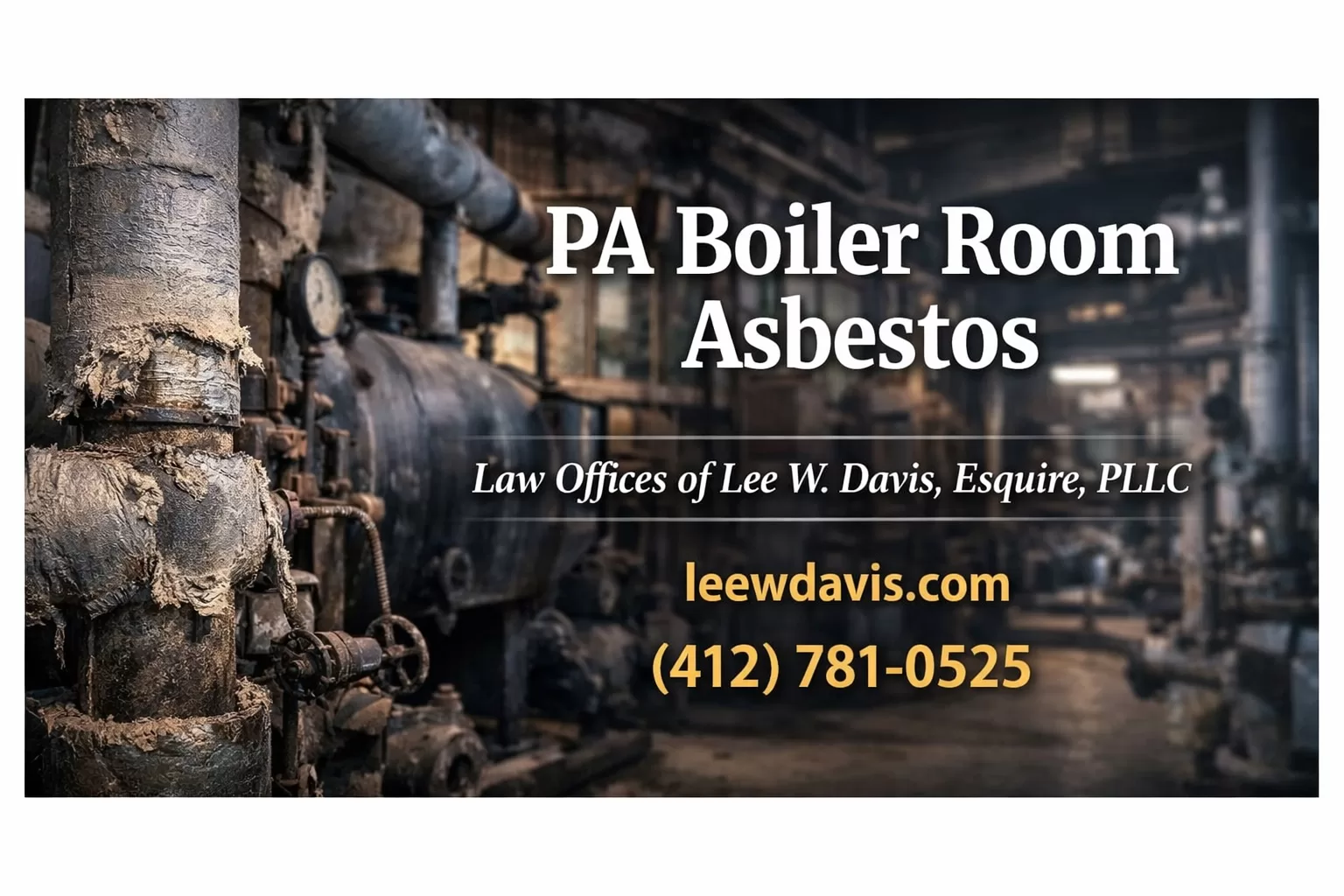
PA Boiler Room Asbestos exposure is a recurring cause of mesothelioma and asbestos-related lung cancer because boiler rooms were built around heat, insulation, and โ€œhigh-temperatureโ€ materialsโ€”exactly where asbestos was used the most. If you worked in or around a boiler room in Pennsylvania as a maintenance mechanic, stationary engineer, pipefitter, electrician, HVAC worker, millwright, or boiler operator, you may have been exposed even if you never handled โ€œrawโ€ asbestos.

๐Ÿ‘‰ Pittsburgh asbestos lawyer

Mesothelioma/Asbestos Legal Help – WV, MI & PA

Speak directly with attorney Lee W. Davis. No call centers. Free, confidential review.

This is not a homeowner question and itโ€™s not a โ€œdust in the atticโ€ situation. Boiler-room exposure is typically occupational: repeated work around insulated piping, valves, pumps, gaskets, packing, refractory materials, and older mechanical equipment that was serviced for years.

Where PA boiler-room exposure usually happened

Boiler rooms show up everywhere in Pennsylvaniaโ€”not just in one industry:

  • Hospitals and medical complexes
  • Apartment high-rises and large public housing buildings
  • Universities and large institutional facilities
  • Factories, warehouses, and distribution centers
  • Municipal buildings and public works facilities
  • Older commercial buildings with central steam systems

Many workers were exposed because boiler rooms were treated as โ€œutility spaceโ€ where insulation and mechanical systems were constantly repaired, replaced, and disturbed.

๐Ÿ‘‰ Search Asbestos Job Sites in Pennsylvania

The exposure sources that matter in PA Boiler Room Asbestos claims

In real cases, exposure proof usually comes from the same repeat list of tasks and materials:

  • Pipe insulation and block insulation
  • Boiler insulation and lagging
  • Refractory and cement used around hot equipment
  • Gaskets and flange work on steam lines
  • Valve and pump packing
  • Steam traps, heat exchangers, and related components
  • Old fireproofing, pipe chases, and mechanical rooms connected to boiler spaces

The legal โ€œproduct identificationโ€ question is not whether you remember a brand name from 1981. Itโ€™s whether your work placed you in the zone where these materials were disturbedโ€”and whether we can document it in a way defendants and trusts canโ€™t dismiss.

Pennsylvania asbestos product identification

What proof actually moves a PA Boiler Room Asbestos case forward

Most people think they need one perfect record. They donโ€™t. Strong claims are built from a credible package:

  • Employment proof (where you worked and when)
  • Work description (what you did in the boiler room: repair, replacement, tear-out, maintenance)
  • Witness support (co-workers who can confirm tasks/materials)
  • Medical documentation (diagnosis and disease type)
  • Pathology confirmation when available (especially for mesothelioma subtyping)

Pennsylvania asbestos work history

Boiler-room claims also benefit from the common-sense reality that the same systems were serviced repeatedly over timeโ€”meaning the exposure was not a one-day event.

Deadlines in Pennsylvania

Pennsylvania asbestos claims are often governed by diagnosis-based timing rules, but the real deadline analysis depends on the facts (and, for wrongful death claims, the date of death). If youโ€™re even thinking about filing, do not wait until you โ€œfind more records.โ€ We can evaluate what you have and identify what matters.


Schools vs. non-school boiler rooms

If your boiler-room exposure occurred in an older school building, thatโ€™s a related but different discussion. For school-specific exposure and claim options, see: Pennsylvania School Asbestos Exposure: Old Schools, Boiler Rooms, and Claim Options (link that page here).

This page is focused on occupational boiler-room exposure across Pennsylvaniaโ€”hospitals, large buildings, industrial facilities, and mechanical systems where asbestos was historically used the most.


Call for a PA Boiler Room Asbestos case review

Iโ€™ve done asbestos product identification work since 1988, starting as a paralegalโ€”tracking job sites, trades, and materials the hard way, before databases and digital records made it easier to โ€œsound informed.โ€ I carried that discipline through the Saginaw foundry casework and later in West Virginia mesothelioma and lung cancer cases, working directly with clients to build exposure proof that is credible, legitimate, and built to survive pushback.

If you worked in a Pennsylvania boiler room and were diagnosed with mesothelioma or an asbestos-related lung cancer, call me. You do not need a perfect memory. You need a strategy that builds proof that holds up.

Start here: PA Boiler Room Asbestos โ€” free case review.

Call (412) 781-0525 or contact us through leewdavis.com

PA Asbestos Pay Stubs: When Payroll Records Prove Exposure

PA Asbestos Pay Stubs | Proof for Claims

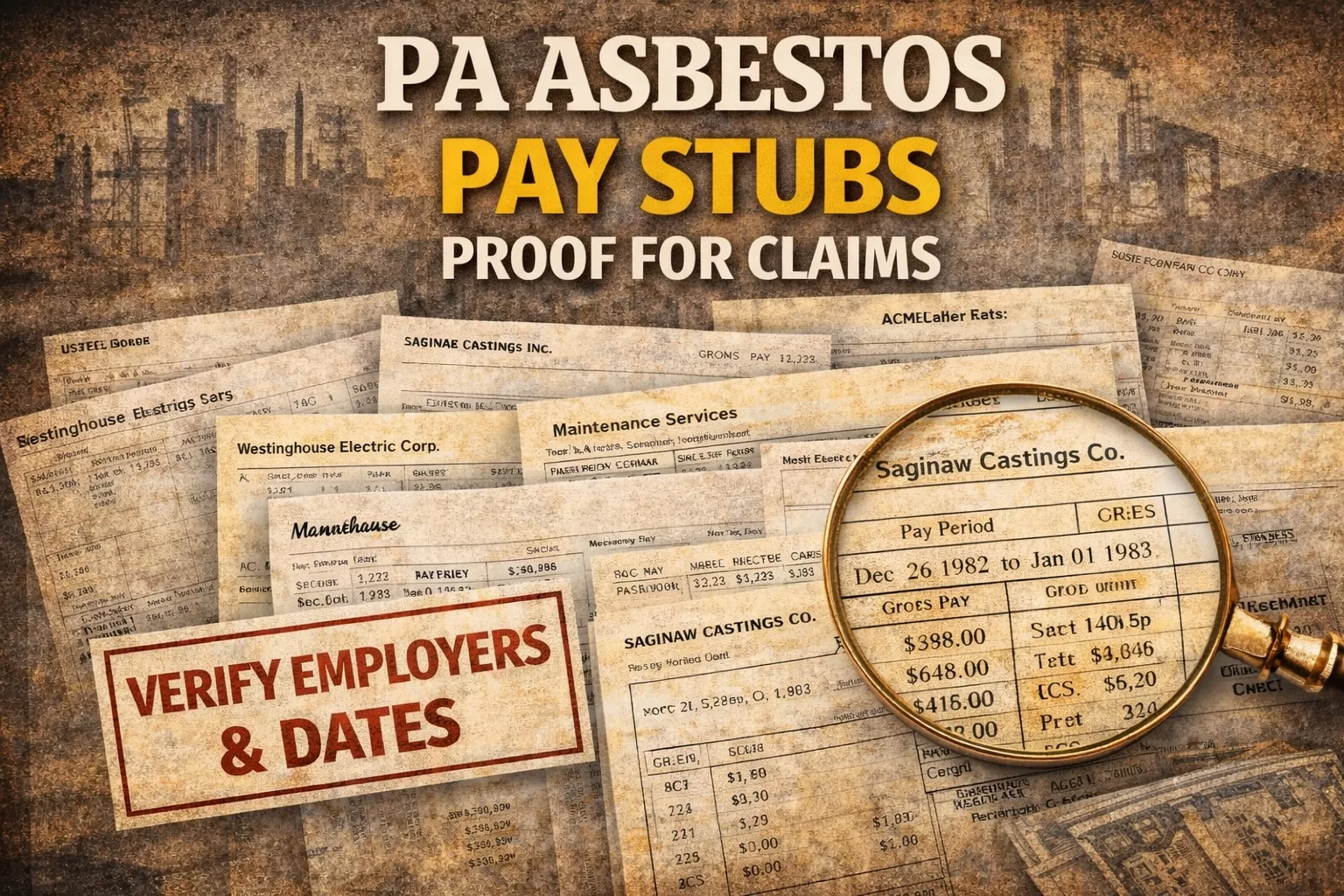
PA Asbestos Pay Stubs can be one of the most overlooked pieces of evidence in a Pennsylvania asbestos caseโ€”especially when the company is gone, the jobsite has changed hands, or your official personnel file โ€œcanโ€™t be found.โ€ Pay stubs donโ€™t list โ€œasbestos,โ€ but they can lock down the facts that matter: who paid you, when you worked, and sometimes where you worked.

Mesothelioma/Asbestos Legal Help – WV, MI & PA

Speak directly with attorney Lee W. Davis. No call centers. Free, confidential review.

If youโ€™re building a claim after a mesothelioma or asbestos lung cancer diagnosis, proof is everything. The strongest cases are the ones that can be documented, not just described.

What pay stubs can prove in a Pennsylvania asbestos case

Pay stubs can help confirm:

  • Employer identity (including corporate names that differ from the โ€œnicknameโ€ everyone used)
  • Work dates (start/stop windows that match product use and job phases)
  • Job classifications (sometimes listed on payroll systems or union wage lines)
  • Overtime and shutdown periods (often when exposure was highestโ€”tear-outs, rebuilds, maintenance)

Even a partial set of stubs can establish a reliable work timeline when memories are fuzzy or records are incomplete.

Where to find old pay stubs

Depending on the employer and era, pay stubs may be available from:

  • The employerโ€™s payroll provider (current HR/payroll department if the company still exists)
  • A successor company after a sale/merger
  • Union benefit offices or pension administrators (sometimes they retain wage documentation)
  • Your personal files (tax folders, bank records, old envelopes)
  • Social Security earnings history (not stubs, but useful for confirming employers and years)

If your pay stubs are missing, you still have options. The key is knowing which record source is most likely to exist for your job and time period.


How pay stubs fit into the overall proof package

Pay stubs are not the whole case. They are one piece that can strengthen the foundation of the claim by confirming employment factsโ€”so the medical evidence and exposure evidence have a solid base.

For related Pennsylvania proof guides, you can also review:

FAQs

Do I need every pay stub to file an asbestos claim?

No. A complete set is helpful, but even partial stubs can confirm the employer and the time period. Other records can fill gaps.

What if my employer closed years ago?

Thatโ€™s common in asbestos litigation. We look for successor entities, payroll vendors, benefit administrators, and alternate sources like SSA earnings history.

Are pay stubs enough to prove asbestos exposure?

Pay stubs usually prove employment and dates. Exposure proof typically comes from jobsite/product evidence, coworker testimony, and work details.

Call for a proof-driven review

Iโ€™ve been building credible exposure records since 1988, when I started doing this work as a paralegalโ€”long before everything was digital. I carried that discipline through the Saginaw foundry asbestos cases and into decades of individual Pennsylvania and West Virginia mesothelioma and lung cancer cases, working directly with clients to develop evidence that holds up.

If youโ€™ve been diagnosed and youโ€™re trying to prove where the exposure happened, call (412) 781-0525. You can also start at leewdavis.com for a confidential review.

Check If Your Family Was Exposed

Get your free guide instantly + a confidential case review.

๐Ÿ”’ 100% Confidential. No obligations.

PA Asbestos Pension Records

PA Asbestos Pension Records

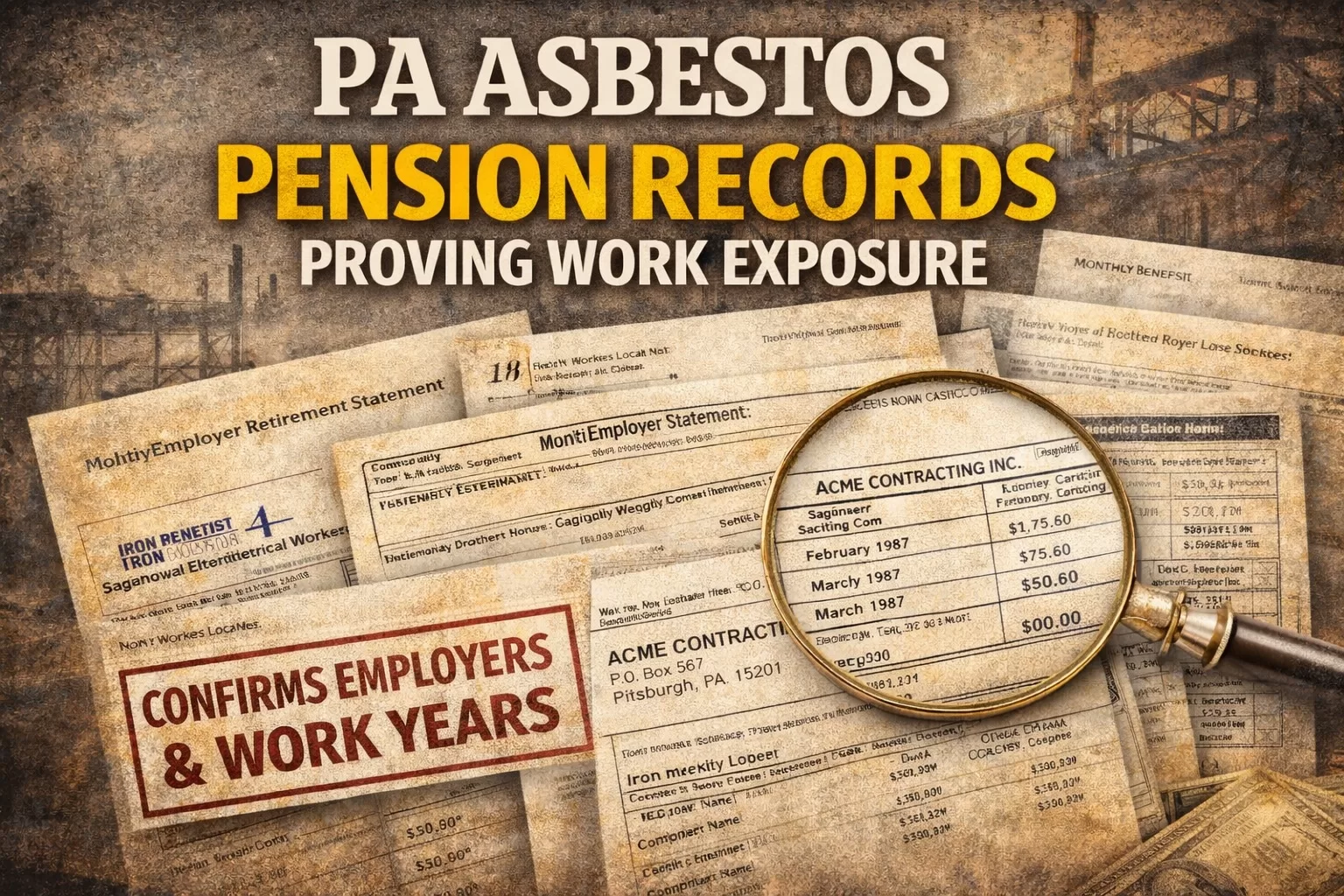
PA Asbestos Pension Records can be the cleanest โ€œproof documentโ€ youโ€™ll ever find in an asbestos caseโ€”especially when the company is gone, the payroll department is gone, and the jobsite is now a parking lot. Pension files donโ€™t argue. They show who paid into the plan, when they paid, and often what classification you worked under. In Pennsylvania asbestos claims, thatโ€™s the difference between โ€œI rememberโ€ and โ€œhereโ€™s the record.โ€

If you worked in mills, power plants, refineries, shipyards, rail, commercial construction, or industrial maintenance, thereโ€™s a good chance a pension plan has better records than your former employer ever did.

For broader guidance on Pennsylvania asbestos investigations, visit Pennsylvania asbestos lawyer support here:

/pennsylvania-asbestos-lawyer/


Why pension records matter in Pennsylvania asbestos cases

Pension records matter because they can establish three things that drive an asbestos claim:

  • Employment confirmation: the employer name(s) tied to you
  • Work dates: start/stop periods, contribution months/years
  • Trade/classification: in many plans, your category or bargaining unit

That combination supports your exposure story without relying on memory alone. When trusts, defendants, or insurers challenge where you worked and when, pension contributions can pin it down.


What counts as โ€œpension recordsโ€?

โ€œPension recordsโ€ can mean more than a single annual statement. Useful records may include:

  • Benefit statements (annual or periodic)
  • Plan participation letters (eligibility and vesting info)
  • Employer contribution histories (who paid in and when)
  • Service credit summaries (credited quarters/years)
  • Classification or unit codes (trade/category identifiers)
  • Multi-employer plan entries (common in unionized trades)

Even a basic benefit statement can be enough to confirm work history when other evidence is missing.


Multi-employer plans and union pension files

A lot of Pennsylvania industrial work ran through multi-employer pension arrangementsโ€”where contributions followed the worker across employers. That structure can be valuable in asbestos claims because it can show:

  • Multiple employers you worked for over time
  • Continuous industry service even when companies dissolved
  • Work periods that line up with known asbestos-heavy eras

Thatโ€™s particularly useful when someone worked in maintenance, shutdowns/turnarounds, or traveled between facilities and contractors.


How pension records fit into a proof package

Pension records are not the whole case, but theyโ€™re a powerful โ€œspineโ€ for your proof. They work best alongside:

Pension proof helps establish the โ€œwhere and when.โ€ Other documents and testimony establish the โ€œwhat you were around.โ€

โธป

Common problems and how pension records solve them

1) The employer is out of business

Pension contributions can still show the employer name and datesโ€”even if the company no longer exists.

2) The work was decades ago

Older work history is exactly where pension documentation can outperform memory.

3) The worker changed contractors frequently

Multi-employer contributions can show continuity and confirm the list of employers.

4) You donโ€™t remember the exact dates

Pension credit summaries often narrow the timeframe to months or quarters.

โธป

What if you donโ€™t have the records?

If you donโ€™t have your pension paperwork, you can still request it. Many people can obtain records from:
โ€ข The pension plan administrator or benefits office
โ€ข A union benefits office (if union-related)
โ€ข A retirement plan servicing company (depending on the plan)

If youโ€™re not sure where to start, thatโ€™s normalโ€”most people arenโ€™t. The point is: these records exist more often than people think, and they can be obtained.

โธป

FAQs

What pension records help prove asbestos exposure in Pennsylvania?

The most useful are benefit statements, employer contribution histories, and service credit summaries because they confirm employer names and work periods that support your exposure history.

Can multi-employer pension files show job history and dates?

Yes. Multi-employer plans commonly track contributions by employer and time period, which can establish a timeline even when individual employers canโ€™t be located.

What if the pension fund says they have no records?

Sometimes records are under a different name, a successor plan, or a third-party administrator. A targeted requestโ€”using the correct identifying informationโ€”often finds what a generic inquiry misses.

Call Lee Now

If your case depends on proving where you worked and when, PA Asbestos Pension Records are often one of the strongest documents you can put in the file.

This is the kind of evidence Iโ€™ve focused on for decadesโ€”starting in 1988 as a paralegal building work histories and product identification proof, through the Saginaw foundry cases, and into the Pennsylvania cases I handle today. Real asbestos cases are won with credible records, not vague stories.

If you want help identifying the right pension source and building a serious proof package for a Pennsylvania claim, call (412) 781-0525 or contact me through leewdavis.com.

Check If Your Family Was Exposed

Get your free guide instantly + a confidential case review.

๐Ÿ”’ 100% Confidential. No obligations.

PA Asbestos W2 Records

PA Asbestos W2 Records

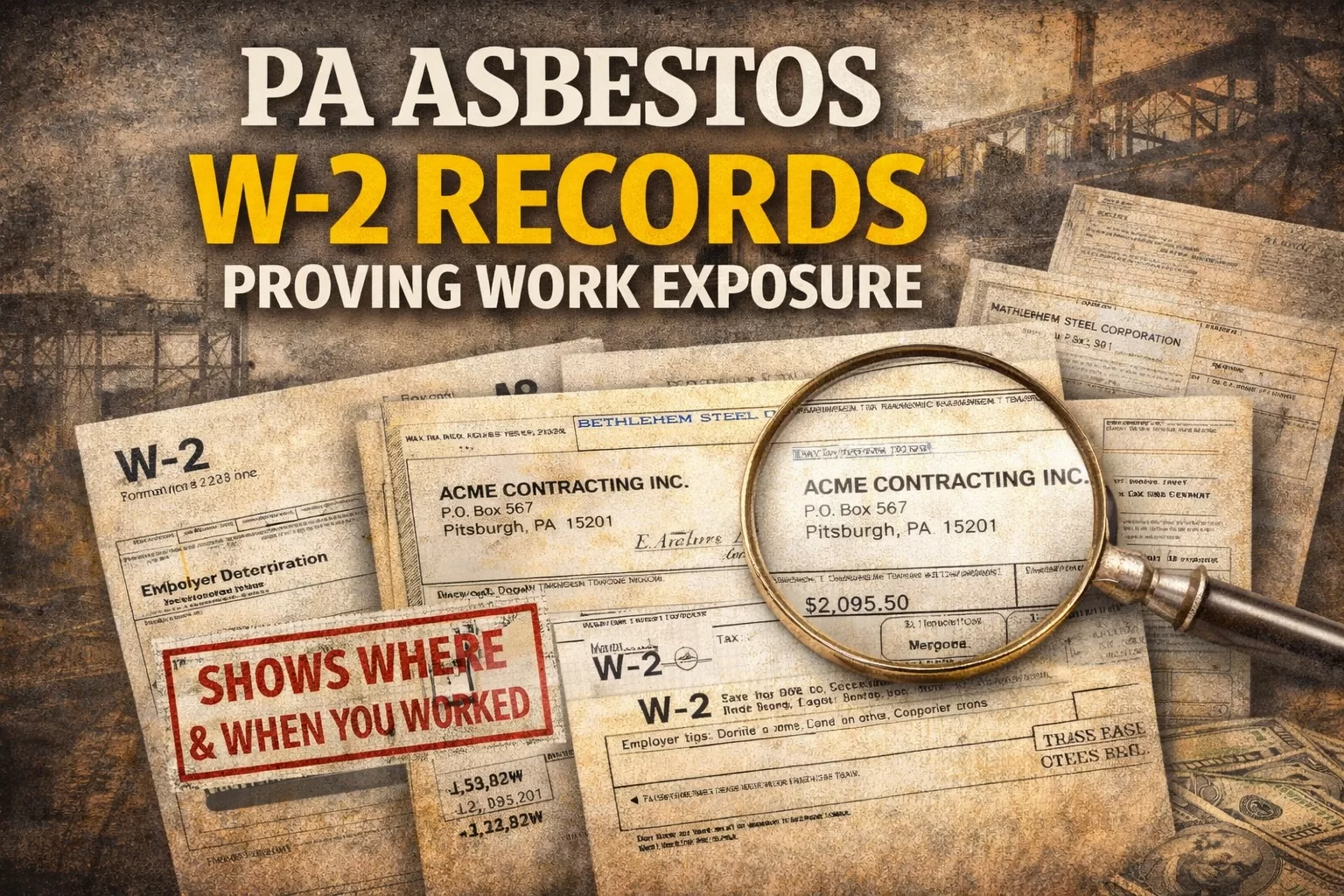
PA Asbestos W2 Records are some of the cleanest โ€œpaper proofโ€ you can use to show who employed you and whenโ€”especially when a company is gone, a jobsite changed names, or the only proof left is your memory. In asbestos cases, dates and employer identity matter because they anchor everything else: the jobsite, the trade, the products used, and the time window that matches disease latency.

Read about: Pittsburgh Asbestos Lawyer

Mesothelioma/Asbestos Legal Help – WV, MI & PA

Speak directly with attorney Lee W. Davis. No call centers. Free, confidential review.

What W-2 records prove (and why it matters)

A W-2 typically confirms:

  • Employer name and address (often the exact legal entity you need)
  • Tax year (your timeline without argument)
  • Wages reported (a reliable marker that you were truly on the payroll)

That matters because asbestos cases are won and lost on credible exposure history. If you canโ€™t show where you worked during the years asbestos products were being installed, removed, or disturbed, defendants and trusts will exploit the gap.

The practical problem: people donโ€™t have old W-2s

Most clients donโ€™t keep W-2s from 20โ€“40 years ago. Thatโ€™s normal. The goal is not perfectionโ€”itโ€™s building a document trail that confirms your employment history clearly enough to support product identification and causation.

Where to get W-2 and wage proof when you donโ€™t have it

Here are the fastest sources I use in real cases:

1) IRS โ€œWage & Income Transcriptโ€ (high value)

The IRS can provide transcripts that reflect W-2 information reported to them. Itโ€™s often the best substitute when the paper W-2 is long gone.

2) Social Security Earnings Record (supports the years)

SSA records are excellent for confirming years and total earnings, and they help when employer names changed. (Itโ€™s not always as specific as a W-2 transcript, but it strengthens the foundation.)

3) Old tax returns or a prior tax preparer

Many preparers keep copies longer than youโ€™d thinkโ€”especially if the file was digitized later.

4) Union benefit records / pension plan administrators

If your work ran through a hall, the benefit side often preserved employer contributions that track your work history.

5) Payroll processors / successor companies

Sometimes the employer is โ€œgone,โ€ but payroll records were handled by a third party or a successor entity that still has archives.


How W-2 proof gets used in a Pennsylvania asbestos claim

W-2 proof does one job extremely well: it locks in the employment frame so the rest of the exposure case can be built without guessing.

Once the employer-years are confirmed, we use that to:

  • Match you to specific plants, departments, and crafts
  • Identify likely asbestos-containing products used during those years
  • Confirm co-worker witness windows (who worked with you when it matters)
  • Support filings with trusts and/or against solvent defendants with consistent, defensible work history

If a defense lawyer wants to argue โ€œhe wasnโ€™t even there,โ€ W-2 proof is how you end that argument.

Read about Pennsylvania Asbestos Product Identification


FAQs

Do I need the original W-2 forms?

No. Transcripts and wage records that reliably confirm employer and year can do the job, especially when paired with other work history proof.

What if the company name on my W-2 isnโ€™t the name everyone used at the plant?

Thatโ€™s common. Many facilities operated under trade names while payroll ran through a parent or affiliate. The W-2 name often helps us trace the correct entity.

What if I was a contractor and worked for multiple employers?

Thatโ€™s exactly where W-2 proof helps. It breaks your work into real, dated segments so we can pinpoint which employers match which jobsites and tasks.

Will W-2 proof help if Iโ€™m filing a trust claim?

Yes. Many trusts demand a credible work history package. Wage records reduce โ€œdeficiencyโ€ issues and delays.


Call to talk through your records

Product identification and work-history proof has been my lane since 1988, when I started building exposure evidence as a paralegalโ€”through the Saginaw foundry casework and then years of West Virginia mesothelioma and lung cancer cases, working directly with clients to develop credible, legitimate exposure proof that holds up under scrutiny.

Read about Pennsylvania Asbestos Exposure Timeline

If youโ€™re sitting on partial recordsโ€”or none at allโ€”Iโ€™ll tell you what matters, what doesnโ€™t, and what we can still prove.

Call (412) 781-0525 or reach me through leewdavis.com for a confidential case review.

Check If Your Family Was Exposed

Get your free guide instantly + a confidential case review.

๐Ÿ”’ 100% Confidential. No obligations.

PA Asbestos Social Security Records

PA Asbestos Social Security Records

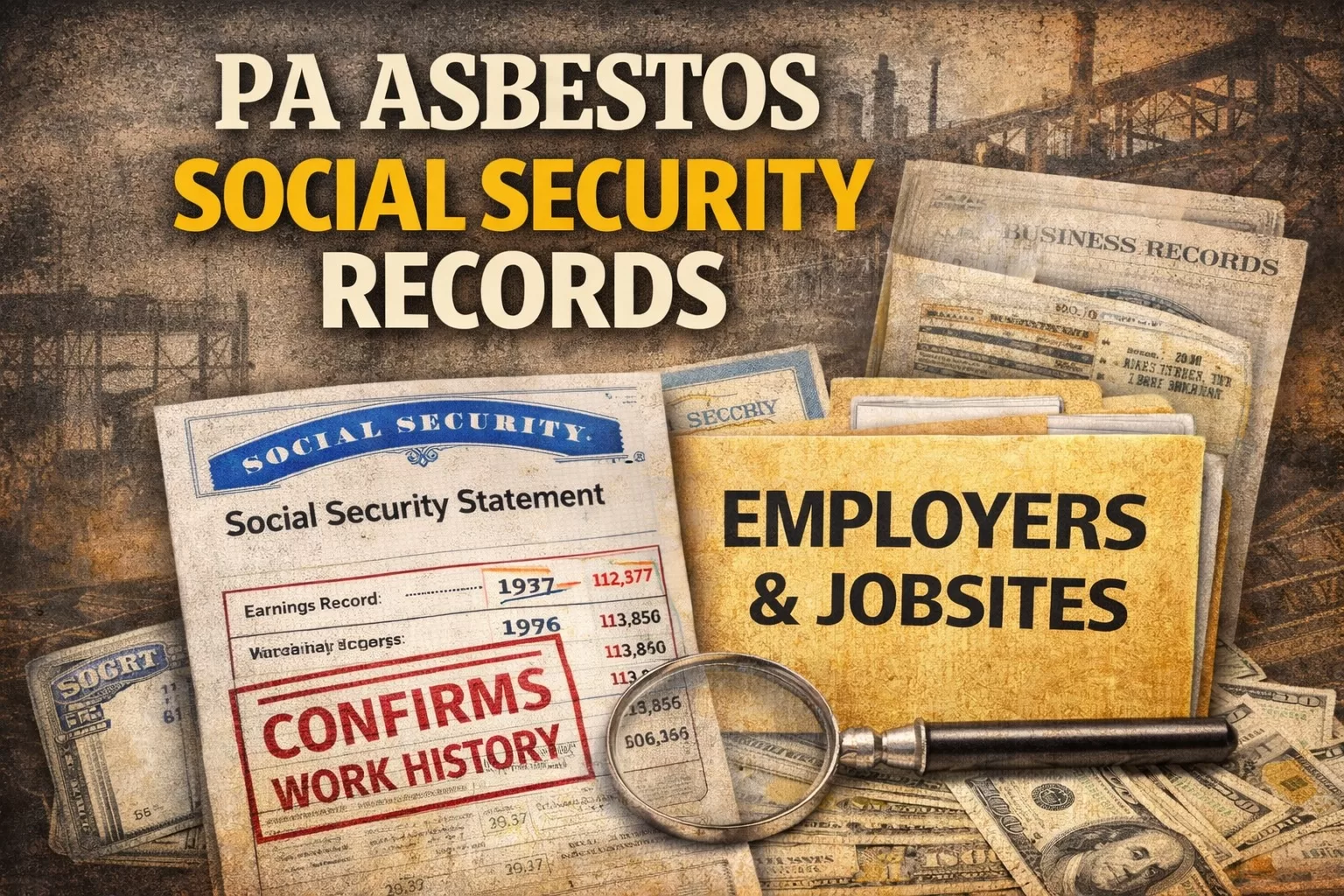
If youโ€™re building an asbestos claim in Pennsylvania, PA Asbestos Social Security records can quietly do a lot of heavy lifting. When an employer is gone, payroll records are missing, or the jobsite is โ€œtoo oldโ€ for anyone to conveniently verify, Social Security earnings history can still show where you worked, when you worked, and who paid you. Thatโ€™s often enough to stabilize the foundation of a case and move the proof forward.

Mesothelioma/Asbestos Legal Help – WV, MI & PA

Speak directly with attorney Lee W. Davis. No call centers. Free, confidential review.

I use Social Security documentation the same way Iโ€™ve used work records since I started doing this in 1988: not as โ€œextra paper,โ€ but as credible, independent confirmation that backs up a work history and makes an exposure story harder to attack.

Read More: Pennsylvania Asbestos Work History


What PA Asbestos Social Security records actually show

Social Security records typically confirm:

  • Employer names tied to your earnings
  • Years and quarters worked
  • Wage totals reported for each year
  • Sometimes employer addresses or identifying details (varies)

That matters because asbestos cases are built on work history + product exposure + medical proof. Social Security records help lock in the first partโ€”work historyโ€”when memories fade and companies vanish.

Read More: Pennsylvania Asbestos Exposure Timeline


When Social Security records help the most

You should seriously consider requesting these records if:

  • You worked decades ago and donโ€™t have pay stubs or W-2s
  • The company changed names, merged, shut down, or โ€œdoesnโ€™t existโ€
  • You were a union tradesman with many short-term job assignments
  • You did maintenance, shutdown, or turnaround work across multiple sites
  • Youโ€™re helping a family member reconstruct a deceased workerโ€™s history

In other words: if the defense will argue โ€œwe donโ€™t even know where he worked,โ€ Social Security records are one of the cleanest ways to answer that.


What to request from Social Security

For asbestos claims, youโ€™re generally looking for an earnings history that identifies employers over time. There are different request paths depending on whether the worker is living or deceased and who is requesting (the worker, spouse, estate representative, etc.).

Practical tip: Social Security documents wonโ€™t usually identify โ€œthe jobsite,โ€ but they can identify the employer or contractor, which lets you reconstruct jobsites through:

  • union records
  • personnel files
  • jobsite rosters
  • coworker statements
  • deposition testimony
  • product identification built from the employerโ€™s typical materials and trades

This is how you convert a paper record into something usable in a real claim.

Read about Pennsylvania Asbestos Product Identification


Common issues you need to watch for

Social Security records are valuable, but they arenโ€™t perfect:

  • Union halls may show up differently than the contractors
  • Some workers have entries that are abbreviated, confusing, or outdated
  • Certain jobs may be missing if pay wasnโ€™t properly reported
  • Records donโ€™t explain what you did (insulator vs. pipefitter vs. mechanic)

Thatโ€™s normal. The point is not to treat these records as the entire case. The point is to use them to anchor the timeline and employers so the rest of the proof has something solid to attach to.


How these records fit into a Pennsylvania asbestos claim

In a Pennsylvania asbestos case, once you can reliably show employer/timeframe, you can usually move faster on:

  • identifying likely asbestos-containing products used by that employer
  • matching trades to typical exposure sources (insulation, gaskets, refractory, cement, packing, valves, boilers)
  • narrowing which defendants belong in the case
  • building a work narrative that makes sense to a jury and survives motions

Thatโ€™s the difference between an โ€œold story someone remembersโ€ and a claim supported by documentation.


Get the work history right before you chase the rest

PA Asbestos Social Security records can confirm your work history even when companies are gone and paperwork is missing. Thatโ€™s exactly the kind of proof-building Iโ€™ve done since I started this work in 1988โ€”through major industrial case inventories and into Pennsylvania asbestos and lung cancer cases where the real issue is always the same: credible exposure evidence.

Read About Pennsylvania Asbestos Trust Claims Help

If you want help identifying what records to request and how to use them to support a legitimate asbestos claim, call (412) 781-0525 or contact me through leewdavis.com for a free case review.

Check If Your Family Was Exposed

Get your free guide instantly + a confidential case review.

๐Ÿ”’ 100% Confidential. No obligations.